A child once asked his father if the sun would rise tomorrow. The father smiled and said yes. The child believed him because he trusted his father’s words. Later, during a difficult time, the father told the child to stay hopeful even when things looked dark. The child had faith that everything would be fine.
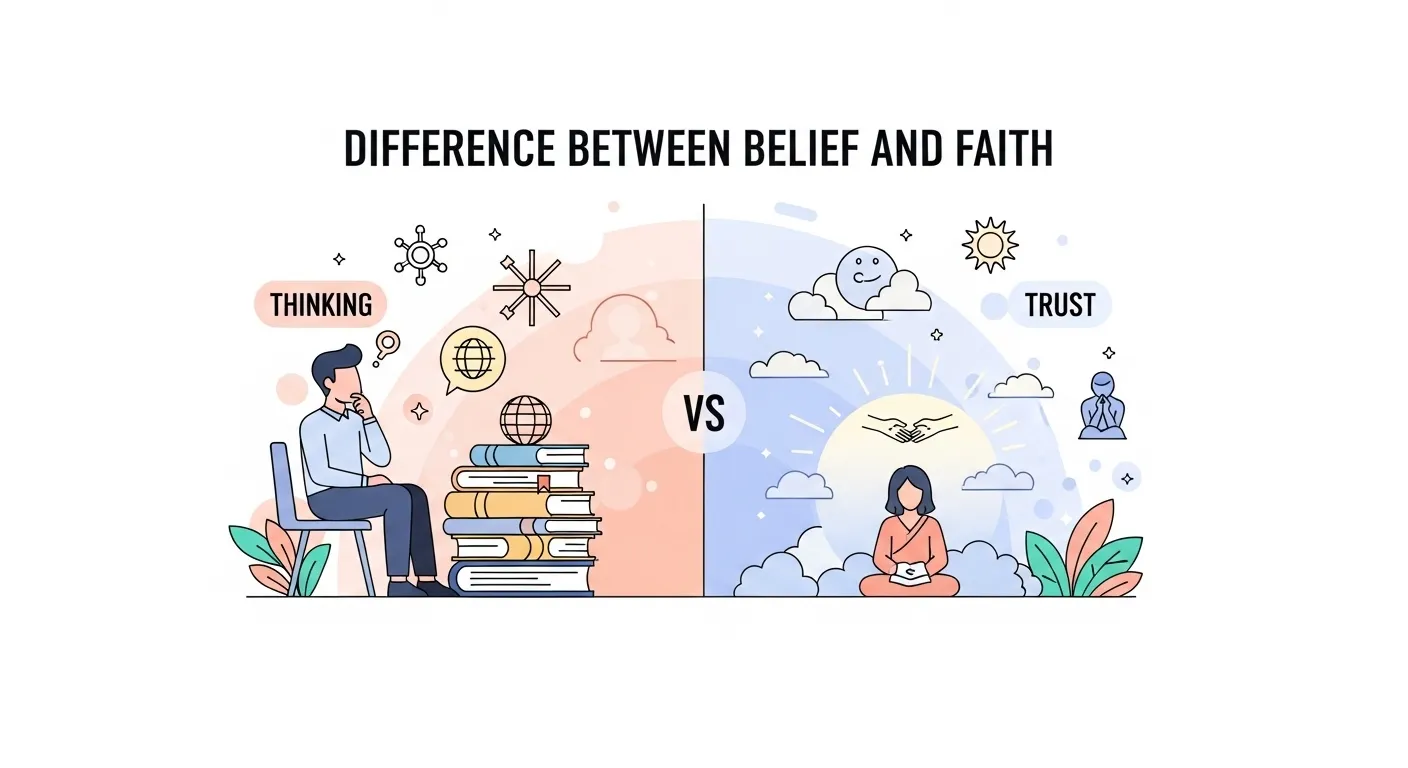
This story shows the difference between belief and faith. A belief is an idea we accept as true based on facts, experience, or information. Faith is a deeper trust, often without needing proof. Many people mix these two words because they are closely related.
However, the difference between belief and faith lies in how strongly we trust something. Understanding the difference between belief and faith helps learners and thinkers use these words correctly. In everyday life and society, knowing the difference between belief and faith helps us understand religion, culture, and human thinking.
Pronunciation of the Keywords
Belief
- US: /bɪˈliːf/
- UK: /bɪˈliːf/
Faith
- US: /feɪθ/
- UK: /feɪθ/
Before exploring more ideas, let us clearly study the difference between belief and faith.
Difference Between Belief and Faith
1. Basic Meaning
Belief:
Belief means accepting something as true.
Examples
- She believes the weather will improve tomorrow.
- He believes hard work brings success.
Faith:
Faith means deep trust or confidence, often without proof.
Examples
- She has faith that her prayers will be answered.
- He kept faith in his friend during hard times.
2. Level of Trust
Belief:
Belief may change when new facts appear.
Examples
- I believed the news until I checked the facts.
- He believed the rumor but later learned it was false.
Faith:
Faith is stronger and more stable.
Examples
- She kept faith in her team even after many losses.
- People often keep faith during difficult moments.
3. Need for Evidence
Belief:
Belief usually depends on evidence or information.
Examples
- Scientists believe the theory because of research.
- I believe the report because it shows data.
Faith:
Faith often exists without clear proof.
Examples
- Many people have faith in spiritual ideas.
- The farmer had faith that rain would come.
4. Area of Use
Belief:
Belief is used in many areas like science, opinions, and everyday thinking.
Examples
- Belief in education improves society.
- His belief about health changed after reading research.
Faith:
Faith is often used in religion, hope, and trust.
Examples
- Faith in God guides many people.
- Faith in the future keeps people hopeful.
5. Emotional Strength
Belief:
Belief may involve thinking more than feeling.
Examples
- She believes exercise improves health.
- He believes the plan will work.
Faith:
Faith often includes deep emotions and trust.
Examples
- The mother had faith in her child’s success.
- The team kept faith despite failure.
6. Stability
Belief:
Beliefs can change easily.
Examples
- His belief about diet changed after reading new studies.
- People change beliefs when they learn new facts.
Faith:
Faith usually remains strong even in doubt.
Examples
- Her faith stayed strong during illness.
- The community kept faith during hard times.
7. Connection to Religion
Belief:
Belief may exist inside or outside religion.
Examples
- He believes in honesty.
- She believes in climate change.
Faith:
Faith is strongly connected with religion or spirituality.
Examples
- Faith in God is important for many people.
- Faith helps believers stay hopeful.
8. Logical vs Emotional
Belief:
Belief often comes from logic or learning.
Examples
- I believe the teacher because she explained the lesson well.
- He believes the report after reading the data.
Faith:
Faith often comes from feelings and trust.
Examples
- She had faith in her dream.
- The community had faith in their leader.
9. Strength in Difficult Times
Belief:
Belief may weaken when problems appear.
Examples
- His belief in the plan faded after many failures.
- People sometimes lose belief when results are poor.
Faith:
Faith often grows stronger during challenges.
Examples
- Faith helped her stay strong during illness.
- The village kept faith after the disaster.
10. Relationship with Hope
Belief:
Belief is connected to understanding.
Examples
- I believe the project will succeed.
- She believes the solution is correct.
Faith:
Faith is closely connected to hope.
Examples
- He has faith that the future will improve.
- Faith kept the family hopeful.
Nature and Behaviour of Both
Belief
Belief is mental and logical. It often grows from knowledge, facts, or observation. People change beliefs when they receive new information.
Faith
Faith is emotional and spiritual. It is based on deep trust and hope. Faith may stay strong even when proof is missing.
Why People Confuse Belief and Faith
Many people confuse these words because both involve accepting something as true. In everyday speech, people often use belief and faith in similar ways. However, belief usually relies on information or evidence, while faith depends more on trust and hope.
Table Showing Difference and Similarity
| Feature | Belief | Faith |
| Meaning | Accepting something as true | Deep trust without proof |
| Strength | Moderate | Very strong |
| Evidence | Often needed | Often not needed |
| Nature | Logical | Emotional and spiritual |
| Stability | Can change | Usually stable |
| Use | General ideas and opinions | Religion, hope, trust |
| Feeling level | Less emotional | Highly emotional |
| Connection to hope | Weak | Strong |
| Similarity | Both involve trust in an idea | Both influence human thinking |
Which Is Better in What Situation?
Belief is better in logical situations.
When people study science, research, or education, belief is more useful. Beliefs help people evaluate information and accept ideas based on facts. For example, students believe scientific theories because they are supported by experiments and evidence.
Faith is better in emotional or spiritual situations.
Faith becomes important when people face uncertainty or hardship. In religion, personal dreams, and relationships, faith gives strength and hope. Many people rely on faith when proof is not available but trust remains strong.
How the Words Appear in Metaphors and Similes
Belief as a metaphor
Belief is often compared to a bridge of ideas.
Example
- His belief in education became a bridge to success.
Faith as a metaphor
Faith is often compared to a light in darkness.
Example
- Her faith was a light during difficult days.
Connotative Meaning of the Keywords
Belief
Connotation: Neutral to positive.
Examples
- Her belief in teamwork improved the project.
- Belief in knowledge supports learning.
Faith
Connotation: Strongly positive.
Examples
- Faith helped the family stay hopeful.
- His faith in kindness changed people’s lives.
Idioms or Proverbs Related to These Words
1. “Leap of faith”
Example
- Starting the new business was a leap of faith.
2. “Seeing is believing”
Example
- After watching the experiment, the students said seeing is believing.
Works in Literature Using the Keywords
- Faithful and Virtuous Night — Poetry — Louise Glück — 2014
- The Power of Faith — Spiritual literature — Various writers — 19th century themes
- Belief: What It Means to Believe — Philosophy — Various essays
Movies Related to These Ideas
- Keeping the Faith — 2000 — USA
- Leap of Faith — 1992 — USA
- Faith Like Potatoes — 2006 — South Africa
Frequently Asked Questions
1. What is belief in simple words?
Belief means accepting something as true.
2. What is faith in simple words?
Faith means strong trust or confidence without needing proof.
3. Can belief become faith?
Yes. A simple belief can grow stronger and become faith over time.
4. Is faith always religious?
No. People can have faith in friends, goals, or the future.
5. Why is it important to know their difference?
It helps people understand thinking, religion, and emotional trust better.
How Both Are Useful for Our Surroundings
Belief helps people build knowledge and make decisions based on facts. It supports science, education, and learning. Faith helps people stay hopeful and strong during difficult times. It strengthens relationships, culture, and spiritual life. Together, belief and faith guide human behavior and values in society.
Final Words for Both
Belief builds understanding through knowledge. Faith builds strength through trust. Both play an important role in shaping human thoughts and actions.
Conclusion
The difference between belief and faith lies mainly in their depth and source. Belief is the acceptance of an idea based on evidence or reasoning. Faith is a deeper trust that may exist even without proof. Both concepts influence how people think, act, and understand the world. In learning and science, belief helps people examine facts and ideas logically. In religion, relationships, and difficult moments, faith provides hope and emotional strength. Understanding the difference between belief and faith allows learners and readers to use these words more clearly and appreciate how both shape human thinking and society.

I’m Zahid Abbas, an educator, researcher, and digital publishing strategist with a passion for linguistics, grammar, and clear communication. As a content creator and SEO specialist, I craft research-driven, reader-focused content that empowers learners and makes knowledge accessible worldwide.