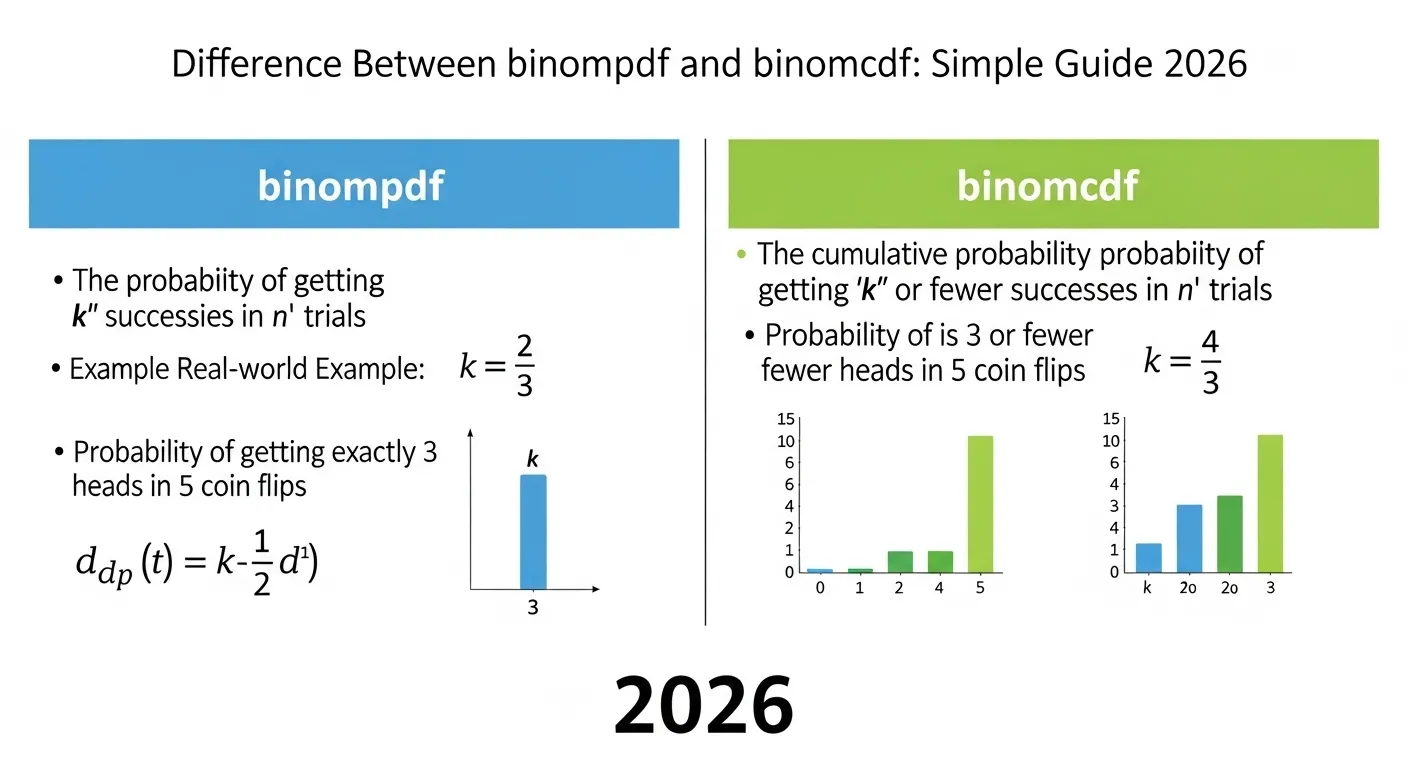
Ali is tossing a coin 5 times. He wants to know the chance of getting exactly 3 heads. His friend Sara wants to know the chance of getting 3 or fewer heads. Their teacher shows them two calculator commands: binompdf and binomcdf. This is where the difference between binompdf and binomcdf becomes clear. It helps students solve probability questions the right way. Many learners mix them up. But the difference between binompdf and binomcdf changes the final answer. If you do not know the difference between binompdf and binomcdf, you may get the wrong result in exams or real life.
Pronunciation
- binompdf
- US: /ˈbaɪnɒm piː diː ɛf/
- UK: /ˈbaɪnɒm piː diː ɛf/
- binomcdf
- US: /ˈbaɪnɒm siː diː ɛf/
- UK: /ˈbaɪnɒm siː diː ɛf/
Now let us see the main idea behind these two terms.
Key Difference Between the Both
binompdf gives the probability of getting exactly a certain number of successes.
binomcdf gives the probability of getting that number or fewer (or up to that number) of successes.
Why Is Their Difference Necessary to Know for Learners and Experts?
Students use these terms in math, statistics, and exams. Engineers use them in risk studies. Doctors use them in medical research. Business experts use them in quality control. If someone confuses them, the answer will be wrong. This may lead to poor decisions. So, knowing the difference helps in study, work, and society. Clear math leads to clear planning.
Difference Between the Keywords
1. Meaning
binompdf: Exact value.
- Chance of exactly 2 heads in 4 tosses.
- Chance of exactly 5 defects in 20 items.
binomcdf: Cumulative value.
- Chance of 2 or fewer heads in 4 tosses.
- Chance of 5 or fewer defects in 20 items.
2. Type of Probability
binompdf: Single point probability.
- Exactly 3 goals.
- Exactly 1 success.
binomcdf: Range probability.
- 3 or fewer goals.
- 1 or fewer success.
3. Formula Base
binompdf: Uses binomial formula once.
- One calculation.
- One result.
binomcdf: Adds many binompdf values.
- Adds 0,1,2,3 cases.
- Total sum result.
4. Output Size
binompdf: Smaller number usually.
- 0.25 probability.
- 0.18 probability.
binomcdf: Larger number usually.
- 0.70 probability.
- 0.85 probability.
5. Calculator Use
binompdf: Used for exact question.
- “Exactly 4 wins.”
- “Exactly 2 errors.”
binomcdf: Used for “at most” question.
- “At most 4 wins.”
- “At most 2 errors.”
6. Graph Shape
binompdf: One bar in graph.
- Bar at x=3.
- Bar at x=5.
binomcdf: Growing curve.
- Value rises step by step.
- Ends at 1.
7. Question Words
binompdf: “Exactly”
- Exactly 6 passes.
- Exactly 1 fail.
binomcdf: “At most”, “up to”
- At most 6 passes.
- Up to 1 fail.
8. Exam Use
binompdf: Direct answer.
- One-step question.
- Short answer.
binomcdf: Multi-step thinking.
- Range question.
- Word problem.
9. Risk Study
binompdf: Exact risk event.
- Exactly 2 system crashes.
- Exactly 1 machine fault.
binomcdf: Total safe range.
- 2 or fewer crashes.
- 1 or fewer faults.
10. Nature of Result
binompdf: Specific and sharp.
- Fixed outcome.
- Single event focus.
binomcdf: Broad and smooth.
- Covers many outcomes.
- Range focus.
Nature and Behaviour of the Both
binompdf: It is exact. It is direct. Also answers one clear question. It does not add other outcomes.
binomcdf: It is cumulative. It grows step by step. Also adds many values. It shows total probability up to a point.
Why Are People Confused About Their Use?
Both words start with “binom.” They relate to binomial distribution. Both appear in calculators. Their names look almost the same. Students often forget that “pdf” means single value and “cdf” means cumulative value.
Table Showing Difference and Similarity
PointbinompdfbinomcdfSimilarityMeaningExact probabilityCumulative probabilityBoth use binomial modelFocusOne outcomeMany outcomesUsed in statisticsQuestion TypeExactlyAt most/up toNeed n and p valuesResult SizeSmallerLargerBetween 0 and 1UseSpecific eventRange eventFound in calculators
Which Is Better in What Situation?
binompdf is better when the question asks for an exact number. For example, “What is the chance of exactly 3 wins?” In exams, this tool saves time. It gives a clear and quick answer. Use it when the event is fixed and single.
binomcdf is better when the question asks for “at most” or “up to.” For example, “What is the chance of 3 or fewer wins?” It is helpful in safety studies and risk checks. It shows the total safe range.
How Are the Keywords Used in Metaphors and Similes?
Sometimes teachers use fun lines:
- “Life is like binompdf. It gives one exact result.”
- “Success grows like binomcdf. It adds step by step.”
These are creative classroom examples.
Connotative Meaning
binompdf: Neutral and technical.
- “Use binompdf for exact answer.”
binomcdf: Neutral and technical.
- “Use binomcdf for total range.”
Both words are academic terms. They do not carry emotion.
Idioms or Proverbs Related to the Words
There are no direct idioms for these words. But related math sayings include:
- “Numbers do not lie.”
- Example: The binomcdf result proved the safety rate.
- “Add it up.”
- Example: Binomcdf helps you add it up.
Works in Literature
These terms appear in math textbooks:
- Introduction to Probability (Textbook, Joseph K. Blitzstein, 2014)
- A First Course in Probability (Textbook, Sheldon Ross, 1976)
Movies Related to Probability
- A Beautiful Mind (2001, USA) – about math and probability.
- Moneyball (2011, USA) – about statistics in sports.
Five Frequently Asked Questions
1. What does binompdf mean? It gives exact probability.
2. What does binomcdf mean? It gives cumulative probability.
3. When should I use binompdf? When question says “exactly.”
4. When should I use binomcdf? When question says “at most” or “up to.”
5. Are both based on binomial distribution? Yes, both use same model.
How Are Both Useful for Surroundings?
They help in research, health studies, and business checks. Also help predict risk. They help control product quality. They help in planning and safety.
Final Words for the Both
binompdf is exact. binomcdf is total up to a point.
Conclusion
The difference between binompdf and binomcdf is simple but important. Binompdf gives the chance of one exact result. Binomcdf gives the chance of that result and all results before it. Both are tools from binomial distribution. Both are useful in study and real life. If students understand the difference, they can solve questions with confidence. Clear understanding prevents mistakes. In math and life, small differences matter.

I’m Zahid Abbas, an educator, researcher, and digital publishing strategist with a passion for linguistics, grammar, and clear communication. As a content creator and SEO specialist, I craft research-driven, reader-focused content that empowers learners and makes knowledge accessible worldwide.