Imagine you want to repair your house roof. You call a contractor and ask how much it might cost. The contractor looks at the roof and says it may cost around $500 to $700. This is an estimate because it is only an approximate cost.
Later, the contractor checks the materials, labor, and time and tells you the exact price will be $650. This is a quote because it is a fixed price.
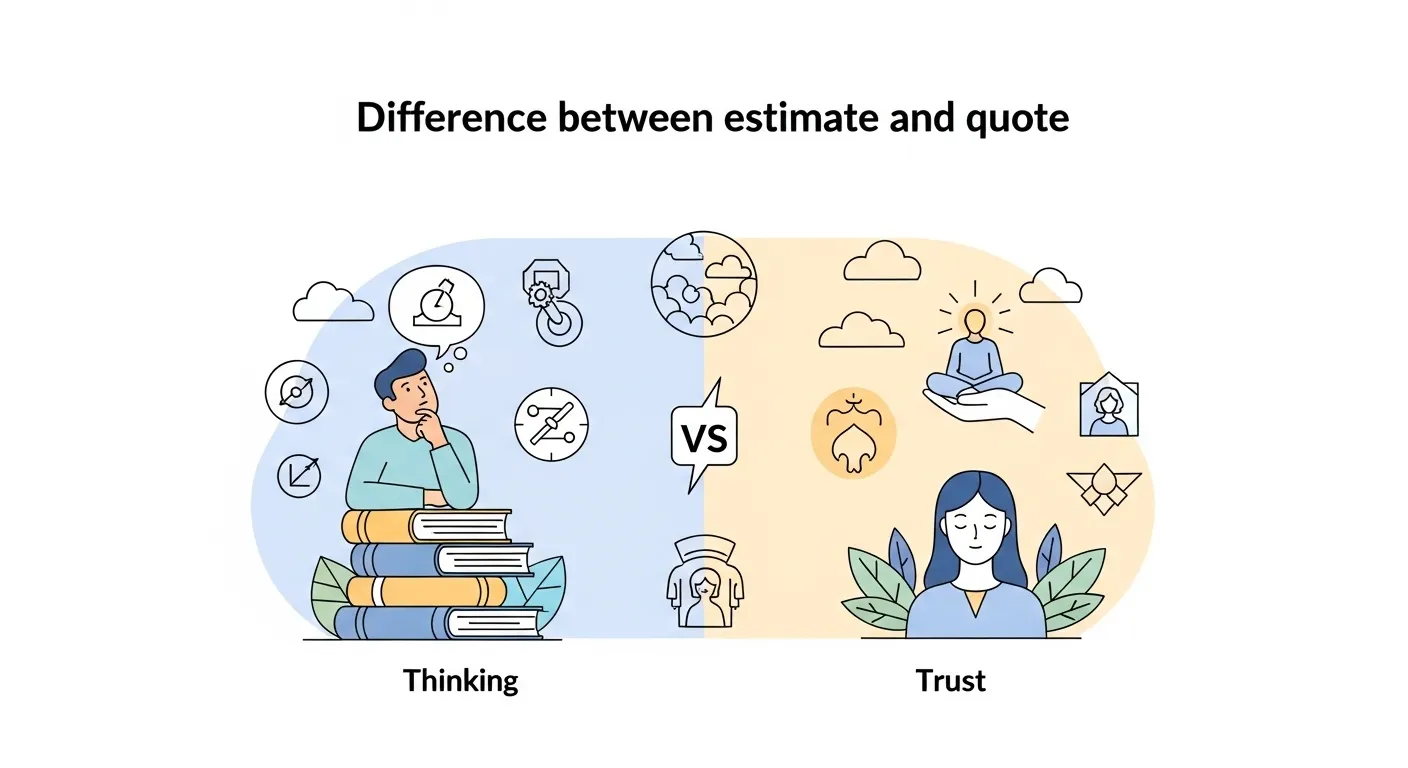
This simple example shows the difference between estimate and quote. An estimate gives an approximate idea of cost, while a quote gives a specific and fixed price for a service or product. Many people mix these terms because both relate to pricing.
However, the difference between estimate and quote becomes clear when we look at certainty and accuracy. Understanding the difference between estimate and quote helps customers and businesses communicate clearly. In business, construction, and services, knowing the difference between estimate and quote prevents confusion and builds trust.
Pronunciation of the Keywords
Estimate
- US: /ˈestɪmət/ (noun), /ˈestɪmeɪt/ (verb)
- UK: /ˈestɪmət/ (noun), /ˈestɪmeɪt/ (verb)
Quote
- US: /kwoʊt/
- UK: /kwəʊt/
Before exploring details, let us understand the difference between estimate and quote more clearly.
Difference Between Estimate and Quote
1. Basic Meaning
Estimate:
An estimate is a rough calculation of cost.
Examples
- The mechanic gave an estimate for repairing the car.
- The builder gave an estimate for building the wall.
Quote:
A quote is an exact price offered for a service or product.
Examples
- The company gave a quote for website design.
- The contractor sent a quote for painting the house.
2. Price Certainty
Estimate:
The price may change later.
Examples
- The repair estimate was $200, but the final cost was higher.
- The builder estimated the cost around $1,000.
Quote:
The price is usually fixed.
Examples
- The shop quoted $350 for the laptop repair.
- The printing company quoted $100 for the order.
3. Level of Accuracy
Estimate:
Less accurate because it is based on assumptions.
Examples
- The doctor estimated recovery time.
- The engineer estimated the construction cost.
Quote:
More accurate because details are already known.
Examples
- The company quoted a final price after inspection.
- The contractor quoted the price after measuring the area.
4. Time of Use
Estimate:
Usually given at the beginning of a project.
Examples
- The designer gave an estimate before starting work.
- The mechanic estimated the repair cost.
Quote:
Usually given after careful evaluation.
Examples
- The contractor quoted the final price after inspection.
- The service company sent a detailed quote.
5. Flexibility
Estimate:
Flexible and open to change.
Examples
- The estimated price increased after material costs changed.
- The project estimate changed during construction.
Quote:
Normally fixed and less flexible.
Examples
- The quoted price stayed the same.
- The customer accepted the quoted cost.
6. Detail Level
Estimate:
Often general and simple.
Examples
- The estimate mentioned only rough costs.
- The builder estimated total materials.
Quote:
Usually detailed and specific.
Examples
- The quote included labor, material, and time.
- The document showed full pricing details.
7. Business Use
Estimate:
Used when full information is not available.
Examples
- A plumber estimated the cost before checking the pipes.
- The mechanic estimated repair expenses.
Quote:
Used when the job details are clear.
Examples
- The plumber quoted a fixed repair price.
- The agency quoted the marketing project cost.
8. Legal Binding
Estimate:
Usually not legally binding.
Examples
- The estimate changed after inspection.
- The customer accepted a new estimate.
Quote:
Often treated as a binding offer.
Examples
- The company honored the quoted price.
- The client approved the quote.
9. Risk Level
Estimate:
Higher risk of price change.
Examples
- The estimate increased due to extra work.
- The cost estimate changed after new materials.
Quote:
Lower risk of change.
Examples
- The quoted price remained stable.
- The company followed the quote exactly.
10. Customer Expectation
Estimate:
Customers expect variation.
Examples
- The repair estimate increased slightly.
- The construction estimate changed.
Quote:
Customers expect the final cost.
Examples
- The client paid the quoted price.
- The company completed the work within the quote.
Nature and Behaviour of Both
Estimate
An estimate is flexible and approximate. It gives a general idea of cost or time. Businesses use it when details are not clear.
Quote
A quote is precise and specific. It shows a confirmed price after proper evaluation. Businesses use quotes when they know all project details.
Why People Confuse Estimate and Quote
People often confuse these words because both relate to pricing. In daily conversation, people use them interchangeably. However, the key difference is certainty. An estimate is a guess based on available information, while a quote is a fixed offer after proper calculation.
Table Showing Difference and Similarity
| Feature | Estimate | Quote |
| Meaning | Approximate cost | Fixed price |
| Accuracy | Less precise | More precise |
| Flexibility | Can change | Usually fixed |
| Detail level | General | Detailed |
| Legal status | Not binding | Often binding |
| Risk | Higher | Lower |
| Time of use | Early stage | After evaluation |
| Customer expectation | Price may change | Price remains same |
| Similarity | Both give price information | Both used in business |
Which Is Better in What Situation?
Estimate is better in early planning.
When a project is still unclear, an estimate helps people understand the possible cost. It allows flexibility because details may change later. Businesses often provide estimates for construction, repair, and creative projects.
Quote is better for final decisions.
When the project details are clear, a quote is more useful. It gives customers a fixed price so they can decide confidently. Quotes are common in professional services, manufacturing, and contracts.
How the Words Appear in Metaphors and Similes
Estimate as a metaphor
Estimate is often compared to a rough map.
Example
- His budget estimate was like a rough map for the project.
Quote as a metaphor
Quote is often compared to a final contract line.
Example
- The company’s quote was the final line before starting work.
Connotative Meaning of the Keywords
Estimate
Connotation: Neutral.
Examples
- The manager gave an estimate for the project cost.
- The engineer estimated the total expense.
Quote
Connotation: Professional and formal.
Examples
- The supplier sent a quote for the materials.
- The company quoted a fixed service price.
Idioms or Proverbs Related to Their Ideas
1. “Ballpark figure”
Example
- The contractor gave a ballpark figure for the repair cost.
2. “Put a price on something”
Example
- The company put a price on the service after evaluation.
Works in Literature Using the Keywords
- The Wealth of Nations — Economics — Adam Smith — 1776 (discusses pricing ideas)
- Capital — Economics — Karl Marx — 1867 (value and price concepts)
Movies Related to Business and Pricing Themes
- The Founder — 2016 — USA
- Joy — 2015 — USA
- Moneyball — 2011 — USA
Frequently Asked Questions
1. What is an estimate?
An estimate is an approximate cost or time calculation.
2. What is a quote?
A quote is a fixed price offered for a product or service.
3. Can an estimate change?
Yes. An estimate may change when more information becomes available.
4. Is a quote final?
Usually yes, because it is based on detailed evaluation.
5. Why do businesses give estimates first?
Because full project details may not be known at the beginning.
How Both Are Useful for Our Surroundings
Estimates help people plan budgets and projects. They give early guidance when information is limited. Quotes help people make final financial decisions because they provide clear pricing. Together, estimates and quotes support fair business communication and help customers understand costs.
Final Words for Both
An estimate gives a rough idea. A quote gives a clear promise. Both are important tools in business and everyday services.
Conclusion
Understanding the difference between estimate and quote helps both customers and businesses avoid confusion. An estimate provides an approximate cost when details are still unclear, while a quote gives a fixed price after careful evaluation. Both terms play important roles in planning and decision-making. Estimates allow flexibility during early stages of a project, while quotes provide certainty before work begins. By learning the difference between estimate and quote, people can communicate better about pricing, manage budgets effectively, and make confident decisions in business and daily life.

I’m Zahid Abbas, an educator, researcher, and digital publishing strategist with a passion for linguistics, grammar, and clear communication. As a content creator and SEO specialist, I craft research-driven, reader-focused content that empowers learners and makes knowledge accessible worldwide.