Imagine you run a small shop. In one day, you sell 100 notebooks. You feel happy because sales are high. But at the end of the month, your accountant tells you your revenue is lower than expected because of discounts and returns. Now you start to think about the difference between revenue and sales.
Many business students and shop owners confuse these two words. They think sales and revenue are the same. But the difference between revenue and sales is important in accounting and business reports.
When you understand the difference between revenue and sales, you can read financial statements with confidence and make better decisions.
Let us break it down in simple words.
Pronunciation
Revenue
- US: /ˈrev.ə.nuː/
- UK: /ˈrev.ə.njuː/
Sales
- US: /seɪlz/
- UK: /seɪlz/
Now that we know how to say them, let’s explore what they really mean and how they are different.
Key Difference Between Revenue and Sales
The main difference is this:
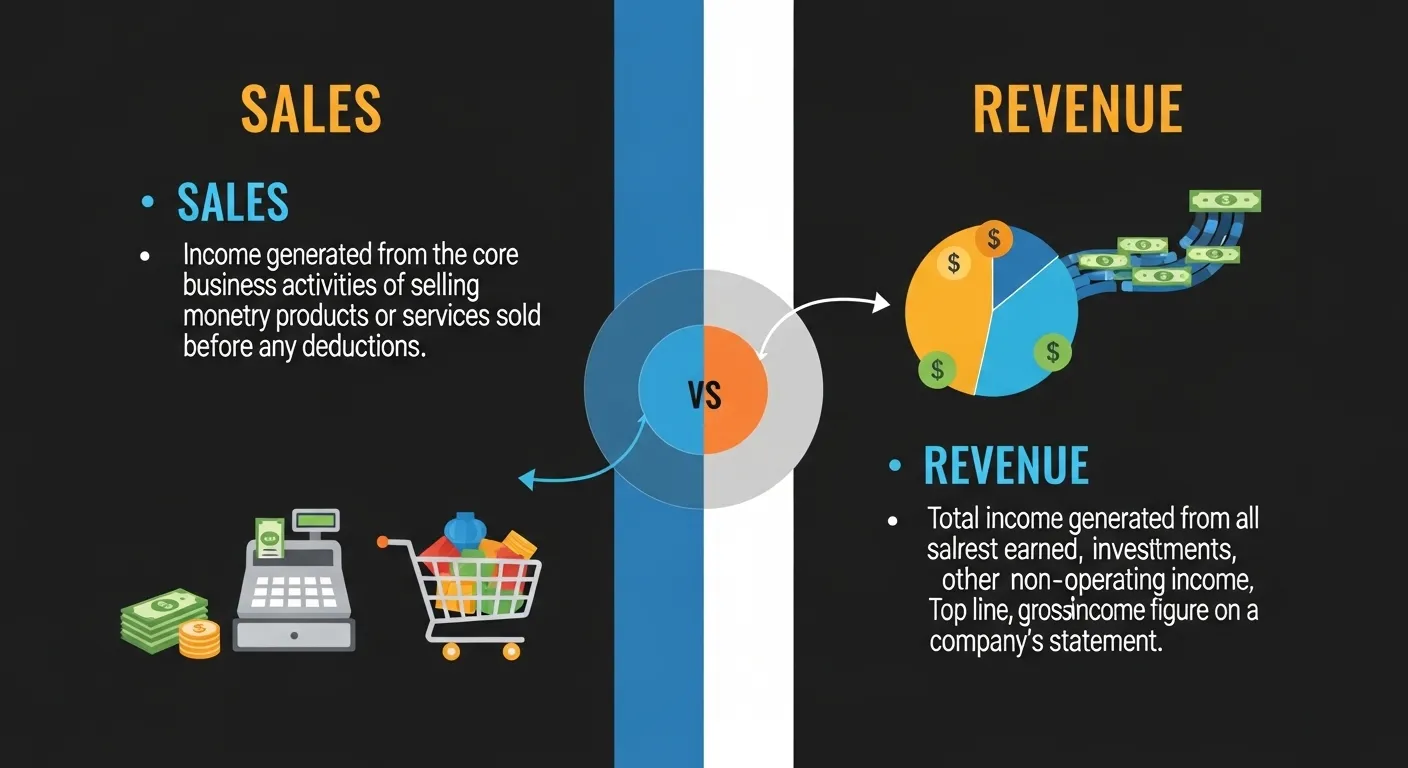
Sales means money earned from selling goods or services.
Revenue means total income a business receives, including sales and other income sources.
Sales are often a part of revenue.
Why Is Their Difference Necessary to Know for Learners and Experts?
Understanding the difference between revenue and sales helps students of business, accounting, and economics read financial reports correctly.
For experts, this difference affects company valuation, tax planning, profit analysis, and investment decisions. If someone confuses revenue and sales, they may misunderstand a company’s true financial health.
Difference Between Revenue and Sales
Basic Meaning
Sales:
Money earned from selling products or services.
Example 1: A bakery sells 50 cakes in a day.
Example 2: A software company sells 100 subscriptions.
Revenue:
Total income earned by a business.
Example 1: Bakery income includes cake sales and catering fees.
Example 2: Software company earns from subscriptions and ads.
2. Scope
Sales:
Narrow concept. Only product or service selling.
Example 1: Selling shoes in a store.
Example 2: Selling online courses.
Revenue:
Broader concept. Includes all income.
Example 1: Shoe store earns rent from extra space.
Example 2: Course platform earns from ads and partnerships.
3. Position in Income Statement
Sales:
Usually listed at the top as “Net Sales.”
Example 1: Retail company shows total sales first.
Example 2: E-commerce reports gross and net sales.
Revenue:
May include sales plus other income.
Example 1: Interest income added.
Example 2: Commission income included.
4. Relationship
Sales:
Part of revenue.
Example 1: Product sales included in revenue.
Example 2: Service sales included in revenue.
Revenue:
Includes sales.
Example 1: Total revenue = sales + other income.
Example 2: Company revenue covers all earnings.
5. Discounts and Returns
Sales:
Reduced by returns and discounts.
Example 1: Customer returns damaged item.
Example 2: Company offers 10% discount.
Revenue:
Calculated after adjustments.
Example 1: Net revenue shown after returns.
Example 2: Final income reported after deductions.
6. Use in Small Business
Sales:
Daily tracking tool.
Example 1: Shop checks daily sales report.
Example 2: Restaurant counts daily food sales.
Revenue:
Monthly or yearly analysis.
Example 1: Annual revenue report prepared.
Example 2: Used for tax filing.
7. Source of Income
Sales:
Comes only from selling goods/services.
Example 1: Clothing brand selling shirts.
Example 2: Gym selling memberships.
Revenue:
Can come from many sources.
Example 1: Brand earns from franchise fees.
Example 2: Gym earns from training sessions and rent.
8. Accounting Term
Sales:
Operational term.
Example 1: Sales team targets monthly goals.
Example 2: Sales manager tracks performance.
Revenue:
Financial reporting term.
Example 1: Investors check revenue growth.
Example 2: Banks review revenue before loans.
9. Example in Real Companies
Companies like Amazon report net sales as main income from products.
But total revenue also includes services like cloud computing and subscriptions.
Similarly, Apple reports product sales and service revenue separately.
10. Importance in Profit Calculation
Sales:
Used to calculate gross profit.
Example 1: Sales minus cost = gross profit.
Example 2: High sales increase profit chance.
Revenue:
Used to measure overall company size.
Example 1: Investors compare revenue growth.
Example 2: Revenue trend shows business expansion.
Nature and Behaviour
Sales:
Focused on transactions. Fast-moving and daily based.
Revenue:
Focused on overall financial health. Broader and long-term view.
Why People Are Confused About Their Use?
- In many small businesses, revenue equals sales.
- Some companies use the words interchangeably.
- Financial news sometimes simplifies the terms.
This creates confusion.
Table: Difference and Similarity Between Revenue and Sales
| Feature | Sales | Revenue | Similarity |
| Meaning | Money from selling | Total income | Both bring money |
| Scope | Narrow | Broad | Related terms |
| Position | Top line item | May include sales | Part of income statement |
| Source | Products/services only | All sources | Measure business income |
| Use | Daily tracking | Financial analysis | Show company growth |
Which Is Better in What Situation?
If you are running a shop and want to track daily performance, sales are more useful. They show how many items you sold today and help manage stock and targets.
If you are an investor or accountant, revenue is more important. It shows the full income picture of the company. Revenue helps measure long-term growth and business strength.
Metaphors and Similes
- “Sales are the heartbeat of a shop.”
- “Revenue is the river that feeds the business.”
Connotative Meaning
Sales
Positive: Growth, activity, success.
Example: “Our sales are booming.”
Neutral: Business transaction.
Revenue
Positive: Financial strength.
Example: “The company’s revenue increased.”
Neutral: Total income figure.
Idioms or Proverbs
While there are no direct idioms, common business phrases include:
- “Boost sales” (increase selling).
Example: The manager worked hard to boost sales. - “Top-line growth” (increase in revenue).
Example: Investors look for top-line growth.
Works in Literature
- Rich Dad Poor Dad — Finance, Robert Kiyosaki, 1997
- The Lean Startup — Business, Eric Ries, 2011
Movies Related to Business and Sales
- The Wolf of Wall Street (2013, USA)
- The Founder (2016, USA)
Frequently Asked Questions
1. Are revenue and sales the same?
No. Sales are part of revenue.
2. Can revenue be higher than sales?
Yes, if a company has other income sources.
3. Is revenue profit?
No. Profit is revenue minus expenses.
4. Why do investors focus on revenue?
Because it shows total income growth.
5. Do small businesses use both terms?
Yes, especially for accounting and tax purposes.
How Both Are Useful for Surroundings
Sales create jobs and daily market activity. Revenue supports taxes, growth, and investment in society. Both help businesses survive and support the economy.
Final Words for Both
Sales show how well you sell.
Revenue shows how strong your business is.
Both are important, but they are not the same.
Conclusion
Understanding the difference between revenue and sales is essential for anyone involved in business. Sales refer to money earned from selling goods or services, while revenue includes total income from all sources. Sales are part of revenue, but revenue gives a broader financial picture. When you clearly know the difference between revenue and sales, you can read financial reports correctly and make smarter business decisions. Both terms play a key role in measuring success and growth in any organization.

I’m Zahid Abbas, an educator, researcher, and digital publishing strategist with a passion for linguistics, grammar, and clear communication. As a content creator and SEO specialist, I craft research-driven, reader-focused content that empowers learners and makes knowledge accessible worldwide.