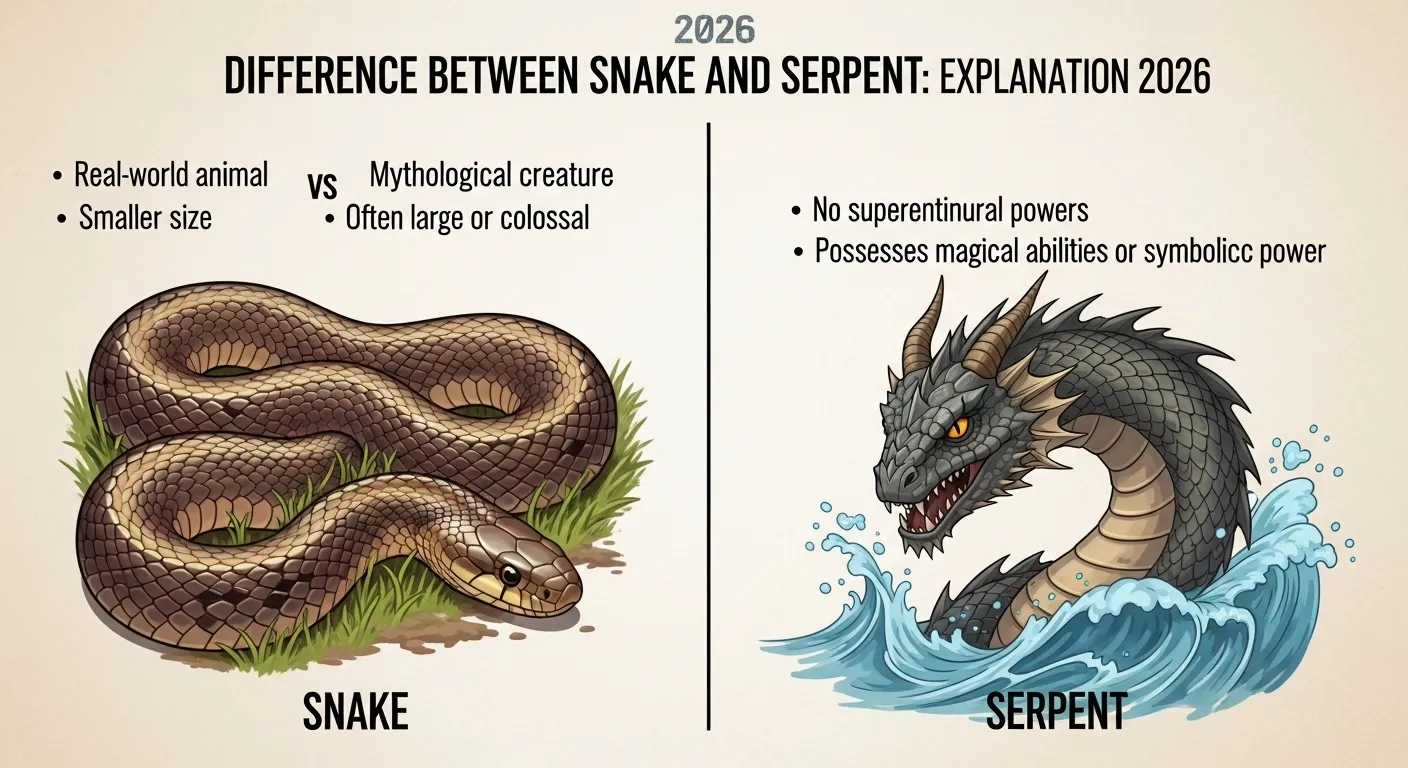
A child sees a long, legless animal in the garden and shouts, “Snake!” Later, in a storybook, the same animal appears in a magical forest and is called a “serpent.” Both words describe the same kind of creature. Yet the feeling is different.
When we study the difference between snake and serpent, we see that one word is common and simple, while the other sounds old and poetic. The difference between snake and serpent is not about biology.
It is about tone, style, and meaning. Many people confuse them. But the difference between snake and serpent becomes clear when we look at daily speech and literature.
Pronunciation
- Snake
- US: /sneɪk/
- UK: /sneɪk/
- Serpent
- US: /ˈsɜːrpənt/
- UK: /ˈsɜːpənt/
Key Difference Between the Both
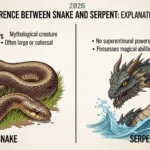
A snake is the common, everyday word for a legless reptile.
A serpent is a more formal, old, or symbolic word for a snake.
Difference Between Snake and Serpent
1. Everyday Use
Snake: Used in daily talk.
- I saw a snake in the grass.
- The snake moved fast.
Serpent: Rare in daily talk.
- The hero fought a giant serpent.
- The serpent guarded the treasure.
2. Tone
Snake: Neutral tone.
- The zoo has a snake.
- A snake lives in the forest.
Serpent: Dramatic tone.
- The dark serpent rose from the cave.
- The serpent hissed in anger.
3. Literature
In the Bible, the word “serpent” appears in the story of Adam and Eve. It has a symbolic meaning.
In stories like The Jungle Book by Rudyard Kipling, the word “snake” is used more simply.
4. Symbolism
Snake: Often means danger.
- He stepped back from the snake.
- A snake bite is harmful.
Serpent: Often means evil or wisdom.
- The serpent tempted Eve.
- The serpent symbol stands for power.
5. Scientific Use
Snake: Used in biology.
- Snakes are reptiles.
- A snake has no legs.
Serpent: Not used in science.
- It appears in myths.
- It appears in poems.
6. Emotional Effect
Snake: Simple and direct.
- The snake is green.
- The snake is small.
Serpent: Strong and mysterious.
- The ancient serpent watched.
- The fiery serpent attacked.
7. Modern Media
In movies like Snakes on a Plane, the common word is used.
In fantasy films, “serpent” sounds more magical.
8. Metaphor
Snake:
- He is a snake. (means a dishonest person)
Serpent:
- The serpent of jealousy entered his heart.
Nature and Behaviour
In real life, both words describe the same animal. A snake or serpent is cold-blooded. It moves by sliding. It can be small or large.
The difference is not in the animal. It is in language and feeling.
Why People Are Confused About Their Use
Both words mean the same animal. Many dictionaries list “serpent” as another word for snake. The confusion happens because one is modern and the other is old and symbolic.
Table Showing Difference and Similarity
| Point | Snake | Serpent | Similarity |
|---|---|---|---|
| Meaning | Legless reptile | Same reptile | Same animal |
| Use | Daily speech | Literary or old style | Refer to reptiles |
| Tone | Neutral | Dramatic | Can show danger |
| Science | Common term | Rare term | Both reptiles |
| Symbol | Danger | Evil or wisdom | Used in metaphor |
Which Is Better in What Situation?
Use snake in daily talk, school work, and science. It is clear and simple. It fits news, reports, and normal speech.
Use serpent in poems, myths, and religious stories. It gives a strong and serious feeling. It sounds ancient and powerful.
How the Words Are Used in Metaphors and Similes
- “He is as silent as a snake.”
- “Her words were like a serpent’s hiss.”
In the Paradise Lost by John Milton, the serpent is a symbol of evil.
Connotative Meaning
Snake:
- Negative: “He is a snake.”
- Neutral: “The snake lives in the jungle.”
Serpent:
- Negative: “The serpent tempted him.”
- Symbolic: “The serpent stands for wisdom.”
Idioms
- “Snake in the grass”
- Example: He looked kind, but he was a snake in the grass.
There are no common daily idioms with “serpent,” but it appears in religious sayings.
Works in Literature
- Paradise Lost (Epic poem, John Milton, 1667)
- The Jungle Book (Children’s fiction, Rudyard Kipling, 1894)
Movies
- Snakes on a Plane (2006, USA)
- The Serpent and the Rainbow (1988, USA)
Five Frequently Asked Questions
1. Are snake and serpent the same?
Yes, they refer to the same animal.
2. Which word is more common?
Snake is more common.
3. Is serpent old-fashioned?
Yes, it sounds old and formal.
4. Is serpent used in religion?
Yes, especially in the Bible.
5. Can both mean a dishonest person?
Yes, both can be negative metaphors.
Final Words
Snake is simple and modern.
Serpent is poetic and symbolic.
Conclusion
The difference between snake and serpent is about language, not biology. Both name the same reptile. “Snake” is common and neutral. “Serpent” is formal and symbolic. Writers use “serpent” for drama and myth. Scientists use “snake” for clarity. When we understand tone and context, we choose the right word. Clear word choice improves writing and speech.

I’m Zahid Abbas, an educator, researcher, and digital publishing strategist with a passion for linguistics, grammar, and clear communication. As a content creator and SEO specialist, I craft research-driven, reader-focused content that empowers learners and makes knowledge accessible worldwide.