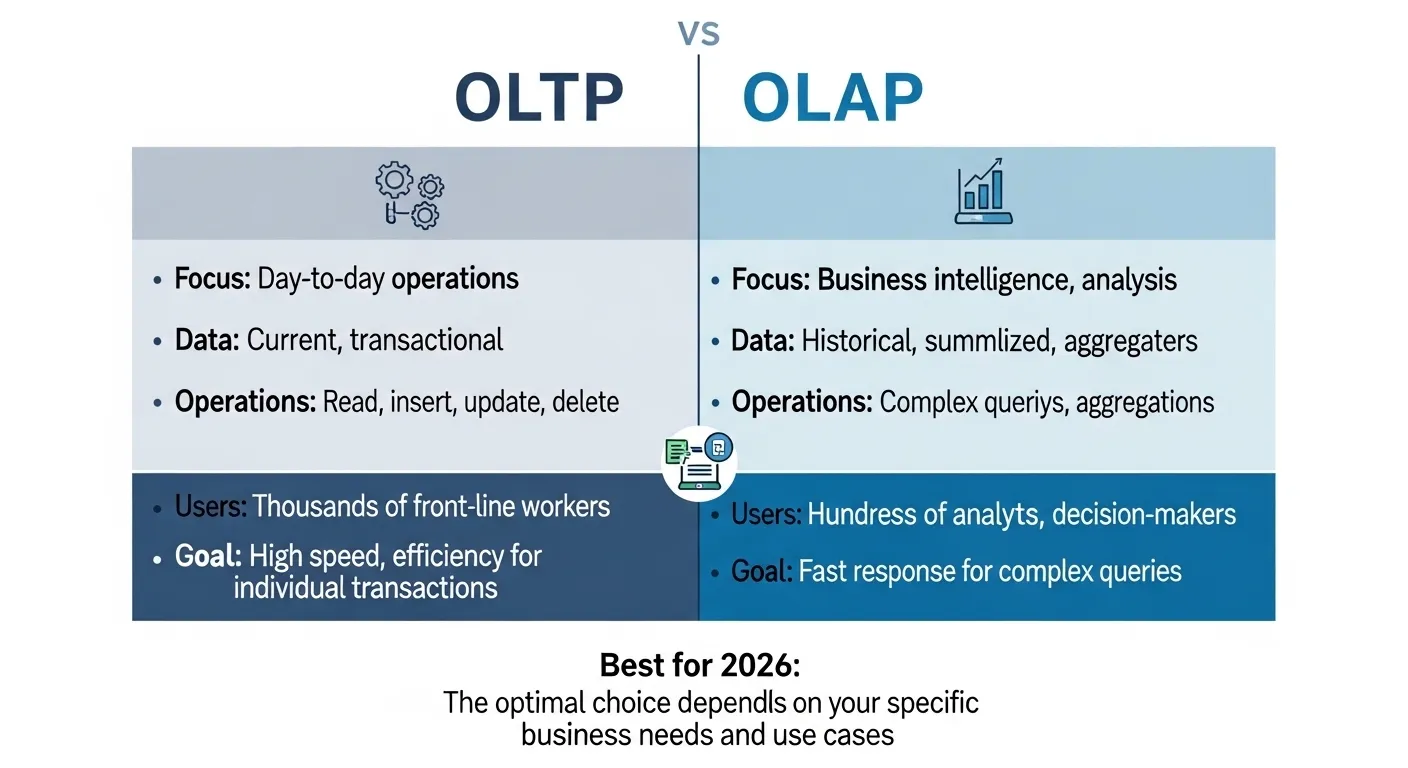
A small online store sells hundreds of products every day. When a customer buys a shirt, the system quickly records the order, updates the inventory, and confirms the payment. This fast process is handled by OLTP. Later, the store owner wants to study sales patterns, such as which product sold most in the last month or which city had the highest demand. For this type of analysis, the system uses OLAP.
This simple story shows the difference between OLTP and OLAP. Both work with data, but they serve different goals. The difference between OLTP and OLAP is mainly about how data is used. OLTP focuses on daily transactions, while OLAP focuses on analyzing large amounts of data. Learning the difference between OLTP and OLAP helps students, analysts, and businesses manage information better. In modern technology systems, understanding the difference between OLTP and OLAP helps people choose the right system for storing and studying data.
Pronunciation of the Keywords
OLTP
- US: /ˌoʊ el tiː ˈpiː/
- UK: /ˌəʊ el tiː ˈpiː/
OLAP
- US: /ˌoʊ el æ ˈpiː/
- UK: /ˌəʊ el æ ˈpiː/
Both words sound like letters spoken separately.
Before we explore the details, let us clearly see the difference between OLTP and OLAP and how each system behaves.
Difference Between OLTP and OLAP
1. Purpose
OLTP:
OLTP is used to manage daily transactions. It records every action in real time.
Examples
- A bank records a money transfer.
- An online store saves a customer purchase.
OLAP:
OLAP is used to analyze stored data and find patterns.
Examples
- A company studies yearly sales trends.
- A hospital analyzes patient records to improve services.
2. Type of Operations
OLTP:
It performs many small operations quickly.
Examples
- Adding a new order.
- Updating a customer’s address.
OLAP:
It performs complex queries on large datasets.
Examples
- Calculating total sales for five years.
- Comparing product performance across regions.
3. Data Volume
OLTP:
It works with small pieces of data per transaction.
Examples
- Recording a single payment.
- Saving one login record.
OLAP:
It handles large volumes of historical data.
Examples
- Analyzing millions of sales records.
- Studying years of weather data.
4. Speed Requirement
OLTP:
Speed must be very high because users interact directly.
Examples
- ATM transactions must finish instantly.
- Online ticket booking must confirm quickly.
OLAP:
Speed is less urgent because analysis may take longer.
Examples
- Monthly sales reports.
- Market research analysis.
5. Data Structure
OLTP:
Data is stored in detailed tables.
Examples
- Customer table.
- Order table.
OLAP:
Data is organized in multidimensional cubes.
Examples
- Sales by region cube.
- Time-based revenue cube.
6. Query Complexity
OLTP:
Queries are simple and short.
Examples
- Insert a new record.
- Update account balance.
OLAP:
Queries are complex and analytical.
Examples
- Find the best-selling product in five countries.
- Calculate profit growth by year.
7. Database Design
OLTP:
Uses normalized databases to avoid duplicate data.
Examples
- Banking transaction systems.
- Airline booking systems.
OLAP:
Uses denormalized databases for faster analysis.
Examples
- Data warehouses.
- Business intelligence systems.
8. Users
OLTP:
Used by operational staff and customers.
Examples
- Cashiers in stores.
- Users making online payments.
OLAP:
Used by analysts and managers.
Examples
- Business analysts studying sales.
- Managers making strategic decisions.
9. Data Updates
OLTP:
Data changes frequently.
Examples
- New orders are added every minute.
- Bank balances update constantly.
OLAP:
Data updates less often.
Examples
- Daily data imports to a warehouse.
- Weekly business reports.
10. Main Goal
OLTP:
The goal is accurate transaction processing.
Examples
- Safe banking transfers.
- Reliable ticket booking.
OLAP:
The goal is decision support and insights.
Examples
- Identifying profitable products.
- Predicting market trends.
Nature and Behaviour of Both
OLTP Nature
OLTP systems are fast, precise, and action-oriented. They focus on recording real-time events. Their behavior is transactional and user-driven.
OLAP Nature
OLAP systems are analytical and research-oriented. They focus on understanding data patterns. Their behavior supports planning and decision making.
Why People Confuse OLTP and OLAP
People often confuse these systems because both work with databases. Both store and process data. The names also look similar. However, OLTP handles transactions, while OLAP studies data patterns. Their purposes are very different.
Table Showing Difference and Similarity
| Feature | OLTP | OLAP |
| Main purpose | Manage daily transactions | Analyze large datasets |
| Data type | Current operational data | Historical data |
| Queries | Simple and quick | Complex and analytical |
| Users | Customers and staff | Analysts and managers |
| Update frequency | Very frequent | Periodic updates |
| Database design | Normalized | Denormalized |
| Speed | Extremely fast | Moderate |
| Data volume | Small per operation | Very large datasets |
| Goal | Transaction accuracy | Business insights |
| Similarity | Both manage and process data | Both support database systems |
Which Is Better in What Situation?
OLTP is better for operational tasks.
When a business needs to record transactions quickly, OLTP is the best system. Banks, e-commerce websites, and booking platforms rely on OLTP to process orders, payments, and user actions instantly. Without OLTP, daily operations would stop.
OLAP is better for analysis and planning.
When organizations want to study trends, compare results, or predict future growth, OLAP becomes more useful. Companies use OLAP tools to analyze sales reports, market behavior, and performance data to guide business decisions.
How the Terms Appear in Metaphors and Similes
OLTP as a metaphor
OLTP is often compared to a busy cashier at a supermarket.
Example
- The payment system works like OLTP, processing each order quickly.
OLAP as a metaphor
OLAP is often compared to a detective studying clues.
Example
- The data analyst used OLAP like a detective studying patterns in evidence.
Connotative Meaning of the Keywords
OLTP
Connotation: Neutral and practical.
Examples
- The OLTP system handled thousands of transactions smoothly.
- Banks depend on OLTP systems for reliable operations.
OLAP
Connotation: Positive and analytical.
Examples
- OLAP tools helped the company discover new market opportunities.
- The analyst used OLAP to find important business insights.
Idioms or Proverbs Related to Their Ideas
Although the words themselves are technical, some idioms match their meanings.
1. “Time is money”
Example: In OLTP systems, time is money because transactions must be fast.
2. “Seeing the bigger picture”
Example: OLAP helps managers see the bigger picture in business data.
Works in Literature Using the Keywords
Since these are modern technical terms, they mainly appear in technology books.
- Data Warehousing Fundamentals — Business/Technology — Paulraj Ponniah — 2001
- The Data Warehouse Toolkit — Technology — Ralph Kimball — 1996
- Business Intelligence Guidebook — Technology — Rick Sherman — 2014
Movies Related to Data and Analytics Themes
Few films mention these terms directly, but some focus on data analysis themes.
- Moneyball — 2011 — USA
- The Social Network — 2010 — USA
- The Great Hack — 2019 — USA/UK
Frequently Asked Questions
1. What is OLTP in simple words?
OLTP is a system that records daily transactions quickly.
2. What is OLAP used for?
OLAP is used to analyze large datasets and find patterns.
3. Can a company use both OLTP and OLAP?
Yes. Many organizations use OLTP for operations and OLAP for analysis.
4. Is OLAP faster than OLTP?
No. OLTP is faster for transactions, while OLAP focuses on complex analysis.
5. Why are both systems important?
Together they help businesses manage daily operations and long-term decisions.
How Both Are Useful for Our Surroundings
OLTP systems support everyday digital services. Online shopping, banking, ticket booking, and ATM machines rely on OLTP to work smoothly.
OLAP systems help organizations improve services. Governments analyze population data. Hospitals study patient records. Businesses examine customer trends. These insights help society make better decisions and plan for the future.
Final Words for Both
OLTP keeps daily digital activities running. OLAP turns stored data into knowledge. Together, they form the backbone of modern data management systems.
Conclusion
Understanding the difference between OLTP and OLAP is important in today’s data-driven world. OLTP systems focus on recording fast and accurate transactions, while OLAP systems focus on analyzing large datasets to discover useful insights. Both systems serve different roles but work together in many organizations. Businesses depend on OLTP to manage everyday operations such as payments and orders. At the same time, they rely on OLAP to study trends and plan future strategies. For students, professionals, and analysts, learning the difference between OLTP and OLAP makes it easier to understand how modern databases work and how information can support smarter decisions.

I’m Zahid Abbas, an educator, researcher, and digital publishing strategist with a passion for linguistics, grammar, and clear communication. As a content creator and SEO specialist, I craft research-driven, reader-focused content that empowers learners and makes knowledge accessible worldwide.