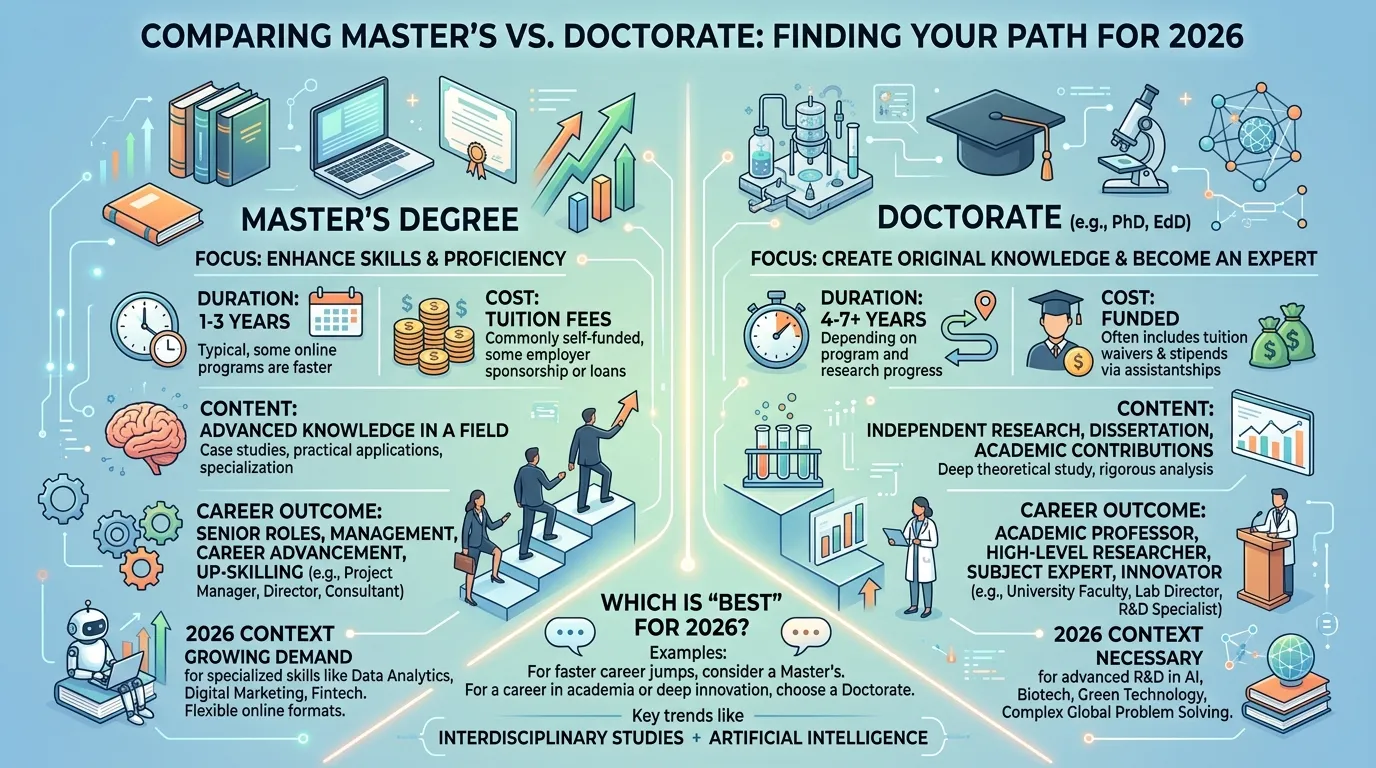
A student planning higher studies at University of Oxford often faces a key question: should they choose a master’s degree or a doctorate? At first, both may seem similar because they are advanced levels of education. However, the difference between master’s and doctorate is deeper than it appears.
The difference between master’s and doctorate lies in purpose, duration, level of research, and career goals. Understanding the difference between master’s and doctorate helps students make informed decisions about their future.
In today’s competitive world, knowing the difference between master’s and doctorate is essential for academic success and professional growth.
Key Difference Between the Both
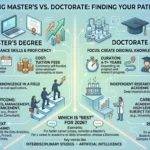
A master’s degree focuses on advanced learning, skill development, and practical application of knowledge in a specific field.
A doctorate (such as a PhD) focuses on original research, discovery, and contribution of new knowledge to a field.
The main difference is advanced study vs original research and expertise.
Why Is Their Difference Necessary to Know for Learners and Experts?
For students, it helps in choosing the right academic path. Also educators, it ensures proper guidance. For employers, it helps in evaluating qualifications. In society, this distinction supports innovation, research, and professional development.
Pronunciation
Master’s
- US: /ˈmæs.tɚz/
- UK: /ˈmɑː.stəz/
Doctorate
- US: /ˈdɑːk.tɚ.ət/
- UK: /ˈdɒk.tər.ət/
Difference Between Master’s and Doctorate
1. Academic Level
A master’s degree is the second stage of higher education after a bachelor’s degree.
- Example 1: Master of Science (MSc).
- Example 2: Master of Business Administration (MBA).
A doctorate is the highest academic degree.
- Example 1: Doctor of Philosophy (PhD).
- Example 2: Doctor of Education (EdD).
2. Purpose and Goal
A master’s aims to deepen knowledge and build professional skills.
- Example 1: Preparing for industry roles.
- Example 2: Gaining specialized expertise.
A doctorate aims to create new knowledge through research.
- Example 1: Conducting original studies.
- Example 2: Publishing academic work.
3. Duration
A master’s typically takes 1 to 2 years to complete.
- Example 1: Full-time programs.
- Example 2: Accelerated courses.
A doctorate usually takes 3 to 6 years or longer.
- Example 1: Extended research period.
- Example 2: Time for thesis development.
4. Structure of Study
A master’s includes structured coursework, lectures, and exams.
- Example 1: Classroom learning.
- Example 2: Group projects.
A doctorate is largely independent and research-based.
- Example 1: Working under a supervisor.
- Example 2: Conducting experiments or studies.
5. Research Requirement
A master’s may require a thesis or project, but it is usually limited in scope.
- Example 1: Short research paper.
- Example 2: Applied project.
A doctorate requires extensive and original research.
- Example 1: Dissertation writing.
- Example 2: Contribution to academic journals.
6. Entry Requirements
A master’s requires a bachelor’s degree.
- Example 1: Undergraduate qualification.
- Example 2: Minimum grade requirement.
A doctorate often requires a master’s degree or exceptional academic performance.
- Example 1: Research proposal submission.
- Example 2: Academic references.
7. Learning Approach
A master’s is guided learning with clear instructions.
- Example 1: Teacher-led sessions.
- Example 2: Structured syllabus.
A doctorate is self-directed learning.
- Example 1: Independent study.
- Example 2: Critical thinking focus.
8. Career Opportunities
A master’s opens doors to professional careers.
- Example 1: Business management roles.
- Example 2: Engineering positions.
A doctorate prepares for academic and research careers.
- Example 1: University professor.
- Example 2: Research scientist.
9. Depth of Knowledge
A master’s provides advanced knowledge in a subject.
- Example 1: Specialized training.
- Example 2: Practical skills.
A doctorate provides expert-level mastery and innovation.
- Example 1: Deep theoretical understanding.
- Example 2: New discoveries.
10. Final Assessment
A master’s is assessed through exams, assignments, and projects.
- Example 1: Written exams.
- Example 2: Coursework evaluation.
A doctorate is assessed through a dissertation and oral defense.
- Example 1: Thesis submission.
- Example 2: Viva voce examination.
Nature and Behaviour of Both
A master’s degree is structured, time-bound, and skill-focused.
A doctorate is flexible, research-intensive, and discovery-focused.
Why Are People Confused About Their Use?
Both are postgraduate degrees, and many people assume they are similar levels. However, the depth, purpose, and outcomes are very different, which leads to confusion.
Table Showing Difference and Similarity
| Feature | Master’s | Doctorate | Similarity |
| Level | Graduate | Highest level | Higher education |
| Duration | 1–2 years | 3–6+ years | Academic programs |
| Focus | Learning | Research | Specialization |
| Outcome | Skills | Knowledge creation | Career growth |
| Requirement | Bachelor’s | Master’s or higher | Study progression |
Which Is Better in What Situation?
A master’s degree is better for students who want to quickly gain advanced skills and enter the job market. It is ideal for professionals aiming to improve their qualifications and career prospects.
A doctorate is better for individuals who are passionate about research, teaching, and becoming experts in a field. It is suitable for those who want to contribute new knowledge and pursue academic or scientific careers.
Connotative Meaning
Master’s – Positive: skilled, qualified, professional
- Example: “A master’s degree enhances career growth.”
Doctorate – Positive: expert, authority, scholar
- Example: “A doctorate represents deep expertise.”
Five Frequently Asked Questions
1. Is a doctorate higher than a master’s?
Yes, it is the highest academic degree.
2. Can I skip a master’s and do a doctorate?
In some systems, yes, if you have strong academic performance.
3. Which takes more time?
A doctorate takes significantly more time.
4. Which is better for industry jobs?
A master’s is usually preferred.
5. Which is better for research careers?
A doctorate is essential.
How Are Both Useful for Surroundings?
Both degrees contribute to society by developing skilled professionals and researchers. Master’s graduates support industries, while doctorate holders drive innovation, research, and education.
Final Words for Both
A master’s builds advanced knowledge and practical skills.
A doctorate creates new knowledge and deep expertise.
Conclusion
The difference between master’s and doctorate is clear when examined closely. A master’s degree focuses on advanced education and professional development, while a doctorate emphasizes original research and academic contribution. Both degrees are valuable but serve different purposes. Choosing between them depends on your career goals, interests, and commitment level. Understanding this difference helps students plan a successful academic and professional journey.

I’m Zahid Abbas, an educator, researcher, and digital publishing strategist with a passion for linguistics, grammar, and clear communication. As a content creator and SEO specialist, I craft research-driven, reader-focused content that empowers learners and makes knowledge accessible worldwide.