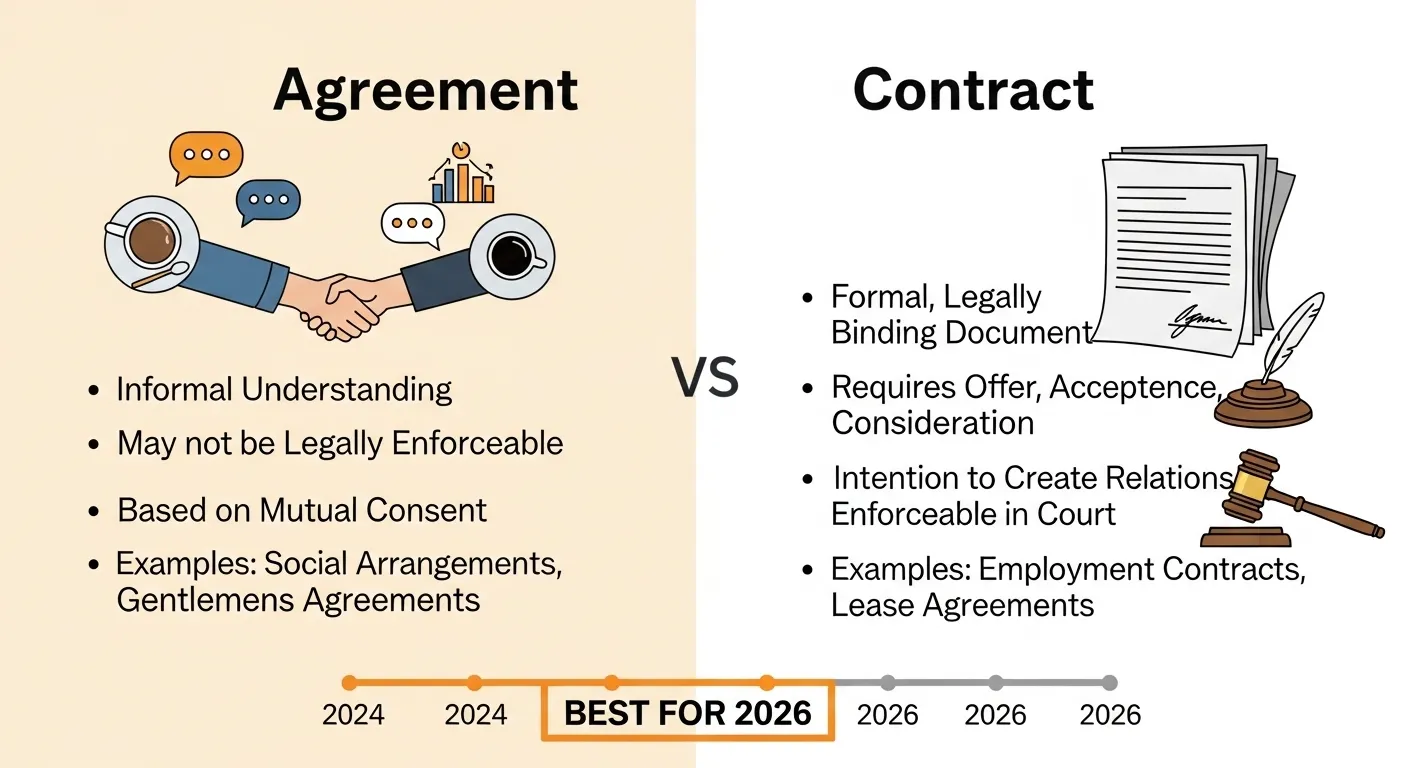
Two neighbors decide to share a water pump. They shake hands and promise to help each other. This is an agreement. Later, one neighbor hires a builder, signs papers, and promises payment after work.
This is a contract. Many people hear these words every day, but they do not always mean the same thing. Knowing the difference between agreement and contract helps in daily life, business, and law. The difference between agreement and contract is mainly about legal force.
An agreement is a common promise between people. A contract is a promise the law can enforce. The difference between agreement and contract matters when money, work, or property is involved. If you understand the difference between agreement and contract, you can make safer choices.
Pronunciation of Both
Agreement
- US: uh-GREE-muhnt
- UK: uh-GREE-muhnt
Contract
- US: KON-trakt (noun), kuhn-TRAKT (verb)
- UK: KON-trakt (noun), kuhn-TRAKT (verb)
Now that the meanings are clear, let us move to the main part and explore how these two terms differ in real life.
Difference Between Agreement and Contract
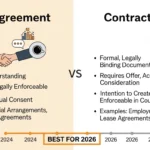
| Point | Agreement | Contract |
| 1 | A mutual understanding | A legal agreement |
| 2 | May be verbal | Often written |
| 3 | Not always enforceable | Enforceable by law |
| 4 | Can be social | Usually business or legal |
| 5 | Needs fewer formal rules | Needs legal elements |
| 6 | Broader term | Narrower term |
| 7 | Low risk sometimes | Often higher risk matters |
| 8 | Can be casual | More formal |
| 9 | May end by choice | May need legal ending |
| 10 | Based on trust | Based on trust and law |
1. Meaning
Agreement: A shared promise or understanding.
Examples:
- Friends agree to meet at 5 PM.
- Two kids agree to share toys.
Contract: A legal promise between parties.
Examples:
- A job contract.
- A house rent contract.
2. Legal Force
Agreement: May not have legal power.
Examples:
- Promise to call tomorrow.
- Promise to help move furniture.
Contract: Can be enforced in court.
Examples:
- Loan repayment contract.
- Service contract.
3. Form
Agreement: Can be spoken or written.
Examples:
- Verbal deal with friend.
- Text message promise.
Contract: Often written and signed.
Examples:
- Lease paper.
- Employment paper.
4. Purpose
Agreement: Often for simple matters.
Examples:
- Share chores.
- Join a trip.
Contract: Often for serious matters.
Examples:
- Buy a car.
- Build a shop.
5. Rules Needed
Agreement: Simple consent may be enough.
Examples:
- Agree on lunch place.
- Agree to study together.
Contract: Needs offer, acceptance, value, and lawful purpose.
Examples:
- Sales contract.
- Freelance contract.
6. Scope
Agreement: Wider term.
Examples:
- Family plans.
- Team plans.
Contract: One kind of agreement.
Examples:
- Insurance contract.
- Work contract.
7. Risk Level
Agreement: Often lower risk.
Examples:
- Share books.
- Walk together.
Contract: Often higher risk.
Examples:
- Business supply deal.
- Land sale deal.
8. Tone
Agreement: Friendly and casual.
Examples:
- “Okay, I agree.”
- “We have a deal.”
Contract: Formal and serious.
Examples:
- Signed office deal.
- Written vendor deal.
9. Ending It
Agreement: Easy to change or stop.
Examples:
- Cancel picnic plan.
- Change meeting time.
Contract: Ending may bring penalty.
Examples:
- Break lease early.
- Cancel service term.
10. Proof
Agreement: Harder to prove if verbal.
Examples:
- No witness promise.
- Phone call promise.
Contract: Easier to prove if written.
Examples:
- Signed sale paper.
- Email contract terms.
Nature and Behaviour of Both
Agreement: Flexible, friendly, and based on trust. It often changes easily.
Contract: Structured, firm, and based on rules. It protects rights and duties.
Why People Are Confused About Their Use?
People use both words for promises. In normal talk, they sound the same. Many people say “agreement” when they mean “contract.” In law, however, there is a clear difference.
Difference and Similarity Table
| Feature | Agreement | Contract | Similarity |
| Promise | Yes | Yes | Both involve promises |
| Legal force | Sometimes no | Yes | Both involve parties |
| Written form | Optional | Common | Both can be written |
| Use | Daily life | Legal/business | Both set expectations |
Which Is Better in What Situation?
Agreement: Better for simple daily matters. It works well with family, friends, or small plans. It saves time and keeps things easy. If trust is strong, an agreement may be enough.
Contract: Better for money, work, property, or long projects. It gives proof and legal safety. It is best when risk is high or many duties exist.
How Are the Keywords Used in Metaphors and Similes?
Agreement
- “Their minds were in agreement like two clocks.”
- Means harmony and unity.
Contract
- “Fear made his heart contract like a fist.”
- Means shrink, tighten, or bind.
Connotative Meaning of Both
Agreement
- Positive: Peace, unity, teamwork
- Example: The peace agreement ended the fight.
- Neutral: Common decision
- Example: We reached an agreement on time.
Contract
- Positive: Safety, order, trust
- Example: The contract protected both sides.
- Negative: Restriction, burden
- Example: He felt trapped by the contract.
- Neutral: Legal paper
- Example: Please sign the contract.
Idioms or Proverbs Related to the Words
Agreement
- Shake on it – confirm a deal
- Example: We shook on it after the talk.
- See eye to eye – agree fully
- Example: They see eye to eye on price.
Contract
- Sign on the dotted line – agree formally
- Example: She signed on the dotted line.
- A deal is a deal – promises must be kept
- Example: Pay today; a deal is a deal.
Works in Literature with the Names
- The Social Contract – Political philosophy, Jean-Jacques Rousseau, 1762
- Agreement – Poetry collection, various modern uses in anthologies
- The Contract – Fiction title used by several writers
Movie Names Made on Keywords
- The Contract – 2006, USA/Germany
- The Marriage Agreement – 2022, Indonesia
- Contract – 2008, India
Five Frequently Asked Questions
1. Is every agreement a contract?
No. Only legal agreements are contracts.
2. Can a verbal promise be a contract?
Yes, sometimes, if legal rules are met.
3. Is a written agreement always a contract?
No. It must meet legal conditions.
4. Which is stronger legally?
A contract is stronger legally.
5. Why should I know the difference?
It helps protect money, rights, and duties.
How Are Both Useful for Surroundings?
Agreements help homes, schools, and teams work in peace. Contracts help shops, jobs, and builders work with safety. Together, they create trust and order in society.
Final Words for the Both
Agreement builds trust. Contract builds trust with legal power. Both are useful when used in the right place.
Conclusion
The difference between agreement and contract is simple but important. An agreement is a shared promise or understanding. A contract is an agreement that the law can enforce. In daily life, agreements help people plan and cooperate. In business and legal matters, contracts give safety and proof. Many people confuse these words because both involve promises. Yet their use is different when rights, money, or duties are involved. Learners, workers, owners, and experts all gain from knowing this topic. Use an agreement for simple low-risk matters. Use a contract for serious or costly matters. When you know the right word, you make better and safer choices.

I’m Zahid Abbas, an educator, researcher, and digital publishing strategist with a passion for linguistics, grammar, and clear communication. As a content creator and SEO specialist, I craft research-driven, reader-focused content that empowers learners and makes knowledge accessible worldwide.