A student reading ancient history may see the names Israel and Judah and think they mean the same place. At first, they were connected as one people, but later they became two separate kingdoms. This is why many readers search for the difference between Israel and Judah.
The difference between Israel and Judah is important in religion, history, and geography. Israel often refers to the northern kingdom, while Judah refers to the southern kingdom after the split of the united monarchy.
Knowing the difference between Israel and Judah helps learners understand ancient texts and events. In this guide, we will explain the difference between Israel and Judah in clear and simple words.
Pronunciation of Both
| Word | US Pronunciation | UK Pronunciation |
| Israel | IZ-ray-el | IZ-ray-ul |
| Judah | JOO-duh | JOO-dah |
A Quick Link to the Main Topic
Now that we know these names are related but not the same, let us look at their true history and clear differences.
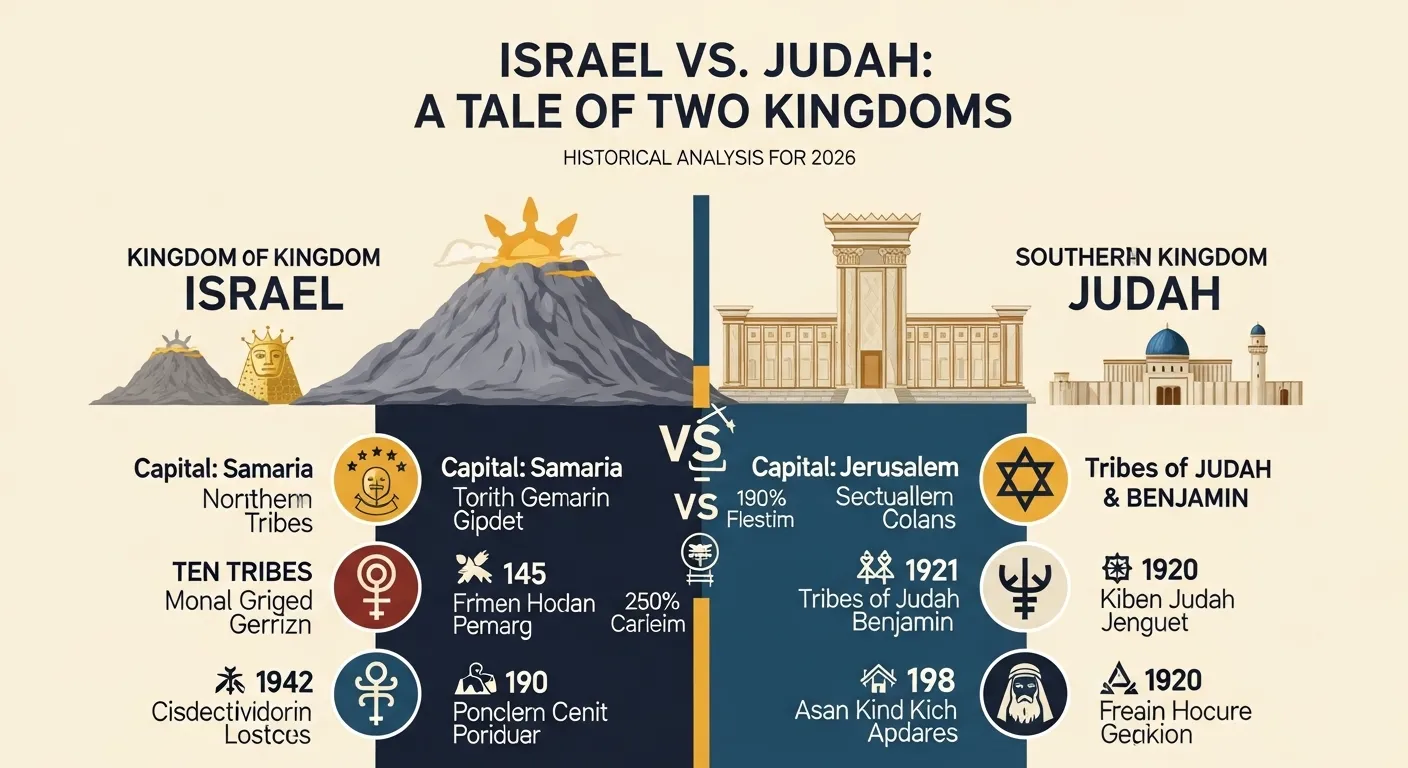
Difference Between Israel and Judah
| Feature | Israel | Judah |
| Main Meaning | Northern kingdom | Southern kingdom |
| Capital | Samaria | Jerusalem |
| Major Tribe Base | Ten tribes | Judah and Benjamin |
| Formation | After kingdom split | After kingdom split |
| Fall | Conquered by Assyria | Conquered by Babylon |
10 Points of Difference Between Israel and Judah
1. Basic Identity
Israel became the northern kingdom. Judah became the southern kingdom.
Examples of Israel:
- Israel had northern lands.
- Israel formed after the split.
Examples of Judah:
- Judah ruled southern lands.
- Judah remained after division.
2. Capital City
Israel’s capital was Samaria. Judah’s capital was Jerusalem.
Examples:
- Samaria led Israel.
- Israel kings ruled from Samaria.
- Jerusalem led Judah.
- Judah kept the temple city.
3. Tribal Makeup
Israel included many northern tribes. Judah centered on Judah and Benjamin.
Examples:
- Israel had larger tribal spread.
- Ten tribes were linked with Israel.
- Judah tribe led Judah.
- Benjamin joined Judah.
4. Religious Center
Israel had alternate worship centers. Judah kept Jerusalem’s temple.
Examples:
- Israel used Bethel.
- Israel used Dan.
- Judah honored Jerusalem temple.
- Judah priests served there.
5. Political Stability
Israel had many dynasties. Judah had one royal line from David.
Examples:
- Israel changed kings often.
- Some Israel rulers were overthrown.
- Judah kept Davidic kings longer.
- Judah had royal continuity.
6. Geographic Position
Israel was north. Judah was south.
Examples:
- Israel bordered northern neighbors.
- Israel had fertile valleys.
- Judah had hill country.
- Judah lay south of Israel.
7. Fall to Empires
Israel fell earlier. Judah fell later.
Examples:
- Israel fell to Assyria.
- Northern kingdom ended first.
- Judah fell to Babylon.
- Southern kingdom lasted longer.
8. Biblical Use of Names
Israel can mean Jacob, all tribes, or northern kingdom. Judah usually means tribe or southern kingdom.
Examples:
- Israel was another name for Jacob.
- Israel also meant the people.
- Judah meant one tribe.
- Judah also meant the kingdom.
9. Symbolic Meaning
Israel often stands for broader national identity. Judah often stands for royal and temple heritage.
Examples:
- Israel represented many tribes.
- Israel signaled covenant people.
- Judah linked to kingship.
- Judah linked to Jerusalem.
10. Later Legacy
Israel gave name to later national identity. Judah gave rise to the term Jew.
Examples:
- Modern names use Israel.
- Israel remains widely known.
- Judah influenced “Jew.”
- Judah shaped later identity terms.
Nature and Behaviour of Both
Israel
Israel was larger in land and population. It often had political change and several ruling houses. It faced strong outside pressure.
Judah
Judah was smaller but more stable at times. It kept Jerusalem as center of worship and government for many years.
Why People Are Confused About Their Use
People are confused because Israel can mean a person (Jacob), a united nation, or the northern kingdom. Judah can mean a son of Jacob, a tribe, or the southern kingdom. The names changed by time and context.
Difference and Similarity Table
| Point | Israel | Judah | Similarity |
| Region | North | South | Both were Hebrew kingdoms |
| Capital | Samaria | Jerusalem | Both had kings |
| Tribes | Mostly ten tribes | Judah + Benjamin | Both came from tribes of Jacob |
| Fall | Assyria | Babylon | Both were conquered |
| Heritage | National name | Source of “Jew” | Both important in history |
Which Is Better in What Situation?
Use Israel when talking about the northern kingdom after the split, the united people in some older contexts, or broader national identity. It is the better term when discussing the ten tribes, Samaria, or northern political history.
Use Judah when talking about the southern kingdom, Jerusalem, the Davidic royal line, or the tribe of Judah. It is the better term when discussing the temple, southern history, exile to Babylon, or origins of the term Jew.
How the Keywords Are Used in Metaphors and Similes
Israel
Connotative Meaning: Positive, neutral, historical
Examples:
- He gathered them like Israel united.
- Their struggle felt like Israel in exile.
Judah
Connotative Meaning: Positive, royal, faithful
Examples:
- She stood firm like Judah’s walls.
- His line was proud as Judah’s kings.
Idioms or Proverbs Related to the Words
No common modern English idioms use these words directly, but they appear in religious and literary phrases.
Examples:
- The lion of Judah stood for strength.
- The house of Israel meant the people.
Works in Literature Using the Names
- The History of the Kingdom of Israel – history, various writers, modern era
- Judah and Jerusalem – religious history, various writers
- The Bible – religious literature, multiple authors, ancient era
Movie Names Made on Keywords
- King David – 1985, USA
- The Bible: In the Beginning… – 1966, Italy/USA
- Jeremiah – 1998, USA/Italy
Five Frequently Asked Questions
1. Were Israel and Judah the same kingdom?
At first they were united, later they split into two kingdoms.
2. Which was north?
Israel was the northern kingdom.
3. Which had Jerusalem?
Judah had Jerusalem.
4. Which fell first?
Israel fell first to Assyria.
5. Why are both names important?
They help explain ancient history, religion, and identity.
How Both Are Useful for Surroundings
These names help people understand ancient politics, religion, migration, and culture. They are useful in education, archaeology, and literature studies. They also help readers understand historical maps and texts.
Final Words for the Both
Israel and Judah were linked by shared roots but became different kingdoms. One mainly points north, the other south, and both shaped later history.
Conclusion
The difference between Israel and Judah becomes clear when viewed through history. Israel was mainly the northern kingdom with Samaria as capital, while Judah was the southern kingdom with Jerusalem as its center. Israel fell earlier to Assyria, while Judah lasted longer before Babylonian conquest. People confuse the names because both came from the same ancestral people and the terms can carry several meanings. Knowing the difference between Israel and Judah helps learners read history with accuracy and helps experts discuss ancient events with clarity. Both names remain deeply important in religious and historical studies.

I’m Zahid Abbas, an educator, researcher, and digital publishing strategist with a passion for linguistics, grammar, and clear communication. As a content creator and SEO specialist, I craft research-driven, reader-focused content that empowers learners and makes knowledge accessible worldwide.