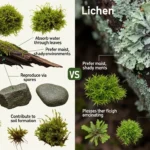
After rain, a child walks through a park and sees soft green patches on stones and gray crust on tree bark. The child asks, are both the same? The answer is no. Moss and lichen may look alike, but they are very different.
Knowing the difference between moss and lichen helps us understand nature. Moss is a small green plant that grows in wet places. Lichen is a living team made of fungus and algae. The difference between moss and lichen is important in forests, gardens, and science.
Many people miss the difference between moss and lichen because both grow on rocks and trees. When you learn the difference between moss and lichen, you can read nature with better eyes.
Key Difference Between the Both
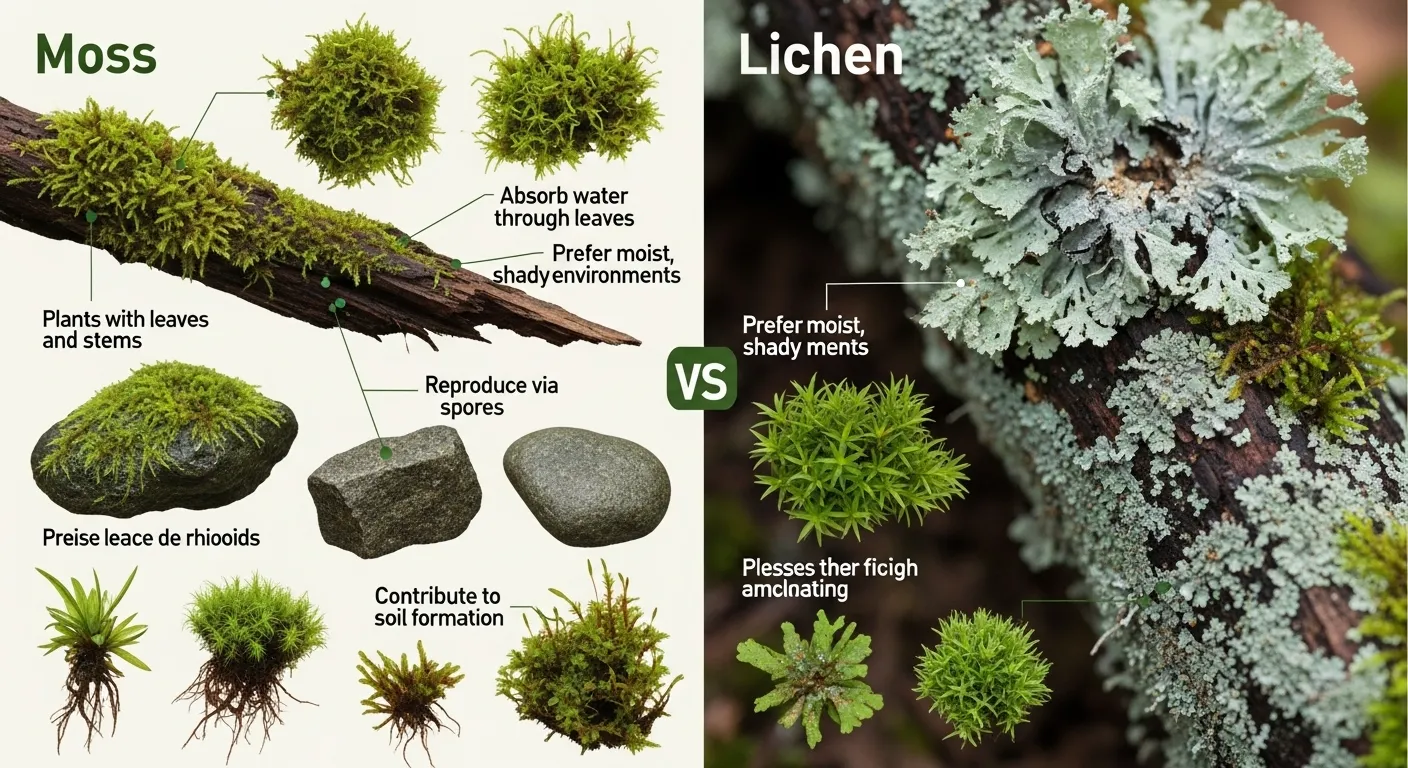
The main difference is simple. Moss is a plant-like organism that grows with tiny leaf-like parts. Lichen is a partnership of fungus and algae living together.
Why Is Their Difference Necessary to Know for Learners and Experts?
Knowing this helps students learn biology. It helps gardeners manage growth on walls and trees. Also helps experts study air quality because lichen is a sign of clean or dirty air. It also helps people protect forests and old buildings.
Pronunciation of Both
Moss
- US: maws
- UK: mos
Lichen
- US: LYE-kun
- UK: LYE-kuhn
Now that we know the basics, let us explore the full differences in an easy way.
Difference Between Moss and Lichen
1. Type of Organism
Moss: A simple non-flowering plant.
Examples:
- Carpet moss in gardens
- Moss on wet stones
Lichen: A team of fungus and algae.
Examples:
- Gray lichen on bark
- Yellow lichen on rocks
2. Color
Moss: Mostly green.
Examples:
- Bright green lawn moss
- Dark green forest moss
Lichen: Gray, white, yellow, orange, or green.
Examples:
- Orange wall lichen
- White tree lichen
3. Texture
Moss: Soft and spongy.
Examples:
- Soft moss mat
- Cushioned moss bed
Lichen: Dry, crusty, or leafy.
Examples:
- Crust on stone
- Leafy bark lichen
4. Structure
Moss: Has stem-like and leaf-like parts.
Examples:
- Upright moss shoots
- Tiny leaf clusters
Lichen: No stems or leaves.
Examples:
- Flat patch lichen
- Branch-like lichen
5. Water Need
Moss: Needs more moisture.
Examples:
- Grows near streams
- Thrives after rain
Lichen: Can live in dry places too.
Examples:
- Desert rocks
- Dry tree bark
6. Growth Speed
Moss: Grows faster.
Examples:
- Garden moss spreads soon
- Damp wall moss returns fast
Lichen: Grows slowly.
Examples:
- Old rock lichen grows for years
- Tree bark patch grows slowly
7. Reproduction
Moss: Reproduces by spores.
Examples:
- Spores in capsules
- Wind spreads spores
Lichen: Reproduces by fragments or spores.
Examples:
- Broken piece grows again
- Fungal spores spread
8. Habitat
Moss: Wet soil, logs, and stones.
Examples:
- Forest floor
- Pond edge
Lichen: Bark, rocks, roofs, walls.
Examples:
- Roof tiles
- Tree trunk
9. Role in Nature
Moss: Holds water and soil.
Examples:
- Stops soil loss
- Keeps ground moist
Lichen: Breaks rock and shows air health.
Examples:
- Helps make soil
- Signals pollution level
10. Life Partnership
Moss: Lives as one organism.
Examples:
- Moss cushion
- Moss patch
Lichen: Lives as two partners.
Examples:
- Fungus + algae patch
- Fungus + cyanobacteria form
Nature and Behaviour of Both
Moss: Soft, green, moisture-loving, and fast to spread in wet shade. It forms mats and keeps water.
Lichen: Tough, slow-growing, and able to survive heat, cold, and dryness. It clings to bark and stone.
Why Are People Confused About Their Use?
People confuse them because both are small, low-growing, and found on rocks, trees, and old walls. From far away, they can look alike.
Difference and Similarity Table
| Feature | Moss | Lichen | Similarity |
| Nature | Plant-like | Fungus + algae team | Both are living organisms |
| Color | Mostly green | Many colors | Both may appear green |
| Texture | Soft | Dry or crusty | Both cover surfaces |
| Habitat | Damp places | Many places | Both grow outdoors |
| Role | Holds water | Shows air quality | Both help nature |
Which Is Better in What Situation?
Moss is better in gardens, terrariums, and wet shady places. It gives a soft green look. Also helps hold soil and moisture. It is useful where people want beauty and water balance. In forests, moss helps tiny insects and keeps the ground cool.
Lichen is better for studying the environment. It helps scientists check air quality. Also can grow where other life struggles. It is useful on rocks, dry bark, and hard places. Lichen also helps break stone into soil over time.
How Are the Keywords Used in Metaphors and Similes?
Moss
- “His beard was thick like moss.”
- “The old wall wore moss like a coat.”
Lichen
- “Memories clung like lichen to stone.”
- “Time spread like lichen on ruins.”
Connotative Meaning of Both
Moss
- Positive: Calm, soft, natural
- Example: The room felt moss-soft and peaceful.
- Neutral: Plant cover
- Example: Moss grew on the path.
- Negative: Neglect or age
- Example: The gate was moss-covered and unused.
Lichen
- Positive: Survival, resilience
- Example: She was strong like lichen in winter.
- Neutral: Surface growth
- Example: Lichen covered the bark.
- Negative: Decay or old age
- Example: Lichen marked the broken wall.
Idioms or Proverbs Related to the Words
There are no common major idioms using these exact words, but related sayings exist.
Rolling Stone Gathers No Moss
Meaning: A person always moving does not settle.
Example: He changes jobs often. A rolling stone gathers no moss.
Old as Moss
Meaning: Very old.
Example: That story is old as moss.
Works in Literature with the Names of Keywords
- Gathering Moss – Memoir/Nature, Robin Wall Kimmerer, 2003
- Mossflower – Fantasy, Brian Jacques, 1988
- Lichen Daughters – Poetry, several modern collections, title use varies
Movie Names Made on Keywords
- Moss – 2010, South Korea
- Spanish Moss – 2014, USA
- Lichen – Short film, 2020, Canada
Five Frequently Asked Questions
1. Is moss a plant?
Yes, moss is a simple non-flowering plant.
2. Is lichen a plant?
No, lichen is a partnership of fungus and algae.
3. Can both grow on rocks?
Yes, both can grow on rocks.
4. Which grows faster?
Moss usually grows faster than lichen.
5. Which shows air pollution?
Lichen is often used to study air quality.
How Are Both Useful for Surroundings?
Moss keeps soil wet, cool, and stable. It adds beauty to parks and gardens. Lichen helps make soil from rock and tells us about clean air. Both support insects, forests, and healthy ecosystems.
Final Words for the Both
Moss is soft and green. Lichen is strong and patient. Both are small wonders of nature.
Conclusion
The difference between moss and lichen is clear when we look closely. Moss is a small plant that loves wet places and forms green mats. Lichen is a team of fungus and algae that can live on bark, stone, and dry land. Moss helps keep water and soil in place. Lichen helps break rock and shows air health. People confuse them because both grow in quiet outdoor places. Yet each has its own role. When we know the difference between moss and lichen, we understand nature better. These tiny forms of life teach us about balance, survival, and beauty.

I’m Zahid Abbas, an educator, researcher, and digital publishing strategist with a passion for linguistics, grammar, and clear communication. As a content creator and SEO specialist, I craft research-driven, reader-focused content that empowers learners and makes knowledge accessible worldwide.