One sunny day, a girl named Sara went to a park. She saw a bright bird and began to wonder where it came from. She then left the path and began to wander around the park. These two words sound alike, but they have different meanings. Wonder means to think about something or feel surprise. Wander means to walk or move around without a clear plan. The difference between wonder and wander is important for people who want to speak and write English well. The difference between wonder and wander can change the meaning of a sentence. Students, teachers, writers, and speakers all need to know how to use these words. Learning the difference between wonder and wander can help you avoid mistakes and share your ideas with ease.
Key Difference Between Wonder and Wander
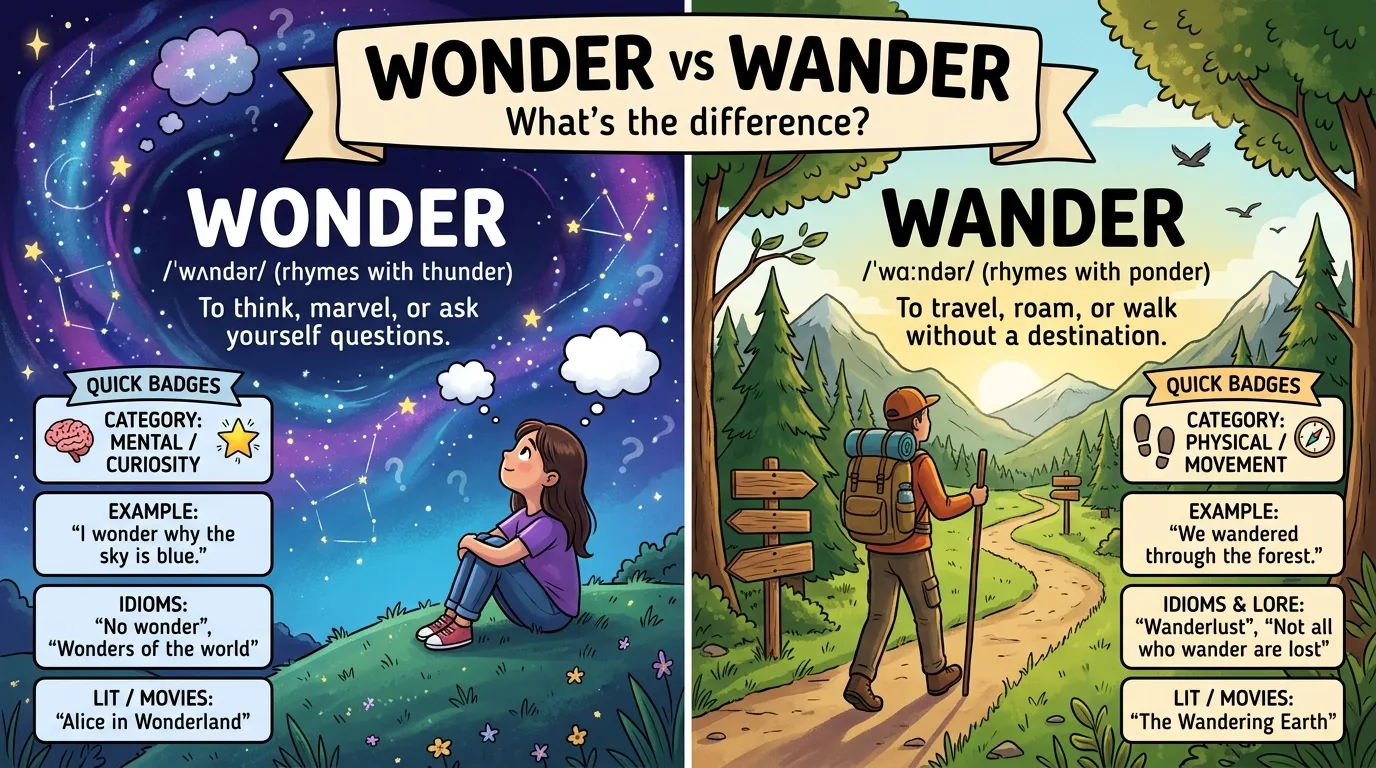
The main difference is that wonder is about thought or surprise, while wander is about movement without a clear goal.
- Wonder: I wonder why the sky is blue.
- Wander: We wander through the garden.
Wonder often happens in the mind. Wander often happens when a person or thing moves from place to place.
Why Is It Important to Know Their Difference?
Knowing these words helps learners use English in the right way. A small word mistake can change the meaning of a sentence. Teachers use the words to explain ideas. Writers use them to show thoughts, feelings, and actions. In daily life, clear words help people share ideas and understand each other. Knowing the difference also helps students read stories and poems with more care.
Pronunciation of Wonder and Wander
Wonder
- US English: /ˈwʌndər/
- UK English: /ˈwʌndə/
Wander
- US English: /ˈwɑːndər/
- UK English: /ˈwɒndə/
A Quick Look Before We Begin
Wonder and wander may look and sound alike, but they do different jobs in a sentence. One helps us talk about thoughts and questions. The other helps us talk about movement. Let us explore ten key differences with easy examples.
Difference Between Wonder and Wander
1. Meaning
Wonder: Wonder means to think about something or feel surprise. It can show that you want to know more.
Wander: Wander means to move around without a clear plan or set path.
Examples:
- I wonder why the stars shine at night.
- The children wander around the park after lunch.
2. Part of Speech
Wonder: Wonder can be a noun or a verb. As a noun, it can mean surprise or amazement. As a verb, it can mean to think or ask yourself something.
Wander: Wander is mainly used as a verb. It describes movement without a clear goal. The noun wanderer means a person who wanders.
Examples:
- The child looked at the rainbow in wonder.
- We wander through the old town each summer.
3. Main Purpose
Wonder: Wonder helps us ask questions in our minds. It can also show surprise.
Wander: Wander describes a person or thing moving from place to place.
Examples:
- I wonder how bees make honey.
- The dog began to wander around the yard.
4. Use in Questions
Wonder: Wonder often appears when someone has a question but does not ask it directly.
Wander: Wander can appear in a question about where someone moved or went.
Examples:
- I wonder if the shop is still open.
- Did you wander far from the group?
5. Use in Daily Life
Wonder: People use wonder when they think about life, ask questions, or feel amazed.
Wander: People use wander when they walk around, explore a place, or lose their way.
Examples:
- I wonder what my friends are doing.
- We like to wander through the market.
6. Link to Feelings
Wonder: Wonder can show joy, surprise, curiosity, or doubt.
Wander: Wander usually describes movement. It can also suggest that a person feels lost or has no clear aim.
Examples:
- She watched the snow fall in wonder.
- He began to wander alone after losing his way.
7. Use in Stories
Wonder: Writers use wonder to show what a character thinks or feels.
Wander: Writers use wander to show where a character goes or how they move.
Examples:
- The boy began to wonder who lived in the castle.
- The knight had to wander through the dark forest.
8. Use in School and Learning
Wonder: Wonder helps students ask questions and seek new ideas.
Wander: Wander can describe moving around a school or a learning space without a clear task.
Examples:
- I wonder why plants need sunlight.
- The pupils wander around the science fair.
9. Common Word Forms
Wonder: Common forms include wondered, wondering, and wonderful. The word wonderful means very good or pleasing.
Wander: Common forms include wandered, wandering, and wanderer.
Examples:
- She wondered how the story would end.
- The lost hiker was wandering in the woods.
10. Use in Figurative Language
Wonder: Wonder can describe a feeling of amazement or a strong wish to know something.
Wander: Wander can describe thoughts that move from one idea to another without focus.
Examples:
- The child stared at the moon in wonder.
- My mind began to wander during the long talk.
Nature and Behaviour of Wonder
Wonder is linked to the mind and heart. It can start when we see something new, face a hard question, or learn about the world. It helps us think, ask questions, and look for answers.
Wonder can also show great surprise or joy. A child may feel wonder when seeing a rainbow for the first time. A student may wonder how the human body works. In both cases, the word shows a thought or feeling rather than physical movement.
Nature and Behaviour of Wander
Wander is linked to movement. It often means to walk or move without a clear goal. A person may wander through a park, a town, or a forest. An animal may wander away from home.
The word can also describe thoughts that move from one idea to another. For example, a student’s mind may wander during a long lesson. In this case, the body may stay still, but the thoughts move away from the task.
Why Do People Confuse Wonder and Wander?
People often confuse wonder and wander because the words look alike and have similar sounds. Both begin with the letter “w” and have two syllables. Some learners may also mix them up when speaking fast.
Their meanings, however, are quite different. Wonder is about thought or surprise. Wander is about movement or a mind that loses focus.
A simple way to remember them is this:
- Wonder = Think.
- Wander = Move.
If you are asking yourself a question, use wonder. If you are moving around without a clear plan, use wander.
Table Showing the Differences and Similarities
| Feature | Wonder | Wander |
| Main meaning | To think or feel surprise | To move without a clear plan |
| Main use | Thought or feeling | Movement or unfocused thought |
| Part of speech | Noun and verb | Mainly a verb |
| Common form | Wondered | Wandered |
| Example | I wonder why it rains. | We wander in the park. |
| Linked to the mind | Yes | Yes, in a figurative sense |
| Linked to movement | Not usually | Yes |
| Can show curiosity | Yes | Not usually |
| Can be used in stories | Yes | Yes |
| Similarity | Both are English words | Both are English words |
Similarities Between Wonder and Wander
- Both are common English words.
- Both can be used in stories and poems.
- Both can describe parts of human life.
- Both have two syllables.
- Both can be used in a figurative way.
- Both have word forms that end in “-ed” and “-ing.”
Which Is Better in What Situation?
Neither wonder nor wander is better than the other. Each word has its own use. Use wonder when you want to talk about a question, a thought, or a feeling of surprise. For example, “I wonder how birds fly.”
Use wander when you want to talk about moving around without a clear plan. For example, “We wander through the village.” The right word depends on what you want to say. If you mean thinking, choose wonder. If you mean moving, choose wander. This simple rule can help you use both words well.
also read more about https://comparificationn.com/difference-between-methanol-and-ethanol-2/
How Are Wonder and Wander Used in Metaphors and Similes?
Writers often use wonder and wander in creative ways. These words can help readers picture thoughts, feelings, and actions.
Wonder in a Metaphor
Example: “Her mind was a world of wonder.”
This means her mind was full of new ideas and questions.
Wonder in a Simile
Example: “His eyes shone like stars in wonder.”
This compares his look of amazement to bright stars.
Wander in a Metaphor
Example: “His thoughts were a boat on a wide sea.”
This means his thoughts moved freely without a clear path.
Wander in a Simile
Example: “Her mind wandered like a bird in the sky.”
This means her thoughts moved from one idea to another.
These examples show how writers can use both words to make language more vivid.
Connotative Meaning of Wonder and Wander
Wonder: Positive or Neutral
Wonder often has a positive meaning. It can show joy, curiosity, or amazement. It can also be neutral when someone is simply thinking about a question.
Positive example: “The child looked at the stars in wonder.”
This shows amazement and joy.
Neutral example: “I wonder what time the train will arrive.”
Here, the word shows a question in the mind.
Wander: Neutral or Negative
Wander is often neutral. It can mean walking around for fun or exploring a place. It may have a negative meaning when someone is lost or has no clear goal.
Neutral example: “We wander through the garden on Sunday.”
Negative example: “The lost child began to wander away from home.”
The meaning depends on the situation.
Idioms and Proverbs Related to Wonder and Wander
There are few common English idioms that use these exact words. However, some sayings have meanings that link to curiosity, travel, and losing focus.
- “Curiosity killed the cat.” This warns that too much curiosity can lead to trouble.
Example: I wonder what is inside the old shed, but I will ask the owner before going in. Curiosity killed the cat. - “Not all who wander are lost.” This well-known saying means that people who travel without a set path may still have a purpose.
Example: Maya likes to wander through new towns and learn about local life. Not all who wander are lost. - “The grass is always greener on the other side.” This means people may think another place or life is better than their own.
Example: Sam began to wonder if life would be better in another city. His father reminded him that the grass is always greener on the other side. - “A journey of a thousand miles begins with a single step.” This means big goals start with small actions.
Example: Nina wondered how she could see the world, so she began by visiting a town near her home. A journey of a thousand miles begins with a single step.
Works in Literature Related to Wonder and Wander
These works explore wonder, travel, discovery, or wandering. Not all of them focus on the exact words in their titles.
- Wonder — Children’s novel; R. J. Palacio; 2012. The story follows a boy who starts school and learns about kindness and acceptance.
- Wanderers — Science fiction novel; Chuck Wendig; 2019. The story follows people on a strange journey across the United States.
- The Hobbit — Fantasy novel; J. R. R. Tolkien; 1937. It tells the story of Bilbo Baggins and his journey to a far-off land.
- The Odyssey — Epic poem; Homer; date uncertain, often placed around the 8th century BCE. It follows Odysseus as he tries to return home after war.
These works connect to wonder and wandering through their themes of curiosity, travel, and discovery.
Movies Related to Wonder and Wander
These films explore wonder, travel, discovery, or the idea of moving through life. They are related to the words, but they do not all focus on their meanings.
- Wonder — 2017; United States. A family drama about a boy who learns to face school life and new people.
- Wander — 2020; Canada and United States. A mystery thriller about a private investigator who looks into a strange case.
- WALL-E — 2008; United States. An animated science fiction film about a small robot who travels beyond Earth.
- The Secret Life of Walter Mitty — 2013; United States. A comedy-drama about a man who goes on a real journey and learns about himself.
- Into the Wild — 2007; United States. A drama based on a young man’s journey away from normal life.
These films connect with wonder or wandering through discovery, travel, and the search for meaning.
Five Possible Asked Questions About Wonder and Wander
1. What is the main difference between wonder and wander?
Wonder means to think about something or feel surprise. Wander means to move around without a clear plan.
2. Can wonder and wander be used in the same sentence?
Yes. For example: “I wonder where the dog will wander next.” Wonder shows a thought, while wander shows movement.
3. Is wonder a noun or a verb?
Wonder can be both. In “I wonder why,” it is a verb. In “The view filled me with wonder,” it is a noun.
4. Is wander only used for walking?
No. Wander can also describe thoughts that move from one idea to another. For example, “My mind began to wander during class.”
5. How can I remember the difference between wonder and wander?
Remember this simple rule: wonder means think, and wander means move. Use wonder for questions and surprise. Use wander for movement without a clear plan.
How Are Wonder and Wander Useful for Our Surroundings?
Wonder and wander help us talk about how we learn and explore the world. Wonder makes us ask questions about nature, people, and new ideas. It can lead to learning and discovery. For example, a child may wonder why leaves change color.
Wander can help us describe exploring places and finding new things. People may wander through a park, a museum, or a new town. They can notice things they may miss when they follow the same path each day.
Both words help us share our thoughts and experiences. Wonder supports curiosity, while wander can describe exploration. Used well, they help us tell clear stories about the world around us.
Final Words on Wonder and Wander
Wonder and wander may look alike, but they have different meanings. Wonder is about thinking, asking questions, or feeling amazed. Wander is about moving around without a clear plan. Both words are useful in daily talk, schoolwork, and writing.
To use them well, think about the meaning you want to share. If you are talking about a thought, use wonder. If you are talking about movement, use wander. With practice, you can learn to use both words with care and confidence.
Conclusion
The difference between wonder and wander is easy to learn when you focus on their meanings. Wonder is about thought, curiosity, or surprise. Wander is about moving from place to place without a clear goal. Both words can also be used in creative writing to describe feelings, thoughts, and journeys. Knowing how to use them helps students, teachers, writers, and English learners share ideas more clearly. Remember the simple rule: wonder means think, while wander means move. Read examples, write your own sentences, and practice using both words in daily life. With time, you will know which word fits each situation and avoid common mistakes.

I’m Zahid Abbas, an educator, researcher, and digital publishing strategist with a passion for linguistics, grammar, and clear communication. As a content creator and SEO specialist, I craft research-driven, reader-focused content that empowers learners and makes knowledge accessible worldwide.