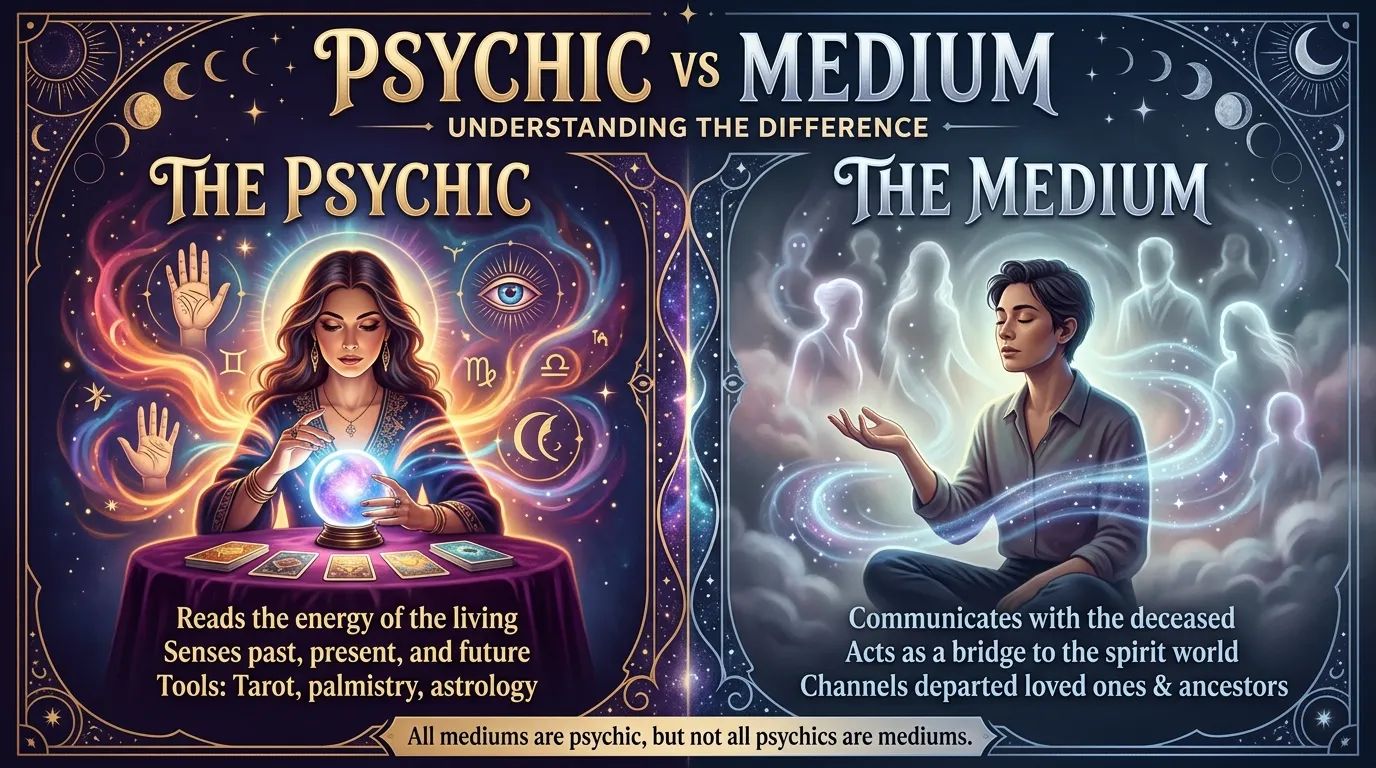
Imagine a woman named Emma who wants to know what may happen in her future. She visits a psychic for a reading. The psychic says she may face a big change in her work. Later, Emma visits a medium because she hopes to feel close to her late mother. A medium claims to connect with spirits of the dead. This story shows the difference between psychic and medium. A psychic is a person who claims to gain information through special mental powers. A medium is a person who claims to speak with spirits. The difference between psychic and medium is important because their claimed roles are not the same. The difference between psychic and medium can help people know what to expect from each service.
Key Difference Between the Two
A psychic claims to get information about people, events, or the future through special senses or mental powers. A medium claims to connect with spirits, often the spirits of people who have died.
Some people say they have both abilities. However, there is no strong scientific proof that psychic powers or spirit communication work as claimed.
Why Is Their Difference Important for Learners and Experts?
Knowing the difference helps people understand these terms in books, films, and daily life. It can also help people make careful choices before paying for a reading.
For learners, these words offer a way to study beliefs and culture. For writers and teachers, they help make stories and lessons clear.And for people who seek comfort after a loss, this knowledge can help them ask questions and protect their money and feelings.
It is also wise to remember that a claim is not the same as proven fact.
Pronunciation of Psychic and Medium
- Psychic
- US: SY-kik
- UK: SY-kik
- Medium
- US: MEE-dee-um
- UK: MEE-dee-um
Difference Between Psychic and Medium
1. Main Meaning
Psychic: A psychic is a person who claims to gain information through special mental powers.
Medium: A medium is a person who claims to connect with spirits.
Examples:
- Example 1: A psychic claims to know that a person may change jobs soon.
- Example 2: A medium claims to receive a message from a person’s late father.
2. Main Purpose
Psychic: A psychic reading often aims to give advice about life, love, work, or the future.
Medium: A medium reading often aims to share messages that are said to come from spirits.
Examples:
- Example 1: A person visits a psychic to talk about a new job.
- Example 2: A person visits a medium to seek a sense of contact with a loved one who has died.
3. Source of Information
Psychic: A psychic may say that the information comes from intuition, energy, or a special sense.
Medium: A medium may say that the information comes from spirits.
Examples:
- Example 1: A psychic says they sense a change in a client’s life.
- Example 2: A medium says they receive a message from a spirit.
4. Focus on the Future
Psychic: Many psychics offer readings about what may happen in the future.
Medium: A medium’s main focus is often spirit contact, not future events.
Examples:
- Example 1: A psychic claims that a person may meet a new friend.
- Example 2: A medium claims that a late relative has a message for the family.
5. Link to Spirits
Psychic: A psychic does not have to claim contact with spirits.
Medium: A medium usually claims to communicate with spirits.
Examples:
- Example 1: A psychic gives a reading about a person’s work without mentioning spirits.
- Example 2: A medium says a spirit is sharing a memory from the past.
6. Tools They May Use
Psychic: Some psychics use tarot cards, palm reading, or other tools. Others say they do not need tools.
Medium: Some mediums use quiet reflection, words, images, or other methods that they believe help them connect with spirits.
Examples:
- Example 1: A psychic uses tarot cards during a reading about love.
- Example 2: A medium sits quietly and says they sense a message from a spirit.
7. Type of Questions
Psychic: People may ask about work, love, choices, or future plans.
Medium: People may ask whether a loved one who has died has a message.
Examples:
- Example 1: “Will I find a new job?” is a question someone may ask a psychic.
- Example 2: “Does my late grandmother have a message?” is a question someone may ask a medium.
8. Skills They Claim to Have
Psychic: A psychic may claim to sense thoughts, feelings, events, or future paths.
Medium: A medium may claim to hear, see, or sense spirits.
Examples:
- Example 1: A psychic says they sense that a client feels worried about a choice.
- Example 2: A medium says they sense the presence of a person who has died.
9. Overlap Between the Two
Psychic: Some psychics focus only on readings about life and choices. Others also claim to be mediums.
Medium: Many mediums also describe themselves as psychic.
Examples:
- Example 1: A psychic offers advice about work but does not claim spirit contact.
- Example 2: A medium offers spirit readings and also gives general life readings.
10. Proof and Trust
Psychic: Claims of psychic powers have not been shown to work in a reliable way under strong scientific tests.
Medium: Claims of spirit communication also lack strong, reliable scientific proof.
Examples:
- Example 1: A psychic’s prediction should not be the only reason a person makes a major life choice.
- Example 2: A medium’s message should not replace trusted support when someone is grieving.
Nature and Behaviour of a Psychic
A psychic is often shown as a person who gives readings about life, feelings, choices, or future events. Some use cards or other tools. Others say they rely on their own inner sense.
A psychic may speak in broad terms about a person’s life. Some people find these readings fun or helpful for thought. But a reading should not be treated as proven fact. It is wise to check important claims and make choices based on clear facts.
Nature and Behaviour of a Medium
A medium claims to act as a link between the living and the spirit world. Many say they can receive messages from people who have died. Some describe seeing spirits, hearing voices, or sensing a presence.
People may seek a medium when they miss someone who has died. Such visits may feel meaningful to them. Still, spirit contact has not been proven by strong scientific evidence. A medium should never use fear or grief to pressure someone into paying more money.
Why Are People Confused About Their Use?
People often mix up these terms because both are linked to claims of special powers. Both may offer readings, use cards, or speak about feelings and life events.
Some people also call themselves both psychics and mediums. This makes the terms seem the same. The main point is simple: a psychic claims to gain special information, while a medium claims to connect with spirits. Their roles may overlap, but they are not always the same.
Table of Differences and Similarities
| Feature | Psychic | Medium |
| Main meaning | Claims to gain special information | Claims to connect with spirits |
| Main focus | Life events, feelings, choices, or the future | Messages from spirits |
| Spirit contact needed? | No | Usually yes |
| Common tools | Cards, palm reading, or no tools | Quiet reflection or other claimed methods |
| Common questions | Work, love, choices, future | Messages from loved ones who have died |
| Can roles overlap? | Yes | Yes |
| Scientific proof | No strong reliable proof of claimed powers | No strong reliable proof of spirit contact |
| Can people find meaning in a reading? | Yes, as a personal or cultural experience | Yes, as a personal or cultural experience |
| Should they replace expert advice? | No | No |
| Need careful judgment? | Yes | Yes |
Which Is Better in What Situation?
A psychic may fit a person’s interest if they want a reading about life choices, love, or work. Some people use such readings for fun or as a way to think about their goals. Still, they should not treat predictions as facts.
A medium may fit a person’s interest if they want a claimed link with a loved one who has died. Some people find this meaningful, but spirit contact is not proven. Neither service is a substitute for medical, legal, or money advice. If grief feels too hard to manage, talking with a trusted person or trained helper may offer real support.
also read more abouthttps://comparificationn.com/difference-between-bacitracin-and-neosporin-2/
How Are Psychic and Medium Used in Metaphors and Similes?
These words are often used in stories and films to describe people who seem to know things others do not.
- Metaphor: “She was the psychic of the team.” This means she seemed to know what might happen next.
- Simile: “He read the room like a psychic.” This means he seemed very good at noticing how people felt.
- Metaphor: “The medium was a bridge between two worlds.” This shows the role a medium claims to have between the living and the spirit world.
- Simile: “Her words came like a message from the past.” This means her words reminded someone of a person or memory from long ago.
These are creative uses of language. They do not prove that psychic powers or spirit contact are real.
Connotative Meaning of Psychic and Medium
Psychic
The word psychic can have positive, negative, or neutral meanings.
- Positive: “The psychic gave her a chance to think about her goals.” This shows a helpful experience.
- Negative: “The fake psychic used fear to take the man’s money.” This shows harm and deceit.
- Neutral: “The book has a psychic character.” This simply describes a character in a story.
Medium
The word medium can also have positive, negative, or neutral meanings.
- Positive: “The medium’s visit brought the family comfort.” This shows how the family felt.
- Negative: “The dishonest medium made false claims to get money.” This shows harmful behaviour.
- Neutral: “The medium appears in the final chapter.” This simply names a role in a story.
The word medium also has other meanings, such as a way to share ideas or a middle size. Its meaning depends on the context.
Idioms and Proverbs Related to Psychic and Medium
There are no common idioms that use the exact words psychic or medium. But some sayings relate to their themes.
- “Seeing is believing.” Example: A person may say, “I need clear proof before I believe the psychic’s claim.”
- “Time will tell.” Example: A psychic makes a prediction, but time will tell whether it comes true.
- “Take it with a grain of salt.” Example: It is wise to take a medium’s claims with a grain of salt because spirit contact is not proven.
- “The proof is in the pudding.” Example: A psychic’s claim should be judged by clear results, not just by strong words.
These sayings remind people to think carefully and ask for proof.
Works in Literature Related to Psychics and Mediums
Many books include psychics, mediums, or spirit contact as part of their stories. Here are some well-known examples:
- The Witch of Blackbird Pond — historical fiction by Elizabeth George Speare, published in 1958. It explores fear, belief, and claims of witchcraft, rather than focusing on psychics or mediums.
- The Turn of the Screw — ghost story by Henry James, published in 1898. It explores ghosts and uncertainty.
- The Medium — a play by Gian Carlo Menotti, first performed in 1946. It follows a woman who claims to contact the dead.
- The Dead — short story by James Joyce, published in 1914. It explores memory, love, and death, but is not about a psychic or medium.
These works explore related themes. They do not all focus on the exact meaning of the two terms.
Movies About Psychics and Mediums
Here are films that feature psychic claims, mediums, or spirit contact:
- The Sixth Sense (1999, United States) — a supernatural thriller about a boy who says he sees dead people.
- Ghost (1990, United States) — a romantic fantasy film in which a medium helps a spirit reach the living.
- The Others (2001, Spain and United States) — a mystery and horror film about a family and strange events in their home.
- The Gift (2000, United States) — a mystery thriller about a woman who claims to have psychic visions.
- The Medium (2021, Thailand and South Korea) — a supernatural horror film about a woman believed to be a spirit medium.
These films use psychic powers and spirit contact as story ideas. They are works of fiction, not proof of such powers.
Five Simpple Asked Questions About Psychic and Medium
1. Is a psychic the same as a medium?
No. A psychic claims to gain special information about people or events. A medium claims to connect with spirits. Some people claim to be both.
2. Can a psychic talk to the dead?
Some psychics may claim they can. But talking with the dead is more closely linked to the role of a medium. Neither claim has strong scientific proof.
3. Does a medium have psychic powers?
Many mediums say they have psychic abilities. But the terms are not the same. A medium’s main claim is contact with spirits.
4. Are psychics and mediums real?
People do offer these services, and many believe in them. But strong, reliable scientific proof for psychic powers or spirit communication is lacking.
5. How can I stay safe when visiting one?
Set a clear spending limit. Do not share bank details or private information. Be careful if someone uses fear, promises to remove a curse for money, or tells you to stop medical care. You can leave at any time.
How Are Psychics and Mediums Useful for Our Surroundings?
Psychics and mediums are part of some cultures, stories, and spiritual practices. Their work can lead to talks about hope, grief, belief, and the way people deal with the unknown.
Some people find personal meaning in a reading. Others see these services as entertainment. In either case, people should be free to choose what they believe. They should also have clear facts and fair treatment. No psychic or medium should use fear or grief to control another person. For serious health, legal, or money matters, people should seek help from trained experts.
Final Words on Psychic and Medium
A psychic and a medium may seem alike, but their main claims are different. A psychic claims to gain special information about life or the future. A medium claims to connect with spirits.
Some people claim to do both. Yet, neither psychic powers nor spirit contact has strong, reliable scientific proof. Read about these topics with an open mind, but also think carefully. Do not let a reading make major choices for you. Your own judgment, trusted support, and clear facts matter most.
Conclusion
The difference between psychic and medium is simple once you know what each word means. A psychic claims to sense information about people, life, or future events. A medium claims to receive messages from spirits. Both terms appear in books, films, and some spiritual practices. People may find personal meaning in these experiences, but strong scientific proof for their claims is lacking. It is wise to ask questions, protect your money, and avoid anyone who uses fear to control you. Do not use a reading in place of expert help for health, legal, or money issues. By knowing the difference, you can understand these terms and make careful choices.

I’m Zahid Abbas, an educator, researcher, and digital publishing strategist with a passion for linguistics, grammar, and clear communication. As a content creator and SEO specialist, I craft research-driven, reader-focused content that empowers learners and makes knowledge accessible worldwide.










