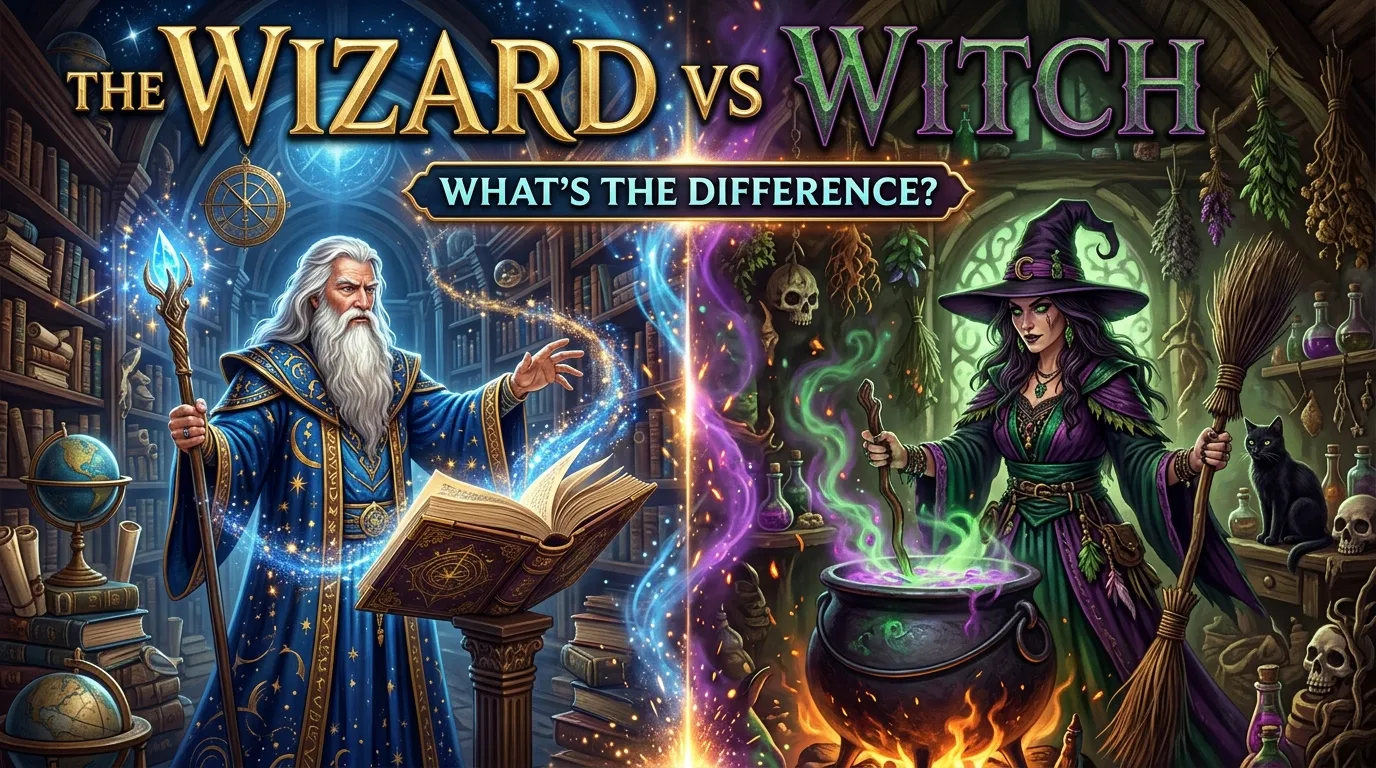
Imagine a child reading a story about a wizard with a long beard and a magic wand. In the next story, the child meets a witch who knows how to make magic potions. Both characters have magic powers, but they may look and act in different ways. This raises a simple question: what is the difference between wizard and witch?
A wizard is a person who uses magic in stories, myths, and fantasy. A witch is also a person linked to magic, but the word has a long and complex history. In many old stories, witches are women who use spells and magic. Yet not all stories show them in the same way. The difference between wizard and witch often depends on culture and story rules. Learning the difference between wizard and witch helps readers understand books, films, and old beliefs.
Key Difference Between the Two
The main difference is how people use the words. A wizard is often shown as a wise person who studies magic. A witch is often linked to spells, herbs, and nature. In many modern stories, both can be good, bad, or neutral. The words do not have one fixed meaning in every culture.
Why Is Their Difference Important for Learners and Experts?
Learners need to know these words to read stories and use English well. Writers need them to build clear and rich characters. Teachers can use them to explain myths, culture, and history. Film makers also use these roles to create new worlds. Knowing the difference helps people avoid old myths and unfair views about real people who may be called witches.
Pronunciation of Wizard and Witch
- Wizard
- US English: /ˈwɪz.ɚd/
- UK English: /ˈwɪz.əd/
- Witch
- US English: /wɪtʃ/
- UK English: /wɪtʃ/
Difference Between Wizard and Witch
1. Meaning
Wizard: A wizard is a person who uses magic. In many stories, a wizard learns magic through study and practice.
- Example 1: The wizard read old books to learn a new spell.
- Example 2: A wise wizard helped the king solve a problem.
Witch: A witch is a person linked to magic. In stories, a witch may use spells, herbs, charms, or magic tools.
- Example 1: The witch made a potion in her small hut.
- Example 2: A kind witch used magic to help a lost child.
2. Gender
Wizard: The word wizard often refers to a male character in old stories. But some modern stories use it for people of different genders.
- Example 1: The young wizard learned magic from his teacher.
- Example 2: In a fantasy game, a woman chose to play a wizard.
Witch: The word witch has often been used for women in old tales. Today, it can also be used by people of different genders in some cultures and modern stories.
- Example 1: The witch helped the village grow food.
- Example 2: The story had a male witch who used magic to protect his home.
3. How They Learn or Use Magic
Wizard: A wizard is often shown as a person who studies magic. He may learn from books, teachers, or years of practice.
- Example 1: The wizard spent years learning how to cast spells.
- Example 2: A young wizard trained at a school of magic.
Witch: A witch may be shown as someone who learns magic from family, nature, old books, or a group of other witches.
- Example 1: The witch learned about herbs from her grandmother.
- Example 2: A witch studied old spells in a forest hut.
These are common story patterns, not rules that all stories must follow.
4. Magic Tools
Wizard: Wizards are often shown with wands, staffs, magic books, or special robes.
- Example 1: The wizard raised his staff to light the dark room.
- Example 2: The wizard used a spell book to find a lost key.
Witch: Witches may use herbs, bowls, charms, candles, or a broom in stories.
- Example 1: The witch mixed herbs in a small bowl.
- Example 2: The witch placed a charm near the door.
Both characters can use the same tools. Their tools depend on the story.
5. Common Appearance
Wizard: A wizard is often shown with a long robe, a tall hat, or a beard. These looks are common in fantasy art.
- Example 1: The old wizard wore a blue robe and a pointed hat.
- Example 2: The wizard had a long white beard and a wooden staff.
Witch: A witch is often shown with a dark dress, a pointed hat, or a broom. But many modern witches look very different.
- Example 1: The witch wore a black hat and a green cloak.
- Example 2: The young witch wore simple clothes and carried a bag of herbs.
6. Role in Stories
Wizard: Wizards often guide heroes, teach skills, or protect a kingdom. Some are also villains.
- Example 1: The wizard taught the young hero how to use magic.
- Example 2: An evil wizard tried to take control of the kingdom.
Witch: Witches may help people, test heroes, or act as villains. Their roles can change from one story to another.
- Example 1: The witch gave the hero a healing potion.
- Example 2: An evil witch placed a spell on the prince.
7. Link to Nature
Wizard: A wizard may use magic linked to stars, fire, water, or other forces. Some stories focus more on study than on nature.
- Example 1: The wizard used star charts to guide his magic.
- Example 2: The wizard called up a wall of water to stop a dragon.
Witch: A witch is often linked to plants, herbs, animals, and the changing seasons.
- Example 1: The witch used leaves to make a potion.
- Example 2: The witch cared for plants that grew in her garden.
These links are story themes. They do not define every wizard or witch.
8. Social Image
Wizard: In many fantasy stories, wizards are shown as wise and respected people. Yet some are feared or hated.
- Example 1: The king asked the wizard for advice.
- Example 2: The people feared the wizard because he used dark magic.
Witch: Witches have often been shown as scary or evil in old tales. Modern books and films also show them as kind, wise, brave, or funny.
- Example 1: The villagers trusted the witch to help with plants.
- Example 2: The townspeople feared the witch because of an old rumor.
9. Main Powers
Wizard: A wizard may be shown using spells to change things, make shields, or move objects.
- Example 1: The wizard made a stone float in the air.
- Example 2: The wizard used a spell to hide the castle.
Witch: A witch may be shown making potions, casting spells, or changing forms.
- Example 1: The witch made a potion that helped a sick bird.
- Example 2: The witch changed into a black cat in the tale.
The powers of both characters depend on the rules of their story.
10. Place in Modern Culture
Wizard: Today, wizards appear in books, films, games, and role-playing stories. They often stand for wisdom, skill, or hidden power.
- Example 1: Children read stories about a young wizard at a magic school.
- Example 2: A player chose a wizard in a fantasy game.
Witch: Witches also appear in books, films, games, and festivals. They may stand for mystery, nature, freedom, or fear.
- Example 1: The family watched a film about a good witch.
- Example 2: The school play had a funny witch who helped the hero.
Nature and Behaviour of a Wizard
A wizard is often shown as calm, wise, and skilled. He may spend years studying spells and learning how magic works. Some wizards guide young heroes and help people in need. Others use their powers to gain control or harm others.
Wizards are not always old men with long beards. In modern stories, they can be young, old, male, female, kind, or cruel. Their nature depends on the writer and the world they live in.
Nature and Behaviour of a Witch
A witch is often shown as a person with magic skills. She may use herbs, spells, charms, or tools to reach her goals. Some witches live close to nature, while others live in towns or grand homes.
Witches can be kind, clever, brave, funny, or evil. Many modern stories give witches strong and complex roles. In real life, some people use the word witch as part of a spiritual or cultural identity. Such people should not be judged by the scary images found in old tales.
Why Are People Confused About Their Use?
People often confuse wizards and witches because both are linked to magic. Both may cast spells, use special tools, and appear in fantasy stories. Some books even use the words in ways that differ from older tales.
Gender can also cause confusion. Old stories often show wizards as men and witches as women. But modern stories may use these words in new ways. A character’s role may matter more than gender.
There is also no single set of magic rules across all books and films. One story may show a witch as evil, while another shows her as a hero. The best way to understand each word is to look at how the writer uses it.
Wizard vs Witch: Differences and Similarities
| Feature | Wizard | Witch |
| Basic meaning | A person linked to magic | A person linked to magic |
| Gender in old stories | Often male | Often female |
| Learning magic | Often shown through study | Often shown through nature, study, or tradition |
| Common tools | Wand, staff, magic book | Herbs, charms, candles, broom |
| Common look | Robe, hat, beard in some tales | Hat, cloak, broom in some tales |
| Common role | Teacher, guide, hero, or villain | Helper, hero, mystery figure, or villain |
| Link to nature | Depends on the story | Often linked to plants and nature |
| Magic powers | Spells, shields, and changes | Spells, potions, and changes |
| Moral nature | Can be good or bad | Can be good or bad |
| Modern use | Books, films, and games | Books, films, and games |
| Similarity | Both use magic in fiction | Both use magic in fiction |
| Similarity | Both can help or harm | Both can help or harm |
Which Is Better in What Situation?
Wizard: A wizard may be a better choice for a story about a magic school, a wise guide, or a person who learns spells from books. For example, a writer may use a wizard to teach a young hero how to save a kingdom. A wizard can also be a strong villain. The word works well when the story focuses on learning, skill, and the use of magic.
Witch: A witch may be a better choice for a story about herbs, nature, old customs, or hidden power. For example, a writer may use a witch who knows how to heal plants or protect a village. A witch can also be a hero or a villain. The word works well when the story explores mystery, tradition, and the link between people and nature.
Neither is better in every case. The best choice depends on the story.
also read more abouthttps://comparificationn.com/difference-between-plum-and-prune-2/
How Are Wizard and Witch Used in Metaphors and Similes?
The words wizard and witch are often used in creative speech. They can describe a person’s skill, charm, or effect on others.
Wizard in a Metaphor
Example: “My uncle is a computer wizard.”
Meaning: He is very skilled at using computers. This does not mean he has real magic powers.
Wizard in a Simile
Example: “She solved the hard puzzle like a wizard.”
Meaning: She solved it with great skill.
Witch in a Metaphor
Example: “The old rumor turned her into a witch in the eyes of the town.”
Meaning: People began to fear and judge her without knowing the truth.
Witch in a Simile
Example: “The wind howled like a witch in the night.”
Meaning: The sound of the wind was strange and scary.
These examples show how the words can add strong images to speech and writing.
Connotative Meaning of Wizard and Witch
Connotation is the feeling or idea a word brings to mind.
Wizard
The word wizard often has a positive or neutral meaning. It may suggest skill, wisdom, and wonder. It can also sound negative when it refers to someone who uses power to harm others.
- Positive: “She is a wizard at math.” This means she is very good at math.
- Neutral: “The wizard entered the room.” This gives a simple story detail.
- Negative: “The evil wizard trapped the village.” This shows a harmful use of magic.
Witch
The word witch can have a positive, negative, or neutral meaning. In old tales, it often brings fear. In modern stories, it can suggest strength, wisdom, or a link to nature.
- Positive: “The kind witch helped the poor family.”
- Neutral: “The witch lived in a small house near the woods.”
- Negative: “The cruel witch cursed the prince.”
The word can also be hurtful when used to insult a real person. It is best to use it with care.
Idioms and Proverbs Related to Wizard and Witch
There are few common English idioms that use wizard or witch directly. But some phrases relate to magic, skill, and strange events.
1. “A wizard at something”
Meaning: A person who is very good at a task.
Example: “Nora is a wizard at fixing phones.”
2. “Work like magic”
Meaning: To work very well or bring a quick result.
Example: “The wizard’s plan worked like magic and saved the town.”
3. “Cast a spell on someone”
Meaning: To charm or strongly attract someone.
Example: “The witch in the story cast a spell on the prince.”
4. “Like a rabbit out of a hat”
Meaning: Something appears in a sudden or surprising way.
Example: “The wizard pulled a bright flower from his hat like a rabbit out of a hat.”
These phrases are linked to magic or wonder. They are not all old proverbs, but they are useful in everyday English.
Works in Literature Related to Wizards and Witches
Wizards and witches appear in many well-known books. These works show how writers use magic to explore good, evil, courage, and power.
- The Wonderful Wizard of Oz — Fantasy novel; written by L. Frank Baum; published in 1900. It features a mysterious wizard and a group of witches.
- Macbeth — Play; written by William Shakespeare; first performed around 1606. It features three witches whose words shape Macbeth’s choices.
- The Lord of the Rings — Fantasy novel; written by J. R. R. Tolkien; published in 1954–1955. It features Gandalf, a wise wizard who helps fight evil.
- The Chronicles of Narnia: The Lion, the Witch and the Wardrobe — Fantasy novel; written by C. S. Lewis; published in 1950. It features the White Witch as a major enemy.
- Harry Potter and the Philosopher’s Stone — Fantasy novel; written by J. K. Rowling; published in 1997. It follows a young wizard who learns about magic and his past.
Movies Related to Wizards and Witches
These films feature wizards, witches, or both. They show how magic can be used for good, evil, humor, and adventure.
- The Wizard of Oz — Fantasy musical; released in 1939; United States. It features the Wizard of Oz and several witches.
- The Lord of the Rings: The Fellowship of the Ring — Fantasy adventure; released in 2001; New Zealand and United States. It features Gandalf, a wise wizard.
- Harry Potter and the Philosopher’s Stone — Fantasy film; released in 2001; United Kingdom and United States. It follows young wizards as they learn magic.
- The Chronicles of Narnia: The Lion, the Witch and the Wardrobe — Fantasy film; released in 2005; United Kingdom and United States. It features the White Witch and a fight between good and evil.
- The Witches — Fantasy comedy film; released in 1990; United Kingdom and United States. It tells the story of a boy who meets a group of witches.
Five Possible Asked Questions About Wizard and Witch
1. Is a wizard the same as a witch?
No. Both are linked to magic, but stories often show them in different ways. A wizard is often shown as a person who studies magic. A witch is often linked to spells, herbs, or nature. These ideas can change from story to story.
2. Can a man be a witch?
Yes, in some modern stories and spiritual groups, a man may use the word witch. Older tales often use witch for women, but language and culture can change.
3. Can a woman be a wizard?
Yes. Some modern stories use wizard for people of any gender. Other stories use different terms. The writer decides how the word works in that world.
4. Are wizards good and witches evil?
No. Both can be good, bad, or somewhere in between. Some stories have evil wizards and kind witches. Other stories show the reverse.
5. Do wizards and witches exist in real life?
Magic powers like those in fantasy stories have not been shown to exist through reliable scientific proof. And but some people use the terms witch or wizard in stories, games, or spiritual settings. Their beliefs and identities should be treated with respect.
How Are Wizards and Witches Useful for Their Surroundings?
In books and films, wizards and witches can help people think about real-life issues. A wise wizard may stand for learning and good choices. A kind witch may stand for care for nature and the needs of others. Their stories can teach lessons about courage, trust, and the results of our actions.
They can also help people learn about old beliefs and the ways that stories change over time. Writers can use them to explore fear and unfair treatment. This matters because old tales sometimes show people as evil just because they are different.
Wizards and witches are fictional figures in many stories, but the lessons in their tales can still help people think about the world around them.
Final Words on Wizard and Witch
A wizard and a witch are both linked to magic, but writers often give them different roles. Wizards are often shown as wise learners who use books, staffs, or spells. Witches are often linked to herbs, nature, potions, and old customs.
Still, these are common story ideas, not strict rules. A wizard can be evil, and a witch can be kind. Both can be brave, clever, or funny. Their roles depend on the story and the culture behind it.
When you read a book or watch a film, look at how each character acts. This will help you understand what the writer means by the words.
Conclusion
The difference between wizard and witch often comes from the way writers use these words in stories. A wizard is often shown as a person who studies and uses magic. A witch is often linked to spells, herbs, and nature. Yet both can have many roles and powers.
Neither word means that a character must be good or evil. Some wizards help people, while others cause harm. Some witches scare people, while others save the day. The words can also have new meanings in modern books, films, and games. By learning these differences, readers can better understand fantasy stories and the cultures that shape them. The key is to look at each character and the world they live in.

I’m Zahid Abbas, an educator, researcher, and digital publishing strategist with a passion for linguistics, grammar, and clear communication. As a content creator and SEO specialist, I craft research-driven, reader-focused content that empowers learners and makes knowledge accessible worldwide.