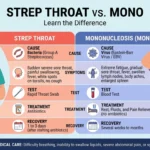
Imagine a student named Alex who wakes up with a sore throat. It hurts to swallow, and Alex feels tired. A friend says it may be strep, while another thinks it could be mono. Both illnesses can cause a sore throat, fever, and trouble with daily tasks. But they are not the same. Strep is a bacterial infection caused by group A Streptococcus bacteria. Mono, short for mononucleosis, is most often caused by the Epstein-Barr virus (EBV). Knowing the difference between strep and mono can help people understand their symptoms and seek the right care. The difference between strep and mono also matters because their causes, tests, and treatments are not the same. A doctor can help find the cause and guide the next steps.
Key Difference Between the Two
The main difference is the germ that causes each illness.
- Strep: A bacterial infection that often causes a sudden sore throat, fever, and pain when swallowing.
- Mono: A viral illness that can cause a sore throat, swollen glands, and strong, lasting tiredness.
Strep may need antibiotics. Mono is caused by a virus, so antibiotics do not treat the virus itself.
Why Is It Important to Know the Difference?
It is important for students, parents, teachers, and health workers to know how these illnesses differ. Both can spread from person to person, but they need different care.
Knowing the signs can help people seek medical advice sooner. It can also stop people from taking antibiotics when they do not need them. This matters because the wrong use of antibiotics can cause side effects and help bacteria become harder to treat.
People with mono may also need to avoid contact sports for a time. This is because mono can make the spleen swell, which raises the risk of a serious injury. A health care professional can advise when it is safe to return to sports.
Pronunciation of Strep and Mono
- Strep: US and UK English: /strep/
- Mono: US and UK English: /ˈmɒn.oʊ/ in common UK-style notation and /ˈmɑː.noʊ/ in common US-style notation.
A Simple Link to the Main Topic
Both illnesses can make a person feel unwell, but their causes and care are different. Let us look at ten key points to see how strep and mono compare.
Difference Between Strep and Mono
1. Cause
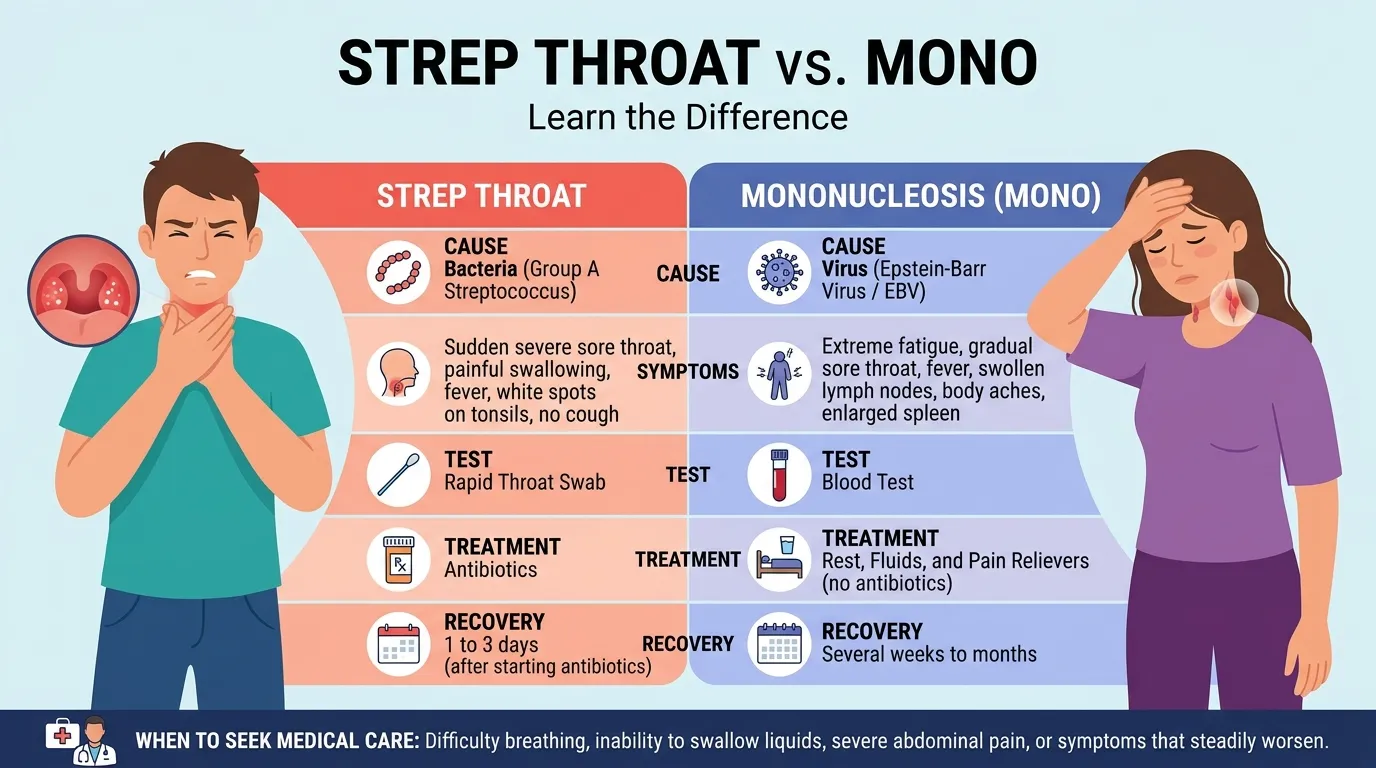
Strep: Strep throat is caused by group A Streptococcus bacteria.
Example 1: A child gets a strep throat infection from these bacteria.
Example 2: A student has a sore throat and tests positive for group A strep.
Mono: Mono is most often caused by the Epstein-Barr virus.
Example 1: A teen gets mono after being exposed to the virus.
Example 2: A young adult has lasting tiredness caused by mono.
2. Main Symptoms
Strep: Common signs include a sudden sore throat, fever, pain when swallowing, and red or swollen tonsils. Some people have white patches on their tonsils.
Example 1: A child develops a sore throat and fever in one day.
Example 2: A student has painful swallowing and swollen tonsils.
Mono: Common signs include a sore throat, fever, swollen lymph nodes, and strong tiredness. Some people also have a swollen spleen or liver.
Example 1: A teen feels very tired for many days and has swollen glands.
Example 2: A college student has a sore throat and needs much more rest than usual.
3. How Symptoms Begin
Strep: Symptoms often begin quickly. A person may feel well one day and have a sore throat the next.
Example 1: A child feels fine at school but wakes up with a fever.
Example 2: A parent notices that a child’s throat hurts a lot within a short time.
Mono: Symptoms may begin slowly. Tiredness can appear before the sore throat or fever.
Example 1: A student feels worn out for days before other signs appear.
Example 2: A young adult first notices low energy, then develops a sore throat.
4. How Long It Lasts
Strep: With the right treatment, many people start to feel better within a few days. A full course of prescribed antibiotics should be taken as directed.
Example 1: A child begins to feel better after starting prescribed treatment.
Example 2: A student returns to normal tasks after the fever and throat pain improve.
Mono: Many people improve over two to four weeks, but tiredness may last for weeks or even months.
Example 1: A teen’s sore throat gets better, but they still feel tired.
Example 2: A college student needs extra rest for several weeks.
5. How It Spreads
Strep: It can spread through close contact with an infected person and through droplets or contact with infected fluids.
Example 1: A child catches strep from someone who is ill.
Example 2: Several people in a home become sick after close contact with an infected family member.
Mono: EBV spreads mainly through saliva. It can spread through kissing or by sharing drinks, cups, or utensils.
Example 1: A teen gets exposed to EBV through saliva.
Example 2: A young adult may spread EBV by sharing a drink with another person.
6. How Doctors Test for It
Strep: A doctor may use a rapid strep test or a throat culture. In children, a negative rapid test may need a throat culture to confirm the result.
Example 1: A child has a throat swab for a rapid strep test.
Example 2: A doctor sends a throat sample to a lab for a culture.
Mono: A doctor may assess symptoms and use blood tests. These may include a blood count or tests for EBV antibodies. A rapid mono test is not always reliable, especially early in the illness.
Example 1: A teen has a blood test because of strong tiredness and swollen glands.
Example 2: A doctor orders EBV antibody tests when the first test does not give a clear answer.
7. Treatment
Strep: A doctor may prescribe antibiotics for confirmed strep throat. Rest, fluids, and suitable pain relief may also help.
Example 1: A child takes the antibiotic prescribed for strep.
Example 2: A student drinks water and rests while recovering.
Mono: There is no routine antibiotic that cures mono. Care often includes rest, fluids, and pain or fever relief that is safe for the person.
Example 1: A teen rests at home and drinks enough water.
Example 2: A student avoids hard exercise while recovering from mono.
8. Use of Antibiotics
Strep: Antibiotics can treat confirmed group A strep throat. They can reduce symptoms, limit spread, and lower the risk of some complications.
Example 1: A doctor prescribes an antibiotic after a positive strep test.
Example 2: A child takes the medicine as directed until the course is complete.
Mono: Antibiotics do not treat the virus that causes mono. Some people with mono develop a rash if they take certain antibiotics, such as amoxicillin or ampicillin.
Example 1: A person with mono does not take antibiotics unless a doctor finds a bacterial infection that needs them.
Example 2: A doctor checks the cause of a sore throat before choosing treatment.
9. Possible Complications
Strep: Untreated strep throat can sometimes lead to problems such as a throat abscess, rheumatic fever, or kidney inflammation.
Example 1: A child with worsening throat pain needs medical care to check for an abscess.
Example 2: A doctor treats confirmed strep to lower the risk of complications.
Mono: Mono can cause an enlarged spleen. In rare cases, the spleen can rupture. Some people also have liver problems or long-lasting fatigue.
Example 1: A teen with mono is told to avoid contact sports until cleared by a health professional.
Example 2: A person with mono seeks urgent care for sudden, severe pain in the upper left belly.
10. Return to School, Work, and Sports
Strep: People with strep throat should follow their clinician’s advice. Many can return to school or work when they have no fever and have taken suitable antibiotics for at least 12 to 24 hours, depending on local guidance.
Example 1: A child stays home until the fever is gone and the required time on antibiotics has passed.
Example 2: A worker checks their clinician’s advice before returning to work.
Mono: A person may return to school or work as they feel able, but sports and heavy lifting need special care because of the risk to the spleen.
Example 1: A student returns to class but skips football practice.
Example 2: An athlete waits for medical clearance before returning to contact sports.
Nature and Behaviour of Strep
Strep throat is a bacterial infection. It often causes a fast, painful illness. It can spread among people who have close contact, especially in schools and homes. A person may have a fever and sore throat without having a cough. Still, symptoms alone cannot prove that it is strep. A test can help confirm the cause.
When a test confirms strep throat, a health care professional may prescribe antibiotics. People should take medicine only as directed and should not use leftover antibiotics.
also read more about https://comparificationn.com/difference-between-since-and-sense-2/
Nature and Behaviour of Mono
Mono is a viral illness. It often affects teens and young adults, though people of any age can get it. It may cause deep tiredness, swollen lymph nodes, fever, and a sore throat. The tiredness can last longer than the other symptoms.
The virus can stay in the body after the person feels better. It may spread through saliva even when symptoms are not clear. Rest and fluids can help, but people should follow medical advice about activity, especially sports.
Why Are People Confused About Strep and Mono?
People often mix up strep and mono because both can cause a sore throat, fever, swollen tonsils, and swollen glands. Both may also make it hard to eat, drink, or go to school.
The key clues are not always enough to tell them apart. Strep often starts quickly, while mono may cause strong tiredness that lasts for weeks. But these patterns can overlap. A sore throat alone cannot show which illness a person has.
Testing is important. A throat swab can check for strep, while blood tests may help identify mono. A doctor can decide which tests are needed.
Table Showing the Differences and Similarities
| Feature | Strep | Mono |
| Main cause | Bacteria | Usually Epstein-Barr virus |
| Common name | Strep throat | Mononucleosis |
| Sore throat | Common | Common |
| Fever | Common | Common |
| Strong tiredness | Can happen | Often a key symptom |
| Main tests | Rapid strep test or throat culture | Blood tests and clinical assessment |
| Antibiotics | May treat confirmed strep | Do not treat the virus |
| How it spreads | Close contact and respiratory droplets | Mainly saliva |
| Usual recovery | Often improves within days with treatment | Often takes weeks; fatigue may last longer |
| Sports concerns | Usually based on how the person feels and clinician advice | Avoid contact sports until medically cleared |
| Similarity | Both can cause fever and a sore throat | Both can cause fever and a sore throat |
Which Is Better in What Situation?
Strep and mono are illnesses, so one is not “better” than the other. The right approach depends on the cause. If a person has a sudden sore throat and fever, a strep test may help the doctor decide whether antibiotics are needed. If the person has strong tiredness, swollen glands, and symptoms that last, the doctor may also check for mono. Do not choose treatment based on symptoms alone. A clinician can decide which tests are right. Seek urgent care for trouble breathing or swallowing, or sudden severe belly pain.
How Are Strep and Mono Used in Metaphors and Similes?
Strep and mono are medical terms, so they are not often used in common metaphors or similes. Still, writers may use them in comparisons to show how an illness feels.
Strep in a simile: “The sore throat felt like sandpaper scraping my throat.”
This shows how painful swallowing can feel.
Mono in a simile: “The tiredness felt like carrying a heavy bag all day.”
This shows how draining mono can be.
Strep as a metaphor: “Strep was an unwelcome visitor that stopped the week in its tracks.”
This presents the illness as a visitor that disrupts daily life.
Mono as a metaphor: “Mono was a fog that made each day feel slow.”
This shows how tiredness can affect daily tasks.
These are creative examples, not medical descriptions.
Connotative Meaning of Strep and Mono
The words strep and mono are mostly neutral medical terms. They name illnesses, not a person’s character.
Strep
- Neutral meaning: The name of a bacterial infection.
- Negative feeling: It may bring to mind pain, fever, and missed school or work.
- Example: “The strep infection kept Sam home for two days.”
Mono
- Neutral meaning: The name of a viral illness.
- Negative feeling: It may bring to mind deep tiredness and a long recovery.
- Example: “Mono made it hard for Lee to keep up with school.”
Neither word has a positive meaning on its own. Both can be used in a calm, factual way when talking about health.
Idioms and Proverbs Related to Strep and Mono
There are no common idioms or proverbs that specifically use the words “strep” or “mono.” However, some health-related sayings can help explain the experience of being ill.
- “An ounce of prevention is worth a pound of cure.” This means that taking steps to prevent illness can be better than treating it later. For example, washing hands and avoiding shared drinks may lower the spread of some germs.
- “Rest and recovery go hand in hand.” This is a common expression, not a traditional proverb. For example, a person with mono may need plenty of rest while recovering.
- “Better safe than sorry.” This means it is wise to check a problem instead of taking a risk. For example, a person with a severe sore throat should seek medical advice rather than guess whether it is strep or mono.
These sayings do not replace medical advice or testing.
Works in Literature Related to Strep and Mono
Strep and mono are medical conditions, not common themes in famous literary titles. The following works discuss health, illness, or the human experience of disease. They are related by theme, not necessarily focused on strep or mono.
- The Plague — Novel, Albert Camus, 1947. It explores a town facing a deadly outbreak.
- The Last Days of Ptolemy Grey — Novel, Walter Mosley, 2010. It explores illness, memory, and care in later life.
- The Fault in Our Stars — Young adult novel, John Green, 2012. It explores young people living with serious illness.
Movies Related to Strep and Mono
There are no widely known major films focused only on strep throat or mono. These films explore illness, health, or life during disease. They are related by theme rather than being stories about these two infections.
- The Fault in Our Stars — 2014, United States. A romantic drama about two teens who live with cancer.
- Contagion — 2011, United States. A thriller about the spread of a new infectious disease.
- Philadelphia — 1993, United States. A drama about a man facing illness and unfair treatment.
Five Possible Asked Questions
1. Can strep and mono cause the same symptoms?
Yes. Both can cause a sore throat, fever, and swollen glands. Strong or lasting tiredness may point toward mono, but testing may be needed to tell them apart.
2. Can you have strep and mono at the same time?
Yes, it is possible to have both infections at once, though it is not the usual case. A health care professional can test for them when needed.
3. Do antibiotics cure both strep and mono?
No. Antibiotics can treat confirmed strep throat. They do not treat the virus that usually causes mono. Some antibiotics may cause a rash in people with mono.
4. How can I know if I have strep or mono?
You cannot know for sure from symptoms alone. A doctor may use a throat swab to check for strep and blood tests to check for mono.
5. When should I seek medical help?
Seek medical advice for a severe or lasting sore throat, high fever, or trouble drinking enough fluids. Get urgent care for trouble breathing or swallowing, sudden severe belly pain, fainting, or signs of dehydration.
How Are Strep and Mono Important for Our Surroundings?
Knowing about strep and mono helps families, schools, and workplaces respond to illness in a safer way. People can stay home when they are sick, avoid sharing drinks, and follow advice on when to return to school or work. These steps may help reduce the spread of germs.
This knowledge also helps people avoid taking the wrong medicine. Antibiotics work against certain bacteria, not viruses. When people understand this, they can use medicine more safely and help slow antibiotic resistance. Schools and sports teams should also understand that mono may need a longer recovery and special limits on physical activity.
Final Words on Strep and Mono
Strep and mono can look alike, but they have different causes. Strep throat is caused by bacteria and may need antibiotics. Mono is usually caused by a virus and often leads to strong tiredness that can last for weeks. Tests help doctors tell the two illnesses apart. Do not self-diagnose or take leftover medicine. Follow the advice of a health care professional, and seek urgent help for severe warning signs.
Conclusion
The difference between strep and mono matters because each illness needs a different plan of care. Strep throat is a bacterial infection that often starts quickly and may improve with the right antibiotics. Mono is usually a viral illness that can cause a sore throat, swollen glands, and long-lasting tiredness. Both can affect school, work, and daily life, but they do not have the same cause or treatment. Since their symptoms can overlap, a person should not rely on symptoms alone to make a diagnosis. A health care professional can choose the right tests and give safe advice. Learning the difference helps people care for themselves and protect others.