Imagine two people at work. The first person lies to others and seems to feel little guilt after causing harm. The second person always wants praise and gets angry when someone else gets more attention. Both may hurt people, but their behavior may have different causes. The first set of traits may be linked to psychopathy. The second may be linked to narcissism.
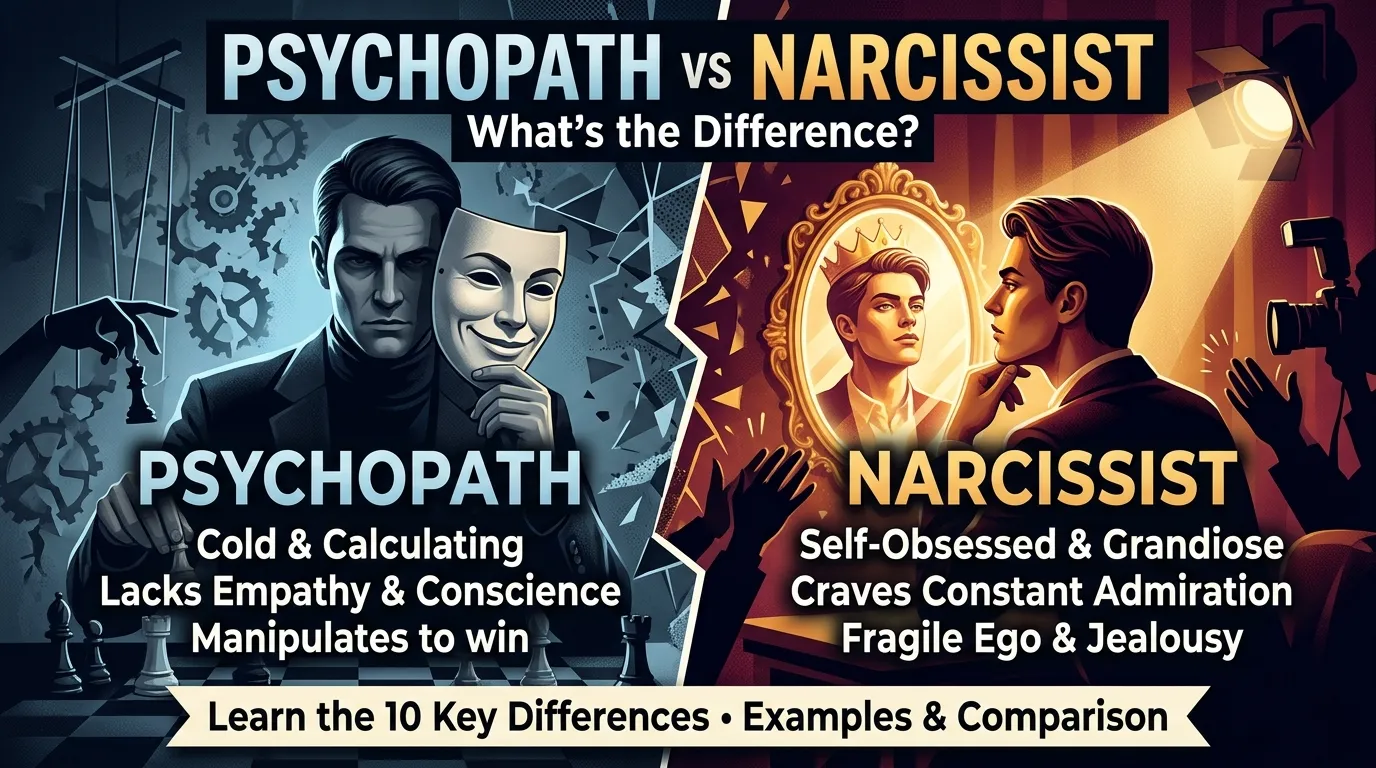
The difference between psychopath and narcissist is important in psychology. A psychopath is often described as a person with traits such as low empathy, little remorse, and manipulative behavior. A narcissist is often described as a person who has a high view of themselves and needs praise. The difference between psychopath and narcissist is not always clear because some traits can overlap. Learning the difference between psychopath and narcissist helps us talk about behavior with care and avoid unfair labels.
Key Difference Between the Two
The main difference is often the person’s core pattern of behavior.
- Psychopath: This term often describes traits linked to low empathy, little guilt, and a lack of remorse. Psychopathy is not a formal diagnosis in the main diagnostic manuals.
- Narcissist: This word often describes a person who is very focused on themselves, seeks praise, and feels they deserve special treatment. Narcissistic personality disorder (NPD) is a recognized mental health diagnosis.
A person may show some narcissistic traits without having NPD. In the same way, a person cannot be called a psychopath just because they lie or act without care. A trained mental health professional must assess lasting patterns of behavior. (Sources: Cleveland Clinic, American Psychiatric Association)
Why Is It Important for Learners and Experts to Know the Difference?
This topic matters in schools, workplaces, homes, and health care. Students can learn how people think and act. Teachers can explain the topic without using harmful labels. Mental health workers can use the right terms when they assess a person’s needs.
This knowledge can also help people set safe limits in difficult relationships. It can help us see the difference between harmful actions and a mental health condition. We should not judge a person by one mistake or a few signs. We should look at patterns, facts, and the effect of a person’s actions.
Pronunciation of Psychopath and Narcissist
| Word | US pronunciation | UK pronunciation |
| Psychopath | SY-koh-path | SY-koh-path |
| Narcissist | NAR-suh-sist | NAR-suh-sist |
A Linking Hook
Both terms can describe traits that affect how a person treats others. Yet the main traits are not the same. Let us look at ten key points to see how they differ.
Difference Between Psychopath and Narcissist
1. Main Traits
Psychopath: Psychopathy is often linked to low empathy, little remorse, and the use of others for personal gain.
Examples:
- A person lies to gain money and shows little guilt about the harm caused.
- A person breaks a promise and seems unconcerned when others suffer.
Narcissist: Narcissism is often linked to self-importance, a need for praise, and a wish to feel special.
Examples:
- A worker talks about their own success but ignores the work of the team.
- A person gets upset when a friend receives more praise.
2. Need for Attention
Psychopath: A person with psychopathic traits may seek attention, but praise is not always the main goal. The person may focus more on control, gain, or excitement.
Examples:
- A person acts in a charming way to win someone’s trust.
- A person stays out of the spotlight but uses others to reach a goal.
Narcissist: A person with strong narcissistic traits may want praise and attention. They may feel hurt or angry when they do not receive it.
Examples:
- A person keeps asking others to praise their work.
- A person feels upset when a party guest gets more attention.
3. Empathy
Psychopath: Psychopathy is often linked to low emotional empathy. This means a person may have trouble sharing or caring about another person’s feelings. The level can vary.
Examples:
- A person sees someone crying but shows little concern.
- A person harms a friend and does not seem to feel guilt.
Narcissist: A person with strong narcissistic traits may find it hard to notice or value other people’s needs, especially when those needs clash with their own. This does not mean every person with narcissistic traits has no empathy.
Examples:
- A person turns every talk back to their own problems.
- A person ignores a friend’s needs while seeking praise.
4. Response to Criticism
Psychopath: A person with psychopathic traits may respond to criticism with calm words, anger, or a plan to protect their own goals. There is no single response for everyone.
Examples:
- A person hears a complaint and changes the subject to avoid blame.
- A person uses lies to hide a mistake that could cost them money.
Narcissist: A person with strong narcissistic traits may feel shame, anger, or hurt when others question their value or success.
Examples:
- A person gets angry when a manager points out an error.
- A person stops speaking to a friend after receiving honest feedback.
5. Guilt and Remorse
Psychopath: Low guilt and little remorse are common features in descriptions of psychopathy. Still, a professional must look at the full pattern.
Examples:
- A person cheats a business partner and shows little regret.
- A person hurts someone’s feelings and makes no effort to repair the harm.
Narcissist: A person with narcissistic traits may feel shame or distress when their image is harmed. They may also blame others instead of accepting fault.
Examples:
- A person blames a teammate after making a mistake.
- A person says an apology is not needed because they believe they did nothing wrong.
6. Relationships
Psychopath: A person with psychopathic traits may use charm, lies, or control to get what they want. Some may have trouble forming deep emotional bonds.
Examples:
- A person starts a friendship mainly to gain money or power.
- A person makes promises but breaks them whenever a better chance appears.
Narcissist: A person with strong narcissistic traits may seek relationships that support their self-image or give them praise. They may struggle when they must share attention or accept another person’s needs.
Examples:
- A person wants a partner who makes them look successful.
- A person feels jealous when their partner receives praise.
7. Manipulation
Psychopath: Manipulation may be used to gain money, control, excitement, or another reward. The person may use lies with little guilt.
Examples:
- A person tells a false story to take money from a friend.
- A person gains trust by acting kind, then uses that trust for personal gain.
Narcissist: Manipulation may be used to protect a person’s image, gain praise, or keep control in a relationship.
Examples:
- A person makes a friend feel guilty for not giving enough praise.
- A person exaggerates their role in a group success.
These examples describe possible patterns. They do not prove that someone has either condition.
8. View of Self
Psychopath: A person with psychopathic traits may feel confident and may not worry much about others’ views. Their self-image can vary.
Examples:
- A person takes a risk without much concern about the harm it may cause.
- A person ignores a warning because they believe they can avoid the result.
Narcissist: A person with strong narcissistic traits may see themselves as special, better than others, or worthy of extra praise. Some may also hide deep feelings of shame or doubt.
Examples:
- A person believes they should always lead the group.
- A person feels small inside when others do not admire them.
9. Rules and Responsibility
Psychopath: Psychopathy may be linked to breaking rules, acting without care, or ignoring other people’s rights. Not every person with psychopathic traits breaks the law.
Examples:
- A person lies on a work report to gain a reward.
- A person takes a risk that may harm others and ignores clear warnings.
Narcissist: A person with strong narcissistic traits may believe that normal rules should not apply to them. They may expect special treatment.
Examples:
- A person cuts in line because they think their time matters more.
- A manager expects praise for work done by the whole team.
10. Help and Treatment
Psychopath: Psychopathy is not a formal diagnosis in the main diagnostic manuals. A mental health professional may assess related traits and other conditions, such as antisocial personality disorder. Support is based on the person’s needs and risks.
Examples:
- A clinician may assess a pattern of lying, low remorse, and harmful actions.
- A care plan may focus on safer choices, responsibility, and reducing harm.
Narcissist: Narcissistic traits do not always mean a person has NPD. When NPD is present, a mental health professional may suggest therapy to help with relationships, emotions, and behavior.
Examples:
- A person may seek therapy to handle criticism in a healthier way.
- A person may learn to listen to others and build more balanced relationships.
There is no simple test that lets a friend or family member diagnose either condition. Assessment needs training and care.
Nature and Behaviour of a Psychopath
Psychopathy is a term used to describe a group of personality traits. These may include low empathy, little remorse, shallow emotional responses, and manipulative behavior. Some people with these traits may act without thinking about the risks. Others may plan their actions with care.
Psychopathy is not the same as being violent. Not everyone described as a psychopath commits a crime. The term is also not the same as psychosis, which can affect a person’s sense of reality.
The word is often used in films and news stories, but real people are more complex than these stories suggest. Only a trained professional can assess behavior in a proper setting.
Nature and Behaviour of a Narcissist
A narcissist, in everyday speech, is a person who seems very focused on themselves. They may seek praise, expect special treatment, or believe they are more important than others.
Narcissistic traits exist on a range. Many people may act proud or selfish at times. This does not mean they have narcissistic personality disorder.
NPD is a long-term pattern that can affect work, family life, and close relationships. It may involve a strong need for admiration, a sense of special status, and trouble seeing other people’s needs. Some people with NPD may also feel shame or deep hurt when they face failure or criticism.
Why Are Psychopath and Narcissist Often Confused?
People often mix up these terms because both can be linked to selfish or harmful behavior. Some people with either set of traits may lie, use others, or show little care for another person’s feelings.
Here are the main reasons for the confusion:
- Overlapping traits: Both may show low empathy or use others for personal gain.
- Media stories: Films often show these people as evil or dangerous, which can lead to false ideas.
- Everyday language: People may call someone a “psychopath” or “narcissist” after a single bad act.
- Different meanings: A casual label is not the same as a mental health diagnosis.
- Hidden feelings: A person’s outward behavior does not always show what they feel inside.
It is best to describe the behavior you see rather than guess at a diagnosis.
Table Showing the Differences and Similarities
| Feature | Psychopath | Narcissist |
| Main focus | Often low empathy and little remorse | Often self-importance and need for praise |
| Attention | May seek attention for a goal | Often wants admiration and recognition |
| Empathy | Often described as low | May be limited, especially when self-interest is involved |
| Guilt | Often low in descriptions of psychopathy | May blame others or feel shame when image is harmed |
| Relationships | May use others for gain or control | May seek praise, status, or support for self-image |
| Criticism | Response can vary | May feel strong shame or anger |
| Rule-breaking | May disregard others’ rights | May expect special treatment |
| Formal diagnosis | Psychopathy is not a separate formal diagnosis in the main manuals | NPD is a recognized diagnosis |
| Violence | Not all people with psychopathic traits are violent | Narcissism does not mean a person is violent |
| Similarity | Traits can affect trust and relationships | Traits can affect trust and relationships |
Which Is Better in What Situation?
Neither a psychopath nor a narcissist is “better.” These are not choices or roles that people should compare like products. The useful question is which behavior is happening and how it affects others.
The term psychopathy may be useful in research or a professional assessment when looking at traits such as low remorse, callousness, or manipulation. It should not be used as a quick label for someone who has acted badly.
The term narcissism may be useful when talking about a strong need for praise, a sense of special status, or self-focused behavior. But a person should not be diagnosed with NPD by a friend, coworker, or online list. In daily life, focus on clear actions, safe limits, and help from a qualified professional when needed.
also read more abouthttps://comparificationn.com/difference-between-an-obstetrician-and-a-gynecologist/
How Are Psychopath and Narcissist Used in Metaphors and Similes?
These words are often used in everyday speech as strong labels. Writers may also use them in figures of speech. Such uses can be unfair if they turn a mental health term into an insult.
Psychopath in a Metaphor
Example: “The villain was a psychopath with a heart of stone.”
This is a fictional way to show a character who seems cold and uncaring. It is not a clinical assessment.
Psychopath in a Simile
Example: “He planned the trick like a cold and careful villain.”
This simile describes the behavior without claiming that a real person has a mental health condition.
Narcissist in a Metaphor
Example: “He was the sun in his own world.”
This metaphor means he wanted all the attention and thought everything should revolve around him.
Narcissist in a Simile
Example: “She acted as if the room were a stage built just for her.”
This simile shows a strong need to be seen and admired.
Writers can use these figures of speech to describe behavior. They should avoid using them as proof of a real person’s diagnosis.
Connotative Meaning of Psychopath and Narcissist
A word’s connotation is the feeling or idea it brings to mind.
Psychopath
Connotation: Strongly negative
In everyday speech, “psychopath” often brings to mind cruelty, danger, or a lack of care. This view can be too simple. Psychopathy is a research term for a set of traits, not a synonym for a killer.
Examples:
- “The movie calls its villain a psychopath.” This gives the character a dark image.
- “He called his rival a psychopath after one argument.” This is a strong label, not a fair assessment.
Narcissist
Connotation: Usually negative
“Narcissist” often suggests pride, selfishness, or a need for praise. The word may be used casually, but NPD is a specific mental health diagnosis.
Examples:
- “He is a narcissist who wants every award.” This suggests a strong need for praise.
- “She called her boss a narcissist because he talked about himself.” This may be a casual label, not a diagnosis.
Both words can carry a strong negative feeling. It is better to name the action, such as lying, boasting, or ignoring a person’s needs, than to use a label without enough facts.
Idioms and Proverbs Related to Psychopath and Narcissist
There are no common English idioms that use the exact words “psychopath” or “narcissist.” However, some sayings can help explain traits linked to self-focus, pride, and harmful actions.
1. “Actions Speak Louder Than Words”
This means that what a person does matters more than what they say.
Example: A person may promise to care about others, but their actions show whether they keep that promise. We should judge behavior over time, not use a label after one event.
2. “Pride Comes Before a Fall”
This saying warns that too much pride can lead to trouble.
Example: A person who believes they are always right may refuse advice and make a poor choice. This can describe arrogant behavior, but it does not prove that the person is a narcissist.
3. “All That Glitters Is Not Gold”
This means that something that looks good may not be good inside.
Example: A person may seem charming at first but later act in a selfish way. The saying reminds us to look at actions over time. It does not mean that charm is a sign of psychopathy.
4. “Look Before You Leap”
This means that people should think before they act.
Example: Before calling someone a psychopath or narcissist, look at the facts and think about the harm a false label may cause.
These sayings can support a lesson about behavior, but they are not medical terms.
Works in Literature Related to Psychopathy and Narcissism
The works below explore characters who may show traits linked to manipulation, self-focus, or a strong need for control. They are fictional portrayals, not tools for diagnosing real people.
- The Talented Mr. Ripley — Psychological crime novel, by Patricia Highsmith, 1955. Tom Ripley uses lies and charm to get what he wants. Readers may study his behavior through the lens of manipulation.
- American Psycho — Satirical horror novel, by Bret Easton Ellis, 1991. The story follows a character whose actions show extreme cruelty and a focus on status. It is not a guide to diagnosing psychopathy.
- The Picture of Dorian Gray — Gothic novel, by Oscar Wilde, 1890. The story explores vanity, beauty, selfishness, and the cost of harmful choices.
- Macbeth — Tragedy, by William Shakespeare, first performed around 1606. It explores ambition, power, guilt, and violence.
- Gone Girl — Psychological thriller, by Gillian Flynn, 2012. The story explores lies, image, control, and harmful behavior in a marriage.
These works help readers explore human behavior. A character may show some traits linked to a term without fitting a real clinical profile.
Movies Related to Psychopathy and Narcissism
The films below explore characters who show manipulation, pride, control, or a lack of care for others. These are fictional portrayals and should not be treated as clinical case studies.
- Psycho — Psychological horror, 1960, United States. The film explores a disturbing fictional character and a series of crimes.
- American Psycho — Psychological horror and satire, 2000, United States. The main character is focused on status and commits terrible acts. The film uses dark satire.
- The Talented Mr. Ripley — Psychological thriller, 1999, United States. The story follows a man who uses lies and deception to enter another person’s life.
- Gone Girl — Psychological thriller, 2014, United States. The film explores deception, control, and the public image of a marriage.
- The Wolf of Wall Street — Crime comedy-drama, 2013, United States. The story explores greed, excess, and the harm caused by dishonest choices.
A film character cannot show the full range of real human behavior. Real people are more complex than the roles shown on screen.
Five Possible Asked Questions About the Difference Between Psychopath and Narcissist
1. Can a person be both a psychopath and a narcissist?
A person can show traits linked to both psychopathy and narcissism. Some traits overlap, such as low empathy or using others for personal gain. Only a qualified professional can assess a person’s behavior and needs.
2. Is a psychopath more dangerous than a narcissist?
There is no simple rule. Risk depends on many factors, including a person’s actions, history, and situation. Neither term alone proves that someone is violent or dangerous.
3. Is narcissism a mental illness?
Narcissistic traits are not always a mental health disorder. Narcissistic personality disorder is a recognized diagnosis. It involves a lasting pattern that can cause problems in relationships and daily life.
4. Is psychopathy an official mental health diagnosis?
Psychopathy is not a separate diagnosis in the main diagnostic manuals. Experts may study psychopathic traits and assess related conditions, including antisocial personality disorder. The terms are related, but they do not mean the same thing.
5. How can I deal with someone who acts in a harmful way?
Focus on what the person does, not on a label. Set clear limits, keep a record of serious work or money issues when useful, and seek help from trusted people. If you feel unsafe, move to a safe place and contact local support or emergency services.
How Are Psychopath and Narcissist Important in Our Surroundings?
Learning about these terms can help people talk about behavior with more care. At home, this knowledge may help people spot harmful patterns and set healthy limits. At work, it can help teams focus on clear actions, such as lying, bullying, or taking credit for another person’s work.
In schools and health care, correct language can reduce stigma. It can also help people seek support when they face hard relationships or troubling behavior. The goal is not to label people as good or bad. The goal is to understand behavior, protect well-being, and respond in a fair way.
We should remember that a mental health term does not tell us everything about a person. Each person has a life story, and a proper assessment takes time.
Final Words on Psychopath and Narcissist
Psychopathy and narcissism are not the same. Psychopathy is often linked to low empathy and little remorse. Narcissism is often linked to self-importance and a strong need for praise. Some traits can overlap, so the difference may not always be clear.
It is also important to know that psychopathy is not a separate formal diagnosis in the main diagnostic manuals, while narcissistic personality disorder is a recognized diagnosis. We should not label people based on one action, a short video, or a story in a film.
The best approach is to notice patterns, name harmful actions, and seek professional help when needed. Clear words can help us understand others without adding unfair shame or fear.
Conclusion
The difference between psychopath and narcissist lies mainly in the traits that stand out. Psychopathy is often linked to low empathy, little remorse, and the use of others for personal gain. Narcissism is often linked to self-importance, a need for praise, and a wish for special treatment. These traits can overlap, but they do not mean the same thing. Psychopathy is not a separate formal diagnosis in the main diagnostic manuals, while narcissistic personality disorder is a recognized mental health condition. Neither label proves that a person is violent or dangerous. We should not diagnose people based on a few actions or online lists. Instead, we should focus on lasting behavior, healthy limits, and professional advice when needed. This helps us speak with care and treat people fairly.

I’m Zahid Abbas, an educator, researcher, and digital publishing strategist with a passion for linguistics, grammar, and clear communication. As a content creator and SEO specialist, I craft research-driven, reader-focused content that empowers learners and makes knowledge accessible worldwide.