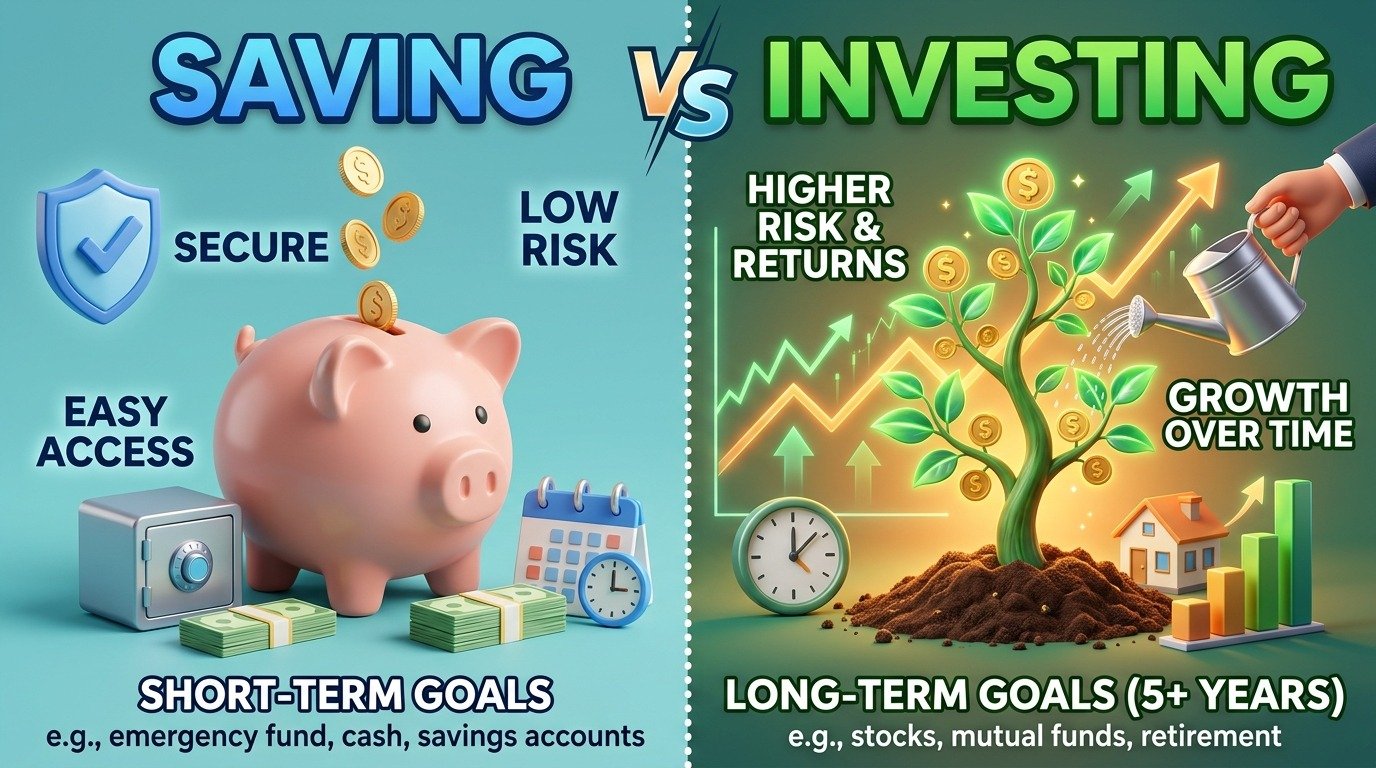
Imagine Ali gets his first full-time job. Every month, he puts some money into a bank account for emergencies. This is saving. Later, he uses another part of his money to buy shares for long-term growth. This is investing. Both actions help him manage his money, but they have different goals. The difference between investing and saving is mainly about how money is used and what the person wants to achieve. Understanding the difference between investing and saving can help people make better money choices. The difference between investing and saving is also important for students, workers, families, and business owners. In simple terms, saving usually focuses on keeping money safe and easy to access, while investing focuses on growing money over time. Knowing the difference between investing and saving helps you choose the right path for each financial goal.
Key Difference Between the Both
The main difference is the goal and level of risk. Saving means putting money aside for safety and near-term needs. Investing means putting money into assets with the goal of earning a return over time, while accepting some risk of loss.
Why Is Their Difference Necessary to Know for the Learners and Experts?
Knowing the difference helps people manage money wisely. A student may need savings for books or an emergency. A worker may invest for long-term goals such as retirement. Financial experts also need this distinction when building financial plans. Understanding both can help society make better financial decisions, reduce money stress, and prepare for future needs.
Pronunciation of Both
- Investing: US: in-VEST-ing | UK: in-VEST-ing
- Saving: US: SAY-ving | UK: SAY-ving
Both ideas are important, but they work in different ways. Let us now look at their key differences.
Difference Between the Keywords
1. Basic Meaning
Saving:
Saving means keeping part of your income for future use. The money is usually kept in a bank account or another relatively safe place.
Examples:
- Sara saves money every month for an emergency.
- Ahmed saves money for a new laptop.
Investing:
Investing means putting money into assets with the hope of earning a return.
Examples:
- Sara invests some money in a diversified fund.
- Ahmed invests for a long-term financial goal.
2. Main Purpose
Saving:
The main purpose of saving is usually safety and access to money.
Examples:
- A family saves for unexpected car repairs.
- A student saves for next semester’s fees.
Investing:
The main purpose of investing is usually long-term growth or income.
Examples:
- A person invests for retirement.
- An investor buys shares with a long-term goal.
3. Risk Level
Saving:
Saving usually involves less risk of losing the original amount, especially when money is held in an insured bank deposit, subject to the account and local rules.
Examples:
- Money in a protected savings account is generally more stable than shares.
- A person may keep emergency money in a bank account.
Investing:
Investing involves the risk that the value of an investment can fall.
Examples:
- A stock can lose value after a market fall.
- A fund can rise or fall with market conditions.
4. Expected Return
Saving:
Savings may earn interest, but the return is usually modest.
Examples:
- A bank may pay interest on a savings account.
- A person may earn interest while keeping emergency money in the bank.
Investing:
Investing aims for a higher potential return, but that comes with higher risk.
Examples:
- Shares may increase in value over many years.
- Bonds may provide interest income.
5. Time Period
Saving:
Saving is often useful for short-term or medium-term goals.
Examples:
- A person saves for a holiday next year.
- A family saves for a home repair.
Investing:
Investing is often better suited to long-term goals.
Examples:
- A worker may invest for retirement.
- Parents may invest for a child’s future education.
6. Access to Money
Saving:
Savings are usually easy to access, depending on the account.
Examples:
- A person may withdraw money from a savings account when needed.
- Emergency savings can help pay an unexpected bill.
Investing:
Access depends on the investment. Selling an investment may take time and its value may have changed.
Examples:
- Shares usually need to be sold before the money can be used.
- Some investments may have withdrawal rules or fees.
7. Effect of Inflation
Saving:
If savings earn less than the inflation rate, the money may lose purchasing power over time.
Examples:
- A fixed amount of cash may buy less after several years of inflation.
- Savings with a low interest rate may not keep pace with rising prices.
Investing:
Some investments have the potential to grow faster than inflation over long periods, but this is not guaranteed.
Examples:
- A diversified stock portfolio may grow over a long period.
- Some real assets may increase in value as prices rise.
8. Emotional Comfort
Saving:
Saving can provide a feeling of safety because the money is usually stable and available.
Examples:
- An emergency fund can reduce worry about unexpected bills.
- Savings can help a person feel ready for a short-term expense.
Investing:
Investing can involve more emotional pressure because prices can move up and down.
Examples:
- An investor may feel worried during a market decline.
- A long-term investor may stay calm during short-term price changes.
9. Common Financial Tools
Saving:
Common saving tools include savings accounts, certificates or term deposits, and cash reserves.
Examples:
- A person may keep an emergency fund in a savings account.
- Someone may use a term deposit for money they do not need immediately.
Investing:
Common investment tools include stocks, bonds, mutual funds, exchange-traded funds, and other assets.
Examples:
- An investor may buy shares.
- An investor may choose a diversified fund.
10. Best Financial Role
Saving:
Saving is important for financial stability and short-term needs.
Examples:
- An emergency fund can cover an unexpected medical or repair bill.
- Savings can help pay for a planned purchase.
Investing:
Investing can help build wealth over a longer period.
Examples:
- A person may invest for retirement.
- An investor may build a long-term portfolio.
Nature and Behaviour of Saving
Saving has a protective nature. It focuses on keeping money available for future needs. It is often less affected by daily market movements than investments.
Saving is especially useful when a person needs money soon. Emergency funds are a good example. Saving can also help people avoid taking expensive debt when an unexpected expense appears.
However, keeping all money in cash or low-return savings for many years can create another problem. Inflation may reduce what that money can buy.
Nature and Behaviour of Investing
Investing has a growth-focused nature. It involves putting money into assets that may increase in value or produce income.
Investment values can rise and fall. This means investing requires patience and an understanding of risk. Long-term investing can give money more time to grow, but returns are never guaranteed.
Diversification can help spread risk, but it cannot remove all investment risk.
also read more about https://comparificationn.com/revenue-and-sales-2/
Why Are People Confused About Their Use?
People often confuse saving and investing because both involve putting money aside for the future. Both can also be part of a good financial plan.
The main difference is what happens to the money. Saving usually focuses on safety and access. Investing focuses more on potential growth and accepts more risk.
For example, keeping three months of living expenses in a savings account is saving. Buying a diversified investment fund for a long-term goal is investing.
The two should not always compete. A person may need both saving and investing to build a strong financial plan.
Investing vs. Saving: Difference and Similarity
| Feature | Saving | Investing |
| Main goal | Safety and access | Growth or income |
| Typical risk | Lower | Higher |
| Potential return | Usually lower | Potentially higher |
| Time frame | Short or medium term | Usually long term |
| Market changes | Usually less affected | Often affected |
| Access | Often easy | Depends on the asset |
| Common tools | Savings accounts, deposits | Stocks, bonds, funds |
| Emergency fund | Suitable | Usually not ideal |
| Retirement growth | May be part of the plan | Often important |
| Inflation risk | Can reduce purchasing power | Some assets may outpace inflation |
| Can money be lost? | Depends on the product and protections | Yes, market value can fall |
| Useful for future goals? | Yes | Yes |
Which Is Better in What Situation?
When Is Saving Better?
Saving is usually better when you need money soon or want an emergency fund. It can help protect money from market swings and keep funds available for unexpected costs. For example, if you plan to buy a laptop in six months, saving may make more sense than investing that money in a risky asset. Saving is also useful for short-term goals and money that you cannot afford to lose. The exact savings product matters because interest rates, access, fees, and deposit protection vary by country and account.
When Is Investing Better?
Investing is usually better for long-term goals when you can accept some risk. It can give your money a chance to grow over many years. Retirement is a common example. A person may also invest for a long-term education or wealth-building goal. However, investing does not guarantee profit. Prices can fall, sometimes sharply. A good investment plan should match your goals, time period, and risk tolerance. It is also important to spread risk rather than putting all your money into one asset.
How Are the Keywords Used in Metaphors and Similes?
Saving
Metaphor:
- “Saving is a financial safety net.”
Simile:
- “Saving is like building a small wall against unexpected costs.”
Investing
Metaphor:
- “Investing is a seed for future wealth.”
Simile:
- “Investing is like planting a tree that may grow over many years.”
These are simple comparisons. They explain the ideas but do not guarantee that investments will grow.
Connotative Meaning of Saving and Investing
Saving
- Positive: Safety, discipline, preparation, and control.
- Negative: It can sometimes suggest fear of spending or excessive caution.
- Neutral: It simply means keeping money for future use.
Example:
“Her saving habit helped her prepare for an emergency.”
Investing
- Positive: Growth, opportunity, planning, and ambition.
- Negative: It can suggest risk or uncertainty.
- Neutral: It means putting money into an asset with the aim of earning a return.
Example:
“His investing plan focused on a long-term goal.”
Idioms and Proverbs Related to the Words
There are no major English idioms that directly mean “saving” or “investing.” However, several common expressions are closely related to money management.
“Save for a rainy day”
Example:
“Maria saves for a rainy day by keeping an emergency fund.”
“Don’t put all your eggs in one basket”
Example:
“An investor should not put all their eggs in one basket, so diversification can be useful.”
“A penny saved is a penny earned”
Example:
“Ali avoids waste because he believes that a penny saved is a penny earned.”
“Make your money work for you”
Example:
“Long-term investing can be one way to try to make your money work for you.”
Works in Literature Related to Saving and Investing
Saving and investing are often discussed in books about money, business, and personal finance rather than in classic fiction.
- The Richest Man in Babylon — Personal finance, George S. Clason, 1926. It uses stories to teach saving and money habits.
- The Intelligent Investor — Investing and finance, Benjamin Graham, 1949. It explains principles of long-term investing.
- A Random Walk Down Wall Street — Finance and investing, Burton G. Malkiel, 1973. It discusses investment markets and strategies.
- Your Money or Your Life — Personal finance, Vicki Robin and Joe Dominguez, 1992. It explores saving, spending, and financial independence.
Movies Related to Saving and Investing
There are few major films specifically about the words “saving” and “investing.” However, these movies explore money, markets, wealth, and financial choices.
- Wall Street — 1987, United States. A drama about stock trading and financial ambition.
- The Pursuit of Happyness — 2006, United States. A drama about work, money, and financial struggle.
- The Big Short — 2015, United States. A film about the 2008 financial crisis and people who bet against the housing market.
- Moneyball — 2011, United States. It explores the use of money, data, and smart resource decisions in sports.
- Dumb Money — 2023, United States. It focuses on individual investors and the GameStop market event.
Frequently Asked Questions
1. What is the main difference between investing and saving?
Saving focuses mainly on keeping money safe and available. Investing focuses on growing money or earning income over time while accepting more risk.
2. Is saving safer than investing?
Usually, yes, but it depends on the financial product. Savings accounts and deposits can have protections in some countries, while investments can lose market value.
3. Should I save or invest first?
Many people build an emergency fund before taking significant investment risk. The right order depends on income, debt, goals, and personal circumstances.
4. Can I save and invest at the same time?
Yes. Many people save for short-term needs while investing money meant for longer-term goals.
5. Can investing make you rich?
Investing can help build wealth over time, but it does not guarantee wealth or profit. Investment values can fall, and losses are possible.
How Are Both Useful for Their Surroundings?
Saving and investing can help people, families, businesses, and communities.
Saving can create financial stability. A person with emergency savings may be better prepared for unexpected costs. Families can also save for education, housing, or other important goals.
Investing can help provide money to businesses and projects. Companies can use investment capital to expand, create products, and hire workers. Investments can also support retirement and long-term financial goals.
Both habits can encourage financial planning. When people understand how to save and invest wisely, they may make better choices about spending, borrowing, and future goals.
Final Words for Both
Saving and investing are not enemies. They serve different purposes.
Saving is mainly about safety, access, and short-term needs. It can help create an emergency fund and prepare for planned expenses.
Investing is mainly about long-term growth or income. It can help people work toward goals such as retirement, but it comes with risk.
A strong financial plan may use both. Save money that you may need soon. Consider investing money that you can leave untouched for a longer period and whose value you can afford to see rise and fall.
The best choice depends on your goals, time frame, financial situation, and comfort with risk.
Conclusion
The difference between investing and saving is simple when we look at their main goals. Saving focuses on keeping money safe and available. Investing focuses on putting money into assets that may grow or produce income over time. Saving is often useful for emergencies and short-term goals. Investing is often more suitable for long-term goals.
Both have an important place in personal finance. Saving can provide a safety base, while investing can offer greater growth potential. However, investing also brings the possibility of loss. The right balance depends on each person’s goals, income, time frame, and risk level. By understanding the difference between investing and saving, people can make clearer financial choices and prepare better for both today’s needs and tomorrow’s goals.

I’m Zahid Abbas, an educator, researcher, and digital publishing strategist with a passion for linguistics, grammar, and clear communication. As a content creator and SEO specialist, I craft research-driven, reader-focused content that empowers learners and makes knowledge accessible worldwide.