Ali had a big test at school. He did not sleep well the night before. His lack of sleep began to affect his focus. As a result, he made more mistakes than usual. The effect of poor sleep was clear. Affect means to change or influence someone or something. Effect means the result of an action or change. The difference between affect and effect can confuse many English learners because the words sound alike. Yet, each word has its own use. The difference between affect and effect is easy to learn with a few simple rules. When you know how to use these words, you can write better sentences and share your ideas with care. This guide will help you learn the difference between affect and effect through clear rules and daily examples.
Key Difference Between the Two
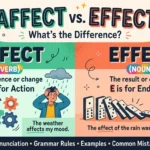
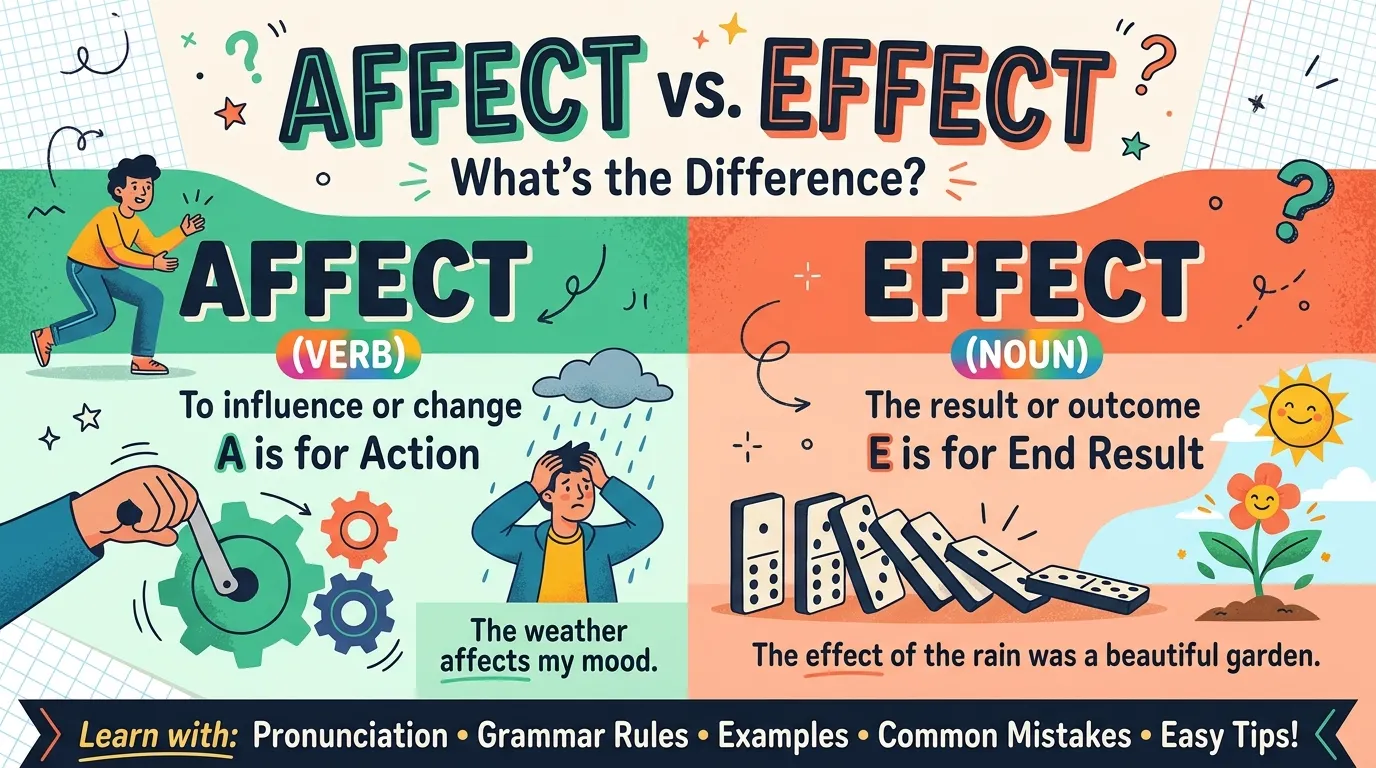
The main difference is simple:
- Affect is usually a verb. It means to change or influence something.
- Effect is usually a noun. It means the result of an action or change.
Examples:
- Rain can affect our plans.
- Rain can have an effect on traffic.
Why Is It Important to Know Their Difference?
Students need these words to write clear essays and answer test questions. Teachers need them to explain ideas in a simple way. Experts use them in reports, emails, and work plans.
These words also matter in daily life. A doctor may explain how a drug can affect the body and what effects it may have. A worker may explain how a new rule affects a team. Using the right word helps people understand the message. It also helps us avoid mistakes in school, at work, and in daily talk.
Pronunciation of Affect and Effect in US and UK English
| Word | US pronunciation | UK pronunciation |
| Affect | /əˈfɛkt/ | /əˈfɛkt/ |
| Effect | /ɪˈfɛkt/ | /ɪˈfɛkt/ |
A Linking Hook to the Main Topic
Now that we know the basic meanings, let us look at ten clear differences. Each point has simple examples to help you choose the right word.
Difference Between Affect and Effect
1. Meaning
Affect: It means to change or influence someone or something.
Examples:
- Loud noise can affect my sleep.
- Cold weather can affect plants.
Effect: It means the result of an action or change.
Examples:
- The effect of loud noise was poor sleep.
- Cold weather had a bad effect on the plants.
2. Part of Speech
Affect: It is usually a verb. A verb tells us what someone or something does.
Examples:
- Stress can affect your health.
- The news affected her mood.
Effect: It is usually a noun. A noun names a person, place, thing, or idea.
Examples:
- The medicine had a good effect.
- The effect of the storm was clear.
3. Use in a Sentence
Affect: It often shows what changes or influences something.
Examples:
- Lack of sleep can affect your work.
- The heat affected our game.
Effect: It often names the result of a change.
Examples:
- The effect was clear.
- The new rule had an effect on sales.
4. Action or Result
Affect: It focuses on the action of changing or influencing something.
Examples:
- The teacher’s words affected the class.
- The new law may affect small shops.
Effect: It focuses on the result of that action.
Examples:
- The teacher’s words had a strong effect on the class.
- The new law had an effect on small shops.
5. Common Word Partners
Affect: It often appears with words such as health, mood, and performance.
Examples:
- Too much sugar can affect your health.
- Stress can affect your mood.
Effect: It often appears in phrases such as have an effect, side effect, and cause and effect.
Examples:
- The drug may have a side effect.
- We studied cause and effect in class.
6. Positive and Negative Changes
Affect: It can describe a good or bad change.
Examples:
- Exercise can affect your health in a good way.
- Bullying can affect a child’s confidence.
Effect: It can name a good or bad result.
Examples:
- Exercise had a good effect on my health.
- Bullying had a harmful effect on the child.
7. Use in School and Work
Affect: It helps explain how one thing changes another.
Examples:
- The new lesson plan may affect student learning.
- A late bus can affect the work schedule.
Effect: It helps explain the result of a change.
Examples:
- The lesson plan had a good effect on student learning.
- The late bus had an effect on the work schedule.
8. Different Word Forms
Affect: Its common forms include affects, affected, and affecting.
Examples:
- The noise affects my focus.
- The rain affected our trip.
Effect: Its common forms include effects as a plural noun and effected as a verb meaning to bring about a change.
Examples:
- The effects of the storm were severe.
- The new team effected a major change.
9. Use in Health and Science
Affect: It describes how one thing may influence the body or a system.
Examples:
- A lack of water can affect the body.
- Poor sleep can affect memory.
Effect: It describes the result or outcome.
Examples:
- The effect of poor sleep was low energy.
- The drug had a mild effect on the patient.
10. Common Mistakes
Affect: Use it when you mean influence or change.
Incorrect: The rain had an affect on our trip.
Correct: The rain had an effect on our trip.
More examples:
- The rain affected our trip.
- Noise can affect your focus.
Effect: Use it when you mean result or outcome.
Incorrect: The new rule may effect how we work. (If you mean “influence”)
Correct: The new rule may affect how we work.
More examples:
- The new rule had an effect on our work.
- The side effects were mild.
Easy rule: Affect is usually the action. Effect is usually the result.
The Nature and Behaviour of Affect
Affect is usually a verb. It shows that one thing changes or influences another. It often names the action that causes a change.
Examples:
- Heat affects the plants.
- Her kind words affected me.
The word can describe changes in health, mood, work, school, or nature. The change may be good, bad, or neutral.
In psychology, affect can also be a noun. It refers to the way a person shows feelings through their face, voice, or actions.
Example: The nurse noted the patient’s calm affect.
The Nature and Behaviour of Effect
Effect is usually a noun. It names what happens because of an action or event. It often appears with words like the, an, or a.
Examples:
- The storm had a strong effect on the town.
- The new rule had an effect on prices.
Effect can also be a verb, but this use is less common. As a verb, it means to bring about or make a change happen.
Examples:
- The new leader hopes to effect change.
- The group worked to effect a fair deal.
Why Do People Confuse Affect and Effect?
People often mix up these words because they sound alike and have related meanings. Both words can appear when we talk about change. This can make it hard to know which word to use.
The easiest way to tell them apart is to check their role in the sentence. If you need a verb that means “influence,” use affect. If you need a noun that means “result,” use effect.
Easy tip:
- Affect = Action
- Effect = End result
For example, “The rain affected the match” tells us what the rain did. “The effect of the rain was a delay” tells us what happened as a result.
also read more about https://comparificationn.com/difference-between-since-and-sense-2/
Table Showing the Differences and Similarities
| Feature | Affect | Effect |
| Main meaning | To influence or change | A result or outcome |
| Usual part of speech | Verb | Noun |
| Main role | Shows an action | Names a result |
| Common phrase | Affect health | Have an effect |
| Positive use | Exercise can affect mood | Exercise has a good effect |
| Negative use | Stress can affect sleep | Stress has a bad effect |
| Less common use | Noun in psychology | Verb meaning to bring about |
| Example | Noise affects my focus. | Noise has an effect on my focus. |
| Similarity | Both relate to change | Both relate to change |
Which Is Better in What Situation?
Neither word is better in every situation. The right word depends on what you want to say. Use affect when you want to show that something has an impact on a person or thing. For example, “Lack of sleep can affect your mood.” Use effect when you want to name the result of an action. For example, “Lack of sleep can have an effect on your mood.”
In most daily sentences, this rule works well. Check whether you need an action or a result. This simple step can help you choose the right word.
How Are Affect and Effect Used in Metaphors and Similes?
A metaphor says that one thing is another thing. A simile compares two things by using like or as.
Affect in Metaphors and Similes
Affect can show how a person or event changes someone’s feelings.
- Example: “Her smile affected me like sunshine after rain.” This is a simile because it uses like to compare her smile to sunshine.
- Example: “The sad news affected him like a dark cloud over the sun.” This compares the effect of the news to a dark cloud.
Effect in Metaphors and Similes
Effect can name the result of an action in a creative way.
- Metaphor: “The effect of her words was a bridge between two friends.” This means her words helped the friends become close again.
- Simile: “The effect of the song was like a warm hug.” This compares the song’s impact to the comfort of a hug.
Connotative Meaning of Affect and Effect
Connotation is the feeling or idea a word brings to mind beyond its basic meaning.
Connotation of Affect
Type: Neutral, positive, or negative
Affect is usually neutral. The words around it show whether the change is good or bad.
- Positive: “Kind words can affect a child’s confidence in a good way.”
- Negative: “Bullying can affect a child’s self-esteem.”
- Neutral: “The new timetable may affect the class schedule.”
Connotation of Effect
Type: Neutral, positive, or negative
Effect is also usually neutral. It names a result, and the context gives that result its tone.
- Positive: “The new plan had a positive effect on the team.”
- Negative: “The storm had a harmful effect on the town.”
- Neutral: “The effect of the change was small.”
Idioms and Proverbs Related to Affect and Effect
There are few common idioms built around the exact words affect and effect. However, several well-known phrases help explain their meanings.
1. Cause and Effect
Meaning: An action and the result it brings.
Example: In class, we learned about cause and effect: heavy rain caused the road to flood.
2. Have an Effect On
Meaning: To cause a change in someone or something.
Example: A kind teacher can have a good effect on a student’s life.
3. Make a Difference
Meaning: To have an impact or bring about a change.
Example: Small acts of kindness can affect a person’s day and make a difference.
4. A Ripple Effect
Meaning: A small action that leads to many other changes.
Example: One student’s kind act had a ripple effect, and soon the whole class began to help others.
5. For Effect
Meaning: To create a strong feeling or response.
Example: The speaker paused for effect, and the room became quiet.
Works in Literature Related to Affect and Effect
The words affect and effect appear in many books, but they are not often the main subjects of a story. The books below explore feelings, actions, and the results of choices.
- Pride and Prejudice — Novel; Jane Austen; 1813. The choices of the characters affect their lives and relationships.
- A Christmas Carol — Novella; Charles Dickens; 1843. Scrooge changes, and his new actions have a positive effect on others.
- Frankenstein — Gothic novel; Mary Shelley; 1818. Victor Frankenstein’s choices have serious effects on many lives.
- The Great Gatsby — Novel; F. Scott Fitzgerald; 1925. The actions of the characters affect their lives and the people around them.
Movies Related to Affect and Effect
These films explore how actions and events change people and shape their lives. Their titles do not use both words as their main theme.
- It’s a Wonderful Life — 1946; United States. The story shows how one person’s life affects a whole town.
- The Butterfly Effect — 2004; United States and Canada. Small changes in the past lead to major effects in the future.
- A Christmas Carol — 2009; United States. Scrooge’s experiences affect his choices and change his life.
- The Pursuit of Happyness — 2006; United States. The main character’s choices and efforts affect his future.
Five Possible Asked Questions About Affect and Effect
1. What is the main difference between affect and effect?
Affect usually means to influence or change something. Effect usually means the result of a change or action.
Example: The rain affected the game. The effect was a delay.
2. Is affect a verb or a noun?
Affect is usually a verb.
Example: Lack of sleep can affect your health.
In psychology, affect can also be a noun that refers to the way someone shows feelings.
3. Is effect a verb or a noun?
Effect is usually a noun.
Example: The medicine had a good effect.
It can also be a verb meaning to bring about a change.
Example: The team hopes to effect change.
4. How can I remember affect and effect?
Remember this simple rule: Affect is the action; effect is the result.
Example: Exercise can affect your mood. The effect may be a happier day.
5. Can affect and effect be used in the same sentence?
Yes. Each word can do a different job in one sentence.
Example: The weather can affect our plans, and the effect may be a delay.
How Are Affect and Effect Useful in Our Surroundings?
The words affect and effect help us explain how things change in the world around us. We use affect to show how one thing can influence another. For example, pollution can affect the air we breathe. We use effect to name the result. For example, one effect of pollution is poor air quality.
These words are useful in school, health care, work, and daily talk. They help us explain causes and results. When we use them well, we can share facts and ideas in a clear way. This helps people understand problems and make better choices.
Final Words on Affect and Effect
Affect and effect may look and sound alike, but they usually have different jobs. Affect is a verb that means to influence or change. Effect is a noun that means the result of an action. Think about whether your sentence needs an action or a result. This will help you choose the right word. Keep reading, writing, and checking your examples. With practice, you will learn to use both words with ease.
Conclusion
The difference between affect and effect is easy to learn when you know the basic rule. Affect usually means to influence or change something. Effect usually means the result of that change. These words are useful in daily life, school, and work. They help us explain how one thing can change another and what happens next. To choose the right word, read your sentence and ask what you mean. If you mean “influence,” use affect. If you mean “result,” use effect. There are a few special uses, but this simple rule works in most cases. With a little practice, you can write clear and correct sentences.

I’m Zahid Abbas, an educator, researcher, and digital publishing strategist with a passion for linguistics, grammar, and clear communication. As a content creator and SEO specialist, I craft research-driven, reader-focused content that empowers learners and makes knowledge accessible worldwide.