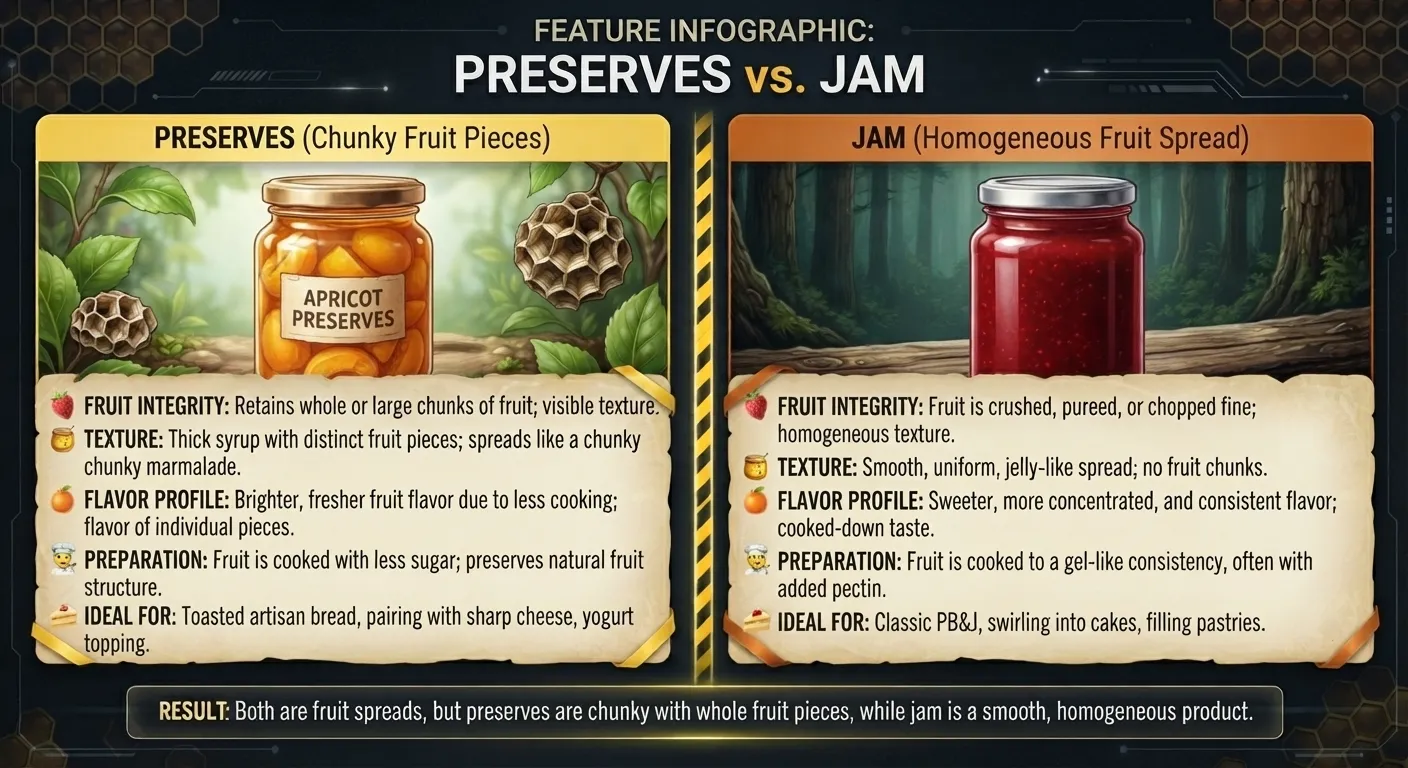
Last summer, my grandmother handed me two jars from her pantry. One said “strawberry preserves.” One said “strawberry jam.” I asked her, “Aren’t these just two names for the same thing?” She smiled and opened both jars. One had whole, soft strawberry chunks floating in thick syrup. The other had a smooth, even spread with no visible fruit pieces at all. That simple moment taught me the real preserves vs jam difference. Preserves keep large pieces or whole fruit inside a thick, syrupy gel. Jam uses crushed or finely chopped fruit, cooked down into a smooth, spreadable texture. The preserves vs jam mix-up trips up many shoppers, since both spreads look similar on a store shelf. Once you learn the true preserves vs jam difference, choosing the right jar for your toast becomes much easier.
Key Difference Between Preserves and Jam
Preserves contain whole or large chunks of fruit, held together in a thick, gel-like syrup. Jam contains crushed or finely chopped fruit, cooked down into a smoother, more evenly spreadable texture.
Why This Difference Matters for Learners and Experts
For home cooks and shoppers, this knowledge helps pick the right spread for toast, baking, or gifting. For food scientists and culinary students, understanding preserves vs jam reflects real techniques in fruit preservation and canning. Food traditions connect families and communities across generations. Knowing preserves vs jam helps people shop smarter, cook better, and appreciate the small details behind everyday pantry staples.
Pronunciation
Preserves
- US English: /prɪˈzɜːrvz/ — said as “prih-ZURVZ.”
- UK English: /prɪˈzɜːvz/ — said very similarly, “prih-ZUHVZ,” with a softer “r” sound.
Jam
- US English: /dʒæm/ — said as “JAM,” a short, simple word.
- UK English: /dʒæm/ — said the same way, “JAM.”
Difference Between Preserves and Jam
1. Fruit texture
Preserves contain whole or large chunks of fruit. Jam contains crushed or finely chopped fruit. Example 1: Strawberry preserves often show whole, soft strawberries suspended in the jar. Example 2: Strawberry jam shows small, broken-down fruit pieces blended smoothly throughout.
2. Overall consistency
Preserves have a chunkier, less uniform texture. Jam has a smoother, more even texture. Example 1: A spoonful of preserves may include a large piece of fruit alongside thick syrup. Example 2: A spoonful of jam spreads evenly, without large fruit chunks breaking up the texture.
3. Cooking method
Preserves are cooked gently, keeping fruit pieces mostly intact. Jam is cooked longer and stirred more, breaking the fruit down further. Example 1: Preserves are often simmered briefly, just enough to soften the fruit without destroying its shape. Example 2: Jam is often simmered and mashed until the fruit fully blends into the mixture.
4. Sugar and syrup thickness
Preserves often sit in a thick, glossy syrup around the fruit. Jam blends the sugar fully into the fruit itself, creating one smooth mixture. Example 1: Preserves may show a clear, thick syrup layer surrounding visible fruit pieces. Example 2: Jam shows no separate syrup layer, since everything blends into one spreadable mixture.
5. Best use in the kitchen
Preserves work well as a topping for desserts, cheese boards, or biscuits, where visible fruit pieces add appeal. Jam works well as an everyday spread for toast, sandwiches, and baked goods. Example 1: Preserves often top a warm biscuit or a slice of cheesecake for a fancy presentation. Example 2: Jam often spreads smoothly over toast or fills a simple peanut butter and jelly sandwich.
6. Visual appearance
Preserves look chunky and rustic, with visible fruit shapes. Jam looks smooth and glossy, with no distinct fruit shapes. Example 1: A jar of preserves often looks homemade and rustic, even when store-bought. Example 2: A jar of jam often looks uniform and polished, spreading cleanly with a knife.
7. Fruit-to-sugar ratio
Preserves often use a higher ratio of fruit to sugar, letting the fruit’s natural shape stand out. Jam often uses a more balanced fruit-to-sugar ratio, focused on a smooth, spreadable result. Example 1: A preserves recipe may call for whole berries mixed into a light syrup. Example 2: A jam recipe blends crushed fruit and sugar together evenly from the start.
8. Regional naming habits
In the US, “preserves” and “jam” are seen as clearly different products. In the UK, “jam” is sometimes used as a broader term, even covering what Americans might call preserves. Example 1: An American shopper will clearly separate “preserves” from “jam” on a grocery shelf. Example 2: A British shopper may casually call a chunky, fruit-filled spread “jam,” even if it closely resembles American preserves.
9. Shelf appeal and marketing
Preserves are often marketed as a premium, gourmet product. Jam is often marketed as a simple, everyday pantry staple. Example 1: A specialty food shop may sell small-batch preserves at a higher price, emphasizing whole fruit quality. Example 2: A regular grocery store often sells jam in large, affordable jars for daily use.
10. Everyday confusion in shopping and recipes
Since both spreads use similar fruit and sugar, and often sit near each other on store shelves, shoppers frequently confuse the two. Example 1: A shopper may grab a jar of preserves while looking for a smooth jam, only noticing the fruit chunks once opened. Example 2: A recipe calling for “jam” may still work with preserves, though the final texture may turn out chunkier than expected.
The Nature and Behavior of Preserves
Preserves behave like a rustic, fruit-forward spread, built to highlight the natural shape and texture of real fruit pieces. Their nature leans toward a heartier, more textured bite, often chosen when people want their spread to visually and texturally showcase real fruit.
The Nature and Behavior of Jam
Jam behaves like a smooth, reliable everyday spread, built for easy, even application. Its nature leans toward simplicity and convenience, making it a dependable choice for quick breakfasts, sandwiches, and baking recipes that need a consistent texture.
Why Do People Get Confused Between Preserves and Jam?
Three reasons cause this mix-up. First, both spreads use similar core ingredients, mainly fruit and sugar, so shoppers assume they are the same product. Second, packaging and marketing do not always clearly explain the texture difference, especially at a quick glance. Third, regional language habits, especially between the US and UK, sometimes blur the line between how “jam” and “preserves” are used in everyday conversation.
Preserves vs Jam: Comparison Table
| Aspect | Preserves | Jam |
| Fruit texture | Whole or large chunks | Crushed or finely chopped |
| Consistency | Chunky, less uniform | Smooth, even |
| Best use | Toppings, cheese boards | Everyday spread, sandwiches |
| Appearance | Rustic, visible fruit pieces | Glossy, uniform |
| Marketing image | Often premium or gourmet | Often simple, everyday staple |
| Similarity | Both are made mainly from cooked fruit and sugar | |
| Similarity | Both are commonly used as sweet spreads or dessert toppings |
Which Is Better in What Situation?
If you want a fancy topping for a cheese board, dessert, or warm biscuit, preserves work better. Their chunky, visible fruit pieces add texture and a more elegant presentation.
If you want a smooth, easy spread for daily toast or a classic sandwich, jam works better. Its even texture spreads cleanly and blends well into simple, everyday meals.
For most kitchens, having both on hand offers the most flexibility. Choose preserves for special touches, and choose jam for quick, reliable, everyday use.
How Are Preserves and Jam Used in Metaphors and Similes?
- “In a jam” — means stuck in a difficult or awkward situation.
- “Smooth as jam” — used informally to describe something spreading evenly or working effortlessly.
- “Well preserved” — used to describe something, or someone, that has held up nicely over time, borrowing loosely from the idea of preserving fruit.
Connotative Meaning
Preserves
- Positive: Suggests quality, tradition, and homemade care. Example: “My grandmother’s peach preserves taste like a warm summer memory.”
- Negative: Rarely negative, though it can feel overly fancy in casual settings. Example: “Preserves felt a bit much for a simple school lunch.”
- Neutral: Used plainly to describe the product. Example: “The recipe calls for two tablespoons of apricot preserves.”
Jam
- Positive: Suggests comfort, simplicity, and everyday joy. Example: “Nothing beats warm toast with a bit of jam in the morning.”
- Negative: Can suggest trouble in its idiomatic use. Example: “We’re really in a jam if the delivery doesn’t arrive on time.”
- Neutral: Used plainly to describe the product. Example: “Spread a thin layer of jam over the toast.”
Idioms or Proverbs
- “In a jam” — means stuck in a difficult or awkward situation. Example: “I’m in a real jam since my car broke down before my flight.”
- “Well preserved” — means something, or someone, has held up nicely despite the passage of time. Example: “For a house built a century ago, it’s remarkably well preserved.”
Works of Literature Featuring the Terms
None found. No widely known novels, poems, or plays center on “preserves” or “jam” as their title or main theme. Both terms mostly appear inside cookbooks, recipes, and casual food writing rather than major literary works.
Movies Made on These Terms
None found. There are no widely known feature films built around “preserves” or “jam” as their central subject or title.
Five Frequently Asked Questions
1. Can I use preserves instead of jam in a recipe? Yes, in most cases. The flavor stays similar, though the texture will turn out chunkier since preserves contain larger fruit pieces.
2. Which spreads more easily, preserves or jam? Jam spreads more easily, thanks to its smooth, even texture, while preserves can feel chunkier to spread evenly.
3. Is one healthier than the other? Nutritionally, both are similar, since they mainly contain fruit and sugar. Some preserves may contain slightly more whole fruit per serving.
4. Why do preserves cost more than jam in some stores? Preserves are often marketed as a premium product, emphasizing whole fruit quality, which can lead to a higher price point.
5. Is British “jam” the same as American “preserves”? Not exactly, though the words sometimes overlap more in British usage, where “jam” can casually describe chunkier spreads that Americans might call preserves.
How Are Preserves and Jam Useful for Our Surroundings?
Both spreads support local food traditions and small businesses in meaningful ways. Home canning and preserving fruit help reduce food waste, allowing families to enjoy seasonal fruit throughout the year. Local farms and small producers also sell preserves and jams at markets, supporting local economies and food culture. Both spreads bring simple comfort to daily meals, connecting people to shared traditions passed down through families and communities.
Final Words
Preserves and jam are close cousins in the pantry, not identical products. One keeps fruit chunky and visible. The other blends fruit into a smooth, easy spread. Knowing the difference helps you pick the right jar for your toast, your table, or your next recipe.
Conclusion
Preserves vs jam question comes down to texture and fruit content. Preserves keep whole or large fruit pieces in a thick syrup, while jam blends crushed fruit into a smooth, even spread. Knowing preserves vs jam helps shoppers choose the right product for their needs, helps home cooks match the right spread to the right recipe, and helps communities appreciate the small traditions behind everyday pantry staples. Whether you prefer the rustic charm of preserves or the smooth simplicity of jam, understanding preserves vs jam helps you enjoy your favorite fruit spread with a little more knowledge.

I’m Zahid Abbas, an educator, researcher, and digital publishing strategist with a passion for linguistics, grammar, and clear communication. As a content creator and SEO specialist, I craft research-driven, reader-focused content that empowers learners and makes knowledge accessible worldwide.










