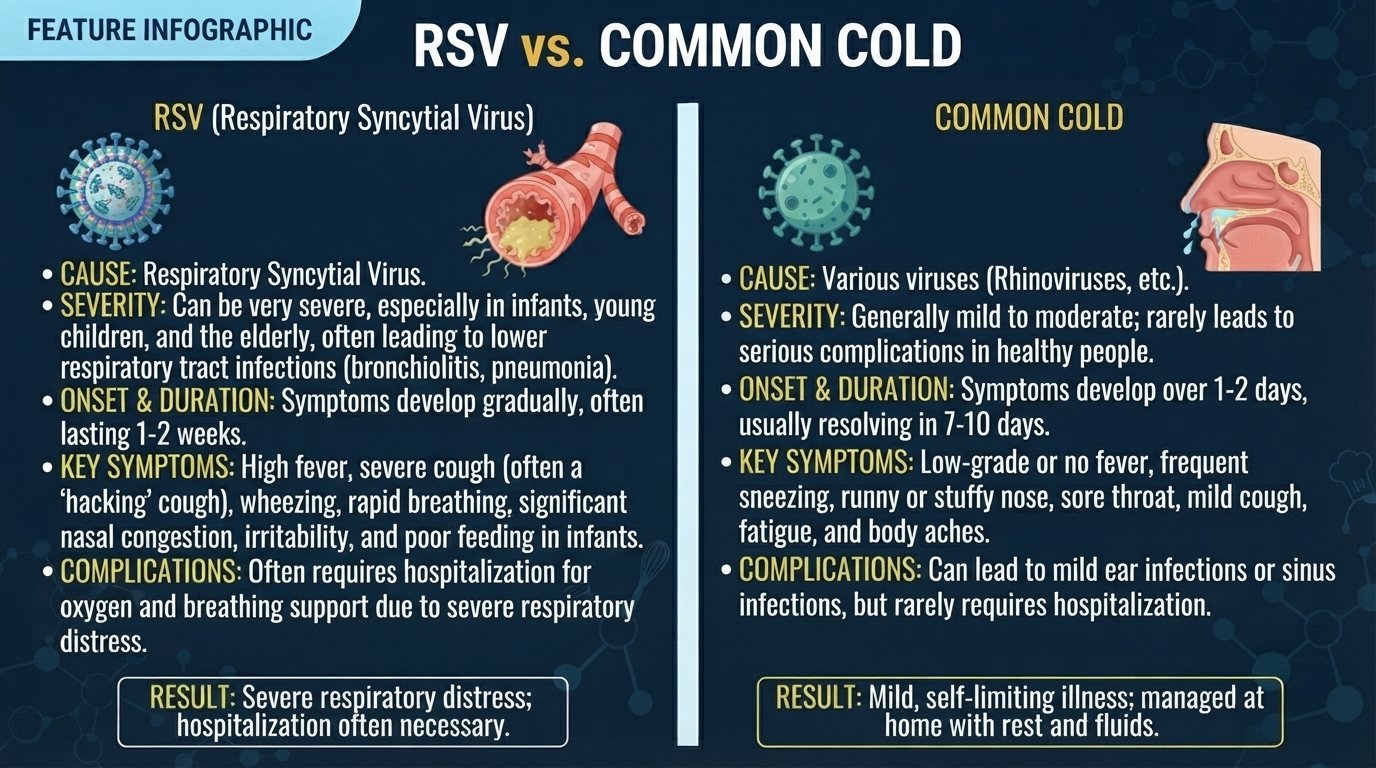
Last winter, a mom in Ohio put her coughing toddler to bed. She thought it was just a cold. By morning, the child was wheezing and having trouble breathing. It was RSV, not a cold at all. This happens in many homes every winter. RSV and cold can look the same at first — runny nose, cough, mild fever. But knowing the difference between RSV and cold can matter a lot. It can mean the difference between a quiet week at home and a trip to the hospital. This is why learning about RSV vs cold is not just extra facts. It helps parents and caregivers know what to do when someone gets sick.
Key Difference Between RSV and Cold
The difference between RSV and cold starts with the cause. A cold usually comes from rhinoviruses. It stays mild and goes away in about a week. RSV, or Respiratory Syncytial Virus, can look like a cold at first. But it can move into the lungs. This can cause serious breathing problems, mostly in babies, older adults, and people with weak immune systems.
Why This Difference Matters
Knowing RSV vs cold helps people make better choices. Should you rest at home, or go to the doctor? Health experts say this matters a lot, because RSV mistaken for a cold can lead to delays in care. This is risky for babies under one year old. When more people understand this, fewer emergency rooms get overloaded, and more lives are saved.
Pronunciation
| Word | US | UK |
| RSV | “R-S-V” (say each letter) | “R-S-V” (say each letter) |
| Cold | “kohld” | “kohld” (similar sound) |
Difference Between RSV and Cold
- What Causes It RSV comes from one virus. A cold can come from over 200 different viruses. Example 1: A child with RSV tests positive for that one specific virus. Example 2: An adult with a cold may never know which of the 200+ viruses caused it.
- How Bad It Gets Colds usually stay mild the whole time. RSV can start mild, then get worse fast. Example 1: Someone with a cold has a scratchy throat but still goes to work. Example 2: A baby with RSV starts with sniffles, then struggles to breathe within days.
- Who Is at Highest Risk Colds affect people of all ages about equally. RSV is more dangerous for babies, older people, and premature infants. Example 1: A healthy adult with a cold feels better in a week. Example 2: A two-month-old with RSV may need oxygen in the hospital.
- Where It Hits the Body Colds mostly stay in the nose and throat. RSV can spread down into the lungs. Example 1: A person with a cold has a stuffy nose and light cough. Example 2: A toddler with RSV starts wheezing from swollen airways in the lungs.
- Fever Colds usually cause little or no fever. RSV often causes a higher fever, especially in kids. Example 1: An adult with a cold has a temperature of 99°F, barely noticeable. Example 2: A child with RSV has a fever of 102°F along with trouble breathing.
- How Long It Lasts Colds usually go away in 7 to 10 days. RSV can last up to two weeks. Breathing trouble often shows up around day 3 to 5. Example 1: A college student with a cold feels normal again in a week. Example 2: A baby with RSV still wheezes 10 days after it started.
- Complications Colds rarely cause other problems in healthy people. RSV can lead to lung infections like bronchiolitis or pneumonia. Example 1: A cold in a healthy adult clears up on its own. Example 2: A baby with RSV needs breathing treatments for bronchiolitis.
- How Doctors Test for It Colds are diagnosed just by looking at symptoms. RSV can be confirmed with a nose swab test. Example 1: A doctor says “It’s just a cold” without any test. Example 2: A doctor orders an RSV test when a baby is wheezing and breathing fast.
- Time of Year Colds happen all year but are more common in winter. RSV has a clearer season, mostly fall through early spring. Example 1: Someone catches a cold in summer from a cold office building. Example 2: RSV cases jump sharply in children’s hospitals every November.
- Prevention and Vaccines There is no vaccine for the common cold, since so many viruses cause it. RSV now has vaccines and antibody shots for people at high risk. Example 1: People wash their hands to avoid catching a cold, since no vaccine exists. Example 2: A pregnant woman gets an RSV vaccine to protect her newborn baby.
How They Behave
Cold: A cold is usually a mild bother. It spreads through droplets and germy surfaces. It irritates the nose and throat, then fades on its own.
RSV: RSV can trick you. It often looks just like a cold for the first two or three days. Then it can move deeper into the lungs, especially in babies and older people, turning a mild illness into a real concern.
Why People Mix Them Up
People confuse RSV and colds because the early symptoms look almost the same — runny nose, sneezing, mild cough. Without a test, even careful parents can’t easily tell them apart in the first day or two. That’s why people often use the words loosely, even though the two illnesses are quite different.
Comparison Table
| Feature | Common Cold | RSV |
| Caused by | 200+ viruses | One specific virus |
| How bad | Mild | Mild to severe |
| Body part hit | Nose and throat | Nose, throat, and lungs |
| Highest risk group | Everyone, mildly | Babies, elderly, weak immune systems |
| Fever | Low or none | Often higher |
| How long | 7–10 days | Up to 2 weeks |
| Complications | Rare | Bronchiolitis, pneumonia |
| Vaccine | No | Yes, for high-risk groups |
| Symptoms | Runny nose, cough, sore throat | Runny nose, cough, wheezing, fever |
| Spreads by | Droplets, touch | Droplets, touch |
| Season | Year-round, winter peak | Fall to spring peak |
Which One Fits Which Situation?
When “cold” fits: If symptoms are light — a scratchy throat, some congestion, no breathing trouble — calling it a cold makes sense. Most healthy adults and older kids fall in this group. Rest, fluids, and simple medicine are usually enough.
When “RSV” fits: If the sick person is a baby, an older adult, or has health problems, and there’s wheezing, fast breathing, or a high fever, it’s safer to think of RSV. In these cases, seeing a doctor early is smarter than assuming “it’s just a cold.”
Metaphors and Similes
- “Her excuse was as thin as a cold” — means the excuse was weak.
- “He gave me the cold shoulder” — means he was being unfriendly.
- “The talks went cold, like a stalled engine” — means progress stopped.
- RSV is a medical term. It is almost never used in metaphors or similes outside of health topics.
Connotative Meanings
Cold (the word):
- Negative: “He gave her a cold stare” — sounds unfriendly.
- Neutral: “It’s cold outside today” — just describes the weather.
- Positive (rare): “Stay cool and collected” — calm under pressure.
RSV:
- Negative: “The RSV outbreak filled the children’s ward” — sounds worrying.
- Neutral: “RSV season starts in October” — just states a fact.
- RSV rarely has a positive tone, since it’s tied closely to illness.
Idioms Using “Cold”
- “Catch a cold” — “Dress warmly, or you’ll catch a cold.”
- “Cold feet” — “He got cold feet before the wedding.”
- “In cold blood” — “The crime was done in cold blood.”
- “Out in the cold” — “After the merger, workers were left out in the cold.”
- “Cold turkey” — “She quit smoking cold turkey.”
RSV has no known idioms, since it’s a modern medical term.
Books and Movies
Books that use “cold” in the title or theme:
- Cold Mountain — novel, Charles Frazier, 1997
- The Call of the Wild — novel, Jack London, 1903
Movies that use “cold” in the title or story:
- Cold Mountain — 2003, USA
- In Cold Blood — 1967, USA
RSV does not appear in known books or movies. It’s a modern medical term, not a common creative topic.
Five Common Questions
1. Can a cold turn into RSV? No. They come from different viruses. But RSV can start with cold-like symptoms, which is why people mix them up.
2. Is RSV more contagious than a cold? Both spread the same way, through droplets and touch. But RSV spreads fast in daycares and hospitals due to close contact.
3. How do I know if my baby has RSV or just a cold? Watch for wheezing, fast breathing, or less feeding. These point to RSV, and mean it’s time to call a doctor.
4. Do colds ever need hospital care? Rarely, usually only with a second infection like an ear infection. RSV, though, is a top cause of baby hospital stays in winter.
5. Is there a cure for either one? No direct cure exists for either. Both are treated with rest and fluids. RSV now has vaccines for high-risk groups; colds do not.
How Both Help Us
Even illness can teach us something useful. Learning about colds teaches basic habits like handwashing and covering coughs. These habits stop many illnesses from spreading, not just colds. Learning about RSV pushes hospitals to plan ahead each season and teaches caregivers to spot warning signs early. This protects the most vulnerable people in our communities.
Final Words
A cold is usually a mild, familiar guest — annoying but not scary. RSV can look the same at first, but it deserves more attention. It can affect the lungs more seriously, especially in babies and older adults. Knowing the difference isn’t about fear. It’s about knowing when to act.
Conclusion
Difference between RSV and cold comes down to how deep the impact goes. One usually stays a mild bother. The other can turn into a serious lung illness for vulnerable people. From causes to risks to treatment, RSV vs cold is a real difference, not just a vocabulary lesson. Watching for warning signs like wheezing, fast breathing, or high fever can help you get the right care fast. Whether you’re a parent, a student, or just someone who wants to be ready this winter, understanding RSV and cold helps you respond with confidence instead of guesswork.

I’m Zahid Abbas, an educator, researcher, and digital publishing strategist with a passion for linguistics, grammar, and clear communication. As a content creator and SEO specialist, I craft research-driven, reader-focused content that empowers learners and makes knowledge accessible worldwide.