Last summer, my neighbor found a large paper nest hanging from his tree. He panicked and yelled, “Hornets!” A pest control worker came out, looked closely, and said, “Actually, this is a wasp nest.” My neighbor was shocked. He thought all big stinging bugs were hornets. The truth surprised him even more. Hornets are actually a type of wasp. Not every wasp is a hornet, but every hornet is a wasp. The wasps vs hornets mix-up happens to almost everyone at some point. People see a flying, striped insect and guess based on size or fear, not real facts. Once you learn the true wasps vs hornets difference, you can spot each one with confidence and know how to react around them safely.
Key Difference Between Wasps and Hornets
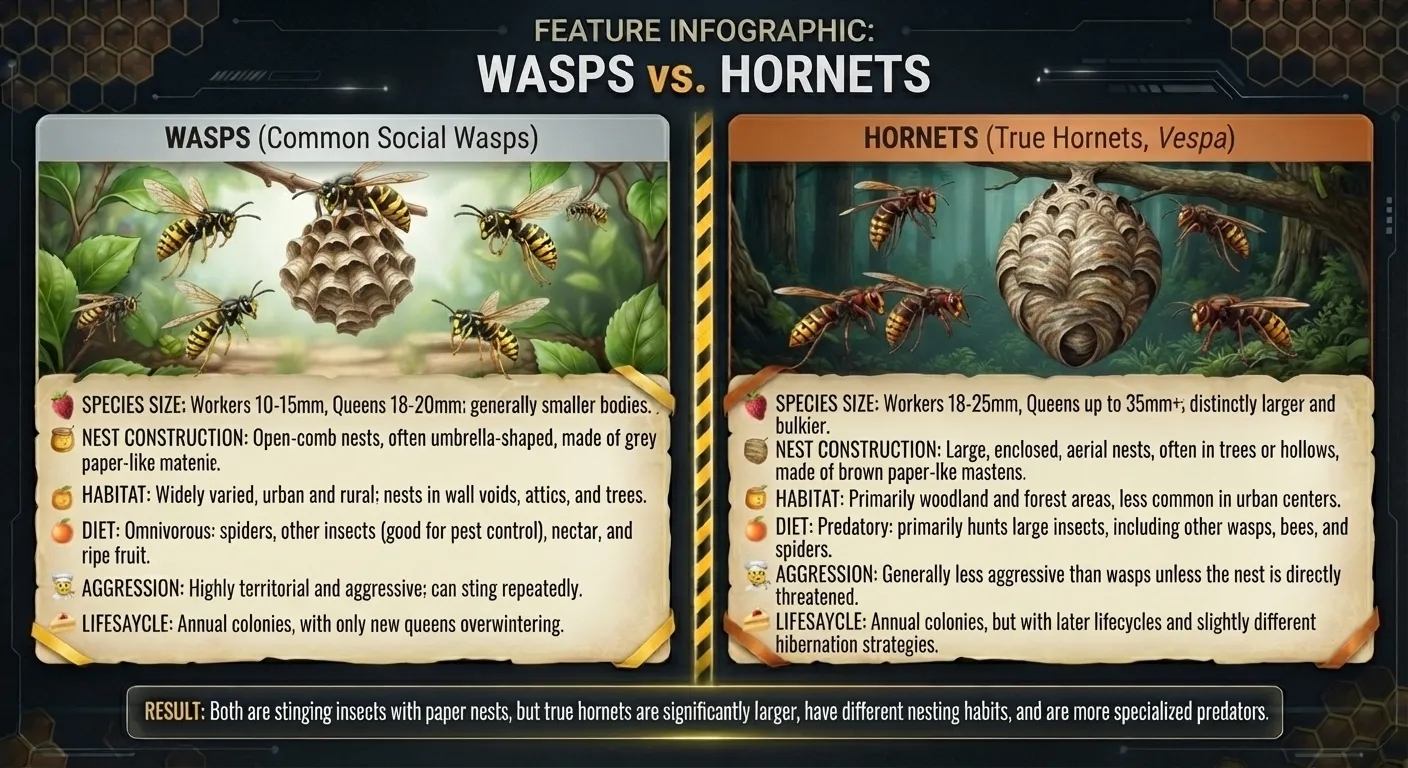
Hornets are one specific group within the larger wasp family. True hornets tend to be bigger, rounder, and build large paper nests in trees. Other wasps, like yellowjackets and paper wasps, come in many shapes and often build smaller nests in the ground or under roofs.
Why This Difference Matters for Learners and Experts
For homeowners, this knowledge helps decide how to handle a nest safely. For students of biology and pest control workers, knowing wasps vs hornets shapes accurate identification and proper treatment methods. Insects play a big role in our shared environment, from pollinating plants to controlling pests. Knowing wasps vs hornets helps people respect these insects, avoid needless fear, and make safer choices around nests in homes, schools, and parks.
Pronunciation
Wasp
- US English: /wɒsp/ — said as “WOSP,” a short, single-syllable word.
- UK English: /wɒsp/ — said the same way, “WOSP.” Both countries pronounce this word almost identically.
Hornet
- US English: /ˈhɔːrnɪt/ — said as “HOR-nit.”
- UK English: /ˈhɔːnɪt/ — said very similarly, “HAW-nit,” with a softer “r” sound.
Difference Between Wasps and Hornets
1. Family relationship
Hornets are a type of wasp. Not all wasps are hornets, but all hornets belong to the wasp family. Example 1: A European hornet is a true hornet, part of the wasp family group. Example 2: A yellowjacket is a common wasp, but it is not considered a true hornet.
2. Size
Hornets tend to be larger than most other wasps. Wasps vary more in size, with many being smaller. Example 1: A European hornet can grow over an inch long. Example 2: A common paper wasp usually stays under an inch long.
3. Body shape
Hornets often have a rounder, thicker body and a wider head. Wasps often have a slimmer, more narrow body, especially at the waist. Example 1: A hornet’s head looks broad compared to its body. Example 2: A wasp’s body often shows a clear, thin “waist” between its chest and stomach.
4. Color patterns
Hornets often show darker colors, like brown or black, sometimes with pale yellow or white markings. Wasps often show bright, bold yellow and black stripes. Example 1: A European hornet looks mostly brown and red-brown, with lighter yellow patches. Example 2: A yellowjacket wasp shows sharp, bright yellow and black bands, similar to warning tape.
5. Nest location
Hornets usually build large, enclosed paper nests in trees or high off the ground. Many wasps build nests underground, in wall cavities, or under roof eaves. Example 1: A hornet nest often hangs from a tree branch, shaped like a large gray football. Example 2: A yellowjacket nest often sits hidden underground, in an old rodent burrow.
6. Nest size
Hornet nests tend to grow quite large, sometimes housing hundreds of insects. Many wasp nests stay smaller, though some wasp colonies can also grow large. Example 1: A mature hornet nest can grow bigger than a basketball by late summer. Example 2: A small paper wasp nest may only hold a few dozen insects under a porch roof.
7. Aggression level
True hornets are often less aggressive unless their nest feels threatened. Some wasps, especially yellowjackets, can become more aggressive, especially near food. Example 1: A hornet flying near a garden will often ignore people who keep their distance. Example 2: A yellowjacket may swarm aggressively around a picnic table full of sugary drinks.
8. Sting pain and venom
Hornet stings are often described as more painful, due to a higher venom concentration. Wasp stings still hurt but are often described as slightly less intense. Example 1: A hornet sting can cause sharp, longer-lasting pain at the sting site. Example 2: A wasp sting causes real pain too, but many describe it as slightly milder than a hornet’s sting.
9. Diet and role in nature
Both hunt insects to feed their young and drink nectar or sugary liquids as adults. Hornets often prey on larger insects, while common wasps hunt a wider range of small pests. Example 1: A hornet may hunt large flies or even small wasps to feed its colony. Example 2: A paper wasp often hunts caterpillars, helping protect garden plants from damage.
10. Regional presence
True hornets are more common in Europe and Asia, with only a few types found in North America. Wasps, including yellowjackets and paper wasps, live almost everywhere around the world. Example 1: The European hornet was introduced to North America and now lives in parts of the eastern United States. Example 2: Yellowjacket wasps are found across nearly every US state, in both cities and rural areas.
The Nature and Behavior of Wasps
Wasps behave like busy, adaptable insects. Many types build nests in a wide range of places, from underground burrows to attic corners. Certain wasps, like yellowjackets, become bold and food-driven in late summer, often showing up uninvited at outdoor meals in search of sugar and protein.
The Nature and Behavior of Hornets
True hornets behave like large, focused colony insects. They build strong, enclosed paper nests and tend to stay calm unless their home feels threatened. Once a hornet nest feels at risk, the colony can respond quickly and forcefully, since hornets defend their nest as a strong, unified group.
Why Do People Get Confused Between Wasps and Hornets?
Three reasons cause this mix-up. First, hornets are technically a type of wasp, so the two names naturally overlap in meaning. Second, many people use “hornet” as a general scare word for any large, stinging insect, even when it is really a wasp. Third, both insects share similar colors, body shapes, and paper-like nests, making them easy to confuse at a quick glance.
Wasps vs Hornets: Comparison Table
| Aspect | Wasps | Hornets |
| Family group | Broad insect family | A specific type within the wasp family |
| Size | Varies, often smaller | Usually larger |
| Body shape | Slim, narrow waist | Rounder, wider head |
| Nest location | Ground, walls, eaves | Trees, high off the ground |
| Aggression | Can be more food-driven, bold | Calmer unless nest is threatened |
| Common examples | Yellowjackets, paper wasps | European hornet, Asian giant hornet |
| Similarity | Both are social insects living in organized colonies | |
| Similarity | Both build paper-like nests from chewed wood and saliva |
Which Is Better in What Situation?
If you spot a bright yellow and black insect near a picnic or trash can, you are likely dealing with a wasp, such as a yellowjacket. In this situation, staying calm and moving food away often works better than swatting at the insect.
If you spot a large, round-headed insect near a big paper nest in a tree, you are likely dealing with a true hornet. In this situation, keeping a safe distance matters most, since a threatened hornet colony can respond strongly to protect its nest.
In both situations, calling a licensed pest control professional is the safest choice for removing a nest near your home, rather than trying to handle either insect alone.
How Are Wasps and Hornets Used in Metaphors and Similes?
- “Stir up a hornet’s nest” — means to cause trouble or anger a group of people.
- “Mad as a hornet” — means extremely angry.
- “Waspish” — used to describe someone sharp-tongued, irritable, or quick to criticize.
Connotative Meaning
Wasp
- Negative: Often suggests annoyance, danger, or sharpness. Example: “He gave a waspish reply when asked about his mistake.”
- Neutral: Used plainly in nature or pest-control talk. Example: “A wasp nest formed under our porch roof.”
- Positive: Rarely positive, though some appreciate wasps for eating garden pests. Example: “Wasps actually help control caterpillars in the garden.”
Hornet
- Negative: Often suggests danger, aggression, or serious trouble. Example: “Criticizing the coach online stirred up a real hornet’s nest.”
- Neutral: Used plainly in nature or educational talk. Example: “The European hornet is common in parts of the eastern US.”
- Positive: Rarely used positively, though hornets are respected for their strong colony teamwork.
Idioms or Proverbs
- “Stir up a hornet’s nest” — means to start trouble or upset many people at once. Example: “Bringing up politics at dinner really stirred up a hornet’s nest.”
- “Mad as a hornet” — means someone is extremely angry. Example: “She was mad as a hornet after finding out about the mistake.”
Works of Literature Featuring the Terms
- The Wasp Factory — literary thriller novel, written by Iain Banks, published in 1984.
- Hornet’s Nest — crime fiction novel, written by Patricia Cornwell, published in 1997.
Movies Made on These Terms
- Wasp Network (2019, France/Brazil/Spain/Belgium) — a drama based on the true story of Cuban spies operating in Florida during the 1990s.
- The Green Hornet (2011, USA) — an action-comedy film based on the fictional superhero character named the Green Hornet, though the film centers on the hero, not the insect itself.
Five Frequently Asked Questions
1. Are all hornets dangerous? Not more than typical wasps in most cases. Hornets can sting if threatened, but they usually stay calm unless their nest feels at risk.
2. Is a yellowjacket a hornet? No. A yellowjacket is a common wasp, not a true hornet, even though people often call it one by mistake.
3. Can a wasp sting more than once? Yes. Unlike honeybees, wasps and hornets can sting multiple times, since their stingers do not stay stuck in the skin.
4. Do hornets and wasps eat the same food? Mostly yes. Both hunt small insects for their young and drink nectar or sugary liquids as adults.
5. What should I do if I find a nest near my home? Keep a safe distance and avoid disturbing it. Contact a licensed pest control professional to remove the nest safely.
How Are Wasps and Hornets Useful for Our Surroundings?
Both insects play an important role in nature, even though people often fear them. They help control pest populations by hunting caterpillars, flies, and other small insects that can damage gardens and crops. They also help pollinate some plants while feeding on nectar. In this way, wasps and hornets support healthy gardens, farms, and ecosystems, working quietly behind the scenes, even when people see them only as a summer nuisance.
Final Words
Wasps and hornets are close relatives, not total strangers. One is a broad family of stinging insects. The other is a specific, often larger member of that same family. Knowing the difference helps you stay calm, stay safe, and understand the real role these insects play in nature.
Conclusion
Wasps vs hornets question comes down to family and features. Hornets are a specific type of wasp, usually larger, rounder, and calmer unless provoked, while other wasps, like yellowjackets, come in many shapes and can act more aggressively around food. Knowing wasps vs hornets helps homeowners react safely around nests, helps students understand basic insect biology, and helps communities appreciate the real benefits these insects bring to gardens and farms. Whether you spot a hornet’s large tree nest or a wasp buzzing near your lunch, understanding wasps vs hornets helps you respond with knowledge instead of fear.

I’m Zahid Abbas, an educator, researcher, and digital publishing strategist with a passion for linguistics, grammar, and clear communication. As a content creator and SEO specialist, I craft research-driven, reader-focused content that empowers learners and makes knowledge accessible worldwide.