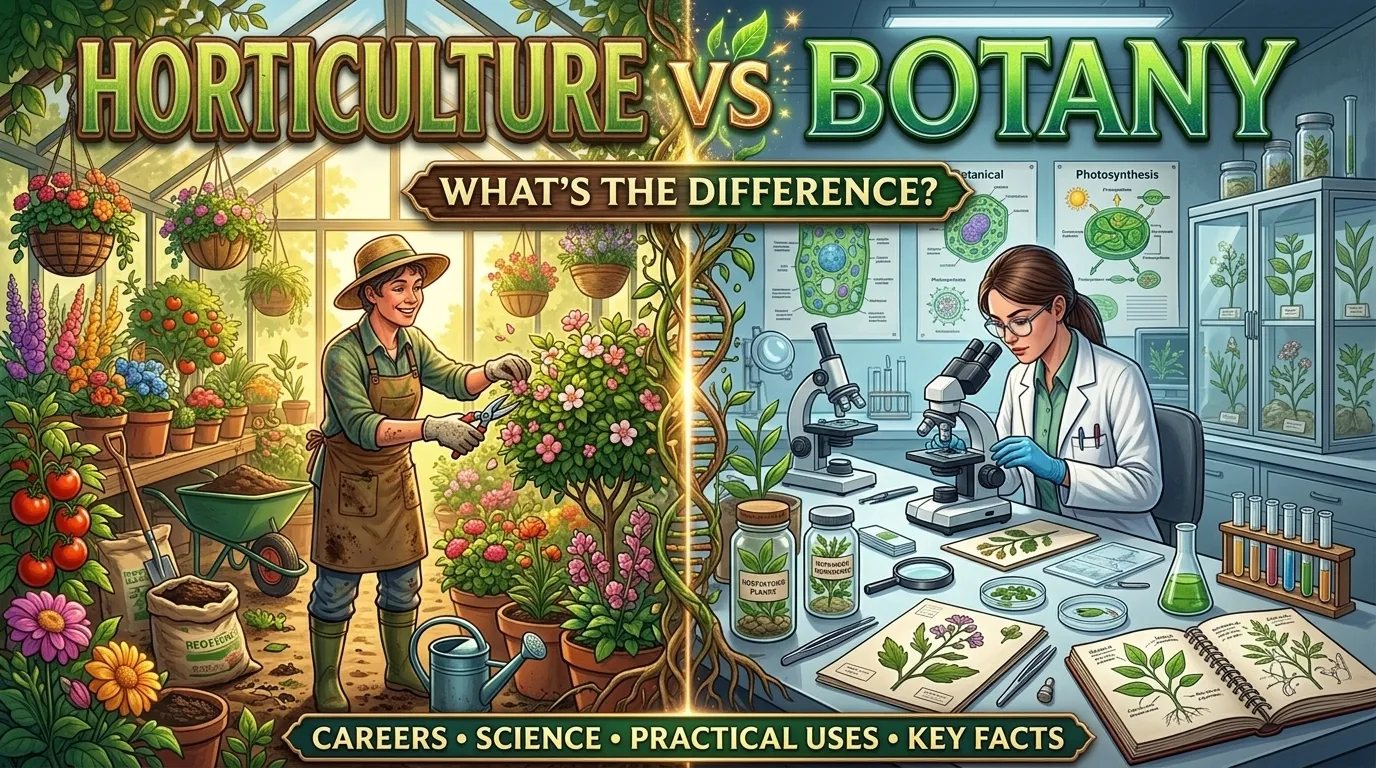
One sunny day, a student visits a garden with her teacher. She sees roses, fruit trees, and green plants. The teacher tells her that horticulture is the art and science of growing plants. Botany is the science of studying plants and how they live. Both fields help us learn about the green world, but they have different goals.
The difference between horticulture and botany is important for students, gardeners, farmers, and plant experts. Horticulture helps people grow healthy plants, fruits, and flowers. Botany helps us learn how plants grow, work, and change. The difference between horticulture and botany may seem small at first. Yet, each field has its own work and value. When we know how they differ, we can better care for plants and protect nature.
Key Difference Between Horticulture and Botany
Horticulture focuses on growing and caring for plants. It aims to improve plant growth, beauty, and food supply. Botany focuses on the study of plants. It looks at their parts, life, growth, and role in nature.
Why Is It Important to Know the Difference?
This difference helps learners choose the right field of study. A person who loves growing flowers may enjoy horticulture. A person who wants to study plant cells may enjoy botany.
Both fields also help society. Horticulture supports food, parks, and gardens. Botany helps us learn about plant life, new medicines, and the health of nature. Together, they help people grow plants and protect the Earth.
Pronunciation of Horticulture and Botany
Horticulture
- US: HOR-tih-kul-cher
- UK: haw-tih-kul-chuh
Botany
- US: BOT-uh-nee
- UK: BOT-uh-nee
Difference Between Horticulture and Botany
1. Meaning
Horticulture: It is the art and science of growing plants for food, beauty, and use.
Examples:
- A gardener grows roses in a park.
- A farmer grows tomatoes in a field.
Botany: It is the science of studying plants and their life.
Examples:
- A scientist studies how leaves make food.
- A student learns how roots take in water.
2. Main Goal
Horticulture: Its main goal is to grow strong, useful, and healthy plants.
Examples:
- A grower finds a better way to grow apples.
- A garden worker helps flowers bloom well.
Botany: Its main goal is to learn how plants live and work.
Examples:
- A scientist studies why some plants lose their leaves.
- A researcher learns how seeds begin to grow.
3. Main Focus
Horticulture: It focuses on growing plants and caring for them.
Examples:
- A gardener cuts dead branches from a tree.
- A grower adds compost to help plants grow.
Botany: It focuses on plant parts, types, and life processes.
Examples:
- A botanist studies the parts of a flower.
- A researcher looks at plant cells under a lens.
4. Workplaces
Horticulture: People in this field may work in gardens, farms, parks, and plant nurseries.
Examples:
- A worker grows young plants in a nursery.
- A garden expert plans a public park.
Botany: People in this field may work in labs, schools, museums, and research centers.
Examples:
- A scientist studies plants in a lab.
- A teacher shows students how leaves work.
5. Tools Used
Horticulture: It often uses tools that help people grow and care for plants.
Examples:
- A gardener uses shears to trim a bush.
- A grower uses a watering system for young plants.
Botany: It often uses tools that help people study plants.
Examples:
- A botanist uses a microscope to study plant cells.
- A researcher uses a camera to record plant growth.
6. Types of Questions
Horticulture: It asks how to grow plants better.
Examples:
- How much water does a tomato plant need?
- Which soil helps roses grow well?
Botany: It asks how plants live and why they act in certain ways.
Examples:
- How does a plant make food from light?
- Why do some plants grow toward the sun?
7. Skills Needed
Horticulture: It needs plant care, planning, and growing skills.
Examples:
- A grower learns when to plant seeds.
- A garden worker learns how to prune trees.
Botany: It needs close study, science skills, and careful research.
Examples:
- A student learns to name plant parts.
- A scientist compares the leaves of two plant types.
8. Food and Farming
Horticulture: It helps people grow fruits, vegetables, herbs, and nuts.
Examples:
- A grower raises strawberries for sale.
- A farmer grows lettuce for local shops.
Botany: It helps people understand plants that give us food.
Examples:
- A scientist studies how a bean plant grows.
- A researcher looks at how a plant fights disease.
9. Link to Nature
Horticulture: It helps people care for plants in gardens and green spaces.
Examples:
- A team plants trees in a school yard.
- A gardener grows flowers for bees and butterflies.
Botany: It helps people learn how plants fit into nature.
Examples:
- A botanist studies plants in a wetland.
- A scientist learns how a rare plant survives in dry soil.
10. Career Choices
Horticulture: It can lead to jobs in plant care, garden design, and crop growing.
Examples:
- A person becomes a garden designer.
- A worker runs a plant nursery.
Botany: It can lead to jobs in plant research, teaching, and nature study.
Examples:
- A person becomes a plant scientist.
- A researcher studies rare plants in forests.
The Nature and Behavior of Horticulture
Horticulture is a practical field. It puts plant knowledge to work. People use it to grow food, make gardens look good, and care for green spaces.
Horticulture also changes with the needs of people and the land. A grower may change the amount of water used in hot weather. A gardener may choose plants that can live in dry soil.
This field joins science with daily work. It uses knowledge about soil, water, light, and plant health. Its main aim is to help plants grow well and meet human needs.
The Nature and Behavior of Botany
Botany is a science that seeks answers about plants. It studies their shape, parts, growth, and life. It also looks at how plants fit into the world around them.
Botany uses careful study and tests. A botanist may look at a leaf, study a seed, or compare two plant types. Some botanists work in labs. Others study plants in forests, fields, or wetlands.
Botany is not only about naming plants. It helps us learn how plants make food, grow, and respond to changes in their homes. This knowledge can help people care for nature.
Why Do People Confuse Horticulture and Botany?
People often confuse these two fields because both deal with plants. Both use plant science, and both can take place in gardens, farms, or labs.
The main reason for the mix-up is that their work can overlap. A horticulturist may use facts found by a botanist. A botanist may study a plant that a horticulturist grows.
Still, their main goals are not the same. Horticulture uses knowledge to grow and care for plants. Botany seeks to understand plants and how they live.
A simple way to remember the difference is this: horticulture is about growing plants, while botany is about studying plants.
Horticulture vs. Botany: Differences and Similarities
| Point | Horticulture | Botany |
| Meaning | Growing and caring for plants | Studying plants |
| Main goal | Better plant growth and use | Better knowledge of plant life |
| Main work | Plant care and growing | Plant study and research |
| Common places | Gardens, farms, nurseries | Labs, schools, fields |
| Main tools | Shears, pots, watering tools | Microscopes, cameras, lab tools |
| Food link | Grows fruits and vegetables | Studies food plants |
| Nature link | Cares for green spaces | Studies plant life in nature |
| Career paths | Garden designer, grower | Botanist, plant researcher |
| Similarity | Both need plant knowledge | Both need plant knowledge |
| Shared value | Both can help protect plants | Both can help protect plants |
Which Is Better in What Situation?
Horticulture is better when the goal is to grow plants, make gardens, or improve crops. It is a good choice for people who enjoy outdoor work and caring for plants. For example, a person who wants to grow fruit trees may choose horticulture.
Botany is better when the goal is to learn how plants work. It suits people who enjoy science, research, and asking questions. For example, a student who wants to study plant cells may choose botany.
Neither field is better in every case. The right choice depends on what you want to do.
also read more about https://comparificationn.com/difference-between-wizard-and-witch-2/
How Are Horticulture and Botany Used in Metaphors and Similes?
The words horticulture and botany are not common in everyday metaphors. However, ideas linked to them often appear in speech and writing.
Horticulture in Metaphors and Similes
Horticulture can stand for care, growth, and hard work.
- Metaphor: “Her garden is a work of art.” This means the garden is planned and cared for with skill.
- Simile: “He cared for the young plants like a loving parent.” This shows care and patience.
- Metaphor: “The school garden is a living classroom.” This means students learn by growing plants.
Botany in Metaphors and Similes
Botany can stand for learning, close study, and the search for facts.
- Metaphor: “The forest is an open book.” This means people can learn much by studying it.
- Simile: “The botanist watched the plant like a careful guard.” This shows close attention.
- Metaphor: “Each leaf is a tiny science lab.” This points to the work that happens inside a leaf.
These examples use plant science to explain ideas in a simple and clear way.
Connotative Meaning of Horticulture and Botany
A word’s connotative meaning is the feeling or idea linked to it. The same word can bring different feelings to different people.
Horticulture: Positive, Negative, and Neutral Meanings
Positive meaning: Horticulture can bring to mind beauty, care, food, and growth.
Example: “Her work in horticulture turned an empty yard into a bright garden.”
Negative meaning: Some people may link horticulture with hard work, high costs, or the need for much care.
Example: “The old garden became a burden because its horticulture needs took too much time.”
Neutral meaning: Horticulture can simply name a field of study or work.
Example: “He plans to study horticulture at college.”
Botany: Positive, Negative, and Neutral Meanings
Positive meaning: Botany can bring to mind learning, discovery, and care for nature.
Example: “Botany helped the class learn why trees matter.”
Negative meaning: Some people may see botany as hard or dull because it can involve long study and complex terms.
Example: “She found botany hard because the plant names were new to her.”
Neutral meaning: Botany can simply refer to the science of plants.
Example: “Botany is part of the school’s science course.”
These feelings are personal. Neither word is good or bad by itself.
Idioms and Proverbs Related to Horticulture and Botany
There are few common idioms that use the exact words horticulture or botany. But many sayings about plants and growth fit both fields.
1. “A Seed Well Sown”
This phrase points to a good start that may bring good results later.
Example: “Teaching children to care for plants is a seed well sown.”
2. “Reap What You Sow”
This saying means that your actions often shape your results.
Example: “The grower cared for the soil all year and reaped what he sowed when the crops grew well.”
3. “Come Up Roses”
This means that things turn out well.
Example: “After weeks of care, the school garden came up roses.”
4. “Barking Up the Wrong Tree”
This means looking in the wrong place or blaming the wrong cause.
Example: “The botanist was barking up the wrong tree when he blamed poor soil for a plant disease.”
5. “Put Down Roots”
This means to settle in a place or build a strong base.
Example: “The family put down roots by planting a garden in their new home.”
These sayings are not technical terms. They are useful ways to link plant ideas with daily life.
Works in Literature Related to Horticulture and Botany
The works below link to gardens, plants, nature, or plant study. Not all of them focus on horticulture or botany as a science.
- The Secret Garden — Children’s novel, by Frances Hodgson Burnett, 1911. It tells the story of children who bring a hidden garden back to life.
- The Botanic Garden — Poetry, by Erasmus Darwin, 1789–1791. This work explores science and nature through verse.
- Walden — Nature writing, by Henry David Thoreau, 1854. It shares thoughts on simple living and the natural world.
- The Natural History of Selborne — Natural history, by Gilbert White, 1789. It records close study of plants, animals, and the seasons.
- Braiding Sweetgrass — Nature writing, by Robin Wall Kimmerer, 2013. It links plant knowledge, science, and care for the natural world.
These books can help readers see why plants matter in both science and daily life.
Movies Related to Horticulture and Botany
These films are related to plants, gardens, farming, or the natural world. They do not all focus on horticulture or botany as a formal field.
- The Secret Garden — 1993, United States and United Kingdom. This film follows children who care for a hidden garden.
- The Lorax — 2012, United States. This animated film shows why trees and the environment need care.
- Wall-E — 2008, United States. This animated film shows a future where a small plant gives people hope.
- The Biggest Little Farm — 2018, United States. This documentary follows a couple as they build a farm and work with nature.
- Fantastic Fungi — 2019, United States. This documentary explores fungi and their role in nature. Fungi are not plants, but they are important to many natural systems.
These films can help viewers think about green spaces, living things, and the need to care for our planet.
Five Possible Asked Questions
1. Is horticulture a branch of botany?
No. Horticulture and botany are linked fields, but they have different goals. Botany studies plants, while horticulture uses plant knowledge to grow and care for them.
2. Can a botanist work in horticulture?
Yes. A botanist can use plant science to help growers and gardeners. Knowledge of plant growth and health can be useful in horticulture.
3. Does horticulture include farming?
Yes. Horticulture includes growing fruits, vegetables, flowers, herbs, and other garden crops. It does not cover every type of farming.
4. Does botany study all plants?
Botany studies plants in many forms, from tiny mosses to large trees. It looks at their parts, growth, life, and links to nature.
5. Which subject is easier to study?
It depends on your interests and skills. Horticulture may suit people who enjoy hands-on plant care. Botany may suit people who enjoy science and research. Both need study and practice.
How Are Horticulture and Botany Useful for Our Surroundings?
Horticulture and botany both help make our surroundings healthier and more pleasant.
Horticulture helps people grow gardens, parks, and food crops. It can add green spaces to towns and homes. Good plant care can also help flowers and trees stay healthy.
Botany helps people learn which plants grow in certain places and what they need to live. This knowledge can guide efforts to protect rare plants and care for natural areas.
Both fields can support bees, birds, and other living things by helping people protect plant life. They also teach us to value trees, flowers, and food plants. When used together, horticulture and botany can help build greener towns and protect nature for future generations.
Final Words on Horticulture and Botany
Horticulture and botany both focus on plants, but they serve different needs. Horticulture is about growing and caring for plants. Botany is about studying plants and learning how they live.
One field puts plant knowledge into action. The other builds that knowledge through study and research. Their work can overlap, and both help people understand the value of plants.
If you want to grow flowers, fruit, or vegetables, horticulture may be right for you. If you want to study plant life, botany may be a better fit. Both are useful paths for anyone who cares about plants and the world around them.
Conclusion
The difference between horticulture and botany lies in their main goals. Horticulture helps people grow and care for plants. Botany helps people study plants and learn how they work. Both fields play an important role in our lives.
Horticulture helps provide food, bright gardens, and green spaces. Botany helps us understand plant growth, plant health, and the role of plants in nature. The two fields also support each other. A horticulturist can use facts from botany to grow plants well, while a botanist can learn from plants grown in gardens and farms.
Neither field is more useful in every case. The best choice depends on your goals. By learning about both, we can care for plants, support nature, and help keep our surroundings green and healthy.

I’m Zahid Abbas, an educator, researcher, and digital publishing strategist with a passion for linguistics, grammar, and clear communication. As a content creator and SEO specialist, I craft research-driven, reader-focused content that empowers learners and makes knowledge accessible worldwide.










