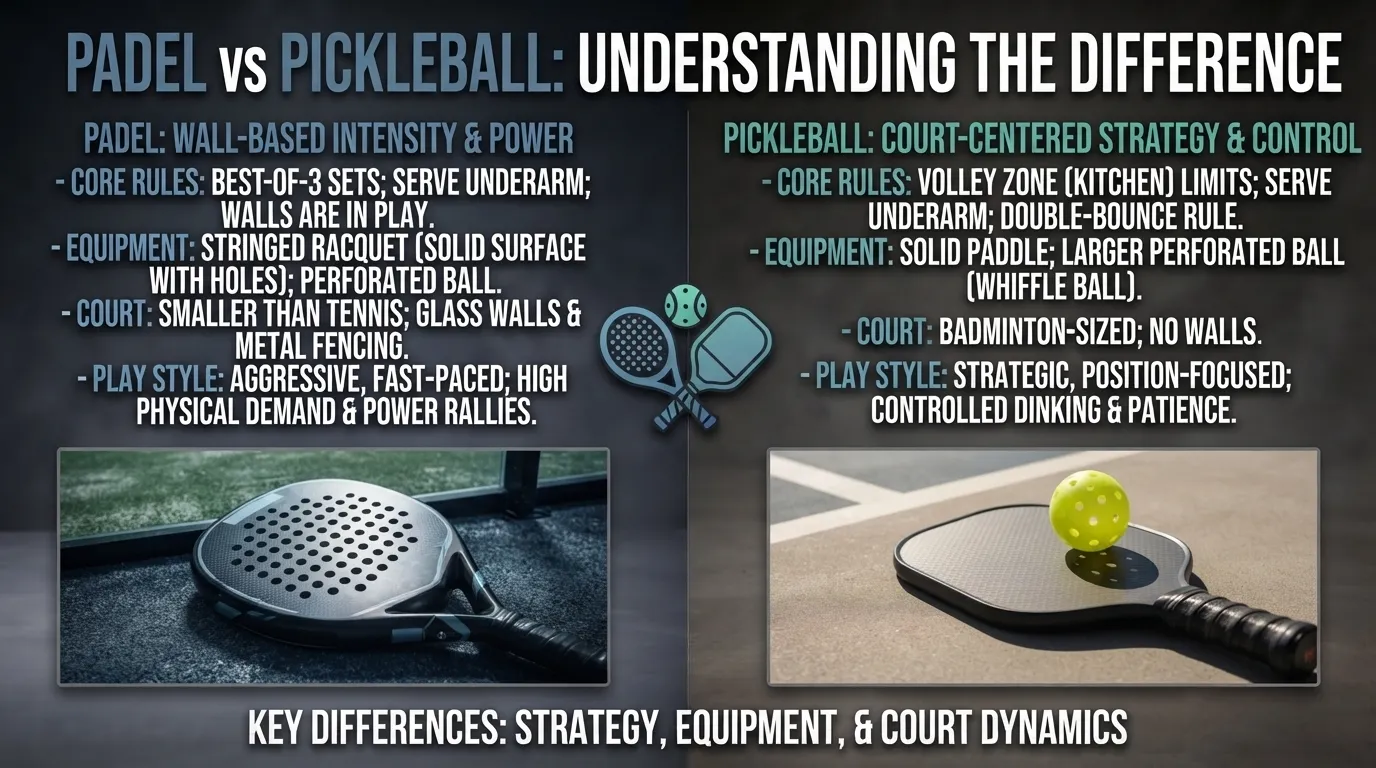
Last summer, my cousin invited me to a new sports club. She said, “Let’s play padel.” I showed up ready to play pickleball, since I had seen it all over social media. We stood at the court, confused. Her court had glass walls all around it. My idea of the game had no walls at all. We had mixed up two very different sports. Padel vs pickleball is a common mix-up these days. Both are paddle sports. Both are growing fast around the world. But padel and pickleball look, feel, and play in very different ways. Once you learn the real padel vs pickleball difference, you will never confuse them again. This guide breaks down padel vs pickleball in plain, simple words.
Key Difference Between Padel and Pickleball
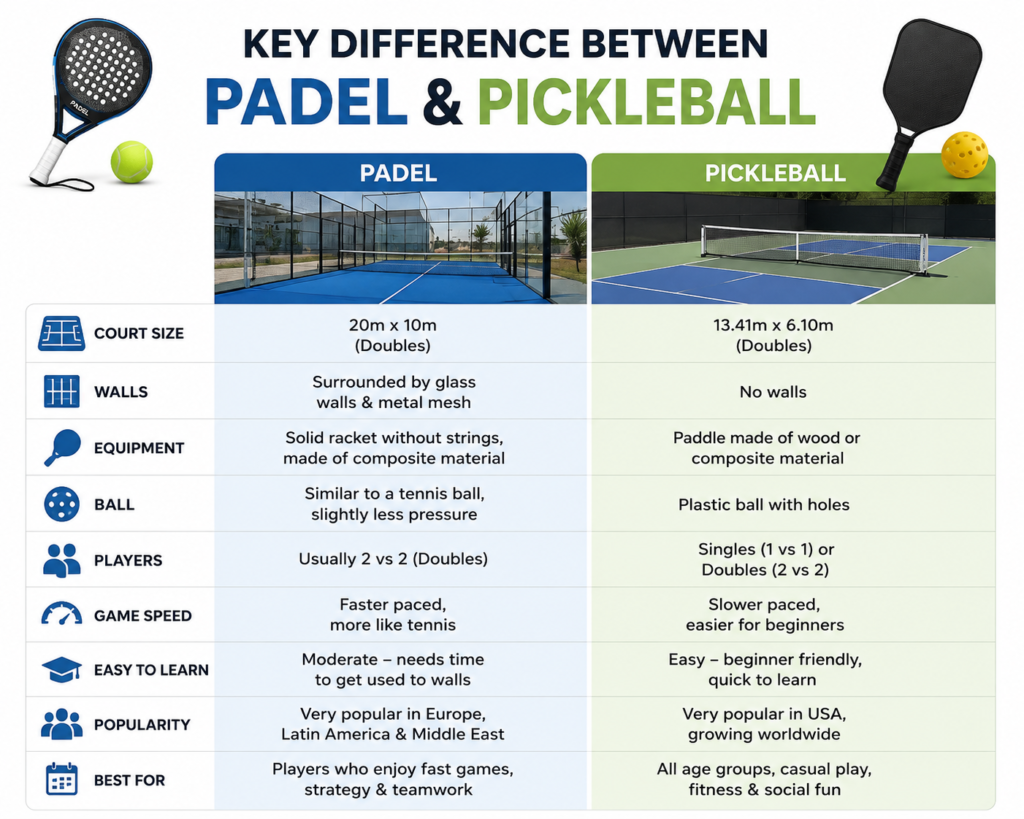
Padel is played inside an enclosed court with glass walls. Players can hit the ball off the walls, much like squash. Pickleball is played on an open court with no walls, more like a small tennis court. The ball must stay inside the lines, not bounce off any wall.
Why This Difference Matters for Learners and Experts
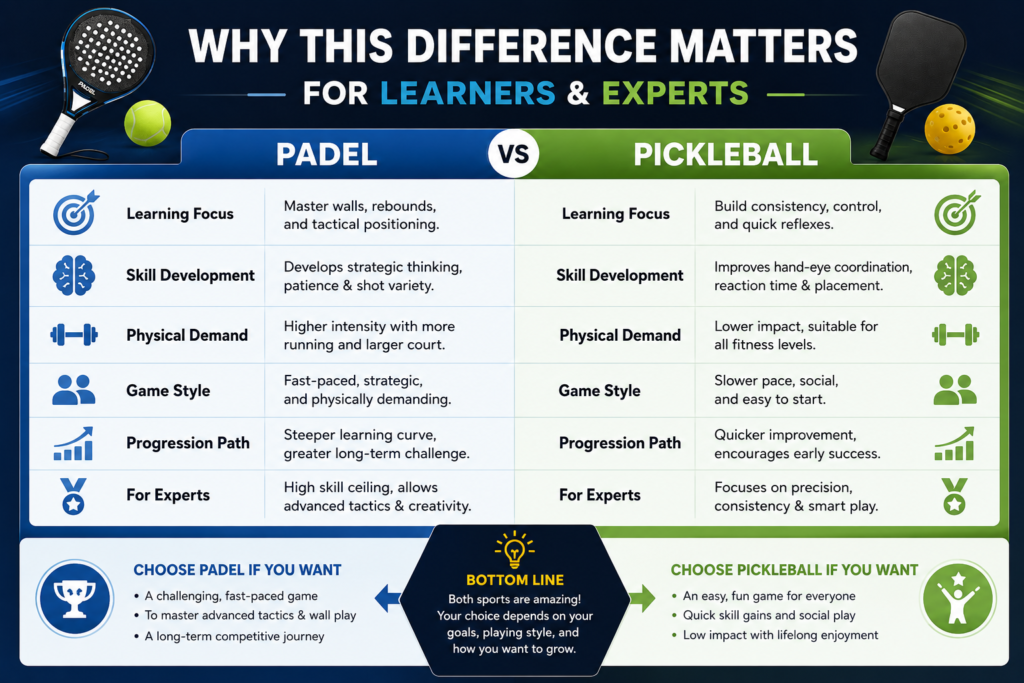
For new players, this difference decides which sport fits their space, skill, and style. Picking the wrong one can lead to confusion on the court. For coaches, sports writers, and club owners, knowing padel vs pickleball helps them teach clearly and build the right facilities. Sports bring people together. They build health, friendships, and community spirit. Knowing the true difference between padel and pickleball helps more people join in, enjoy the right game for them, and grow these fast-rising sports the right way.
Pronunciation
Padel
- US English: /pəˈdɛl/ — said as “puh-DELL,” with the stress on the second part.
- UK English: /pəˈdɛl/ — said the same way, “puh-DELL.” Some new players mistakenly say “PAD-el,” but the correct sound rhymes with “propel.”
Pickleball
- US English: /ˈpɪkəlbɔːl/ — said as “PICK-el-ball,” a simple, clear compound word.
- UK English: /ˈpɪkəlbɔːl/ — said the same way, “PICK-el-ball.” Both countries pronounce this word almost identically.
Difference Between Padel and Pickleball
1. Court design Padel is played inside an enclosed court with glass or mesh walls. Pickleball is played on an open court with no walls at all. Example 1: A padel ball can bounce off the back glass wall and stay in play. Example 2: A pickleball that flies past the baseline is simply out, since there is no wall to stop it.
2. Country of origin Padel began in Mexico in 1969. Pickleball began in the United States in 1965. Example 1: A businessman named Enrique Corcuera built the first padel court at his home in Mexico. Example 2: Three dads on Bainbridge Island, Washington, invented pickleball to entertain their bored kids.
3. Ball type Padel uses a low-pressure ball, similar to a tennis ball but softer. Pickleball uses a hard plastic ball full of small holes, like a wiffle ball. Example 1: A padel ball bounces lower and slower than a normal tennis ball. Example 2: A pickleball makes a light, hollow sound when it hits the paddle, due to its holes.
4. Paddle design Padel paddles are solid but full of small holes. Pickleball paddles are solid with no holes at all. Example 1: A padel paddle looks a bit like a cheese grater, with many small holes across its face. Example 2: A pickleball paddle looks flat and smooth, much like a large ping pong paddle.
5. Number of players allowed Padel is almost always played in doubles, with two players on each side. Pickleball can be played in singles or doubles. Example 1: Padel clubs are built around four players sharing one court at a time. Example 2: Pickleball players can enjoy a quick one-on-one match or a doubles game with friends.
6. Court size A padel court is smaller than a tennis court but has walls that add extra playing space. A pickleball court is even smaller, close to the size of a badminton court. Example 1: A padel court measures about 20 meters long and 10 meters wide. Example 2: A pickleball court measures about 13.4 meters long and 6.1 meters wide.
7. Use of walls in strategy In padel, players use wall bounces as part of their strategy, aiming shots that bounce cleverly off the glass. In pickleball, there are no walls, so all strategy depends on placement and speed within the lines. Example 1: A skilled padel player may aim a shot to bounce off the side wall and confuse their opponent. Example 2: A skilled pickleball player may aim a soft shot just over the net, since there is no wall to help the ball stay in.
8. Popularity by region Padel is hugely popular in Spain, Latin America, and parts of Europe. Pickleball is hugely popular in the United States and growing fast in Canada. Example 1: Spain has thousands of padel clubs and millions of active players. Example 2: Many American neighborhoods now paint pickleball lines directly onto old tennis courts.
9. Learning curve Padel can feel tricky at first, since players must learn how to use the walls. Pickleball tends to feel easier to pick up quickly, since the rules stay close to simple tennis basics. Example 1: A new padel player may struggle to judge how the ball will bounce off the glass. Example 2: A new pickleball player can often rally within their first few minutes on the court.
10. Net height and serving style Padel uses a net height and serving style close to tennis, with an underhand serve. Pickleball also uses an underhand serve, but with its own specific rules, like serving diagonally and letting the ball bounce once before certain shots. Example 1: A padel serve must be hit underhand, below waist height, similar to squash-style serving. Example 2: A pickleball serve must clear a “kitchen” zone near the net, a rule unique to the sport.
The Nature and Behavior of Padel
Padel behaves like a fast, clever, wall-based game. Its nature rewards patience and smart shot placement, since players can use the walls to extend rallies and set up tricky angles. It shares some spirit with squash, where reading the bounce off a wall becomes just as important as the swing itself.
The Nature and Behavior of Pickleball
Pickleball behaves like a light, quick, and social game. Its nature rewards fast reflexes and soft, controlled shots, especially near the net. Since there are no walls, every shot must land within the lines, making placement and timing more important than raw power.
Why Do People Get Confused Between Padel and Pickleball?
Three reasons cause this mix-up. First, both sports use paddles instead of rackets, so they sound similar at first. Second, both have grown in popularity around the same time, often appearing together in sports news and social media. Third, both games are newer to many countries, so casual fans have not yet learned the clear rules and setup that separate padel from pickleball.
Padel vs Pickleball: Comparison Table
| Aspect | Padel | Pickleball |
| Court type | Enclosed, with walls | Open, no walls |
| Origin | Mexico, 1969 | United States, 1965 |
| Ball type | Low-pressure, tennis-like | Hard plastic, full of holes |
| Paddle type | Solid, with small holes | Solid, no holes |
| Players | Doubles only | Singles or doubles |
| Court size | Larger, about 20m x 10m | Smaller, about 13.4m x 6.1m |
| Similarity | Both use solid paddles instead of strung rackets | |
| Similarity | Both are fast-growing, social, easy-to-learn racket sports |
Which Is Better in What Situation?
If you enjoy strategy, wall bounces, and playing doubles with friends, padel is the better choice. Its enclosed court keeps the ball in play longer, making rallies exciting and social.
If you want a fast, easy sport to learn with fewer space needs, pickleball is the better choice. Its smaller court and simple rules make it easy to set up almost anywhere, even on an old tennis or basketball court.
For most beginners, the right choice often comes down to access. Choose padel if your area has enclosed courts and enjoys doubles play, and choose pickleball if you want something quick to learn with wide, easy access.
How Are Padel and Pickleball Used in Metaphors and Similes?
Since both sports are still fairly new, they do not yet appear in classic idioms. But writers and players sometimes create playful comparisons:
- “Bouncing around like a padel ball off the glass” — used to describe someone moving unpredictably or energetically.
- “Quick as a pickleball rally” — used to describe something fast-paced and full of quick back-and-forth action.
These are casual, modern comparisons, not fixed sayings.
Connotative Meaning
Padel
- Positive: Suggests fun, social energy, and a trendy lifestyle. Example: “We booked a padel court for a fun weekend hangout.”
- Negative: Rarely negative, though some may see it as an expensive hobby. Example: “Padel courts and gear can get pricey for casual players.”
- Neutral: Used plainly to describe the sport. Example: “Padel combines elements of tennis and squash.”
Pickleball
- Positive: Suggests friendliness, easy fun, and community spirit. Example: “Our neighborhood pickleball nights bring everyone together.”
- Negative: Sometimes joked about as a trend for older adults or beginners only. Example: “Some serious athletes still see pickleball as too casual a sport.”
- Neutral: Used plainly to describe the sport. Example: “Pickleball uses a plastic ball and solid paddles.”
Idioms or Proverbs
There are no known idioms or proverbs built around “padel” or “pickleball.” Both are still fairly modern sports, and neither term has been around long enough to enter everyday sayings. It is more honest to say this clearly than to invent fake idioms.
Works of Literature Featuring the Terms
None found. No well-known novels, poems, or plays center on “padel” or “pickleball.” Both sports mostly appear in sports guides, news articles, and how-to content, not in major literary works.
Movies Made on These Terms
None found. There are no widely known feature films built around “padel” or “pickleball” as their main subject. Both sports have grown mostly through social media, local clubs, and word of mouth rather than film or television.
Five Frequently Asked Questions
1. Which sport is easier to learn, padel or pickleball? Most beginners find pickleball easier to learn quickly, since its rules stay close to simple tennis and there are no walls to judge.
2. Do padel and pickleball use the same paddle? No. Padel paddles have small holes across their face. Pickleball paddles are solid, with no holes allowed under standard rules.
3. Can I play padel alone, like a solo sport? No. Padel is almost always played in doubles, with two players on each side of the net.
4. Why is pickleball so popular in the US right now? Pickleball is popular because it needs a small court, low-cost gear, and simple rules, making it easy to play at parks, gyms, and driveways.
5. Is padel similar to squash or tennis? Padel borrows ideas from both. It uses walls like squash and a net and scoring style similar to tennis.
How Are Padel and Pickleball Useful for Our Surroundings?
Both sports bring real value to communities. They give people an easy way to stay active, meet new friends, and enjoy time outdoors or in local clubs. Padel often brings people together in social, doubles-based matches, building strong local sports communities, especially in Europe and Latin America. Pickleball often brings together players of many ages, from kids to grandparents, using shared park spaces and low-cost equipment. Together, these sports help build healthier, more connected neighborhoods, one match at a time.
Final Words
Padel and pickleball are not the same sport, even though people often mix them up. One uses walls and doubles play. The other uses open courts and simple rules. Knowing the difference helps you pick the right sport, find the right court, and enjoy your game with confidence.
Conclusion
Padel vs pickleball question comes down to court design, equipment, and play style. Padel is played inside enclosed courts with wall bounces and doubles-only matches, while pickleball is played on small, open courts with simple, tennis-like rules. Knowing padel vs pickleball helps new players choose the right sport for their space and skill level, helps coaches teach clearly, and helps communities build the right facilities as both sports keep growing. Whether you love clever wall shots or fast, simple rallies, understanding padel vs pickleball helps you jump into the right game with confidence.

I’m Zahid Abbas, an educator, researcher, and digital publishing strategist with a passion for linguistics, grammar, and clear communication. As a content creator and SEO specialist, I craft research-driven, reader-focused content that empowers learners and makes knowledge accessible worldwide.