Last week, Ali went to the doctor because he had severe constipation. The doctor gave him two choices: a suppository or an enema. Ali felt confused because both seemed similar. Many people ask about the difference between suppository and enema because both help with bowel problems. Still, they work in different ways.
Knowing the difference between suppository and enema is useful for students, patients, and English learners. These medical words are common in hospitals, pharmacies, and health articles. If you understand them, you can follow medical advice more easily. In this guide, you will learn simple meanings, uses, examples, and key differences in very easy English.
What is “Suppository”?
A suppository is a small medicine placed inside the rectum. It melts slowly because of body heat. Then the medicine starts working inside the body. Doctors often use suppositories for constipation, fever, pain, or nausea.
A suppository is usually soft and shaped like a small cone or bullet. People use it when swallowing medicine is hard.
History of Suppository
Suppositories have been used for thousands of years. Ancient Egyptians and Greeks used natural oils and herbs as rectal medicine. In the 1800s, doctors started making modern suppositories with cocoa butter and medical chemicals. Later, factories produced them in clean and safe forms. Today, suppositories are common in hospitals and homes. They help people who cannot take medicine by mouth. Over time, they became safer, easier to use, and more effective for many health problems around the world.
What is “Enema”?
An enema is a liquid pushed into the rectum through a small tube. It helps clean the bowels or soften stool. Doctors often use enemas before surgery or medical tests.
Some enemas contain medicine, while others only contain water or saline solution.
History of Enema
Enemas also have a very old history. Ancient people in Africa, Egypt, and Greece used hollow tubes and water to clean the bowels. In the 17th century, enemas became very popular in Europe. Doctors believed they could remove harmful waste from the body. Later, modern medicine improved enema tools and liquids. Today, enemas are used for constipation, medical exams, and some treatments. Hospitals now use safe plastic equipment and measured liquids to make the process cleaner and more comfortable for patients.
Suppository vs Enema
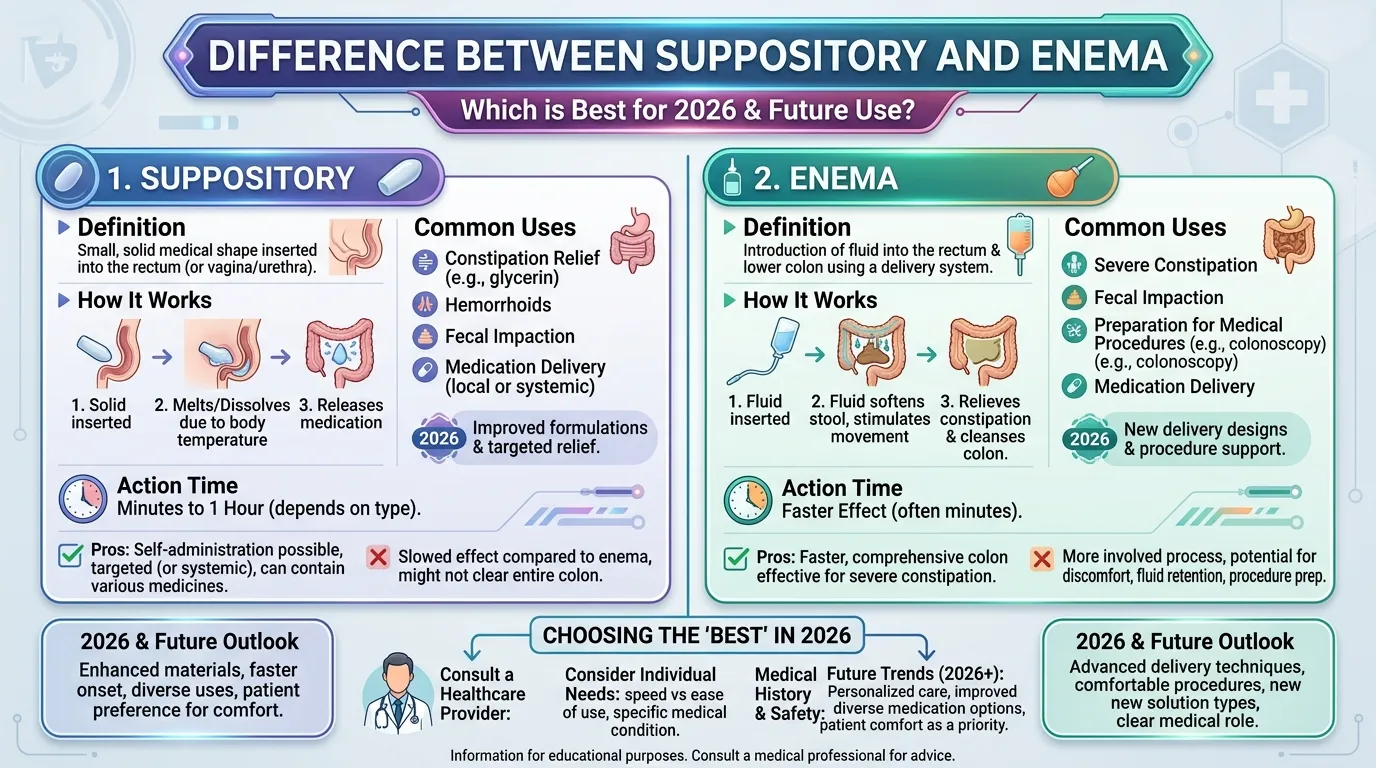
A suppository is a solid medicine placed in the rectum, while an enema is a liquid inserted into the rectum for cleaning or treatment.
Both help bowel problems, but they work differently. Let us explore them in detail.
How “Suppository” Works
A suppository melts inside the body after insertion. Then the medicine enters the blood or softens stool.
Key Features
- Solid form of medicine
- Small and easy to insert
- Melts with body heat
- Often used for constipation
- Can reduce pain or fever
🔵 The doctor gave Sara a suppository for constipation.
🔵 My child used a suppository because he could not swallow medicine.
Uses
- Treating constipation
- Giving medicine to sick patients
- Reducing fever
- Helping people with nausea
- Pain relief
How “Enema” Works
An enema pushes liquid into the rectum. The liquid softens stool and cleans the bowel quickly.
Key Features
- Liquid form
- Uses a tube or bottle
- Cleans the bowel fast
- Often used before surgery
- Can contain medicine
🟢 The nurse used an enema before the patient’s test.
🟢 My grandfather used an enema for severe constipation.
Uses
- Cleaning the intestines
- Treating constipation
- Preparing for medical exams
- Giving medicine through liquid
Which One Should You Use?
A suppository is better for mild constipation or medicine delivery. It is smaller and easier for many people.
An enema is better for deep bowel cleaning or severe constipation. Doctors often recommend it before surgery or scans.
10 Differences Between Suppository and Enema
1. Form
Suppository
A suppository is solid.
🔴 The suppository melted after insertion.
🔴 She used a glycerin suppository yesterday.
Enema
An enema is liquid.
🔴 The enema bottle contained saline water.
🔴 The nurse prepared the liquid enema carefully.
2. Method of Use
Suppository
It is placed inside the rectum by hand.
🔴 He inserted the suppository slowly.
🔴 The medicine entered the body quickly.
Enema
It uses a tube or nozzle.
🔴 The doctor inserted the enema tube gently.
🔴 The liquid flowed into the bowel.
3. Speed
Suppository
It works slowly.
🔴 The suppository worked after 30 minutes.
🔴 She waited for the medicine to melt.
Enema
It works faster.
🔴 The enema cleaned the bowel quickly.
🔴 He felt relief within minutes.
4. Purpose
Suppository
It mainly delivers medicine.
🔴 The suppository reduced his fever.
🔴 The child used it for pain relief.
Enema
It mainly cleans the bowel.
🔴 The enema removed waste from the intestines.
🔴 The patient used it before surgery.
5. Size
Suppository
It is small.
🔴 The suppository looked like a tiny cone.
🔴 She carried it easily in her bag.
Enema
It is larger because it contains liquid.
🔴 The enema kit was large.
🔴 The bottle held warm water.
6. Comfort Level
Suppository
Many people find it more comfortable.
🔴 The suppository caused little discomfort.
🔴 He preferred it over liquid treatment.
Enema
Some people find it uncomfortable.
🔴 The enema felt strange at first.
🔴 The patient felt pressure during use.
7. Medical Use
Suppository
Used for fever, pain, and nausea.
🔴 Doctors use suppositories for children.
🔴 It helped stop vomiting.
Enema
Used before medical tests.
🔴 The enema prepared the bowel for surgery.
🔴 The clinic used enemas before scans.
8. Ingredients
Suppository
Contains fats or medicine.
🔴 Cocoa butter is common in suppositories.
🔴 The medicine melted with body heat.
Enema
Contains water or saline liquid.
🔴 The saline enema softened the stool.
🔴 Some enemas contain soap solution.
9. Ease of Travel
Suppository
Easy to carry.
🔴 She packed suppositories for travel.
🔴 They fit inside a small box.
Enema
Harder to carry.
🔴 The enema kit needed more space.
🔴 Liquid bottles can leak during travel.
10. Cleaning Effect
Suppository
Provides less bowel cleaning.
🔴 The suppository softened stool only.
🔴 It did not fully clean the intestines.
Enema
Provides full bowel cleaning.
🔴 The enema emptied the bowel completely.
🔴 Doctors used it before examination.
Why People Get Confused About Their Use
People often confuse suppositories and enemas because both are inserted into the rectum. Both also help constipation and bowel problems. Their medical use seems similar at first. However, one is solid and the other is liquid. They also work at different speeds and for different purposes.
Table: Difference and Similarity
| Feature | Suppository | Enema | Similarity |
| Form | Solid | Liquid | Both enter the rectum |
| Main Use | Medicine delivery | Bowel cleaning | Both help constipation |
| Speed | Slower | Faster | Both can give relief |
| Size | Small | Larger | Both need careful use |
| Comfort | Usually easier | Sometimes uncomfortable | Both are medical treatments |
| Equipment | No tube needed | Tube or bottle needed | Both require hygiene |
Which is Better in What Situation?
A suppository is better for mild constipation, fever, or pain relief. It is simple and easy to use at home. Children and old age patients often use it because swallowing medicine can be difficult.
An enema is better for severe constipation or bowel cleaning before surgery. It works faster and cleans more deeply. Doctors often recommend it before medical tests or hospital procedures.
How Are “Suppository” and “Enema” Used in Metaphors and Similes?
🟣 “The quick solution was like an enema cleaning out old problems.”
🟣 “Her advice worked like a suppository, slowly fixing the issue.”
🟣 “The new policy flushed problems away like an enema.”
Connotative Meaning
Both words usually have a neutral medical meaning. Sometimes people feel embarrassed because they involve rectal treatment.
🟣 Positive: “The suppository gave fast relief.”
🟣 Neutral: “The doctor explained the enema procedure.”
🟣 Negative: “He feared using an enema.”
Idioms or Proverbs
There are no common English idioms directly related to suppositories or enemas. Still, people sometimes use funny informal expressions.
🟣 “Clean out the system” means removing problems completely.
Example: “The new rules cleaned out the system.”
🟣 “Hard pill to swallow” means difficult truth.
Example: “The bad news was a hard pill to swallow.”
Works in Literature
🟣 The Anatomy of Melancholy — The Anatomy of Melancholy by Robert Burton (1621) mentions old medical treatments like enemas.
🟣 The Canterbury Tales — The Canterbury Tales by Geoffrey Chaucer (1400s) discusses medieval medicine practices.
Movies Related to the Keywords
🟣 Patch Adams — 1998, USA — A medical comedy-drama about doctors and patients.
🟣 The Doctor — 1991, USA — Shows hospital life and medical treatments.
Questions
1. What is the main difference between suppository and enema?
A suppository is solid medicine, while an enema is liquid treatment.
2. Which works faster?
An enema usually works faster than a suppository.
3. Are both used for constipation?
Yes, both can help constipation.
4. Can children use suppositories?
Yes, doctors often give suppositories to children.
5. Do enemas hurt?
Most enemas do not hurt, but they may feel uncomfortable.
Final Words
Medical words can sound confusing at first. Still, learning them makes health information easier to understand. Suppositories and enemas both help people feel better, but they work in different ways. When you know their uses and meanings, you can speak and read about health topics with more confidence.
Conclusion
Understanding the difference between suppository and enema is important for daily health knowledge. A suppository is a small solid medicine that melts inside the body, while an enema is a liquid used to clean or treat the bowel. Both are helpful, but doctors use them for different reasons. Suppositories are often easier and more comfortable for mild problems. Enemas work faster and clean more deeply. By learning these simple differences, students, patients, and English learners can better understand medical advice and health discussions.

I’m Zahid Abbas, an educator, researcher, and digital publishing strategist with a passion for linguistics, grammar, and clear communication. As a content creator and SEO specialist, I craft research-driven, reader-focused content that empowers learners and makes knowledge accessible worldwide.