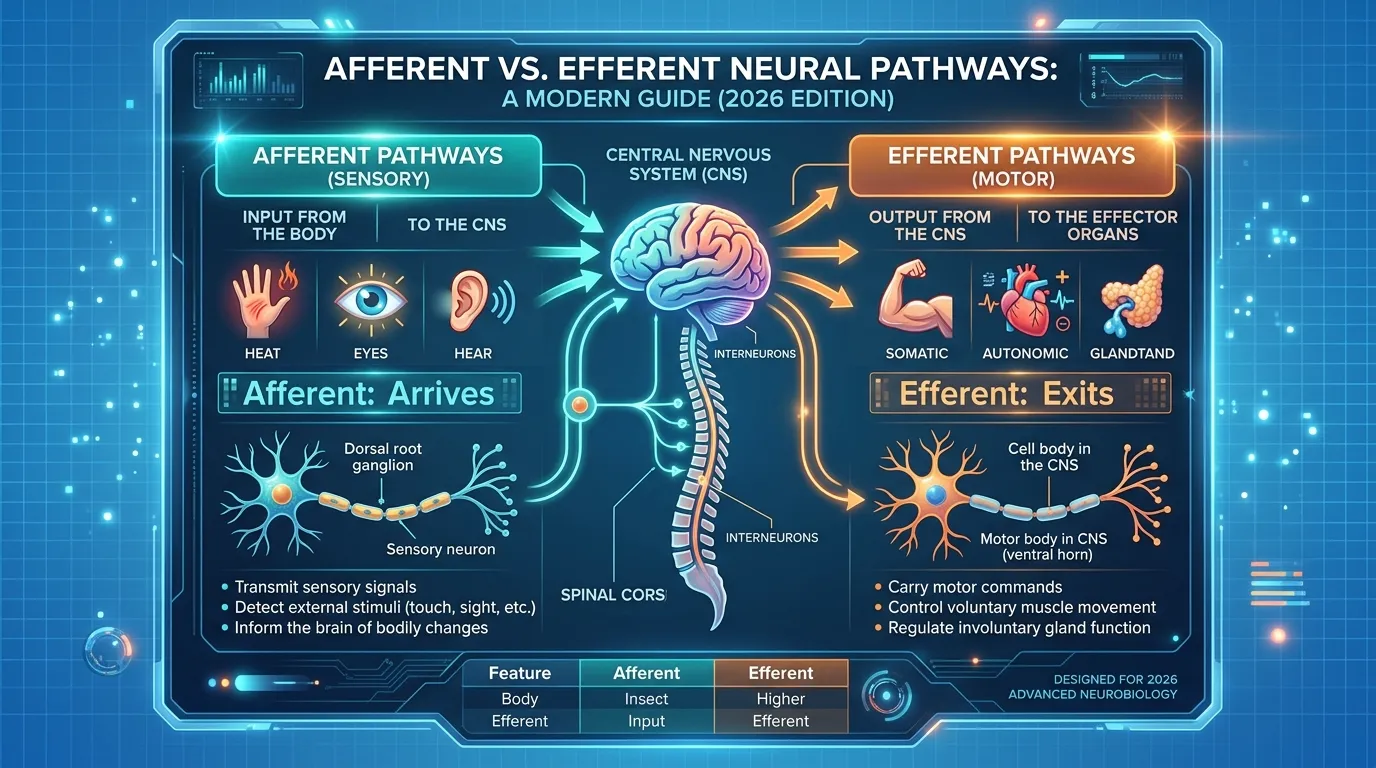
A boy touches a hot pan in the kitchen. In one second, his hand pulls away. But how did his body react so fast? Special nerves carried messages between his hand and brain. This is where the difference between afferent and efferent becomes important.
Many students find the difference between afferent and efferent confusing because the words sound very similar. Still, the idea is simple once you know the direction of the signals. Afferent nerves carry signals to the brain. Efferent nerves carry signals away from the brain to muscles and organs. Learning the difference between afferent and efferent helps students, medical learners, and English learners understand the nervous system more clearly.
What is “Afferent”?
Afferent means carrying signals toward the brain or central nervous system. These nerves bring sensory information from the body.
History of Afferent
The word “afferent” comes from a Latin word meaning “to bring toward.” Early scientists and doctors used this term while studying the nervous system and body signals. As medical science improved, researchers discovered that some nerves carried information from the skin, eyes, ears, and other body parts to the brain. They named these nerves afferent nerves because they moved signals inward. Today, doctors, nurses, and biology students use the word afferent to explain how the body senses pain, touch, heat, sound, and many other feelings.
What is “Efferent”?
Efferent means carrying signals away from the brain or central nervous system. These nerves send commands to muscles and organs.
History of Efferent
The word “efferent” also comes from Latin and means “to carry away.” Scientists used this word after learning that some nerves move instructions from the brain to the rest of the body. These nerves help muscles move and organs work correctly. Over time, the term became common in biology, medicine, and anatomy studies. Today, doctors and teachers use the word efferent to explain body movement, reflexes, breathing, and muscle control. It is an important term in learning how the nervous system sends responses through the body.
Afferent vs Efferent
Afferent nerves carry sensory signals to the brain, while efferent nerves carry motor signals away from the brain.
Now let us explore both terms in a simple and clear way.
How Afferent Works
Afferent nerves collect information from the body and send it to the brain.
Key Features
- Carry sensory signals
- Move toward the brain
- Help with touch and pain
- Part of the nervous system
- Connected with body senses
Example Sentences
🔵 Afferent nerves carried the pain signal to the brain.
🔵 The doctor explained how afferent pathways work.
Uses
- Biology studies
- Medical learning
- Understanding body senses
- Nervous system education
- Reflex actions
How Efferent Works
Efferent nerves send instructions from the brain to muscles and organs.
Key Features
- Carry motor signals
- Move away from the brain
- Control muscles
- Help body movement
- Send brain commands
Example Sentences
🟢 Efferent nerves helped the boy move his hand.
🟢 The brain used efferent signals to control the legs.
Uses
- Movement control
- Muscle action
- Medical science
- Reflex response
- Brain communication
Which One Should You Use?
Use afferent when talking about signals going to the brain. Use efferent when talking about signals leaving the brain toward muscles or organs.
10 Differences Between Afferent and Efferent
1. Signal Direction
Afferent: Afferent signals move toward the brain.
🔴 Afferent nerves carried heat signals.
🔴 The skin sent messages to the brain.
Efferent: Efferent signals move away from the brain.
🔴 Efferent nerves moved the arm.
🔴 The brain sent commands to muscles.
2. Main Function
Afferent: Afferent nerves handle sensation.
🔴 The body felt pain through afferent nerves.
🔴 Afferent fibers sensed cold weather.
Efferent: Efferent nerves handle movement.
🔴 Efferent nerves helped him walk.
🔴 The muscles moved after brain signals.
3. Type of Information
Afferent: Afferent nerves carry sensory information.
🔴 The eyes sent visual signals.
🔴 The ears sent sound information.
Efferent: Efferent nerves carry motor information.
🔴 The brain ordered the hand to move.
🔴 Leg muscles received commands.
4. Body Role
Afferent: Afferent nerves help the body feel.
🔴 She felt the warm cup.
🔴 He noticed sharp pain quickly.
Efferent: Efferent nerves help the body act.
🔴 He jumped away from danger.
🔴 She lifted the heavy box.
5. Brain Connection
Afferent: Afferent nerves send messages into the brain.
🔴 The signal entered the spinal cord.
🔴 Sensory nerves reached the brain.
Efferent: Efferent nerves send messages out from the brain.
🔴 The brain controlled the fingers.
🔴 Signals left the spinal cord.
6. Related System
Afferent: Afferent nerves belong to sensory systems.
🔴 Touch receptors used afferent pathways.
🔴 Sensory cells sent signals inward.
Efferent: Efferent nerves belong to motor systems.
🔴 Motor neurons moved the body.
🔴 The motor system activated muscles.
7. Reflex Action
Afferent: Afferent nerves detect danger first.
🔴 The hand sensed the hot pan.
🔴 Pain signals traveled quickly.
Efferent: Efferent nerves create the response.
🔴 The hand pulled away instantly.
🔴 Muscles reacted fast.
8. Example in Daily Life
Afferent: Feeling cold uses afferent nerves.
🔴 He felt cold rain on his skin.
🔴 Her fingers sensed ice.
Efferent: Running uses efferent nerves.
🔴 The legs moved during the race.
🔴 The arms lifted the bag.
9. Memory Trick
Afferent: “A” in afferent means “arriving” at the brain.
🔴 Students used the trick in class.
🔴 The teacher explained the arrival idea.
Efferent: “E” in efferent means “exit” from the brain.
🔴 The signal exited the brain.
🔴 The memory trick helped students learn.
10. Medical Importance
Afferent: Afferent nerves help doctors study sensation problems.
🔴 Doctors tested pain response.
🔴 Nurses checked touch sensation.
Efferent: Efferent nerves help doctors study movement problems.
🔴 The patient had weak muscle control.
🔴 Doctors tested leg movement.
Why People Get Confused About Their Use
People confuse these words because they sound almost the same. Both also relate to nerves and the nervous system. Students often forget which one moves toward the brain and which one moves away. Simple memory tricks can help make the difference easier.
Table: Difference and Similarity
| Feature | Afferent | Efferent | Similarity |
| Direction | Toward brain | Away from brain | Both are nerve pathways |
| Main Role | Sensory signals | Motor signals | Both help body communication |
| Function | Feeling | Movement | Both belong to nervous system |
| Signal Type | Incoming | Outgoing | Both use neurons |
| Example | Feeling heat | Moving hand | Both help reflexes |
Which is Better in What Situation?
Afferent pathways are important when the body needs to sense danger, touch, pain, or temperature. They help people react safely and understand their surroundings.
Efferent pathways are important when the body needs movement and action. They help muscles work, support balance, and allow people to walk, run, and move objects.
How Are “Afferent” and “Efferent” Used in Metaphors and Similes?
🟣 “Ideas moved like afferent signals” means ideas moved inward quickly.
🟣 “His orders spread like efferent signals” means commands moved outward fast.
🟣 “Her thoughts arrived like afferent nerves” means information came smoothly.
🟣 “The team reacted like efferent pathways” means the team acted quickly.
Connotative Meaning
Afferent
🟣 Positive: “Afferent signals help protect the body.”
🟣 Neutral: “The book explained afferent pathways.”
🟣 Negative: “Damaged afferent nerves may reduce sensation.”
Efferent
🟣 Positive: “Efferent nerves support body movement.”
🟣 Neutral: “The lesson focused on efferent signals.”
🟣 Negative: “Weak efferent signals can affect muscles.”
Idioms or Proverbs
🟣 “Mind over matter.”
Meaning: The brain can control actions.
Example: Efferent signals help the brain control movement.
🟣 “Feel it in your bones.”
Meaning: Strongly sense something.
Example: Afferent nerves help people feel pain and temperature.
Works in Literature
🟣 Gray’s Anatomy — Henry Gray, 1858
🟣 Principles of Neural Science — Eric Kandel, 1981
Movies Related to the Keywords
🟣 Awakenings — 1990, United States
🟣 Brain on Fire — 2016, Canada
Frequently Asked Questions
1. What is the main difference between afferent and efferent?
Afferent nerves carry signals to the brain, while efferent nerves carry signals away from the brain.
2. Which nerves control movement?
Efferent nerves control movement.
3. Which nerves carry pain signals?
Afferent nerves carry pain signals.
4. Why are these words confusing?
They sound similar and are both related to nerves.
5. What is a simple memory trick?
Afferent means arriving. Efferent means exiting.
Final Words
Afferent and efferent nerves work together to help the body feel and move. Learning these words may seem hard at first, but simple examples make them much easier to understand.
Conclusion
The difference between afferent and efferent is mainly about signal direction and function. Afferent nerves carry sensory information toward the brain, while efferent nerves send movement commands away from the brain. Both are important parts of the nervous system and help the body react, move, and stay safe. Understanding the difference between afferent and efferent can help students and English learners understand biology and medical topics more clearly.

I’m Zahid Abbas, an educator, researcher, and digital publishing strategist with a passion for linguistics, grammar, and clear communication. As a content creator and SEO specialist, I craft research-driven, reader-focused content that empowers learners and makes knowledge accessible worldwide.