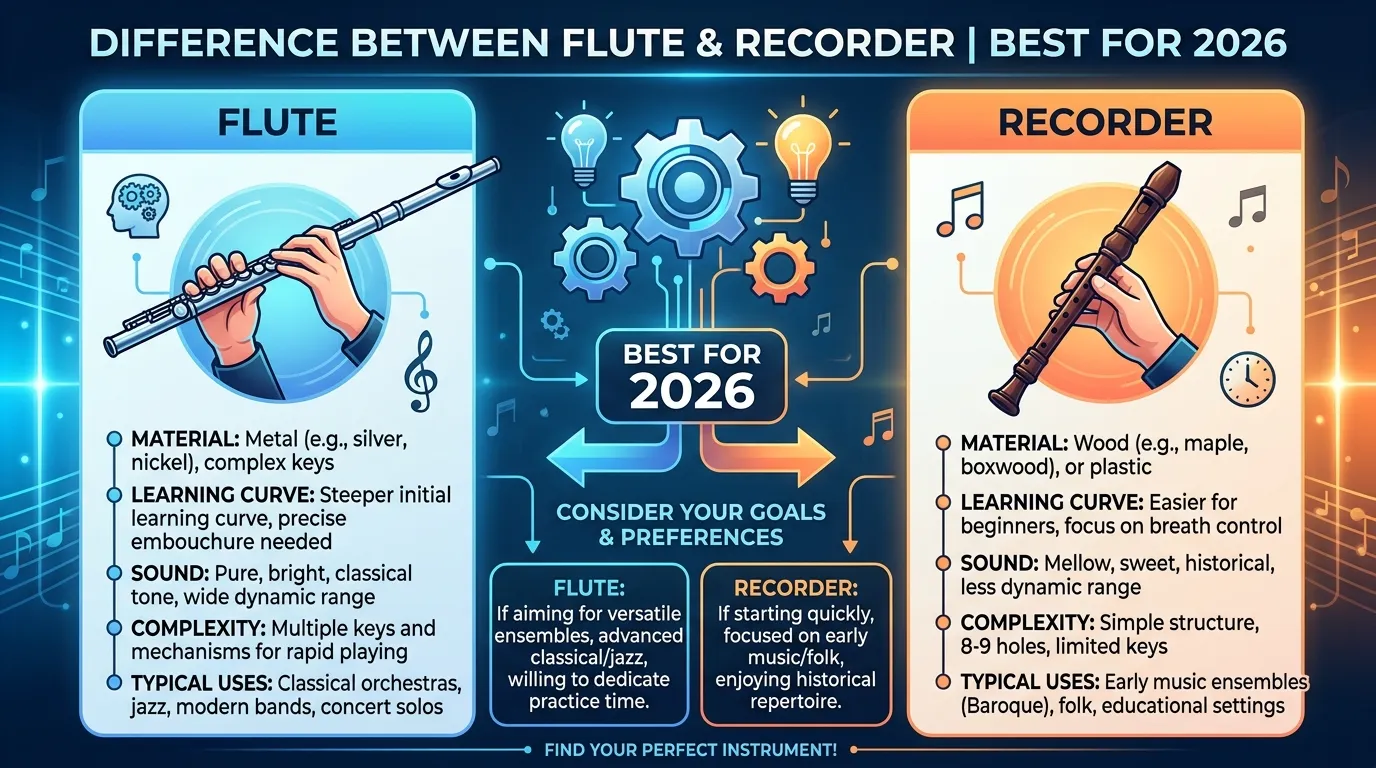
A child joins a music class at school. The teacher shows two instruments. One is long and shiny metal. The other is small and simple with holes on the front. The child asks, “Which one is the flute, and which one is the recorder?” Many beginners ask this question because both instruments make soft and beautiful sounds. Still, the difference between flute and recorder is easy to understand.
The difference between flute and recorder mainly comes from shape, playing style, and sound. A flute is played from the side, while a recorder is played from the front. Learning the difference between flute and recorder helps music students, English learners, and beginners choose the right instrument. It also makes music words easier to understand in school and daily life.
What is “Flute”?
A flute is a musical instrument that makes sound when air moves across a hole. People usually hold it sideways while playing.
History of Flute
The flute is one of the oldest musical instruments in the world. Early flutes were made from bones, wood, and bamboo thousands of years ago. Ancient people in China, India, and Europe used flutes in music and ceremonies. Over time, makers improved the design and added metal parts. Modern flutes became popular in orchestras during the 1800s. Today, flutes are used in classical music, school bands, jazz, and pop music. Many students learn the flute because of its smooth and bright sound.
What is “Recorder”?
A recorder is a simple wind instrument with a mouthpiece and finger holes. Players blow air directly into the top.
History of Recorder
The recorder became popular in Europe during the Middle Ages and Renaissance periods. Musicians used it in royal courts, schools, and churches. Early recorders were usually made from wood and came in different sizes. During the 1600s and 1700s, the recorder was widely used in classical music. Later, the flute became more popular, and the recorder lost attention for some time. In the modern world, schools started using recorders again because they are cheap and easy to learn. Today, many children begin music lessons with a recorder.
Flute vs Recorder
A flute is a side-blown instrument with a bright sound, while a recorder is a front-blown instrument with a softer sound.
Now let us explore their features and differences in an easy way.
How Flute Works
A flute makes sound when air moves across the mouth hole.
Key Features
- Usually made of metal
- Played sideways
- Bright and clear sound
- Used in orchestras
- Needs breath control
Example Sentences
🔵 She played the flute in the school band.
🔵 The flute made a sweet and soft sound.
Uses
- School music classes
- Orchestras
- Concerts
- Classical music
- Pop and jazz music
How Recorder Works
A recorder makes sound when air moves through its mouthpiece.
Key Features
- Often made of plastic or wood
- Played straight in front
- Simple finger holes
- Easy for beginners
- Soft sound
Example Sentences
🟢 The child learned songs on the recorder.
🟢 My teacher gave me a blue recorder.
Uses
- Beginner music lessons
- School activities
- Home practice
- Early music education
- Folk music
Which One Should You Use?
Choose a recorder if you are a beginner or young student. Choose a flute if you want advanced music learning and stronger sound control.
10 Differences Between Flute and Recorder
1. Playing Position
Flute: A flute is played from the side.
🔴 She held the flute sideways.
🔴 The player moved the flute near her lips.
Recorder: A recorder is played from the front.
🔴 He held the recorder straight.
🔴 The recorder pointed downward.
2. Material
Flute: Flutes are often made of metal.
🔴 The silver flute looked shiny.
🔴 Her flute was made of steel.
Recorder: Recorders are usually plastic or wood.
🔴 My recorder was plastic.
🔴 The wooden recorder looked old.
3. Difficulty Level
Flute: Flute is harder for beginners.
🔴 It took time to make sound on the flute.
🔴 My sister practiced flute daily.
Recorder: Recorder is easier to learn.
🔴 The child learned recorder quickly.
🔴 Beginners enjoy simple recorder songs.
4. Sound
Flute: Flute has a bright sound.
🔴 The flute sounded clear in the hall.
🔴 Her flute music was strong.
Recorder: Recorder has a soft sound.
🔴 The recorder sounded gentle.
🔴 We heard soft recorder music.
5. Mouthpiece
Flute: Flute has an open mouth hole.
🔴 He blew across the flute hole.
🔴 The flute needed careful airflow.
Recorder: Recorder has a built-in mouthpiece.
🔴 She blew directly into the recorder.
🔴 The recorder was easy to use.
6. Use in Schools
Flute: Flutes are common in bands.
🔴 The band had three flute players.
🔴 Students practiced flute together.
Recorder: Recorders are common in beginner classes.
🔴 The teacher gave recorders to children.
🔴 Recorder lessons started in grade school.
7. Price
Flute: Flutes are usually more expensive.
🔴 Her flute cost a lot of money.
🔴 Professional flutes can be costly.
Recorder: Recorders are cheaper.
🔴 My recorder was affordable.
🔴 Schools buy many recorders easily.
8. Size
Flute: Flutes are longer and wider.
🔴 The flute case looked large.
🔴 He carried a long flute.
Recorder: Recorders are smaller.
🔴 The recorder fit in my bag.
🔴 She carried the recorder easily.
9. Music Style
Flute: Flute is common in orchestras and jazz.
🔴 The orchestra featured flute music.
🔴 Jazz bands use flutes sometimes.
Recorder: Recorder is common in school and folk music.
🔴 Folk groups played recorders.
🔴 Children used recorders in class.
10. Breath Control
Flute: Flute needs stronger breath control.
🔴 She practiced breathing for flute.
🔴 The flute player controlled airflow carefully.
Recorder: Recorder needs simpler airflow.
🔴 Kids easily learned recorder breathing.
🔴 The recorder worked with gentle air.
Why People Get Confused About Their Use
People get confused because both instruments belong to the woodwind family and use finger holes and breath. They also make soft musical sounds. Some beginners think they are the same instrument. Still, their shape, playing style, and sound are different.
Table: Difference and Similarity
| Feature | Flute | Recorder | Similarity |
| Playing Style | Side-blown | Front-blown | Both use air |
| Material | Mostly metal | Plastic or wood | Both are instruments |
| Difficulty | Harder | Easier | Both need practice |
| Sound | Bright | Soft | Both make melodies |
| Use | Orchestra and band | Beginner classes | Both used in music |
Which is Better in What Situation?
Flute is better for advanced music learning, orchestras, and concerts. It gives a rich and bright sound. Many serious music students choose flute for long-term practice.
Recorder is better for beginners and children. It is cheap, light, and easy to learn. Schools often use recorders for first music lessons.
How Are “Flute” and “Recorder” Used in Metaphors and Similes?
🟣 “Soft as a recorder” means calm and gentle.
🟣 “Clear like a flute” means pure and bright.
🟣 “Her voice flowed like a flute” means her voice sounded musical.
🟣 “The room stayed quiet like a recorder tune” means the room felt peaceful.
Connotative Meaning
Flute
🟣 Positive: “The flute gives elegant music.”
🟣 Neutral: “He bought a flute.”
🟣 Negative: “Some people think flute practice is difficult.”
Recorder
🟣 Positive: “The recorder is perfect for beginners.”
🟣 Neutral: “The class used recorders.”
🟣 Negative: “Some people think recorders sound too simple.”
Idioms or Proverbs
🟣 “Face the music.”
Meaning: Accept the result of your actions.
Example: He forgot practice time and had to face the music.
🟣 “Blow your own trumpet.”
Meaning: Talk proudly about yourself.
Example: She always blows her own trumpet after concerts.
Works in Literature
🟣 The Magic Flute — Emanuel Schikaneder, 1791
🟣 Flute’s Journey — Lynne Sharon Schwartz, 1986
Movies Related to the Keywords
🟣 The Magic Flute — 1975, Sweden
🟣 The Pied Piper — 1972, United Kingdom
Frequently Asked Questions
1. Is flute harder than recorder?
Yes. Flute usually needs more practice and breath control.
2. Which instrument is better for children?
Recorder is often better for beginners and young children.
3. Is a recorder a flute?
No. They are different instruments, though both are wind instruments.
4. Which instrument sounds brighter?
Flute usually sounds brighter and stronger.
5. Are both used in schools?
Yes. Many schools teach both instruments.
Final Words
Flutes and recorders both create beautiful music. One is simple for beginners, while the other offers advanced musical skills. Learning their differences can make music study easier and more fun.
Conclusion
The difference between flute and recorder is mainly about playing style, sound, material, and difficulty. A flute is side-blown and gives a bright sound. A recorder is front-blown and easier for beginners. Both instruments are important in music education and performance. Understanding the difference between flute and recorder helps students, music lovers, and English learners choose the right instrument with confidence.

I’m Zahid Abbas, an educator, researcher, and digital publishing strategist with a passion for linguistics, grammar, and clear communication. As a content creator and SEO specialist, I craft research-driven, reader-focused content that empowers learners and makes knowledge accessible worldwide.