Two friends were talking about tea and coffee at a café. One friend said, “I like the former more.” The other friend looked confused because he did not know what “former” meant. Many English learners face this problem every day. The difference between former and latter can seem hard at first, but it becomes easy with simple examples.
Understanding the difference between former and latter helps people read books, understand conversations, and write better English. These two words are common in schools, offices, and daily life. The difference between former and latter is mainly about order. One points to the first thing, and the other points to the second thing. Once you learn the rule, using them becomes simple and natural.
What is “Former”?
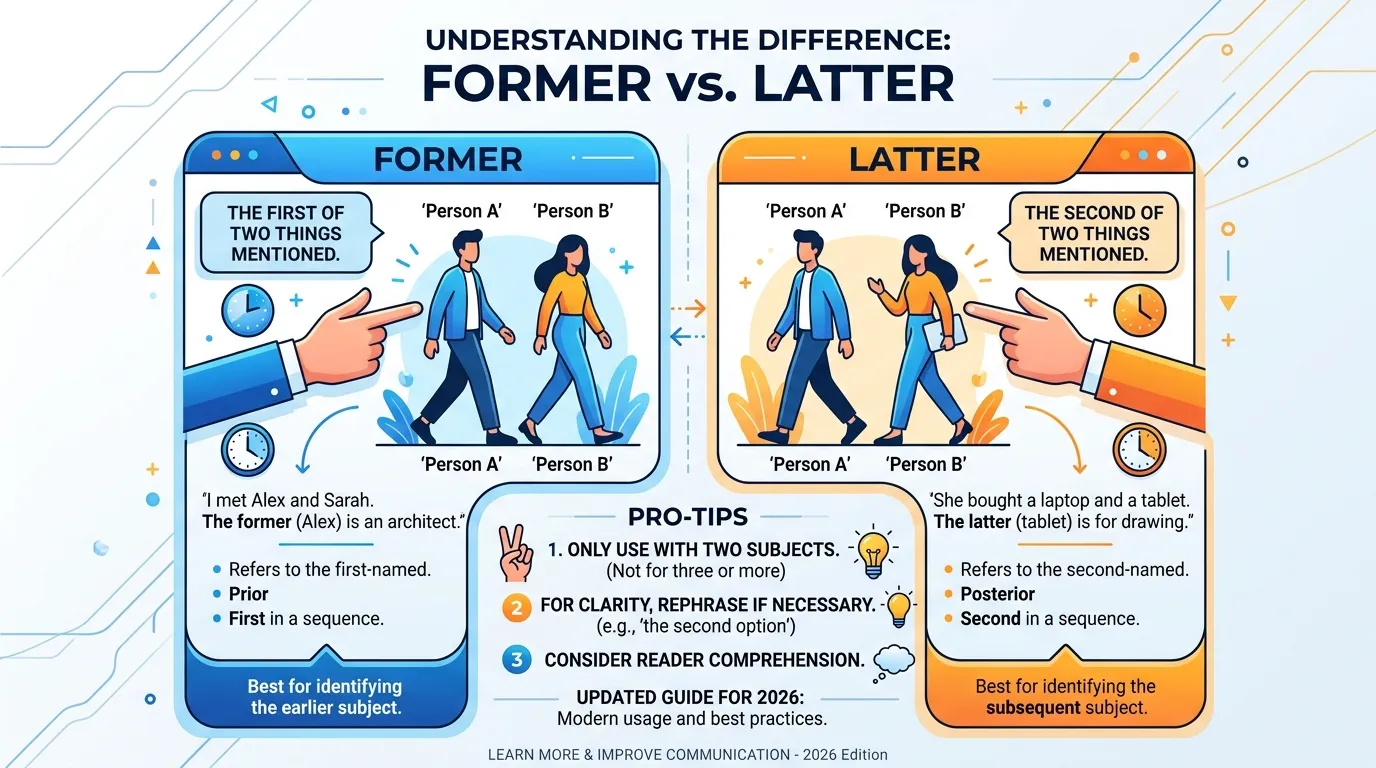
Former means the first of two people, things, or ideas already mentioned.
History of Former
The word “former” comes from old English and Germanic languages. It was used many centuries ago to talk about something earlier or before another thing. Over time, English speakers started using “former” to point to the first item in a pair. Writers and teachers used it to avoid repeating words in long sentences. Today, “former” is common in books, news articles, school lessons, and conversations. It helps make sentences shorter and clearer. Many English learners study this word early because it is useful in both speaking and writing.
What is “Latter”?
Latter means the second or last of two people, things, or ideas already mentioned.
History of Latter
The word “latter” also comes from old English roots. Long ago, people used it to describe something closer to the end or later in time. As English changed, “latter” became a way to point to the second item in a sentence with two choices. Writers liked this word because it made writing smooth and simple. Today, “latter” is used in books, articles, schools, and business writing. It helps readers quickly understand which item is being discussed without repeating the same words many times.
Former vs Latter
Former points to the first item mentioned, while latter points to the second item mentioned.
Now let us look at how these two words work in real sentences and daily life.
How Former Works
Former refers to the first thing already mentioned.
Key Features
- Refers to the first item
- Used with two choices
- Makes writing shorter
- Common in formal English
- Helps avoid repetition
Example Sentences
🔵 Ali likes apples and bananas. He prefers the former.
🔵 We visited Lahore and Karachi. The former was quieter.
Uses
- School writing
- News articles
- Daily conversation
- Business reports
- Books and essays
How Latter Works
Latter refers to the second or last thing already mentioned.
Key Features
- Refers to the second item
- Used after mentioning two things
- Common in reading and writing
- Makes sentences smooth
- Avoids repeating nouns
Example Sentences
🟢 Sara bought shoes and sandals. She liked the latter more.
🟢 I watched a comedy and a drama. The latter was exciting.
Uses
- Academic writing
- Office communication
- Stories and novels
- Daily speaking
- Articles and blogs
Which One Should You Use?
Use “former” when talking about the first item in a sentence. Use “latter” when talking about the second item. Both words work best when only two things are mentioned.
10 Differences Between Former and Latter
1. Position
Former: Former points to the first item.
🔴 Tea and coffee were served. I liked the former.
🔴 Ahmed and Bilal came late. The former apologized.
Latter: Latter points to the second item.
🔴 Tea and coffee were served. I liked the latter.
🔴 Ahmed and Bilal came late. The latter apologized.
2. Meaning
Former: Means earlier or first.
🔴 The former plan worked better.
🔴 She picked the former choice.
Latter: Means later or second.
🔴 The latter idea sounded smart.
🔴 He agreed with the latter option.
3. Use in Writing
Former: Used to avoid repeating the first noun.
🔴 I bought a pen and a notebook. The former was blue.
🔴 The former answer was correct.
Latter: Used to avoid repeating the second noun.
🔴 I bought a pen and a notebook. The latter was expensive.
🔴 The latter answer was wrong.
4. Time Sense
Former: Can suggest something earlier in time.
🔴 My former teacher was kind.
🔴 He met his former boss yesterday.
Latter: Can suggest something later in time.
🔴 The latter years were peaceful.
🔴 She enjoyed the latter part of the movie.
5. Easy Memory Trick
Former: Former starts with “F” for first.
🔴 Former means first item.
🔴 I remembered former with “first.”
Latter: Latter starts with “L” for last.
🔴 Latter means last item.
🔴 I remembered latter with “last.”
6. Formality
Former: More common in formal English.
🔴 The former statement was true.
🔴 Lawyers use former often.
Latter: Also common in formal English.
🔴 The latter claim was false.
🔴 Teachers explain the latter point clearly.
7. Sentence Role
Former: Refers back to the beginning.
🔴 Cats and dogs are friendly, but I prefer the former.
🔴 The former item sold quickly.
Latter: Refers back to the end.
🔴 Cats and dogs are friendly, but I prefer the latter.
🔴 The latter item stayed unsold.
8. Common Context
Former: Often used for jobs or relationships.
🔴 He met his former coach.
🔴 She spoke to her former classmate.
Latter: Often used in comparison.
🔴 Between math and science, I chose the latter.
🔴 The latter option was easier.
9. Reader Focus
Former: Makes readers think about the first item.
🔴 The former city was cleaner.
🔴 I liked the former design.
Latter: Makes readers think about the second item.
🔴 The latter city was busier.
🔴 She preferred the latter design.
10. Word Direction
Former: Looks backward to the first point.
🔴 The former reason made sense.
🔴 We discussed the former topic first.
Latter: Looks toward the final point.
🔴 The latter reason was weak.
🔴 We ended with the latter topic.
Why People Get Confused About Their Use
People confuse these words because both refer to things already mentioned. Many learners forget which word points to the first item and which points to the second. Also, these words are more common in formal English than in casual speech.
Table: Difference and Similarity
| Feature | Former | Latter | Similarity |
| Meaning | First item | Second item | Both refer to earlier words |
| Position | Beginning | End | Both compare two things |
| Memory Tip | First | Last | Both improve writing |
| Use | Formal writing | Formal writing | Both avoid repetition |
| Common Context | Earlier choice | Later choice | Both appear in books |
Which is Better in What Situation?
Former is better when you want to talk about the first item in a sentence. It is useful in essays, reports, and conversations where repeating words feels unnecessary.
Latter is better when you want to focus on the second item. It helps readers quickly understand your point. Both words make writing shorter and cleaner.
How Are “Former” and “Latter” Used in Metaphors and Similes?
🟣 “The former path was bright” means the first choice looked better.
🟣 “The latter road felt dark” means the second choice seemed harder.
🟣 “Life moved from the former to the latter” means life changed from one stage to another.
🟣 “His thoughts stayed with the latter idea” means he focused on the second idea.
Connotative Meaning
Former
🟣 Positive: “My former teacher inspired me.”
🟣 Neutral: “He met his former neighbor.”
🟣 Negative: “The former rule caused problems.”
Latter
🟣 Positive: “The latter choice improved the project.”
🟣 Neutral: “The latter chapter was short.”
🟣 Negative: “The latter decision failed badly.”
Idioms or Proverbs
🟣 “First things first.”
Meaning: Important things should come before others.
Example: The former task needed attention first.
🟣 “Better late than never.”
Meaning: Doing something late is still better than not doing it.
Example: The latter response still helped the team.
Works in Literature
🟣 Pride and Prejudice — Jane Austen, 1813
🟣 Hamlet — William Shakespeare, 1603
Movies Related to the Keywords
🟣 The King’s Speech — 2010, United Kingdom
🟣 Dead Poets Society — 1989, United States
Frequently Asked Questions
1. What does former mean?
Former means the first item mentioned.
2. What does latter mean?
Latter means the second or last item mentioned.
3. Can former and latter be used for more than two things?
Usually, they are used only for two things.
4. Which one means first?
Former means first.
5. Why are these words useful?
They make writing shorter and clearer.
Final Words
Former and latter may look difficult at first, but they are easy once you remember the order. Practice them with simple daily examples, and your English will become clearer and stronger.
Conclusion
The difference between former and latter is simple and useful in English. Former points to the first item, while latter points to the second item. These words help writers and speakers avoid repetition and make sentences easier to read. Learning the difference between former and latter can improve speaking, writing, reading, and overall English confidence.

I’m Zahid Abbas, an educator, researcher, and digital publishing strategist with a passion for linguistics, grammar, and clear communication. As a content creator and SEO specialist, I craft research-driven, reader-focused content that empowers learners and makes knowledge accessible worldwide.