A woman walks through a vegetable market on a cold winter day. She picks up a small white vegetable and then sees a larger yellow one beside it. She asks the seller, “Are these both turnips?” The seller smiles and explains the difference between turnip and rutabaga. Many people ask this same question because both vegetables look similar at first glance.
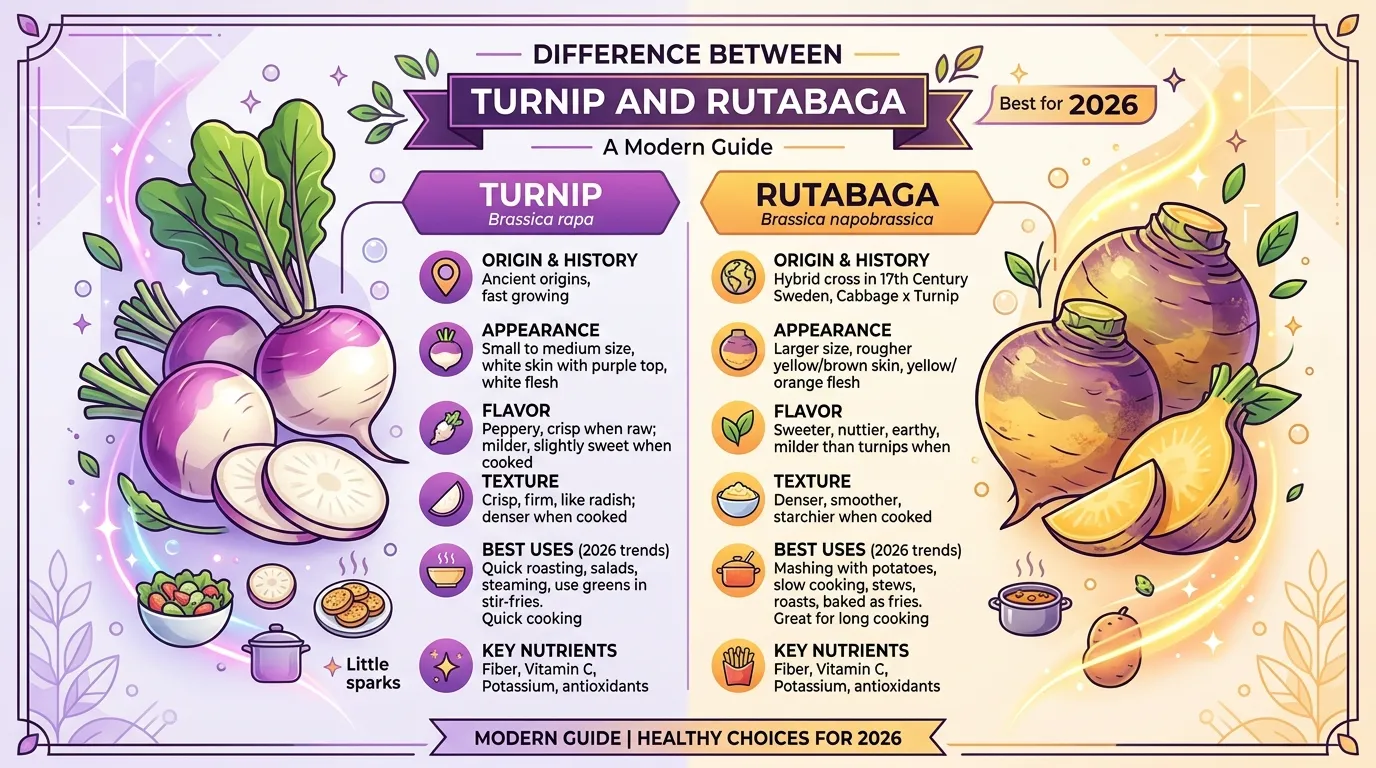
The difference between turnip and rutabaga becomes clear when you look at size, color, taste, and texture. Turnips are usually smaller and sharper in taste. Rutabagas are larger and sweeter. Learning the difference between turnip and rutabaga helps students, cooks, and English learners understand recipes, shopping lists, and food conversations more easily.
What is “Turnip”?
A turnip is a small root vegetable with white flesh and purple or white skin. It has a slightly sharp taste.
History of Turnip
Turnips have been grown for thousands of years in Europe and Asia. Ancient farmers used turnips as an important food because they grew well in cold weather. People also fed turnips to animals during winter. Over time, turnips became common in soups, stews, and salads. In many countries, poor families depended on turnips when other foods were hard to find. Today, turnips are still popular because they are healthy, easy to grow, and useful in many dishes around the world.
What is “Rutabaga”?
A rutabaga is a large root vegetable with yellow flesh and brownish-purple skin. It tastes sweeter than a turnip.
History of Rutabaga
Rutabagas first became popular in northern Europe. Many experts believe they developed from a natural mix of cabbage and turnip plants. Farmers liked rutabagas because they survived cold weather and stored well during winter. Later, people in Sweden, Canada, and other cold regions began using them in daily cooking. Rutabagas became common in soups, mashed dishes, and roasted meals. Today, they remain an important winter vegetable in many homes and restaurants.
Turnip vs Rutabaga
Turnips are smaller and sharper in flavor, while rutabagas are larger and sweeter.
Now let us explore their differences in a simple and clear way.
How Turnip Works
Turnips grow quickly and are often used in light meals and fresh dishes.
Key Features
- Small size
- White flesh
- Slightly spicy taste
- Fast-growing vegetable
- Soft texture when cooked
Example Sentences
🔵 My mother added turnips to the soup.
🔵 Fresh turnips tasted crisp in the salad.
Uses
- Soups
- Salads
- Stews
- Healthy meals
- Winter cooking
How Rutabaga Works
Rutabagas grow larger and have a sweeter, richer taste.
Key Features
- Large size
- Yellow flesh
- Sweet flavor
- Hard texture
- Long storage life
Example Sentences
🟢 We roasted rutabaga with potatoes.
🟢 The rutabaga tasted sweet and soft after cooking.
Uses
- Roasted dishes
- Mashed vegetables
- Winter meals
- Farm cooking
- Healthy recipes
Which One Should You Use?
Choose turnip when you want a lighter and sharper flavor. Choose rutabaga when you want a sweeter and richer vegetable for roasting or mashing.
10 Differences Between Turnip and Rutabaga
1. Size
Turnip: Turnips are usually small.
🔴 The turnip fit in my hand.
🔴 Small turnips cooked quickly.
Rutabaga: Rutabagas are larger.
🔴 The rutabaga felt heavy.
🔴 One rutabaga fed the whole family.
2. Flesh Color
Turnip: Turnips have white flesh.
🔴 The sliced turnip looked bright white.
🔴 White turnips filled the basket.
Rutabaga: Rutabagas have yellow flesh.
🔴 The rutabaga looked yellow inside.
🔴 Yellow flesh made it easy to identify.
3. Taste
Turnip: Turnips taste sharp and peppery.
🔴 The turnip tasted slightly spicy.
🔴 Raw turnips had a strong bite.
Rutabaga: Rutabagas taste sweeter.
🔴 The rutabaga tasted mild and sweet.
🔴 Children liked the sweet flavor.
4. Texture
Turnip: Turnips are softer.
🔴 The turnip became soft in soup.
🔴 Cooked turnips broke apart easily.
Rutabaga: Rutabagas are firmer.
🔴 The rutabaga needed more cooking time.
🔴 Its texture stayed thick after boiling.
5. Skin Color
Turnip: Turnips often have white and purple skin.
🔴 The top of the turnip looked purple.
🔴 White skin covered the lower half.
Rutabaga: Rutabagas have brownish-yellow skin.
🔴 The rutabaga looked darker outside.
🔴 Its rough skin felt thick.
6. Cooking Time
Turnip: Turnips cook faster.
🔴 The turnip soup was ready quickly.
🔴 Thin slices cooked in minutes.
Rutabaga: Rutabagas take longer to cook.
🔴 The rutabaga boiled slowly.
🔴 Large pieces needed extra time.
7. Growing Season
Turnip: Turnips grow quickly in cool weather.
🔴 Farmers planted turnips in autumn.
🔴 Turnips grew within weeks.
Rutabaga: Rutabagas need more growing time.
🔴 Rutabagas stayed longer in the ground.
🔴 Farmers harvested them late in the season.
8. Calories
Turnip: Turnips are lower in calories.
🔴 Turnips are good for light meals.
🔴 The salad stayed healthy with turnips.
Rutabaga: Rutabagas have slightly more calories.
🔴 Rutabaga mash felt filling.
🔴 The dish gave more energy.
9. Popular Use
Turnip: Turnips are common in soups and salads.
🔴 The cook added turnips to stew.
🔴 Fresh turnips worked well in salad.
Rutabaga: Rutabagas are common in mashed dishes.
🔴 Rutabaga mash tasted creamy.
🔴 Roasted rutabaga smelled sweet.
10. Storage
Turnip: Turnips spoil faster.
🔴 Fresh turnips should be eaten soon.
🔴 The turnips softened after days.
Rutabaga: Rutabagas store longer.
🔴 Rutabagas stayed fresh all winter.
🔴 Farmers stored rutabagas in cool rooms.
Why People Get Confused About Their Use
People confuse turnips and rutabagas because both are root vegetables with similar shapes and colors. Grocery stores may place them together. Some recipes also use them in the same way. Still, rutabagas are larger, sweeter, and yellow inside, while turnips are smaller and whiter.
Table: Difference and Similarity
| Feature | Turnip | Rutabaga | Similarity |
| Size | Smaller | Larger | Both are root vegetables |
| Flesh Color | White | Yellow | Both grow underground |
| Taste | Sharp | Sweet | Both are healthy |
| Texture | Soft | Firm | Both are used in cooking |
| Cooking Time | Faster | Slower | Both work in winter dishes |
Which is Better in What Situation?
Turnips are better for light soups, fresh salads, and quick cooking. They have a sharper taste and cook faster. People who enjoy fresh and simple meals often choose turnips.
Rutabagas are better for roasting, mashing, and rich winter meals. Their sweet flavor and firm texture make them perfect for warm comfort food during cold weather.
How Are “Turnip” and “Rutabaga” Used in Metaphors and Similes?
🟣 “Plain as a turnip” means simple or ordinary.
🟣 “Sweet like rutabaga” means warm and pleasant.
🟣 “Cold as a winter turnip field” describes strong cold weather.
🟣 “Strong like a rutabaga root” means solid and tough.
Connotative Meaning
Turnip
🟣 Positive: “Turnips remind people of healthy farm food.”
🟣 Neutral: “The basket held fresh turnips.”
🟣 Negative: “Some think turnips taste too sharp.”
Rutabaga
🟣 Positive: “Rutabaga feels warm and comforting.”
🟣 Neutral: “The recipe used rutabaga.”
🟣 Negative: “Some people dislike the strong smell.”
Idioms or Proverbs
🟣 “You cannot get blood from a turnip.”
Meaning: You cannot get something from someone who has nothing.
Example: The poor farmer had no money left because you cannot get blood from a turnip.
🟣 “As fresh as a garden vegetable.”
Meaning: Very fresh and healthy.
Example: The turnips looked as fresh as a garden vegetable.
Works in Literature
🟣 Peter Rabbit — Beatrix Potter, 1902
🟣 The Enormous Turnip — Traditional tale, 19th century
Movies Related to the Keywords
🟣 Fantastic Mr. Fox — 2009, United States
🟣 Peter Rabbit — 2018, Australia/United States
Frequently Asked Questions
1. Is rutabaga the same as turnip?
No. Rutabaga is larger, sweeter, and yellow inside.
2. Which tastes sweeter?
Rutabaga tastes sweeter than turnip.
3. Which cooks faster?
Turnip cooks faster because it is softer and smaller.
4. Can both be used in soup?
Yes. Both vegetables work well in soups and stews.
5. Which stores longer?
Rutabaga stores longer in cool places.
Final Words
Turnips and rutabagas may look alike, but each one has its own flavor, texture, and cooking style. Learning these food differences can improve both cooking skills and English vocabulary.
Conclusion
The difference between turnip and rutabaga is mainly about size, taste, color, and texture. Turnips are smaller, sharper, and softer, while rutabagas are larger, sweeter, and firmer. Both vegetables are healthy and useful in many meals. Understanding the difference between turnip and rutabaga helps students, cooks, and English learners choose the right vegetable with confidence.

I’m Zahid Abbas, an educator, researcher, and digital publishing strategist with a passion for linguistics, grammar, and clear communication. As a content creator and SEO specialist, I craft research-driven, reader-focused content that empowers learners and makes knowledge accessible worldwide.