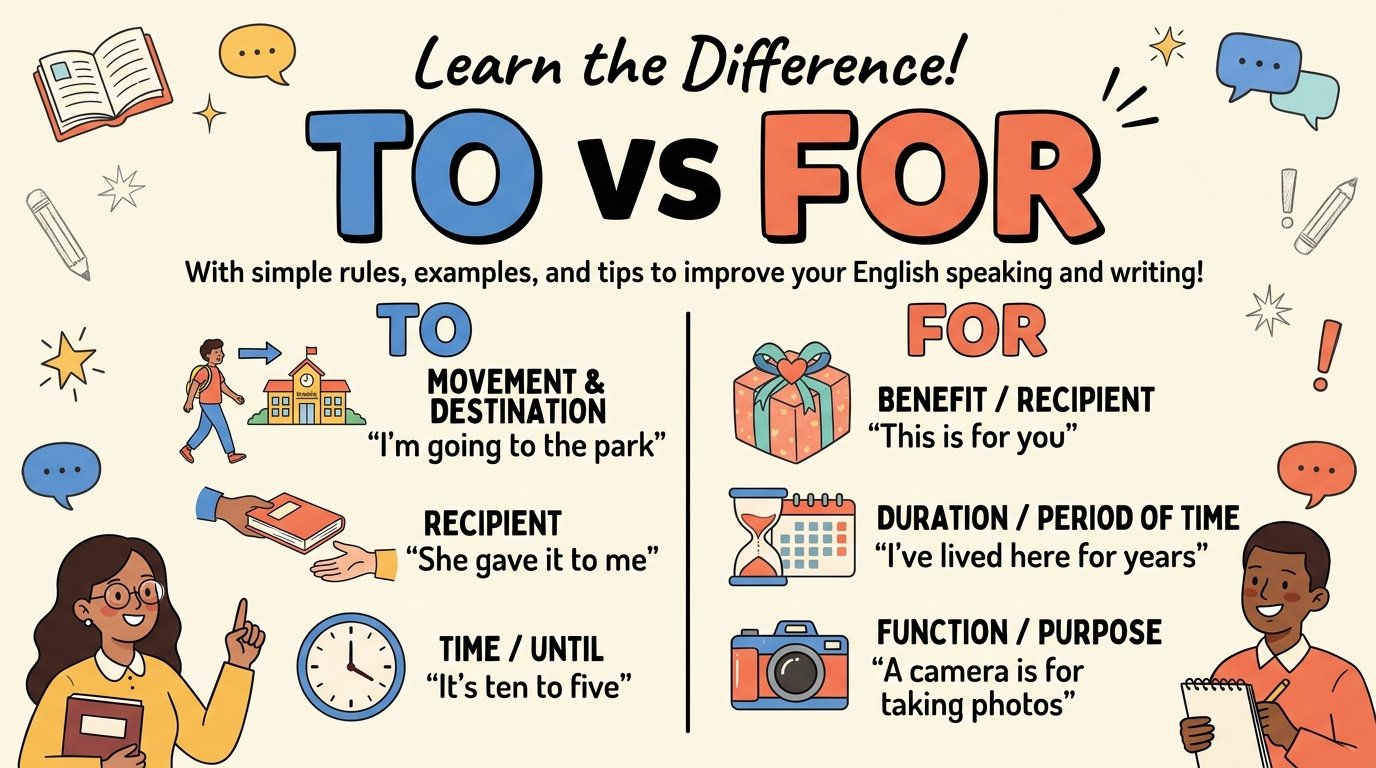
Sara wants to give a gift to her friend. She says, “This gift is to Ali.” Later, she says, “I bought this gift for Ali.” Both sentences look alike, but they have a small difference. The word to often shows direction or the person who receives something. The word for often shows purpose, help, or benefit. The difference between to and for can seem hard at first, but it is easy to learn with simple examples. These two words are common in daily speech and writing. Knowing the difference between to and for helps us speak in a clear way. It also helps us avoid mistakes in school, at work, and in daily life.
Key Difference Between To and For
- To often shows where someone or something goes.
- For often shows who gets help or why we do something.
Example: I sent a letter to Mia. I wrote a letter for Mia.
Why Is It Important to Know the Difference Between To and For?
Learners need these words to build clear sentences. Teachers use them to explain ideas. Writers use them to share facts and feelings. Workers use them in emails and talks. A small mistake can change the meaning of a sentence. When we know the right word, we can share our thoughts with less confusion.
Pronunciation of To and For (US and UK)
| Word | US pronunciation | UK pronunciation |
| To | /tuː/ or /tə/ | /tuː/ or /tə/ |
| For | /fɔːr/ or /fər/ | /fɔː/ or /fə/ |
A Simple Link to the Main Topic
Both words can link ideas in a sentence. Yet they do not always mean the same thing. Let us look at ten key ways to use them.
Difference Between To and For
1. Direction vs. Purpose
To can show the place where a person or thing moves. For can show the reason for an action.
Examples with to:
- We walked to school.
- He ran to the door.
Examples with for:
- I went out for a walk.
- She studies for her test.
2. Receiver vs. Person Who Benefits
To often names the person who gets something. For often names the person who will use or enjoy it.
Examples with to:
- I gave the book to Sam.
- She sent a card to her aunt.
Examples with for:
- I bought a book for Sam.
- He made tea for his mother.
3. Movement vs. Help
To can show movement toward a place or person. For can show that we do something to help someone.
Examples with to:
- The child went to his father.
- Please come to my house.
Examples with for:
- I carried the bag for my sister.
- He opened the door for me.
4. Time Limit vs. Length of Time
To can show the end of a time range. For can show how long something lasts.
Examples with to:
- The shop is open from nine to five.
- We have class from Monday to Friday.
Examples with for:
- I slept for eight hours.
- She stayed there for two days.
5. Verb Patterns
Some verbs often use to before another person or action. Other phrases use for to show a reason or goal.
Examples with to:
- I want to learn English.
- She hopes to win the game.
Examples with for:
- We plan for the future.
- He asked for help.
Note that some verbs can use either word, but the meaning or sentence pattern may change.
6. Sharing vs. Getting Ready
To can show the person who hears or receives a message. For can show who a task or item is meant to help.
Examples with to:
- Please explain the rule to me.
- She spoke to her teacher.
Examples with for:
- He saved a seat for me.
- I packed lunch for my son.
7. Giving Information vs. Showing a Reason
To can point to the person who receives information. For can explain why an action is done.
Examples with to:
- I told the truth to my friend.
- She read the story to the class.
Examples with for:
- I thanked him for his help.
- She left early for a good reason.
8. Comparison vs. Intended Use
To appears in phrases that compare one thing with another. For can show what an item is used for or who it is meant for.
Examples with to:
- I prefer tea to coffee.
- This road is close to my home.
Examples with for:
- This cup is for water.
- These shoes are for running.
9. Reactions vs. Support
To can follow words that show a reaction or feeling toward something. For can show support or a choice in favor of something.
Examples with to:
- The news was a shock to me.
- Her words were kind to the child.
Examples with for:
- I am for the new plan.
- They cheered for their team.
10. Set Phrases
Some common phrases use to, while others use for. It helps to learn them as full phrases.
Examples with to:
- I look forward to the trip.
- She is kind to everyone.
Examples with for:
- Thank you for your time.
- He is famous for his songs.
The Nature and Use of To
The word to has several jobs in English.
- It can show movement: “Go to the park.”
- It can show the person who receives something: “Give it to me.”
- It can come before a verb: “I like to read.”
- It can show a link or comparison: “I prefer rice to bread.”
In short, to often points toward a place, person, action, or idea.
The Nature and Use of For
The word for also has many jobs.
- It can show a person who benefits: “This gift is for you.”
- It can show purpose: “These tools are for work.”
- It can show how long something lasts: “We waited for an hour.”
- It can give a reason: “Thank you for coming.”
In short, for often tells us why something happens, who it helps, or how long it lasts.
Why Do People Often Confuse To and For?
People often confuse these words because both can appear when we talk about people, gifts, plans, and actions.
For example:
- “I gave a gift to Ali.” Ali gets the gift.
- “I bought a gift for Ali.” Ali will benefit from the gift.
The meaning can be close, but the focus is not the same. Some verbs also use one word by rule. We say “listen to music” and “ask for help.” Reading, speaking, and learning common phrases can help us choose the right word.
Difference and Similarity Between To and For
| Point | To | For |
| Main use | Direction, receiver, or link | Purpose, benefit, or reason |
| Movement | Walk to the park | Walk for exercise |
| Giving | Give it to Ana | Buy it for Ana |
| Time | From one to five | Wait for an hour |
| Before a verb | Want to play | Usually not used in the same way |
| Help | Tell it to me | Do it for me |
| Similarity | Both link words and ideas | Both link words and ideas |
Which Is Better in What Situation?
Neither to nor for is better in every case. The right word depends on what you want to say. Use to when you talk about a place, a receiver, or an action, as in “Go to class” or “I want to eat.” Use for when you talk about a reason, a benefit, or a time span, as in “This is for you” or “I waited for an hour.” Think about the meaning first. Then choose the word that fits the sentence.
also read more about https://comparificationn.com/difference-between-tablet-and-laptop-2/
How Are To and For Used in Metaphors and Similes?
These words can appear in figurative language. They help link people, feelings, and ideas.
Examples with to:
- “Her heart turned to stone.” This means she seemed cold or unkind.
- “He is a light to the world.” This means he gives hope or help.
Examples with for:
- “She is a star for her team.” This means she stands out and helps the team.
- “He fought for his dreams.” This means he worked hard to reach his goals.
A simile often uses “like” or “as,” but to and for may still help show the link between ideas.
Connotative Meaning of To and For
Connotation means the feeling or idea a word brings to mind. Both words are mostly neutral. Their meaning depends on the sentence.
To: Neutral, Positive, or Negative
- Neutral: “I went to the shop.” It gives a place.
- Positive: “She was kind to me.” It shows care.
- Negative: “He was cruel to the dog.” It shows harm.
For: Neutral, Positive, or Negative
- Neutral: “This room is for meetings.” It gives a purpose.
- Positive: “I am happy for you.” It shows joy for someone.
- Negative: “He blamed me for the mistake.” It links a person to blame.
The words themselves are not good or bad. The words around them shape the feeling.
Idioms and Common Phrases With To and For
These are common phrases, rather than all being traditional proverbs.
Phrases With To
- Look forward to: Feel happy about something that will happen.
I look forward to seeing my cousins. - Face to face: Meet in person.
We spoke face to face after class. - To the point: Clear and focused.
Her answer was short and to the point.
Phrases With For
- For good: Forever.
They left the town for good. - For a change: To do something different from usual.
Let us walk to school for a change. - An eye for an eye: The idea that harm should be repaid with equal harm.
The teacher said that an eye for an eye can lead to more pain.
Works in Literature That Use To and For
To and for are common words, so they appear in many books. These works are examples of titles that contain one of the words, not books that focus on grammar.
- “To Kill a Mockingbird” — Novel, Harper Lee, 1960. The title uses to before a verb.
- “For Whom the Bell Tolls” — Novel, Ernest Hemingway, 1940. The title begins with for.
- “A Letter to God” — Short story, G. L. Fuentes, first published in 1939. The title uses to to show the receiver.
- “For the Term of His Natural Life” — Novel, Marcus Clarke, 1874. The title uses for to show a length of time.
Movies With To and For in Their Titles
These films include to or for in their titles. They are not all about the words themselves.
- “To Kill a Mockingbird” — 1962, United States. A drama film based on Harper Lee’s novel.
- “To All the Boys I’ve Loved Before” — 2018, United States. A teen romance film.
- “Forrest Gump” — 1994, United States. A drama-comedy film.
- “For Your Eyes Only” — 1981, United Kingdom. A James Bond spy film.
Five Possible Asked Questions About To and For
1. What is the main difference between to and for?
To often shows direction, a receiver, or an action. For often shows purpose, benefit, or reason.
2. Can I say “This gift is to you”?
The usual phrase is “This gift is for you.” You can say “I gave this gift to you” when you talk about the act of giving.
3. Do we use to before verbs?
Yes, we often use to before a verb. For example, “I want to sleep.” This is called the infinitive form.
4. How do we use for with time?
Use for to say how long something lasts. For example, “I studied for two hours.”
5. Can to and for be used in the same sentence?
Yes. For example, “I went to the shop for bread.” Here, to shows where you went, while for tells us why you went.
How Are To and For Useful in Daily Life?
These words help us share clear ideas at home, school, and work. We use to to give directions, send messages, and explain plans. We use for to offer help, state a reason, or explain who will benefit. For example, “Give this note to your teacher” tells someone who should receive the note. “Make a card for your teacher” tells someone who the card is meant to please. Using the right word can make requests polite and clear. It can also help people avoid mistakes in emails, lessons, and talks.
Final Words on To and For
The words to and for are short, but they do a lot of work in English. To often points to a place, person, or action. For often tells us a reason, purpose, or benefit. The best way to learn them is to read examples and use them in your own sentences. When you are unsure, ask yourself: “Am I showing where something goes, or why it is done?” This small question can help you choose the right word.
Conclusion
The difference between to and for is simple when we look at the meaning of a sentence. To often shows direction, a receiver, or an action, while for often shows purpose, help, or a reason. Both words are used every day, so learning them can improve your speaking and writing. For example, “I sent a letter to my friend” tells us who got the letter. “I wrote a letter for my friend” tells us who the letter was meant to help. Keep reading, writing, and speaking with these words. With practice, you will learn to use them in the right .

I’m Zahid Abbas, an educator, researcher, and digital publishing strategist with a passion for linguistics, grammar, and clear communication. As a content creator and SEO specialist, I craft research-driven, reader-focused content that empowers learners and makes knowledge accessible worldwide.