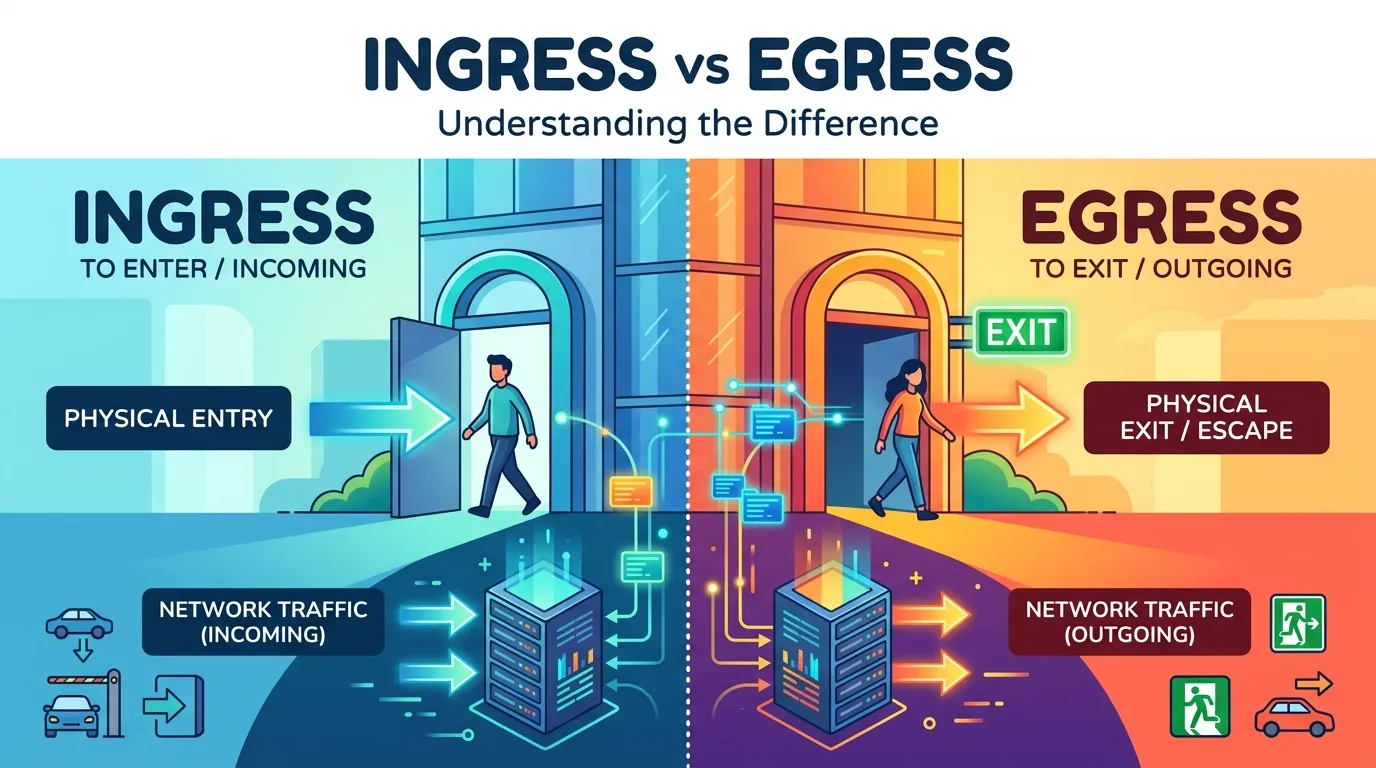
Imagine you are visiting a large stadium. You see one gate marked Ingress and another marked Egress. The ingress gate is where people enter the stadium. The egress gate is where people leave it. This simple example shows the difference between ingress and egress. Ingress means entering a place or system. Egress means leaving a place or system. The difference between ingress and egress is important in buildings, transport, computer networks, and safety planning. Engineers, security teams, and network experts often use these words. The difference between ingress and egress helps people understand the direction of movement. Knowing the difference between ingress and egress also makes technical instructions easier to follow. Although the words sound formal, their basic meanings are simple: ingress is in, while egress is out.
Key Difference Between Ingress and Egress
The main difference is the direction of movement.
- Ingress means movement into a place, system, or network.
- Egress means movement out of a place, system, or network.
For example, people entering a building use an ingress route. People leaving the building use an egress route.
In computer networks, incoming traffic is called ingress traffic. Outgoing traffic is called egress traffic.
Why Is Their Difference Necessary to Know for Learners and Experts?
Knowing these words is important because they appear in safety rules, building plans, computer networks, transport systems, and technical documents.
Learners can understand signs and instructions more easily when they know these terms. Experts use them to plan safe buildings, control network traffic, and manage movement.
In society, clear entry and exit systems can save time and improve safety. During an emergency, people need safe egress routes. In technology, proper ingress and egress rules can help control data movement.
Pronunciation of Ingress and Egress
Ingress
- US: /ˈɪnɡres/
- UK: /ˈɪnɡres/
Egress
- US: /ˈiːɡres/
- UK: /ˈiːɡres/
The basic idea is easy to remember: ingress is going in, and egress is going out. Now let us explore the difference in more detail.
Difference Between the Keywords
1. Basic Meaning
Ingress means entering or moving into a place or system.
Example 1:
The main door provides safe ingress to the building.
Example 2:
The guard checked visitors during ingress.
Egress means leaving or moving out of a place or system.
Example 1:
The emergency door provides safe egress.
Example 2:
The signs show the best egress route.
2. Direction
Ingress always describes movement toward the inside.
Example 1:
The entrance controls the ingress of visitors.
Example 2:
The gate allows vehicle ingress.
Egress describes movement toward the outside.
Example 1:
The exit allows vehicle egress.
Example 2:
The workers used the rear door for egress.
3. Use in Buildings
Ingress is important when people enter a building.
Example 1:
The hotel has a wide entrance for easy ingress.
Example 2:
The school controls student ingress each morning.
Egress is important when people leave a building.
Example 1:
The building has several emergency egress doors.
Example 2:
The hall must have a clear egress path.
4. Use in Emergencies
Ingress can describe people entering an area during an emergency.
Example 1:
Emergency workers needed quick ingress into the building.
Example 2:
The rescue team found a safe point of ingress.
Egress is especially important during emergencies because people need to leave safely.
Example 1:
The fire exit provides emergency egress.
Example 2:
The safety plan shows several egress routes.
5. Use in Computer Networks
Ingress means data entering a network, device, or system.
Example 1:
The firewall checks ingress traffic.
Example 2:
The server received a large amount of ingress data.
Egress means data leaving a network, device, or system.
Example 1:
The firewall controls egress traffic.
Example 2:
The company monitors egress data for security.
6. Use in Security
Ingress control helps control who or what enters an area.
Example 1:
The security team checks ingress at the main gate.
Example 2:
The card reader controls employee ingress.
Egress control manages or monitors movement out.
Example 1:
The security system records egress from the building.
Example 2:
The gate controls vehicle egress.
7. Use in Transport
Ingress can describe passengers or vehicles entering a transport area.
Example 1:
The station has separate areas for passenger ingress.
Example 2:
The road allows easy vehicle ingress.
Egress describes passengers or vehicles leaving.
Example 1:
The parking area has two egress lanes.
Example 2:
The airport designed the road for quick egress.
8. Use in Access Planning
Ingress planning focuses on how people or objects get inside.
Example 1:
The architect planned easy ingress for visitors.
Example 2:
The hospital needs simple ingress for ambulances.
Egress planning focuses on how people or objects get out.
Example 1:
The architect planned several egress routes.
Example 2:
The hospital needs clear egress for patients.
9. Use With Security Rules
Ingress rules decide what can enter a system.
Example 1:
The firewall has strict ingress rules.
Example 2:
The company blocks unsafe ingress traffic.
Egress rules decide what can leave a system.
Example 1:
The firewall uses egress rules to control outgoing traffic.
Example 2:
The security team created egress rules for sensitive data.
10. Main Purpose
The main purpose of ingress is to manage or describe entry.
Example 1:
The entrance was designed for smooth customer ingress.
Example 2:
The network uses ingress controls to protect incoming traffic.
The main purpose of egress is to manage or describe exit.
Example 1:
The emergency plan improves safe egress.
Example 2:
The network uses egress controls to monitor outgoing traffic.
Nature and Behaviour of Ingress
Ingress is about coming in. It can describe people, vehicles, air, water, information, or digital traffic.
The word is common in technical and formal language. It is often used when direction matters.
For example:
- People enter a stadium.
- Water enters a building.
- Data enters a network.
- Vehicles enter a parking area.
All these actions can be described as ingress.
Nature and Behaviour of Egress
Egress is about going out. It can describe people, vehicles, information, air, water, or digital traffic leaving a place or system.
For example:
- People leave a stadium.
- Water leaves a drainage system.
- Data leaves a network.
- Vehicles leave a parking area.
Egress is especially important in safety planning because people need clear ways to leave buildings during emergencies.
Why Are People Confused About Their Use?
People often confuse ingress and egress because both words describe movement. They also sound formal and appear together in technical documents.
A simple memory trick can help:
Ingress = In
The first part of ingress sounds like in.
Egress = Exit
Think of egress as the route to the outside.
For example:
- Ingress: entering a building.
- Egress: leaving a building.
- Ingress traffic: data coming into a network.
- Egress traffic: data going out of a network.
Difference and Similarity Between Ingress and Egress
| Feature | Ingress | Egress |
| Basic meaning | Entry | Exit |
| Direction | Into a place or system | Out of a place or system |
| Building use | Entering a building | Leaving a building |
| Network use | Incoming traffic | Outgoing traffic |
| Safety use | Entry routes | Exit routes |
| Security use | Controls what enters | Controls what leaves |
| Transport use | Vehicle or passenger entry | Vehicle or passenger exit |
| Main focus | Coming in | Going out |
| Similarity | Both describe movement | Both describe movement |
| Opposite term | Egress | Ingress |
Which Is Better in What Situation?
Neither ingress nor egress is better. Each word is useful for a different direction. Ingress is better when you need to describe entry. It is useful in building access, network traffic, security, and transport. For example, a company may create rules for incoming network traffic.
Egress is better when you need to describe exit. It is useful in emergency planning, building design, traffic management, and network security. For example, a firewall may control outgoing data. The correct word depends on the direction of movement. Use ingress for in and egress for out.
also read more about https://comparificationn.com/difference-between-estimate-and-quote-2/
How Are Ingress and Egress Used in Metaphors and Similes?
These words can also be used creatively to describe ideas and experiences.
Metaphors With Ingress
- “Knowledge is the ingress to wisdom.”
This means knowledge can be a way to reach wisdom. - “Hope was the ingress to a better life.”
This means hope opened a path toward something better.
Similes With Ingress
- “The new idea entered his mind like ingress through an open door.”
This compares an idea entering the mind with physical entry. - “The information moved in like water through an open gate.”
This describes information entering freely.
Metaphors With Egress
- “Education is an egress from poverty.”
This means education can help people move away from poverty. - “The door was an egress from fear.”
This means the door represented a way to escape fear.
Similes With Egress
- “The solution was like an egress from a difficult problem.”
It describes a solution as a way out. - “Hope was like an open exit from darkness.”
It compares hope to a way of leaving a difficult situation.
Connotative Meaning of Ingress and Egress
Connotative Meaning of Ingress
Positive
Ingress can suggest access, opportunity, and welcome.
Example:
The new entrance provides easy ingress for all visitors.
Negative
Ingress can suggest unwanted entry when used in security contexts.
Example:
The system detected unauthorized ingress.
Neutral
Ingress can simply mean entry.
Example:
The building has two points of ingress.
Connotative Meaning of Egress
Positive
Egress can suggest freedom, safety, or escape.
Example:
The emergency door gave everyone a safe egress route.
Negative
Egress can suggest loss, escape, or something leaving.
Example:
The company was concerned about the egress of sensitive data.
Neutral
Egress can simply mean exit.
Example:
The sign shows the correct egress route.
Idioms and Proverbs Related to Ingress and Egress
There are no common traditional idioms that directly use the words ingress and egress. However, common expressions about entering and leaving can help explain their ideas.
“Come in”
This means to enter.
Example:
Please come in and take a seat.
This expresses the basic idea of ingress.
“Get out”
This means to leave.
Example:
We need to get out before the building closes.
This expresses the basic idea of egress.
“Show someone the door”
This means to ask someone to leave.
Example:
The manager showed the rude customer the door.
“Make an entrance”
This means to enter in a noticeable way.
Example:
The actor made a grand entrance at the event.
Works in Literature Related to Ingress and Egress
The exact words ingress and egress are not common titles or major themes in famous literary works. However, entering, leaving, doors, journeys, and escape are important ideas in many works.
- The Odyssey — Epic poem, Homer, traditionally dated to around the 8th century BCE. It explores journeys, departures, arrivals, and the return home.
- The Divine Comedy — Epic poem, Dante Alighieri, 1320. It follows a journey through different realms and explores movement from one place to another.
- The Hobbit — Fantasy novel, J. R. R. Tolkien, 1937. It follows Bilbo’s journey away from home and his eventual return.
- The Lion, the Witch and the Wardrobe — Fantasy novel, C. S. Lewis, 1950. It uses a doorway as a way into another world.
Movies Related to Ingress and Egress
The words ingress and egress are not usually used as movie titles. However, many films involve themes of entering, leaving, escape, and movement.
- The Great Escape — 1963, United States. It centers on prisoners trying to escape from a camp.
- The Terminal — 2004, United States. It explores movement, entry, and restrictions within an airport.
- Inception — 2010, United States/United Kingdom. It explores entering and leaving dream worlds.
- The Maze Runner — 2014, United States/United Kingdom. It involves finding ways into and out of a dangerous maze.
- Escape Room — 2019, United States. It focuses on finding ways out of dangerous rooms.
Frequently Asked Questions
1. What is the main difference between ingress and egress?
Ingress means entering. Egress means leaving. They describe opposite directions of movement.
2. What does ingress mean in networking?
Ingress means data or network traffic coming into a device, network, or system.
3. What does egress mean in networking?
Egress means data or network traffic leaving a device, network, or system.
4. Which word is used for emergency exits?
Egress is commonly used for emergency exits and escape routes because it describes movement out of a building.
5. What is an easy way to remember ingress and egress?
Remember ingress = in and egress = exit. This simple connection makes the difference easy to remember.
How Are Ingress and Egress Useful for Our Surroundings?
Ingress and egress are useful in many parts of daily life. Buildings need safe ways for people to enter and leave. Roads need entry and exit points. Airports and stadiums need clear movement plans.
These ideas are even more important during emergencies. A clear egress route can help people leave a dangerous place quickly.
Technology also uses these terms. Computer systems monitor incoming and outgoing data. This can improve security and help prevent harmful traffic.
Good ingress and egress planning makes places safer, easier to use, and easier to manage.
Final Words for Ingress and Egress
Ingress and egress are simple words once their directions are clear.
Ingress means in.
Egress means out.
Ingress describes entry into a place, network, or system. Egress describes movement away from it.
These words are useful in construction, safety, transport, security, and computer networking. Learning them can also make technical English easier to understand.
Conclusion
The difference between ingress and egress is mainly about direction. Ingress means entering or moving into a place or system. Egress means leaving or moving out. These words are widely used in buildings, emergency planning, transport, security, and computer networks. Ingress can describe people entering a building or data entering a network. Egress can describe people leaving a building or data leaving a network. Both words help experts describe movement in a clear way. They are also important for safety because buildings need safe egress routes. The easiest way to remember them is simple: ingress means in, while egress means out. Once this basic idea is clear, using both words becomes much easier.

I’m Zahid Abbas, an educator, researcher, and digital publishing strategist with a passion for linguistics, grammar, and clear communication. As a content creator and SEO specialist, I craft research-driven, reader-focused content that empowers learners and makes knowledge accessible worldwide.