Imagine Ali owns a small shoe shop. One day, he sells 20 pairs of shoes and gets $1,000 from customers. This money is called sales because it comes from selling shoes. At the end of the month, Ali also earns money from other business services. When he looks at the wider income of his business, he thinks about revenue. This simple example shows the difference between revenue and sales. Sales focus on money from goods or services sold. Revenue is a wider term used for income earned by a business. The difference between revenue and sales matters in accounting, business, and finance. Learning the difference between revenue and sales helps students, business owners, workers, and investors understand financial reports. It also makes business discussions clearer.
Key Difference Between the Both
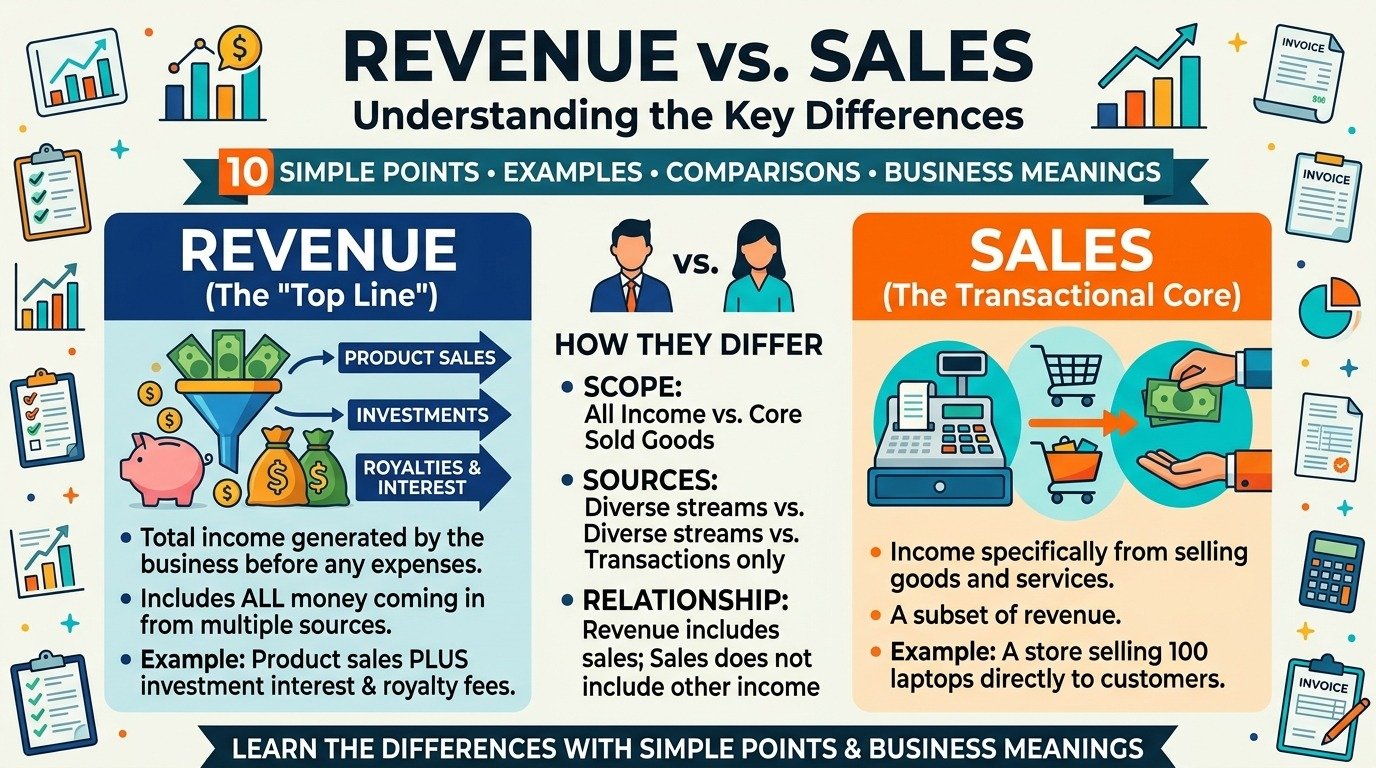
The main difference between revenue and sales is their scope.
Sales are money earned from selling goods or services.
Revenue is the wider income a business reports from its business activities. In many companies, sales are the main part of revenue.
Why Is Their Difference Necessary to Know for Learners and Experts?
Knowing the difference is important for both learners and experts. Students need these terms when studying accounting, finance, or business. Business owners need them to understand how their companies are performing.
Experts also use these terms when reading financial reports. Investors may look at revenue growth to study a company. Sales figures can help them understand customer demand.
These terms also matter in society. Businesses create jobs, sell products, pay taxes, and provide services. Understanding their financial results helps people make better economic decisions.
Pronunciation of Both
Revenue
- US English: REV-uh-noo
- UK English: REV-uh-nyoo
Sales
- US English: saylz
- UK English: saylz
The two words are closely linked, but they do not always mean the same thing. Let us now look at the main differences one by one.
Difference Between the Keywords
1. Basic Meaning
Revenue is a broad term for income earned by a business through its normal activities and other qualifying sources.
Examples of revenue:
- A software company earns money from subscriptions and services.
- A hotel earns income from rooms, food, and other services.
Sales means money earned by selling goods or services to customers.
Examples of sales:
- A shoe store sells shoes worth $10,000.
- A bakery sells cakes worth $2,000.
2. Scope
Revenue has a wider scope. It can include sales and other types of business income, depending on the company’s accounting method.
Examples of revenue:
- A company earns money from product sales and service fees.
- A software firm earns subscription income and support income.
Sales have a narrower scope. They focus on goods or services sold.
Examples of sales:
- A phone shop earns sales from phones sold.
- A furniture store earns sales from tables and chairs sold.
3. Source of Income
Revenue can come from more than one business source.
Examples of revenue:
- A company earns money from product sales and licensing.
- A business earns income from sales and customer services.
Sales come directly from selling products or services.
Examples of sales:
- A clothing store earns sales from selling shirts.
- A restaurant earns sales from selling meals.
4. Relationship With Customers
Revenue can include income linked to different business activities.
Examples of revenue:
- A technology company earns money from software sales and support services.
- A hotel earns money from rooms, food, and events.
Sales have a direct connection with customer purchases.
Examples of sales:
- A customer buys a laptop from a store.
- A customer pays a restaurant for a meal.
5. Use in Financial Reports
Revenue is a major figure in many financial reports. It can help show the size of a company’s income.
Examples of revenue:
- A company reports annual revenue of $20 million.
- An investor compares revenue from two years.
Sales may be shown as sales, net sales, or sales revenue.
Examples of sales:
- A retailer reports quarterly sales of $500,000.
- A car company reports vehicle sales for the year.
6. Measurement of Business Performance
Revenue gives a broad view of income.
Examples of revenue:
- A business sees revenue grow from $2 million to $3 million.
- A company checks yearly revenue to study growth.
Sales show how well goods or services are being sold.
Examples of sales:
- A store checks monthly shoe sales.
- A car company checks the number and value of cars sold.
7. Effect of Customer Demand
Revenue can change because of many factors. These may include sales, prices, subscriptions, and services.
Examples of revenue:
- Revenue rises after a company adds a new service.
- Revenue falls when customer demand becomes weak.
Sales are strongly affected by customer demand.
Examples of sales:
- Ice cream sales rise during hot weather.
- Coat sales may rise during winter.
8. Use for Investors
Revenue helps investors study the wider financial performance of a company.
Examples of revenue:
- An investor studies revenue growth over five years.
- An investor compares the revenue of two companies.
Sales help investors understand how well products or services are selling.
Examples of sales:
- Rising car sales may show strong customer demand.
- Falling phone sales may show weaker demand.
9. Business Planning
Revenue helps a company plan its wider financial activities.
Examples of revenue:
- A company uses revenue trends to plan future expansion.
- A business studies revenue before opening a new branch.
Sales help a company plan its selling activities.
Examples of sales:
- A shop studies sales before ordering more stock.
- A company studies sales before launching a new product.
10. Size and Coverage
Revenue can cover a wider range of income.
Examples of revenue:
- A company has product income and service income.
- A software company earns from subscriptions and support.
Sales cover the value of goods or services sold.
Examples of sales:
- A bookstore records money from books sold.
- A restaurant records money from meals sold.
Simple rule: Sales are about selling. Revenue gives a wider view of business income.
Nature and Behaviour of Revenue
Revenue is broad in nature. It gives a wider picture of a business’s income.
Revenue can rise when a business grows. It can fall when business activity becomes weak. Prices, customers, services, and market conditions can all affect revenue.
For example, a company may increase revenue by selling more products. It may also increase revenue by adding a new service.
Revenue is useful for long-term business analysis. Managers and investors often study it over several periods.
Nature and Behaviour of Sales
Sales are more direct. They focus on goods or services sold to customers.
Sales can change quickly. Customer demand, prices, advertising, competition, seasons, and product quality can affect sales.
For example, a toy store may have high sales before a holiday. A clothing store may have higher sales during a seasonal promotion.
Sales are important because they show what customers are buying.
Why Are People Confused About Their Use?
People often confuse revenue and sales because they are closely related.
In many businesses, sales are the main source of revenue. This makes the two terms look like the same thing.
Business reports can also use phrases such as sales revenue or net sales. This can create more confusion.
The easiest way to remember them is:
Sales = money from goods or services sold.
Revenue = broader business income.
However, exact reporting can vary by company and accounting rules. So, it is always useful to check how a company defines each term in its financial statements.
also read morhttps://comparificationn.com/thinkpad-and-ideapad/e about
Difference and Similarity Between Revenue and Sales
| Feature | Revenue | Sales |
| Basic meaning | Broader business income | Money from goods or services sold |
| Scope | Wider | Narrower |
| Main source | Business activities | Customer purchases |
| Customer connection | Can be direct or indirect | Usually direct |
| Financial reports | Important financial figure | May form part of revenue |
| Main purpose | Shows wider income | Shows selling activity |
| Customer demand | One factor | Major factor |
| Business planning | Useful | Very useful |
| Similarity | Both measure business income | Both measure business income |
| Relationship | May include sales | Can be a major part of revenue |
Which Is Better in What Situation?
When Is Revenue Better to Use?
Revenue is better when you want to discuss the wider income of a business. It is useful for investors, managers, accountants, and business owners. For example, if a company earns money from products, subscriptions, and services, revenue can give a broader picture. Revenue is also useful when comparing business performance over several years. A company can study whether its revenue is growing or falling. However, revenue does not tell the whole story. A company can have high revenue but still have high costs and low profit. Therefore, revenue is best when you want to understand the overall income side of a business.
When Are Sales Better to Use?
Sales are better when you want to focus on products or services sold to customers. They are useful for sales teams, shop owners, managers, and investors. For example, a clothing store can study sales to learn which clothes customers buy most. A car company can study vehicle sales to understand demand. Sales can also help a business decide how much stock to keep. When sales fall, a company may need to change its prices, products, or marketing. Therefore, sales are best when the main question is about customer purchases and selling performance.
How Are the Keywords Used in Metaphors and Similes?
Business writers sometimes use revenue and sales in creative comparisons.
Revenue as a Metaphor
- “Revenue is the fuel of a business.”
- “Revenue is the lifeline of the company.”
These phrases show that revenue supports business activity.
Sales as a Metaphor
- “Sales are the engine of the business.”
- “Sales are the heart of the market.”
These phrases show how important customer purchases can be.
Revenue in Similes
- “The company’s revenue grew like a rising tide.”
- “Revenue moved like a strong river.”
Sales in Similes
- “Sales rose like a rocket.”
- “Sales fell like a stone.”
These comparisons make business ideas easier to understand.
Connotative Meaning of Revenue
Positive Meaning
Revenue can suggest growth and success.
Example:
“Strong revenue helped the company open new branches.”
Negative Meaning
Revenue can suggest trouble when it falls.
Example:
“Falling revenue worried the company’s managers.”
Neutral Meaning
Revenue is often a neutral financial term.
Example:
“The company reported annual revenue of $5 million.”
Connotative Meaning of Sales
Positive Meaning
Sales can suggest success and strong customer demand.
Example:
“High sales helped the business grow.”
Negative Meaning
Low sales can suggest weak demand.
Example:
“Low sales forced the store to reduce its costs.”
Neutral Meaning
Sales can simply describe business activity.
Example:
“The company reported sales of 50,000 units.”
Idioms and Proverbs Related to Revenue and Sales
There are no famous traditional idioms that directly mean revenue. However, several common business expressions are linked to sales and money.
“Boost sales”
This means to increase sales.
Example:
“The company offered discounts to boost sales.”
“Drive sales”
This means to help increase sales.
Example:
“Good advertising can drive sales.”
“Make money”
This means to earn money.
Example:
“The new product helped the company make money.”
“Bottom line”
This business expression often refers to the final profit figure.
Example:
“Higher sales helped improve the company’s bottom line.”
“Money talks”
This common saying means money can have strong influence.
Example:
“In business, people often say that money talks.”
Works in Literature Related to Revenue and Sales
The exact terms revenue and sales are mainly business terms. They are not common literary themes by themselves. However, some famous works deal with money, trade, selling, wealth, and business.
- The Merchant of Venice — Drama, William Shakespeare, around 1596–1598. It deals with trade, money, debt, and business.
- Death of a Salesman — Drama, Arthur Miller, 1949. It focuses on a salesman, work, money, and the idea of success.
- The Wealth of Nations — Economics, Adam Smith, 1776. It discusses markets, trade, labor, and economic activity.
Movies Related to Revenue and Sales
There are few major films specifically about the accounting term revenue. However, several movies focus on sales, business, money, and financial success.
- Death of a Salesman — 1985, United States. It follows a struggling salesman and his family.
- Glengarry Glen Ross — 1992, United States. It focuses on salesmen facing strong pressure to sell.
- The Pursuit of Happyness — 2006, United States. It follows a man trying to build a career in sales and finance.
- The Wolf of Wall Street — 2013, United States. It explores aggressive sales, money, and financial markets.
- The Founder — 2016, United States. It tells a business story about the growth of McDonald’s.
Five Frequently Asked Questions About Revenue and Sales
1. What is the main difference between revenue and sales?
Sales are money earned from selling goods or services. Revenue is a broader income measure and can include sales and other qualifying business income.
2. Are revenue and sales the same?
No, not always. Sales can be a major part of revenue, but the terms can have different meanings in financial reporting.
3. Can sales be higher than revenue?
Usually, sales and revenue are closely related, and the answer depends on how the business defines and reports them. In many cases, sales are included within revenue.
4. Why are sales important?
Sales show how much a business earns from selling products or services. They can also show customer demand.
5. Why is revenue important?
Revenue gives a broader view of a company’s income. It helps managers, investors, and business owners study business performance.
How Are Both Useful for Their Surroundings?
Revenue and sales can affect the wider community and economy.
A business with strong sales may need more workers. It may also buy more materials from other businesses. This can support jobs and local suppliers.
Revenue also helps businesses plan their future. A company with healthy income may invest in better tools, new products, training, and services.
Sales can also help businesses understand what people want. When companies study customer buying habits, they can improve their products.
In this way, revenue and sales are not only accounting terms. They are also useful for understanding business activity in society.
Final Words for Both
Revenue and sales are closely connected, but they are not always identical.
Sales focus on goods or services sold to customers.
Revenue gives a wider view of income from business activities.
Remember this simple rule:
Sales are about selling, while revenue is about the wider income picture.
Once you understand this rule, financial reports and business conversations become much easier to understand.
Conclusion
The difference between rhttps://monday.com/blog/crm-and-sales/revenue-vs-sales/evenue and sales is important for anyone who wants to understand business and finance. Sales usually show the money earned from goods or services sold to customers. Revenue is a broader term that can cover sales and other qualifying business income. Sales help show customer demand and selling performance. Revenue helps show the wider income activity of a business. Both terms are useful for students, business owners, workers, managers, and investors. They also help people understand how businesses work in society. The best way to remember the difference is simple: sales focus on selling, while revenue gives a wider income view. Once you learn this difference, you can use both terms with greater confidence and accuracy.

I’m Zahid Abbas, an educator, researcher, and digital publishing strategist with a passion for linguistics, grammar, and clear communication. As a content creator and SEO specialist, I craft research-driven, reader-focused content that empowers learners and makes knowledge accessible worldwide.