Imagine that Ali wants to repair his house. He calls a builder and explains the work. The builder says the job may cost about $2,000. This is an estimate. Later, after checking the house, the builder gives Ali a written price of $2,200 for the work. This is a quote. The difference between estimate and quote is important when people buy goods or services. An estimate gives an expected cost, while a quote usually gives a more specific price for a defined job. The difference between estimate and quote can affect budgets, contracts, and business decisions. Many customers ask about the difference between estimate and quote before they hire a service provider. Knowing the difference between estimate and quote helps both customers and businesses avoid confusion about prices, work, and payment.
Key Difference Between an Estimate and a Quote
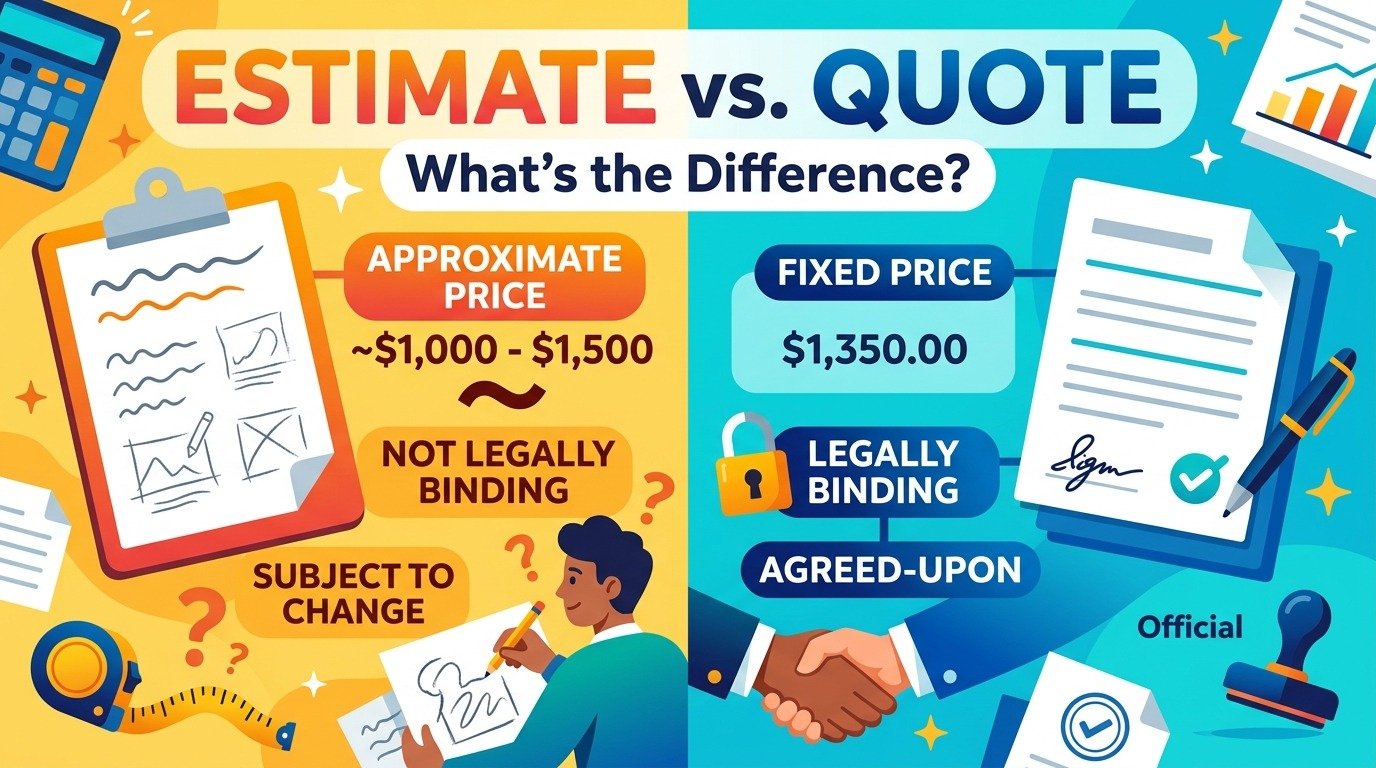
The main difference is certainty.
An estimate is an approximate cost. The final price may change when the actual work or costs become clear.
A quote is a specific price offered for a defined service or job. It usually gives the customer a clearer price before the work begins.
Simple example:
- Estimate: “The repair may cost about $1,000.”
- Quote: “We will complete the repair for $1,050.”
Why Is Their Difference Necessary to Know for Learners and Experts?
Knowing the difference is useful in daily life and business. Customers need to know whether a price is only an approximation or a firm offer. This helps them plan their money.
Workers and businesses also need this knowledge. A clear estimate can help start a discussion. A clear quote can help both sides agree on the price and work.
In society, clear pricing builds trust. It can reduce arguments between customers and service providers. It also helps people make better financial choices.
Pronunciation of Estimate and Quote
Estimate
- US: /ˈestəmət/ as a noun
- UK: /ˈestɪmət/ as a noun
Quote
- US: /kwoʊt/
- UK: /kwəʊt/
Difference Between the Keywords
1. Basic Meaning
An estimate is an approximate calculation of a cost, amount, or result.
Example 1:
The mechanic gave me an estimate for the car repair.
Example 2:
The builder estimated the cost at $5,000.
A quote is a stated price for a particular product or service.
Example 1:
The company gave us a quote for the new roof.
Example 2:
I asked the printer for a quote for 500 books.
2. Level of Accuracy
An estimate is usually less exact.
Example 1:
The painting job is estimated to cost $800.
Example 2:
The repair estimate is around $500.
A quote is usually more exact.
Example 1:
The company quoted $850 for the painting job.
Example 2:
The printer gave us a quote of $600.
3. Price Certainty
An estimate gives an expected price.
Example 1:
The plumber estimated the repair at $300.
Example 2:
The building work may cost $10,000, according to the estimate.
A quote gives a specific offered price.
Example 1:
The plumber quoted $300 for the repair.
Example 2:
The company quoted $10,000 for the project.
4. Changes in Price
An estimate can change as more information becomes available.
Example 1:
The repair estimate increased after the mechanic found another problem.
Example 2:
The building estimate changed when material prices increased.
A quote may also have conditions, but it normally gives a clearer price for the stated work.
Example 1:
The quote was $2,000 for the listed work.
Example 2:
The company changed the quote after the customer added another room.
5. Use in Business
Estimates are useful when a business does not yet know the exact cost.
Example 1:
The contractor sent an estimate before visiting the site.
Example 2:
The designer gave an estimate for the whole project.
Quotes are common when a customer wants to compare prices.
Example 1:
We received three quotes from different companies.
Example 2:
The customer chose the lowest quote.
6. Use Before a Final Decision
An estimate helps a customer decide if a project may fit the budget.
Example 1:
The estimate was too high, so we delayed the project.
Example 2:
The estimate helped us plan our budget.
A quote can help the customer decide whether to accept a specific offer.
Example 1:
We accepted the company’s quote.
Example 2:
She rejected the quote because it was too expensive.
7. Written Form
An estimate can be spoken or written.
Example 1:
The builder gave me a quick estimate over the phone.
Example 2:
The company sent a written estimate by email.
A quote is often given in writing.
Example 1:
Please send me a written quote.
Example 2:
We signed the quote before the work began.
8. Legal and Contract Meaning
An estimate is not usually the same as a final contract price.
Example 1:
The final bill was higher than the estimate.
Example 2:
The estimate helped us understand the possible cost.
A quote can become part of an agreement when the customer accepts it, depending on the terms.
Example 1:
The customer accepted the quote and signed the agreement.
Example 2:
The accepted quote showed the agreed price.
9. Common Questions
People often ask for an estimate when they want to know about how much something may cost.
Example 1:
“Can you give me an estimate for the repair?”
Example 2:
“Do you have an estimate for the project?”
People often ask for a quote when they want a specific price.
Example 1:
“Can you give me a quote for 100 chairs?”
Example 2:
“Could you send me a quote by Friday?”
10. Main Purpose
The main purpose of an estimate is to give a reasonable idea of cost or amount.
Example 1:
The estimate helped us plan our spending.
Example 2:
The cost estimate helped the manager prepare a budget.
The main purpose of a quote is to offer a specific price for defined work or goods.
Example 1:
The quote showed the price for the new windows.
Example 2:
The customer compared quotes before choosing a supplier.
Nature and Behaviour of an Estimate
An estimate is flexible. It gives an idea rather than complete certainty. It may be based on past experience, available information, average prices, or early calculations.
An estimate can change when new facts appear. For example, a builder may give an estimate before opening a wall. After opening the wall, the builder may find more damage. The final cost may then be higher.
Estimates are useful when the exact cost is not known yet.
Nature and Behaviour of a Quote
A quote is more specific. It normally describes a product or service and gives a price for it.
A quote may also include details such as:
- The work included
- Materials
- Quantity
- Price
- Taxes
- Delivery
- Payment terms
- How long the quote is valid
A quote can have conditions. Therefore, customers should read it carefully before accepting it.
also read more abouthttps://comparificationn.com/difference-between-belief-and-faith-2/
Why Are People Confused About Their Use?
People often confuse these words because both are used when talking about money and prices.
A customer may say, “Can I get an estimate?” when they actually need a firm price. Another customer may ask for a quote when they only want a rough idea.
The easiest way to remember them is:
Estimate = about how much?
Quote = what price are you offering?
For example, if you are planning a large project but have not decided the details, ask for an estimate. If you know exactly what you want and need a specific price, ask for a quote.
Difference and Similarity Between Estimate and Quote
| Feature | Estimate | Quote |
| Meaning | Approximate cost | Specific offered price |
| Accuracy | Usually less exact | Usually more exact |
| Main purpose | Budget planning | Price decision |
| Can change? | Often can change | Usually has stated terms |
| Common in business | Yes | Yes |
| Can be written? | Yes | Yes |
| Based on details | May use limited details | Usually uses clear details |
| Helps customers | Yes | Yes |
| Used before work | Yes | Yes |
| Main similarity | Both discuss expected cost | Both discuss expected cost |
Which Is Better in What Situation?
An estimate is better when the final cost is not yet clear. It is useful for building, repairs, moving, large projects, and early planning. For example, a customer may ask for an estimate before deciding whether to repair or replace a machine. An estimate gives a useful starting point.
A quote is better when the customer knows what they want and needs a clear price. It is useful when comparing suppliers, ordering products, or hiring a company for a defined job. A quote can make the buying decision easier. Neither word is always better. The right choice depends on how much information is available and how certain the price needs to be.
How Are Estimate and Quote Used in Metaphors and Similes?
These words can also be used in creative language.
Metaphors With Estimate
- “His estimate was a rough map.”
This means the estimate gave only a general idea. - “The budget was built on an estimate.”
This compares the estimate to a foundation.
Similes With Estimate
- “The estimate was like a first guess.”
It shows that the number was not final. - “Her estimate was as rough as a sketch.”
It shows that the figure was not exact.
Metaphors With Quote
- “The quote was a price tag for the project.”
It shows that the quote gave a clear price. - “The quote became a bridge between the buyer and seller.”
It shows how a quote can help both sides reach an agreement.
Similes With Quote
- “The quote was like a clear road map.”
It gave the customer a clear idea of the cost. - “His quote was as clear as a price tag.”
It shows that the price was easy to understand.
Connotative Meaning of Estimate and Quote
Connotative Meaning of Estimate
Positive
An estimate can suggest planning and professional knowledge.
Example:
The engineer’s careful estimate helped the company control its budget.
Negative
An estimate can sometimes suggest uncertainty.
Example:
The customer was worried because the estimate could change later.
Neutral
Estimate can simply mean an approximate calculation.
Example:
The estimate for the project is $20,000.
Connotative Meaning of Quote
Positive
A quote can suggest clarity, professionalism, and transparency.
Example:
The company gave us a clear quote before starting the work.
Negative
A quote can seem expensive or restrictive when the customer does not like the offered price.
Example:
The customer rejected the quote because it was too high.
Neutral
Quote can simply mean a stated price.
Example:
We received a quote for the office furniture.
Idioms and Proverbs Related to Estimate and Quote
There are no very common traditional idioms that use estimate and quote directly. However, several common expressions are useful when talking about their meaning.
“Take a guess”
This means to give an approximate answer.
Example:
Can you take a guess at the cost of the repair?
This is close to the idea of an estimate.
“Ballpark figure”
This means a rough number.
Example:
The contractor gave us a ballpark figure of $10,000.
“Get a second opinion”
This means to ask another person for advice or another view.
Example:
The repair estimate seemed high, so we decided to get a second opinion.
“Compare apples with apples”
This means to compare similar things fairly.
Example:
When comparing quotes, make sure you compare apples with apples.
Works in Literature Related to Estimates and Quotes
The words estimate and quote are mainly business and everyday terms rather than major literary themes. However, works that explore money, trade, business, and social value can help readers understand the ideas behind them.
- The Merchant of Venice — Drama, William Shakespeare, 1596–1598. It explores trade, money, contracts, and financial agreements.
- Hard Times — Novel, Charles Dickens, 1854. It explores business, industry, money, and practical thinking.
- The Great Gatsby — Novel, F. Scott Fitzgerald, 1925. It explores wealth, money, social value, and business.
- Death of a Salesman — Drama, Arthur Miller, 1949. It explores sales, work, money, and the pressure of business life.
Movies Related to Estimates and Quotes
- The Pursuit of Happyness — 2006, United States. It focuses on work, money, sales, and financial struggle.
- The Founder — 2016, United States. It explores business growth, deals, money, and commercial decisions.
- Moneyball — 2011, United States. It explores numbers, estimates, data, and decision-making.
- Glengarry Glen Ross — 1992, United States. It focuses on sales, business pressure, and competition.
- The Big Short — 2015, United States. It explores financial decisions, prices, predictions, and risk.
possible Asked Questions
1. What is the main difference between an estimate and a quote?
An estimate is an approximate cost. A quote is a specific price offered for defined goods or services.
2. Is an estimate the final price?
Usually, no. An estimate may change when the actual cost becomes clear.
3. Is a quote always final?
Not always. A quote can have terms and conditions. Customers should check its validity period and what work it includes.
4. Should I ask for an estimate or a quote?
Ask for an estimate when you need a rough idea of cost. Ask for a quote when you need a specific price for clearly defined work.
5. Can a business charge more than an estimate?
It may be possible, depending on the agreement and local rules. The business should explain major changes in cost clearly.
How Are Estimate and Quote Useful for Our Surroundings?
Estimates and quotes help people make better choices in everyday life. When someone wants to repair a car, build a house, paint a room, or buy office furniture, price information is important.
An estimate helps people plan their money. A quote helps people compare real offers.
Businesses also benefit from clear pricing. Good estimates can help companies plan resources. Good quotes can help customers understand what they are buying.
Clear price information can build trust between buyers and sellers. It can also reduce confusion, unexpected costs, and disagreements.
Final Words for Estimate and Quote
An estimate gives an approximate idea of cost. A quote gives a more specific price for a defined product or service.
Remember this simple rule:
Estimate = approximate price.
Quote = specific price offered.
If the details are not final, an estimate may be more suitable. If the details are clear and you want a specific price, a quote is usually the better choice.
Conclusion
The difference between estimate and quote is simple when we focus on price certainty. An estimate gives an approximate idea of what something may cost. It is useful when the final cost is not yet known. A quote gives a more specific price for defined goods or services. It is useful when a customer wants to compare prices or make a buying decision. Both are important in business and daily life. They help customers plan their money and help businesses communicate clearly. An estimate can change as new information appears, while a quote usually has clear terms and conditions. By knowing when to use each word, customers and businesses can avoid confusion. In simple words, use estimate for an approximate cost and quote for a specific price.

I’m Zahid Abbas, an educator, researcher, and digital publishing strategist with a passion for linguistics, grammar, and clear communication. As a content creator and SEO specialist, I craft research-driven, reader-focused content that empowers learners and makes knowledge accessible worldwide.