Imagine Maria meeting a new Spanish-speaking friend. She wants to ask, “Who are you?” She can say “¿Quién eres?” But when she asks, “How are you?” or “How are you feeling?”, she may use “¿Cómo estás?” Maria soon learns that eres and estás are not interchangeable. Both words mean a form of “you are,” but they come from different Spanish verbs. Eres comes from ser, while estás comes from estar. This is the main idea behind the difference between eres and estas. Understanding the difference between eres and estas helps Spanish learners speak with more confidence. The difference between eres and estas is also important because using the wrong word can change the meaning of a sentence.
Key Difference Between Eres and Estas
The main difference is the verb they come from.
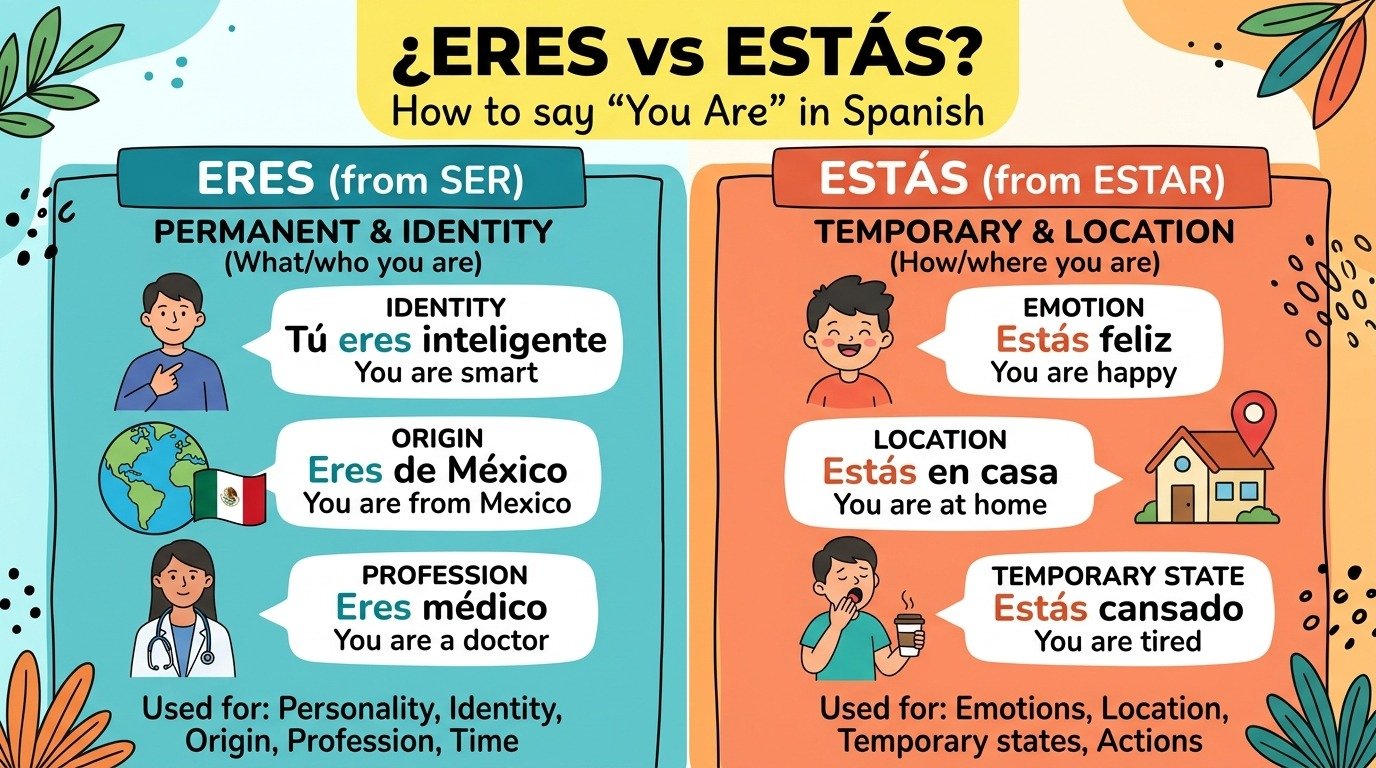
Eres comes from ser. It is usually used for identity, characteristics, origin, profession, and other things seen as defining or identifying someone or something.
Estás comes from estar. It is usually used for temporary conditions, feelings, locations, and states.
In simple words:
Eres = you are, from ser
Estás = you are, from estar
For example:
- Eres amable. = You are kind.
- Estás cansado. = You are tired.
Why Is Their Difference Necessary to Know for Learners and Experts?
Knowing the difference between eres and estás is important for Spanish learners. A small change can make a sentence sound wrong or change its meaning.
Students need this difference when speaking and writing Spanish. Teachers need it when explaining Spanish grammar. Translators and language experts also need to choose the correct verb.
The difference is useful in society because language helps people communicate clearly. When someone says “Eres feliz” and “Estás feliz,” the two sentences can suggest different ideas about happiness.
Pronunciation of Eres and Estás
Eres is pronounced with two syllables.
Estás is also pronounced with two syllables. The stress falls on the second syllable because of the written accent.
In standard Spanish, the pronunciation does not change between US and UK English speakers. The Spanish sounds remain the same.
Now, let us look at the ten main differences. Simple examples will make the rules easier to remember.
Difference Between the Keywords
1. Different Spanish Verbs
The first difference is their source verb.
Eres:
Eres is the tú form of ser in the present tense.
Examples:
- Eres mi amigo. — You are my friend.
- Eres estudiante. — You are a student.
Estás:
Estás is the tú form of estar in the present tense.
Examples:
- Estás en casa. — You are at home.
- Estás cansado. — You are tired.
2. Identity vs. Current State
Eres is often used to identify someone or describe what someone is like.
Examples:
- Eres mi hermano. — You are my brother.
- Eres muy amable. — You are very kind.
Estás is often used for a current state or condition.
Examples:
- Estás enfermo. — You are sick.
- Estás ocupado. — You are busy.
3. Permanent or Defining Qualities
Eres is commonly used for qualities that describe a person’s identity or character.
Examples:
- Eres inteligente. — You are intelligent.
- Eres paciente. — You are patient.
Estás can describe how someone is at a particular moment.
Examples:
- Estás nervioso. — You are nervous.
- Estás tranquilo. — You are calm.
The difference is not always simply “permanent versus temporary.” Context matters.
4. Origin and Nationality
Eres is normally used when talking about where someone is from.
Examples:
- Eres de España. — You are from Spain.
- Eres mexicano. — You are Mexican.
Estás is not normally used to express someone’s permanent origin.
Instead, estar can describe someone’s current location.
Examples:
- Estás en España. — You are in Spain.
- Estás en México. — You are in Mexico.
5. Profession and Role
Eres is normally used to talk about a person’s profession, occupation, or role.
Examples:
- Eres profesor. — You are a teacher.
- Eres médico. — You are a doctor.
Estás can be used with a role when the meaning is about a current position or situation, often with estar de.
Examples:
- Estás de profesor este año. — You are working as a teacher this year.
- Estás de guardia hoy. — You are on duty today.
6. Location
Estás is normally used for location.
Examples:
- Estás en la escuela. — You are at school.
- Estás aquí. — You are here.
Eres is not normally used to say where someone is located.
However, ser can appear in sentences about where an event takes place.
Examples:
- La fiesta es en mi casa. — The party is at my house.
- La reunión es en la oficina. — The meeting is at the office.
This is an important special use of ser.
7. Feelings
Estás is commonly used for a person’s current feelings or emotional state.
Examples:
- Estás feliz. — You are happy.
- Estás triste. — You are sad.
Eres can also be used with emotional words, but the meaning can become more general or characteristic.
Examples:
- Eres feliz. — You are happy.
- Eres triste. — You are a sad person.
The exact meaning depends on context.
8. Appearance and Condition
Both verbs can be used with adjectives, but they can give different meanings.
Eres:
It can describe a characteristic.
Examples:
- Eres guapo. — You are handsome.
- Eres fuerte. — You are strong.
Estás:
It can describe how someone looks or feels at the moment.
Examples:
- Estás guapo hoy. — You look handsome today.
- Estás fuerte después del entrenamiento. — You look strong after the training.
9. Time and Situations
Ser is used in many expressions about time.
Eres itself is used when the subject is tú, but not normally to tell the time.
For example, ser is used in:
- Son las tres. — It is three o’clock.
- Es lunes. — It is Monday.
Estar is used to describe a current situation.
Examples:
- Estás en una situación difícil. — You are in a difficult situation.
- Estás listo para el examen. — You are ready for the exam.
10. Meaning Can Change With the Adjective
This is one of the most interesting differences.
Some adjectives can change meaning when used with ser or estar.
Eres aburrido.
This can mean: You are a boring person.
Example:
- Eres aburrido cuando hablas de ese topic. — You are boring when you talk about that topic.
Estás aburrido.
This means: You are bored.
Example:
- Estás aburrido porque no tienes nada que hacer. — You are bored because you have nothing to do.
Another example is listo:
Eres listo. — You are clever.
Estás listo. — You are ready.
This shows why choosing the correct verb is important.
Nature and Behaviour of Eres
Eres comes from ser. It often introduces information about identity, origin, characteristics, profession, relationships, and other defining ideas.
It usually answers questions such as:
- Who are you?
- What are you like?
- Where are you from?
- What do you do?
Examples:
- Eres mi amigo.
- Eres muy amable.
- Eres de Colombia.
- Eres estudiante.
The meaning can still depend on context. “Permanent” is a useful beginner rule, but it does not explain every use of ser.
Nature and Behaviour of Estás
Estás comes from estar. It often describes location, feelings, conditions, and temporary states.
It can answer questions such as:
- Where are you?
- How are you?
- What condition are you in?
Examples:
- Estás en casa.
- Estás cansado.
- Estás feliz.
- Estás listo.
Again, “temporary” is a useful guide, but it is not a perfect rule for every use of estar.
Why Are People Confused About Their Use?
People are confused because both eres and estás can translate as “you are” in English.
English does not normally make the same distinction between ser and estar.
For example:
- Eres inteligente. = You are intelligent.
- Estás cansado. = You are tired.
Both English sentences use “are,” but Spanish uses two different verbs.
Another problem is the simple rule that ser means permanent and estar means temporary. This rule helps beginners, but it has exceptions.
The best approach is to learn the common uses of each verb and then learn special cases through examples.
also read more abouthttps://comparificationn.com/thinkpad-and-ideapad/
Difference and Similarity Between Eres and Estás
| Feature | Eres | Estás |
| English meaning | You are | You are |
| Spanish verb | Ser | Estar |
| Person | Tú | Tú |
| Main use | Identity and characteristics | State, condition, and location |
| Origin | Yes | No, normally |
| Location | No, normally | Yes |
| Profession | Yes | Sometimes, with special structures |
| Feelings | Can describe general character | Common for current feelings |
| Current condition | Less common | Very common |
| Same in English? | “You are” | “You are” |
| Similarity | Both are forms of “to be” | Both are forms of “to be” |
Which Is Better in What Situation?
When Is Eres Better?
Use eres when you want to talk about identity, origin, profession, relationships, or characteristics.
For example, say “Eres estudiante” when you mean “You are a student.” Say “Eres de Perú” when you mean “You are from Peru.”
Use eres when the information helps identify or describe the person. It is also used with many adjectives that describe qualities.
Examples include Eres amable and Eres inteligente.
Remember that “permanent” is only a learning guide. Ser has many uses that are not simply permanent.
When Is Estás Better?
Use estás when you want to talk about location, current feelings, or a present condition.
For example, say “Estás en casa” for “You are at home.” Say “Estás cansado” for “You are tired.”
Estás is also used with many conditions that can change.
Examples include:
- Estás enfermo. — You are sick.
- Estás feliz. — You are happy.
The context is important. Do not choose estar only because something seems temporary.
How Are the Keywords Used in Metaphors and Similes?
Eres in Metaphors
Eres un sol.
This can mean “You are a sun” in a metaphorical sense. It may suggest that you bring warmth or happiness.
Eres una roca.
This can suggest that you are strong and dependable.
Eres in Similes
Spanish similes often use como, meaning “like” or “as.”
Eres como un sol.
You are like the sun.
Eres como una roca.
You are like a rock.
Estás in Metaphors
Estás en una nube.
Literally, “You are in a cloud.” It can suggest that you are dreaming or not fully focused.
Estás en un laberinto.
Literally, “You are in a maze.” It can suggest that you are confused.
Estás in Similes
Estás como un niño con un juguete nuevo.
You are like a child with a new toy.
Estás como una hoja al viento.
You are like a leaf in the wind.
These examples show that both words can appear in creative language.
also read more about https://comparificationn.com/difference-between-binompdf-and-binomcdf-2/
Connotative Meaning of Eres and Estás
Connotative Meaning of Eres
Positive:
It can suggest identity, strength, kindness, or ability.
Example:
Eres muy valiente. — You are very brave.
Negative:
It can describe an unwanted personal quality.
Example:
Eres egoísta. — You are selfish.
Neutral:
It can simply identify someone.
Example:
Eres mi hermano. — You are my brother.
Connotative Meaning of Estás
Positive:
It can describe a good current condition.
Example:
Estás feliz. — You are happy.
Negative:
It can describe a difficult current condition.
Example:
Estás enfermo. — You are sick.
Neutral:
It can describe location.
Example:
Estás en la oficina. — You are in the office.
Idioms and Expressions Related to Eres and Estás
There are not many traditional English-style idioms built specifically around the exact words eres and estás. However, both appear in many common Spanish expressions.
1. ¿Cómo estás?
Meaning: How are you?
Example:
Hola, Ana. ¿Cómo estás?
Hello, Ana. How are you?
2. ¿Quién eres?
Meaning: Who are you?
Example:
¿Quién eres y de dónde vienes?
Who are you and where are you from?
3. Eres lo que eres
Meaning: You are what you are.
Example:
No cambies para agradar a otros. Eres lo que eres.
Do not change to please others. You are what you are.
4. Estás de suerte
Meaning: You are lucky.
Example:
Hoy estás de suerte.
You are lucky today.
5. Estás en las nubes
Meaning: You are daydreaming or not paying attention.
Example:
Estás en las nubes durante la clase.
You are daydreaming during the class.
Works in Literature Related to Eres and Estás
There are no major literary works specifically written about the Spanish words eres and estás. However, these forms naturally appear in Spanish literature because they are common forms of ser and estar.
- Don Quixote — Novel, Miguel de Cervantes, 1605/1615. The Spanish text contains many forms of everyday Spanish verbs.
- One Hundred Years of Solitude — Novel, Gabriel García Márquez, 1967. The work is an important Spanish-language novel.
- The House of the Spirits — Novel, Isabel Allende, 1982. It was originally written in Spanish and uses natural Spanish grammar.
- Like Water for Chocolate — Novel, Laura Esquivel, 1989. It is another major Spanish-language work.
Movies Related to Eres and Estás
No major films are specifically made about the words eres and estás. However, Spanish-language films and films about Spanish-speaking cultures naturally use these forms.
- Volver — Drama, 2006, Spain.
- Pan’s Labyrinth — Fantasy/Drama, 2006, Spain/Mexico.
- Roma — Drama, 2018, Mexico.
- Coco — Animation/Fantasy, 2017, United States.
- The Sea Inside — Biography/Drama, 2004, Spain.
Five Frequently Asked Questions
1. What is the main difference between eres and estás?
Eres comes from ser and often describes identity or characteristics. Estás comes from estar and often describes a current state, condition, or location.
2. Does eres mean “you are”?
Yes. Eres can mean “you are” when the verb is ser.
Example:
Eres mi amigo.
You are my friend.
3. Does estás also mean “you are”?
Yes. Estás can also mean “you are,” but it comes from estar.
Example:
Estás en casa.
You are at home.
4. Is eres always permanent and estás always temporary?
No. This is a useful beginner rule, but it is not complete. Spanish uses ser and estar in many different ways.
For example:
La fiesta es en mi casa.
The party is at my house.
Here, ser is used for the location of an event.
5. How can I remember the difference?
A simple starting rule is:
Eres → identity and characteristics
Estás → location and current states
Then learn common examples and special uses as you progress.
How Are Both Useful for Their Surroundings?
Eres helps people describe identity and relationships. It can help us say who someone is, where they are from, what they do, or what qualities they have.
Estás helps people describe present situations. It can tell us where someone is and how they feel or what condition they are in.
These uses are important in daily communication. People use them at home, at school, at work, and in social situations.
Using the correct word helps people understand each other. It also makes Spanish communication more natural and clear.
Final Words for Eres and Estás
The words eres and estás both mean a form of “you are,” but they come from different Spanish verbs.
Eres = ser
Estás = estar
Use eres mainly for identity, origin, profession, and characteristics.
Use estás mainly for location, feelings, and current conditions.
Do not depend only on the idea of “permanent” and “temporary.” That rule is useful, but Spanish has many special uses.
The best way to learn is to study each verb with simple sentences and real examples.
Conclusion
The difference between eres and estás is one of the most important basic ideas in Spanish grammar. Both words can translate as “you are,” but they come from two different verbs. Eres comes from ser and is often used for identity, origin, profession, relationships, and characteristics. Estás comes from estar and is often used for location, feelings, and current conditions. The difference may seem difficult at first because English uses the same word, “are,” for both. With regular practice, however, the rule becomes easier. Learn common examples instead of memorizing only one simple rule. When you understand when to use eres and estás, your Spanish becomes clearer, more natural, and more confident.

I’m Zahid Abbas, an educator, researcher, and digital publishing strategist with a passion for linguistics, grammar, and clear communication. As a content creator and SEO specialist, I craft research-driven, reader-focused content that empowers learners and makes knowledge accessible worldwide.