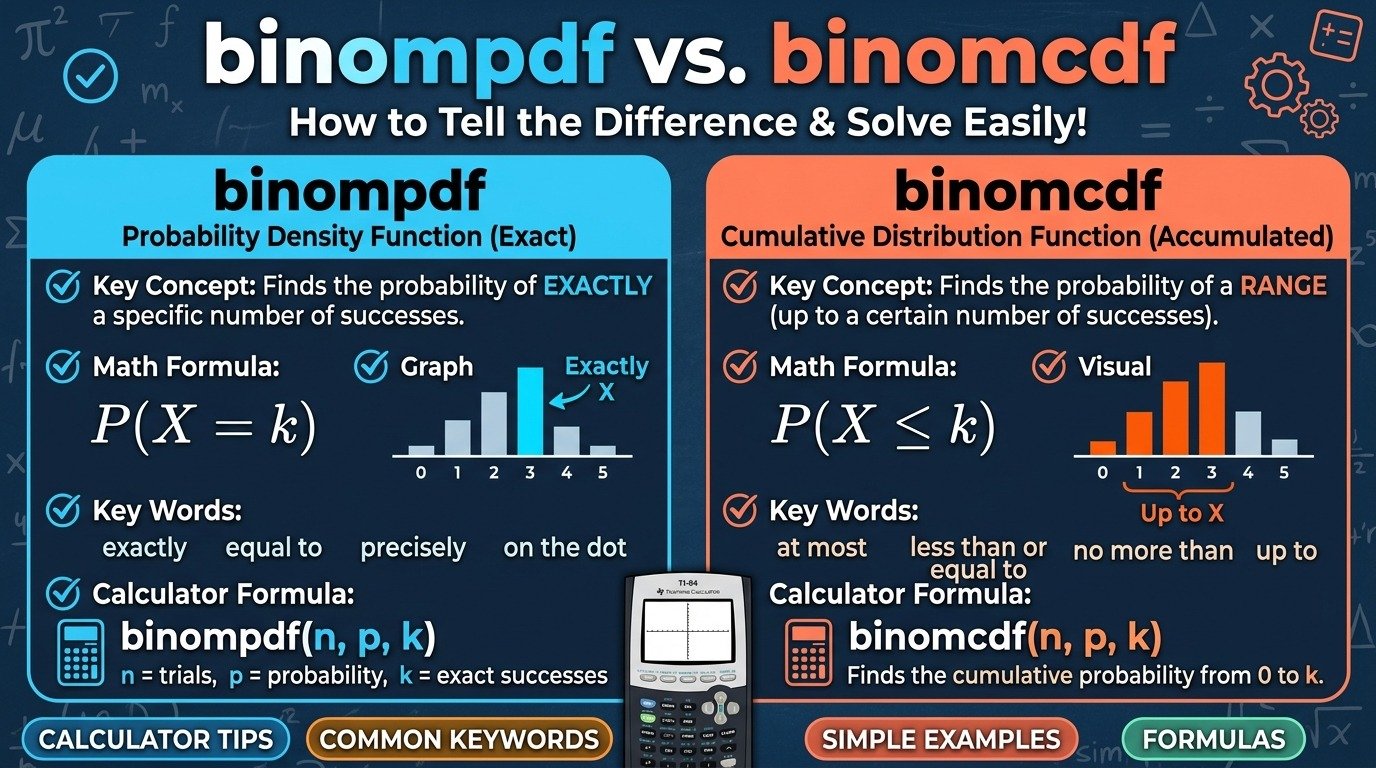
Imagine Sara is studying probability for her math test. Her teacher gives her a question about a basketball player who has a 70% chance of making a shot. Sara wants to know the chance of making exactly 4 shots out of 6. Her calculator can use binompdf for this question. Later, her teacher asks for the chance of making 4 or fewer shots. Now Sara needs binomcdf. The difference between binompdf and binomcdf is mainly about what they count. Binompdf finds the probability of an exact number of successes. Binomcdf finds the probability of a range up to a given number. Understanding the difference between binompdf and binomcdf helps students choose the right calculator function. The difference between binompdf and binomcdf also makes binomial probability easier to understand.
Key Difference Between the Both
The main difference is:
- binompdf gives the probability of getting an exact number of successes.
- binomcdf gives the probability of getting that number or fewer successes.
For example:
- binompdf(n, p, x) → probability of exactly x successes.
- binomcdf(n, p, x) → probability of x or fewer successes.
Why Is Their Difference Necessary to Know for the Learners and Experts?
Knowing this difference is important because using the wrong function can give the wrong answer.
Students use these functions in probability classes, tests, and homework. Teachers use them to explain binomial distributions. Researchers and professionals can also use binomial probability when studying repeated yes-or-no events.
A small change in the question can change the correct function. Words such as exactly, at most, and or fewer give important clues.
Understanding these functions helps people:
- solve probability questions faster.
- choose the correct calculator function.
- reduce calculation errors.
- understand probability results.
- explain data more clearly.
Pronunciation of binompdf and binomcdf
- binompdf: commonly read as “binomial P-D-F.”
- binomcdf: commonly read as “binomial C-D-F.”
In both US and UK English, the letter names P-D-F and C-D-F are generally pronounced in the same way.
Now let us look at the key differences with simple examples.
Difference Between the Keywords
1. Basic Purpose
binompdf
Binompdf finds the probability of getting an exact number of successes in a fixed number of trials.
Example 1:
A coin is tossed 10 times. You want the chance of getting exactly 6 heads. Use binompdf.
Example 2:
A player takes 8 free throws. You want the chance of making exactly 5. Use binompdf.
binomcdf
Binomcdf finds the probability of getting a number of successes up to and including a given value.
Example 1:
A coin is tossed 10 times. You want the chance of getting 6 or fewer heads. Use binomcdf.
Example 2:
A player takes 8 free throws. You want the chance of making 5 or fewer. Use binomcdf.
2. Exact Number vs. Range
binompdf
Binompdf focuses on one exact result.
Example 1:
You want exactly 3 defective items in a sample of 20.
Example 2:
You want exactly 7 correct answers on a 10-question test.
binomcdf
Binomcdf includes several results.
Example 1:
You want 3 or fewer defective items.
Example 2:
You want 7 or fewer correct answers.
3. Important Question Words
binompdf
Look for words such as:
- exactly
- equal to
- precisely
Example 1:
“What is the chance of exactly 4 successes?”
Example 2:
“What is the probability of exactly 2 defective products?”
These questions point to binompdf.
binomcdf
Look for words such as:
- at most
- no more than
- or fewer
- less than or equal to
Example 1:
“What is the chance of at most 4 successes?”
Example 2:
“What is the probability of 2 or fewer defective products?”
These questions point to binomcdf.
4. Number of Probabilities Included
binompdf
Binompdf gives one probability for one exact result.
For example, it can find:
P(X = 4)
Example 1:
The chance of exactly 4 successes.
Example 2:
The chance of exactly 2 failures.
binomcdf
Binomcdf adds probabilities from the beginning up to the selected value.
For example:
P(X ≤ 4)
This includes:
P(X = 0) + P(X = 1) + P(X = 2) + P(X = 3) + P(X = 4)
Example 1:
The chance of 4 or fewer successes.
Example 2:
The chance of 2 or fewer defective products.
5. Type of Probability
binompdf
Binompdf gives a single-point probability.
Example 1:
A factory checks 15 products. Find the chance that exactly 3 are defective.
Example 2:
A student guesses on 5 multiple-choice questions. Find the chance of exactly 2 correct answers.
binomcdf
Binomcdf gives a cumulative probability.
Example 1:
Find the chance that 3 or fewer products are defective.
Example 2:
Find the chance that the student gets 2 or fewer correct answers.
6. Calculator Function
binompdf
On a compatible calculator, you may enter:
binompdf(n, p, x)
Here:
- n = number of trials
- p = probability of success
- x = exact number of successes
Example 1:
binompdf(10, 0.5, 6) finds the probability of exactly 6 successes.
Example 2:
binompdf(20, 0.2, 4) finds the probability of exactly 4 successes.
binomcdf
You may enter:
binomcdf(n, p, x)
It gives the probability of x or fewer successes.
Example 1:
binomcdf(10, 0.5, 6) finds the probability of 6 or fewer successes.
Example 2:
binomcdf(20, 0.2, 4) finds the probability of 4 or fewer successes.
7. Use of the Word “Exactly”
binompdf
The word exactly is a strong clue for binompdf.
Example 1:
“What is the probability of exactly 5 successes?”
Use binompdf.
Example 2:
“What is the probability of exactly 8 customers buying a product?”
Use binompdf.
binomcdf
Binomcdf is not normally used when the question asks only for one exact value.
Example 1:
If the question asks for exactly 5 successes, binomcdf is not the direct choice.
Example 2:
If the question asks for exactly 8 customers, binomcdf is not the direct choice.
8. Use of “At Most” and “Or Fewer”
binompdf
Binompdf does not directly add all probabilities from zero to a number.
Example 1:
“At most 5 successes” is not a direct binompdf question.
Example 2:
“5 or fewer successes” is not a direct binompdf question.
binomcdf
Binomcdf is designed for this type of question.
Example 1:
“At most 5 successes” → use binomcdf with 5.
Example 2:
“5 or fewer successes” → use binomcdf with 5.
9. Graph and Distribution Meaning
binompdf
Binompdf tells you the probability at one particular value of the binomial distribution.
Example 1:
You can find the probability of exactly 4 successes.
Example 2:
You can find the probability of exactly 7 successes.
binomcdf
Binomcdf gives the total probability from zero successes up to a selected value.
Example 1:
It can find the probability of 4 or fewer successes.
Example 2:
It can find the probability of 7 or fewer successes.
10. Best Use
binompdf
Use binompdf when the question asks for one exact outcome.
Example 1:
Exactly 3 customers respond to an offer.
Example 2:
Exactly 6 students pass a test.
binomcdf
Use binomcdf when the question asks for a total up to a certain value.
Example 1:
3 or fewer customers respond.
Example 2:
6 or fewer students pass.
also read more abouthttps://comparificationn.com/clifton-and-bondi/
Nature and Behaviour of binompdf
Binompdf is an exact probability function. It looks at one particular number of successes.
It is useful when the question has a clear target. You are not adding several outcomes yourself. The calculator gives the probability for that exact number.
For example:
P(X = 4)
means exactly 4 successes.
Binompdf is useful for questions where precision matters.
Nature and Behaviour of binomcdf
Binomcdf is a cumulative probability function. It combines several probabilities.
For example:
P(X ≤ 4)
means:
- 0 successes
- 1 success
- 2 successes
- 3 successes
- 4 successes
All these probabilities are added together.
Binomcdf is useful when the question gives an upper limit.
Why Are People Confused About Their Use?
The two functions have very similar names. Both are used for binomial probability. Both also use the same basic inputs:
- number of trials
- probability of success
- number of successes
The main difference is easy to miss.
The best clue is the wording of the question.
If the question says exactly, think binompdf.
If it says at most, no more than, or or fewer, think binomcdf.
For example:
- Exactly 4 → binompdf
- 4 or fewer → binomcdf
Remembering this simple rule can prevent many mistakes.
Difference and Similarity Between binompdf and binomcdf
| Feature | binompdf | binomcdf |
| Main purpose | Finds an exact probability | Finds a cumulative probability |
| Exact result | Yes | No, not by itself |
| Includes smaller values | No | Yes |
| Common wording | Exactly | At most, no more than, or fewer |
| Formula idea | P(X = x) | P(X ≤ x) |
| Number of outcomes | One | Several |
| Uses binomial distribution | Yes | Yes |
| Uses n | Yes | Yes |
| Uses p | Yes | Yes |
| Best use | Exact number | Upper limit |
| Similarity | Both solve binomial probability questions | Both solve binomial probability questions |
Which Is Better in What Situation?
When Is binompdf Better?
Binompdf is better when you need the probability of one exact number. It is useful when a question says exactly, precisely, or equal to. For example, if a teacher asks for the chance of exactly 4 successes in 10 trials, binompdf is the correct choice. It is also useful when you want to compare the probability of different exact outcomes. You can use it to find the chance of exactly 2, exactly 3, or exactly 4 successes. In simple words, choose binompdf when you want one specific result.
When Is binomcdf Better?
Binomcdf is better when you want a total probability up to a certain point. It is useful for phrases such as at most, no more than, and or fewer. For example, if you want the chance of getting 4 or fewer successes in 10 trials, binomcdf is the better choice. It adds the probabilities of all results from zero through 4. It is helpful when several outcomes can satisfy the question. In simple words, choose binomcdf when you want a range that starts at zero and ends at a given number.
How Are the Keywords Used in Metaphors and Similes?
Binompdf and binomcdf are mathematical calculator functions. They are not normally used as metaphors or similes in everyday English. However, we can use simple comparisons to understand their roles.
binompdf as a Metaphor
“Binompdf is a spotlight on one result.”
This means it focuses on one exact number.
“Binompdf is a single box on a shelf.”
This shows that it selects one exact outcome.
binompdf as a Simile
“Binompdf is like asking for exactly one seat.”
You want one specific result.
“Binompdf works like a target.”
It focuses on one exact value.
binomcdf as a Metaphor
“Binomcdf is a basket of results.”
It collects several probabilities.
“Binomcdf is a net that catches everything up to a point.”
It includes all results from zero up to the selected number.
binomcdf as a Simile
“Binomcdf is like counting everyone up to the fifth person.”
It includes the earlier people too.
“Binomcdf is like adding all steps before reaching the final step.”
It includes several outcomes.
Connotative Meaning of binompdf and binomcdf
These are technical terms, so they have mostly neutral meanings.
binompdf
Positive connotation:
It may suggest accuracy and precision.
Example:
“Binompdf gives us the exact probability we need.”
Negative connotation:
A beginner may connect it with confusion or difficult math.
Example:
“The student felt confused when first using binompdf.”
Neutral connotation:
It simply names a probability function.
Example:
“Use binompdf to find the probability of exactly 4 successes.”
binomcdf
Positive connotation:
It may suggest useful and complete probability information.
Example:
“Binomcdf helped us find the total probability for several outcomes.”
Negative connotation:
It may seem difficult to beginners because it includes several outcomes.
Example:
“The student was confused by the cumulative result.”
Neutral connotation:
It simply refers to a cumulative binomial probability function.
Example:
“Use binomcdf to find the probability of 4 or fewer successes.”
Idioms or Proverbs Related to binompdf and binomcdf
There are no traditional English idioms or proverbs specifically related to binompdf or binomcdf. They are technical calculator terms.
However, common expressions can help explain their ideas.
“The exact number”
Example:
“Binompdf helps you find the exact number you need.”
“Up to a point”
Example:
“Binomcdf adds the probabilities up to a point.”
“Count every one”
Example:
“Binomcdf is useful when you need to count every outcome up to a given value.”
These are common expressions, not special mathematical idioms.
Works in Literature Related to binompdf and binomcdf
There are no well-known literary works that specifically use binompdf or binomcdf as major subjects. These are calculator functions used in mathematics education.
However, several important books explain probability and statistics:
- The Art of Statistics — Nonfiction, David Spiegelhalter, 2019. It explains how statistics can help us understand real-world questions.
- Statistics — Textbook, David Freedman, Robert Pisani, and Roger Purves, 1978. It introduces important ideas in statistics and probability.
- Introduction to Probability — Mathematics textbook, Dimitri P. Bertsekas and John N. Tsitsiklis, 2002. It covers probability concepts used in mathematical study.
These books are related to the ideas behind binomial probability, but they are not books specifically about the two calculator commands.
Movies Related to binompdf and binomcdf
There are no major movies specifically made about binompdf or binomcdf. These are specialized mathematics functions.
Some movies are related to mathematics, numbers, probability, or mathematical thinking:
- A Beautiful Mind — 2001, United States. A biographical drama about mathematician John Nash.
- The Imitation Game — 2014, United Kingdom and United States. A historical drama about mathematician and codebreaker Alan Turing.
- Hidden Figures — 2016, United States. A historical drama about mathematicians and scientists at NASA.
- Moneyball — 2011, United States. A sports drama that shows the use of statistics and data in baseball.
These films are related to mathematics and data, but they do not specifically focus on binompdf or binomcdf.
Frequently Asked Questions
1. What is the main difference between binompdf and binomcdf?
Binompdf finds the probability of an exact number of successes. Binomcdf finds the probability of that number or fewer successes.
2. When should I use binompdf?
Use binompdf when the question says exactly, equal to, or precisely.
For example, exactly 5 successes → binompdf.
3. When should I use binomcdf?
Use binomcdf when the question says at most, no more than, or or fewer.
For example, 5 or fewer successes → binomcdf.
4. Does binomcdf include the number entered?
Yes. Binomcdf gives the probability of getting x or fewer successes.
For example:
binomcdf(n, p, 5)
means:
P(X ≤ 5)
It includes 5.
5. Are binompdf and binomcdf used for the same type of distribution?
Yes. Both are used with the binomial distribution. The difference is what probability you want to find.
How Are Both Useful for Their Surroundings?
Binompdf and binomcdf are useful because probability helps people make better decisions.
Businesses can use probability to study customer responses. Schools can use it to teach students about chance. Researchers can use it to study repeated yes-or-no events.
For example, a company may study how many customers respond to an offer. Binompdf can find the chance of getting an exact number of responses. Binomcdf can find the chance of getting a number of responses up to a certain limit.
These tools help turn uncertain events into numbers. This makes data easier to understand and use.
Final Words for Both
Binompdf and binomcdf are both useful tools for binomial probability.
The easiest rule to remember is:
Exactly = binompdf
At most or fewer = binomcdf
Binompdf focuses on one exact result. Binomcdf combines results from zero up to a selected number.
Once you learn this small difference, many binomial probability questions become much easier.
Conclusion
The difference between binompdf and binomcdf is mainly about the type of probability you need. Binompdf finds the probability of one exact number of successes. Binomcdf finds the combined probability of getting that number or fewer successes. The words in a question can help you choose the right function. If you see exactly, think of binompdf. If you see at most, no more than, or or fewer, think of binomcdf. Both functions work with the binomial distribution and use the number of trials and probability of success. Learning this difference can save time and prevent mistakes. With practice, students can quickly recognize which function to use and solve binomial probability problems with greater confidence.

I’m Zahid Abbas, an educator, researcher, and digital publishing strategist with a passion for linguistics, grammar, and clear communication. As a content creator and SEO specialist, I craft research-driven, reader-focused content that empowers learners and makes knowledge accessible worldwide.