A student learning Spanish once said to his teacher, “Tú eres cansado.” The teacher smiled and corrected him: “You should say tú estás cansado.” The student was confused. Both words seemed to mean “you are.” This small moment shows the common question about the difference between eres and estás.
In Spanish, both eres and estás translate to “you are” in English, but they are used in different situations. Understanding the difference between eres and estás helps learners speak naturally and avoid common mistakes.
Many beginners struggle with the difference between eres and estás because both forms describe a person, yet they express different meanings. By learning the difference between eres and estás, students can describe identity, personality, and temporary conditions correctly.
Key Difference Between the Both
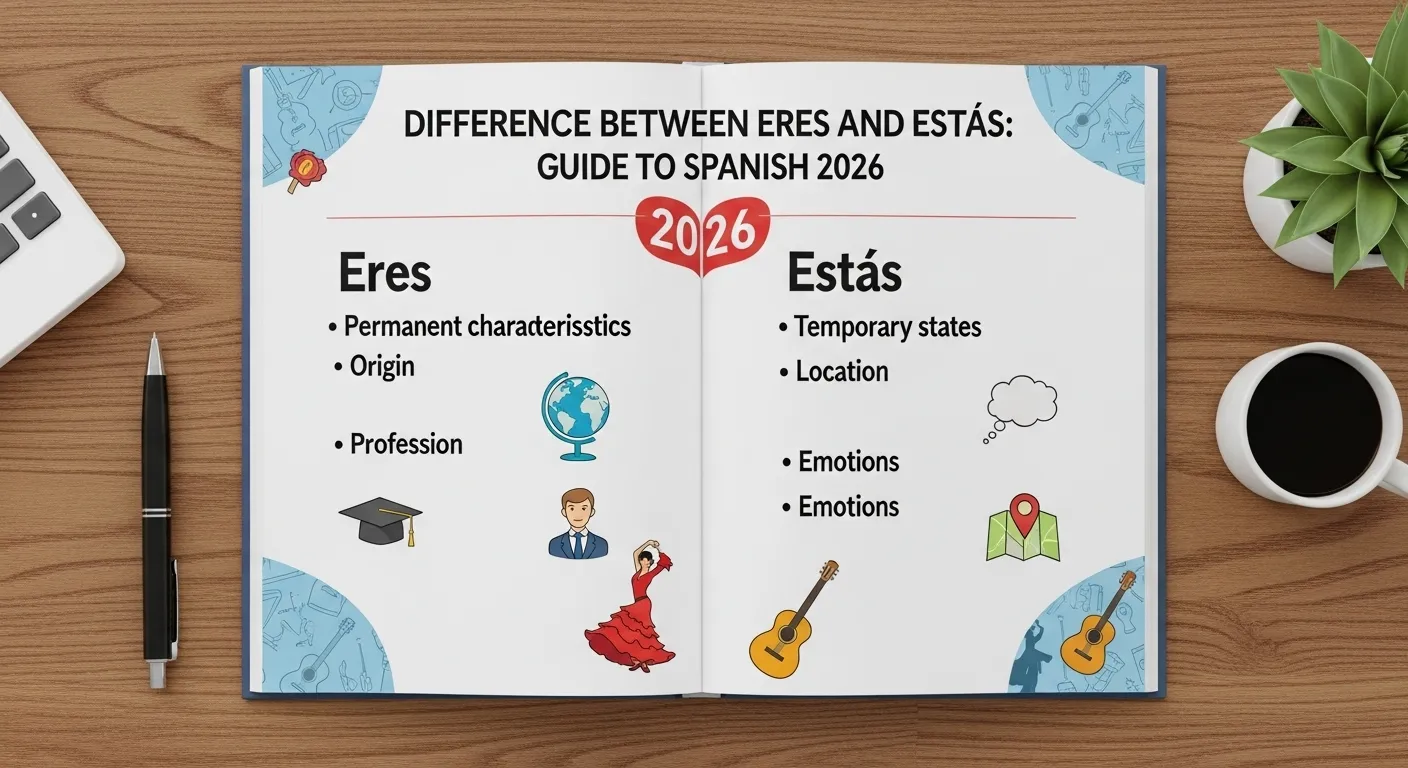
The main difference between eres and estás is simple:
- Eres is used for permanent traits or identity.
- Estás is used for temporary states or conditions.
Why Is Their Difference Important for Learners and Experts?
Knowing the difference between eres and estás helps learners communicate clearly in Spanish. Teachers use this concept to explain the verbs ser and estar, two important verbs in the language. Understanding this difference also helps translators, writers, and language learners express meaning correctly in conversation and writing.
Pronunciation
| Word | US Pronunciation | UK Pronunciation |
| Eres | /ˈeɾes/ | /ˈeɾes/ |
| Estás | /esˈtas/ | /esˈtas/ |
Now let us explore the detailed difference between eres and estás.
Difference Between Eres and Estás
1. Verb Origin
Eres:
Comes from the Spanish verb ser.
Examples:
- Tú eres estudiante.
- Tú eres inteligente.
Estás:
Comes from the Spanish verb estar.
Examples:
- Tú estás cansado.
- Tú estás ocupado.
2. Meaning
Eres:
Used for identity or defining qualities.
Examples:
- Tú eres mi amigo.
- Tú eres doctor.
Estás:
Used for temporary states.
Examples:
- Tú estás feliz hoy.
- Tú estás enfermo.
3. Time Duration
Eres:
Describes long-lasting or permanent traits.
Examples:
- Tú eres alto.
- Tú eres amable.
Estás:
Describes temporary situations.
Examples:
- Tú estás cansado.
- Tú estás nervioso.
4. Personality vs Condition
Eres:
Used for personality.
Examples:
- Tú eres generoso.
- Tú eres divertido.
Estás:
Used for physical or emotional conditions.
Examples:
- Tú estás triste.
- Tú estás relajado.
5. Profession or Role
Eres:
Used for profession.
Examples:
- Tú eres profesor.
- Tú eres ingeniero.
Estás:
Not normally used for professions.
Examples:
- Incorrect: Tú estás profesor.
- Correct: Tú eres profesor.
6. Location
Eres:
Not used for location.
Examples:
- Incorrect: Tú eres en casa.
- Correct form uses estar.
Estás:
Used for location.
Examples:
- Tú estás en casa.
- Tú estás en la escuela.
7. Describing Objects
Eres:
Describes characteristics of objects.
Examples:
- El coche es rápido.
- La casa es grande.
Estás:
Describes temporary condition.
Examples:
- La puerta está abierta.
- La sopa está caliente.
8. Weather and Time
Eres:
Not used for weather.
Examples:
- Incorrect: Tú eres frío.
- Weather uses estar or hacer.
Estás:
Can describe weather conditions.
Examples:
- El día está frío.
- El clima está agradable.
9. Stability
Eres:
Represents stable identity.
Examples:
- Tú eres mi hermano.
- Tú eres líder.
Estás:
Represents changing states.
Examples:
- Tú estás listo.
- Tú estás ocupado hoy.
10. Language Learning Rule
Eres:
Think of permanent identity.
Examples:
- Tú eres amable.
- Tú eres fuerte.
Estás:
Think of temporary state.
Examples:
- Tú estás cansado.
- Tú estás feliz hoy.
Nature and Behaviour of Eres and Estás
Eres expresses identity, personality, and long-term qualities. It helps describe who someone is.
Estás expresses temporary conditions, emotions, and location. It helps describe how someone feels or where someone is.
Why People Confuse Eres and Estás
People confuse them because English uses only one verb: “to be.” Spanish uses two verbs, ser and estar, which divide meaning into permanent and temporary ideas.
Table Showing Difference and Similarity
| Feature | Eres | Estás |
| Verb | Ser | Estar |
| Meaning | Permanent trait | Temporary state |
| Use | Identity and personality | Feelings and location |
| Time | Long-term | Short-term |
| Similarity | Both mean “you are” in English | Both describe people |
Which Is Better in What Situation?
Eres is better when describing identity, personality, profession, or permanent traits. It helps define who a person is in a lasting way.
Estás is better when describing emotions, temporary conditions, or location. It explains how someone feels or where someone is at a certain moment.
Eres and Estás in Metaphors and Similes
Examples:
- “Eres como una estrella.” (You are like a star.)
- “Hoy estás como el sol.” (Today you are like the sun.)
These comparisons show admiration or mood.
Connotative Meaning
Eres
Positive:
- “Tú eres brillante.”
Neutral:
- “Tú eres estudiante.”
Negative:
- “Tú eres terco.”
Estás
Positive:
- “Tú estás feliz.”
Neutral:
- “Tú estás aquí.”
Negative:
- “Tú estás enojado.”
Idioms or Expressions
- Estar en las nubes – to be daydreaming
- Example: Hoy estás en las nubes.
- Ser pan comido – very easy
- Example: El examen es pan comido.
Works in Literature
- Don Quixote – novel by Miguel de Cervantes (1605)
- La Casa de Bernarda Alba – play by Federico García Lorca (1936)
Movies Related to Spanish Language
- The Sea Inside – 2004, Spain
- Pan’s Labyrinth – 2006, Spain/Mexico
Frequently Asked Questions
1. Do eres and estás mean the same?
Both mean “you are,” but they describe different situations.
2. When should I use eres?
Use it for identity or permanent traits.
3. When should I use estás?
Use it for temporary states or location.
4. Are they forms of different verbs?
Yes. Eres comes from ser, and estás comes from estar.
5. Why is this rule difficult for learners?
Because English uses only one verb “to be.”
How Eres and Estás Help Our Surroundings
These words help people describe identity, emotions, and location clearly in Spanish communication. They support language learning, translation, and cultural exchange.
Final Words for Both
Eres defines who someone is.
Estás describes how someone feels or where someone is.
Conclusion
Understanding the difference between eres and estás is an important step in learning Spanish. Both words translate to “you are,” but they express different meanings. Eres describes permanent traits, identity, and professions, while estás describes temporary conditions, emotions, and location. By learning the difference between eres and estás, language learners can communicate more accurately and confidently. This distinction helps create clear meaning in conversation and writing, making Spanish easier to understand and use in everyday life.

I’m Zahid Abbas, an educator, researcher, and digital publishing strategist with a passion for linguistics, grammar, and clear communication. As a content creator and SEO specialist, I craft research-driven, reader-focused content that empowers learners and makes knowledge accessible worldwide.