Imagine a person sees an ad for a new pair of shoes. They click the ad and visit an online store. Later, they click another link to return to the same store. The website owner may see two clicks, but the number of website sessions depends on how the visits are tracked.
Clicks count how many times people click a link, ad, or search result. Sessions count visits to a website or app. These visits help website owners learn how people use their pages. The difference between clicks and sessions is important for anyone who works in digital marketing. Knowing the difference between clicks and sessions helps people read reports and check ad results. It also helps experts see if their campaigns bring people to the right pages. In short, clicks show actions, while sessions show visits.
Key Difference Between Clicks and Sessions
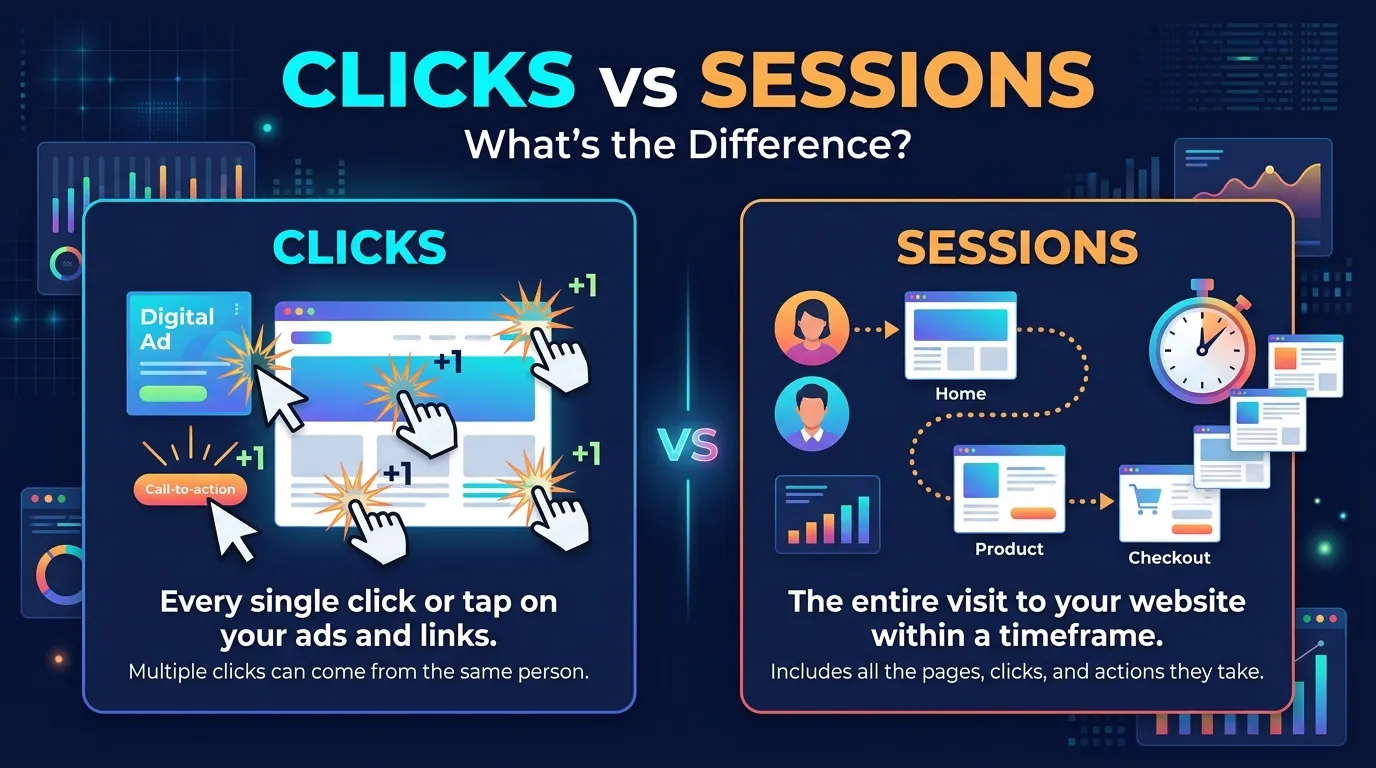
A click is an action. A session is a visit to a website or app. One session may include many clicks, page views, and other actions.
Why Is This Difference Important for Learners and Experts?
Learners need to know these terms to understand website reports. Experts use them to check ads, improve websites, and plan better campaigns. This knowledge also helps businesses use their money well and serve their customers better.
Pronunciation of Clicks and Sessions
- Clicks
- US: /klɪks/
- UK: /klɪks/
- Sessions
- US: /ˈsɛʃənz/
- UK: /ˈsɛʃənz/
Difference Between Clicks and Sessions
1. Meaning
Clicks: A click happens when a person selects a link, ad, button, or search result.
- Example 1: A user clicks an ad for a laptop.
- Example 2: A student clicks a link to open an online lesson.
Sessions: A session is a period of activity on a website or app.
- Example 1: A shopper visits a store website and looks at three products.
- Example 2: A student opens a learning site and reads two lessons in one visit.
2. What They Count
Clicks: Clicks count link or ad selections. The exact count depends on the platform and its tracking rules.
- Example 1: An ad gets 100 clicks.
- Example 2: A blog link gets 30 clicks from a newsletter.
Sessions: Sessions count visits as measured by the website’s analytics tool.
- Example 1: A website records 80 sessions in one day.
- Example 2: A travel site records 200 sessions during a holiday sale.
3. Main Purpose
Clicks: Clicks help show if people act on links or ads.
- Example 1: A marketer checks clicks to see if an ad gets attention.
- Example 2: A shop owner compares clicks on two product ads.
Sessions: Sessions help show how often people visit a website and use it.
- Example 1: A blog owner checks sessions to learn how much traffic the site gets.
- Example 2: A school checks sessions to see how often students use its learning site.
4. User Activity
Clicks: A click shows one tracked selection. It does not always prove that the page loaded or that the user stayed on the site.
- Example 1: A person clicks an ad but closes the page before it loads.
- Example 2: A user clicks a link to read a news story.
Sessions: A session can include many actions during one visit.
- Example 1: A shopper opens a product page, reads reviews, and adds an item to a cart.
- Example 2: A reader opens a blog post and then reads two more posts.
5. Relationship With Page Views
Clicks: A click may open a page, but some clicks do not lead to a page view.
- Example 1: A user clicks a broken link.
- Example 2: A user clicks a button that downloads a file.
Sessions: A session may contain one or more page views, based on what the user does.
- Example 1: A visitor reads one page and leaves.
- Example 2: A visitor reads five pages during one visit.
6. How They Appear in Reports
Clicks: Click data often appears in ad, email, and search reports.
- Example 1: An ad report shows 500 clicks.
- Example 2: A search report shows 90 clicks on a website result.
Sessions: Session data often appears in website analytics reports.
- Example 1: An analytics report shows 350 sessions today.
- Example 2: A store report shows 1,200 sessions this month.
7. How They Help Measure Success
Clicks: Clicks help measure how well a link or ad gets people to act.
- Example 1: An ad with many clicks may attract strong interest.
- Example 2: A low click count may show that an ad needs better text or images.
Sessions: Sessions help measure website visits and traffic patterns.
- Example 1: More sessions may show that a new campaign brings visitors to a site.
- Example 2: Fewer sessions may lead a team to review its traffic sources.
8. Can One Person Create Many?
Clicks: Yes. One person can click the same link more than once. Some reports may count repeated clicks.
- Example 1: A user clicks an ad, returns to the page, and clicks it again.
- Example 2: A shopper clicks several product links in a newsletter.
Sessions: Yes. One person can start many sessions over time.
- Example 1: A user visits a website in the morning and returns in the evening.
- Example 2: A student visits a course site each day for a week.
9. Factors That Affect the Count
Clicks: The count may depend on the platform’s rules, repeated clicks, and how clicks are filtered.
- Example 1: An ad platform may remove clicks it marks as invalid.
- Example 2: A link report may count clicks on a button even if the next page fails to load.
Sessions: The count may depend on analytics settings, time limits, consent choices, and tracking problems.
- Example 1: A long break in activity may lead the tool to start a new session.
- Example 2: A visitor who blocks tracking may not appear in the report as expected.
10. Best Use
Clicks: Clicks are useful when checking links, ads, and search results.
- Example 1: A business compares clicks on two ads.
- Example 2: A writer checks how many people click a link in an email.
Sessions: Sessions are useful when checking website traffic and visits.
- Example 1: A store checks sessions after a sale begins.
- Example 2: A news site checks sessions after publishing a major story.
Nature and Behaviour of Clicks
Clicks are action-based measures. They show that someone selected a tracked link, ad, or item. They can happen before a website visit begins or during a visit. A person can click many links in one session.
Clicks can also come from different sources, such as search engines, emails, social media, and online ads. A high click count can show interest, but it does not always mean that people stayed on the site or bought something.
Nature and Behaviour of Sessions
Sessions are visit-based measures. They group activity on a website or app into visits based on the rules of the analytics tool. A session may include page views, clicks, searches, and purchases.
A session does not always mean a new person has arrived. The same person can visit a website many times. Also, session counts can change based on tracking settings and the way a tool defines the start and end of a visit.
ALSO READ MORE ABOUT https://comparificationn.com/difference-between-ucaas-and-ccaas-2/
Why Are People Confused About Their Use?
People often confuse clicks and sessions because both help measure online activity. They also appear in digital marketing reports.
There are three main reasons for this confusion:
- Both relate to visitors: Clicks and sessions can both rise when a campaign brings people to a website.
- One session can include many clicks: A person may click several links during one visit.
- The numbers may not match: A click may not lead to a recorded session. The page may fail to load, tracking may be blocked, or the two tools may use different rules.
The key point is simple: clicks count actions, while sessions count visits.
Difference and Similarity Between Clicks and Sessions
| Feature | Clicks | Sessions |
| Meaning | A selection of a link, ad, or item | A visit to a website or app |
| Main focus | User action | User visit |
| What it measures | Tracked clicks | Visits grouped by analytics rules |
| One visit can include | Many clicks | One session may include many actions |
| One person can create many | Yes | Yes |
| Common reports | Ads, search, email | Website analytics |
| Shows interest | May show interest in a link or ad | May show interest in the website |
| Proves a purchase? | No | No |
| Depends on tracking? | Yes | Yes |
| Shared value | Both help measure online activity | Both help measure online activity |
Similarity: Both help people understand how users respond to online content. Neither one alone proves that a visitor found the site useful or made a purchase.
Which Is Better in What Situation?
When Are Clicks Better?
Clicks are better when you want to know how well a link, ad, or search result attracts action. For example, a business can compare two ads to see which one gets more clicks. A writer can check clicks on links in an email. A high click count may show that the message catches people’s eyes. However, clicks alone cannot tell you if users stay on the website or buy a product. For this reason, clicks work best when you want to measure the response to a link or ad.
When Are Sessions Better?
Sessions are better when you want to learn how often people visit a website or app. For example, a shop can check sessions after starting a sale. A blog owner can compare visits before and after sharing a new post. Sessions help teams understand traffic and study changes over time. Still, more sessions do not always mean more sales or happier users. A website may get many visits but few purchases. Sessions work best when you want to measure visits and study how people use your site.
How Are Clicks and Sessions Used in Metaphors and Similes?
Clicks and sessions are technical terms, so they do not have many common idioms. Still, writers can use them in simple metaphors and similes to explain online activity.
Metaphors for Clicks
A click can be called “a doorway to a website.” It shows the action that may lead someone to a page.
- Example: “Each click was a doorway to the shop’s new range of shoes.”
A click can also be called “a tap on the digital shoulder.” It draws attention to the action of selecting a link.
- Example: “The ad got a tap on the digital shoulder from hundreds of users.”
Similes for Clicks
- “Clicks came like raindrops during the big sale.”
- “The link spread like a spark, drawing many clicks.”
Metaphors for Sessions
A session can be called “a visit to a digital shop.” It stands for the time a person spends on a website.
- Example: “Each session was a visit to the store, even if the shopper bought nothing.”
Similes for Sessions
- “Sessions rose like waves after the new ad went live.”
- “The website felt like a busy market, with sessions arriving all day.”
These examples make the terms easier to understand, but they are creative phrases rather than standard technical definitions.
Connotative Meaning of Clicks and Sessions
Connotation is the feeling or idea that a word brings to mind. In digital reports, both terms are usually neutral.
Connotative Meaning of Clicks
Neutral meaning: A click is simply an online action.
- Example: “The page received 100 clicks today.”
Positive meaning: Clicks may suggest interest or strong ad appeal.
- Example: “The new campaign earned many clicks from interested shoppers.”
Negative meaning: Clicks may suggest poor results when they do not lead to useful visits or sales.
- Example: “The ad got many clicks but few sales.”
Connotative Meaning of Sessions
Neutral meaning: A session is a measured visit.
- Example: “The site recorded 400 sessions this week.”
Positive meaning: More sessions may suggest that a website is attracting visitors.
- Example: “Sessions grew after the company shared its new guide.”
Negative meaning: Many sessions with few useful actions may point to a problem.
- Example: “The site had many sessions, but few people finished the order.”
Remember that the numbers need context. A high count is not always a sign of success.
Idioms and Proverbs Related to Clicks and Sessions
There are no widely used English idioms or proverbs that directly use “clicks” and “sessions” in the web analytics sense. However, common sayings can help explain these ideas.
1. “First impressions matter.”
This saying means that the first thing people see can affect what they do next.
- Example: “The ad’s design mattered because first impressions matter, and it helped attract clicks.”
2. “The proof is in the pudding.”
This means that results show whether something works.
- Example: “The ad received many clicks, but the proof is in the pudding: the team also checked sessions and sales.”
3. “Actions speak louder than words.”
This means that what people do can matter more than what they say.
- Example: “Clicks showed that users acted on the ad, while sessions helped the team study their visits.”
These sayings are related to the ideas behind the terms, not direct technical definitions.
Works in Literature Related to Clicks and Sessions
The exact words “clicks” and “sessions” are not common central themes in classic literature in the digital analytics sense. The following works explore technology, online life, or the digital world and can help readers think about online behaviour.
- The Circle — Technology-themed novel, written by Dave Eggers, published in 2013. It explores online life, privacy, and digital culture.
- Little Brother — Young adult science fiction novel, written by Cory Doctorow, published in 2008. It explores computers, surveillance, and digital freedom.
- Neuromancer — Science fiction novel, written by William Gibson, published in 1984. It explores computers and cyberspace.
These works do not focus on web analytics terms as their main subject, but they provide context for thinking about digital activity and online users.
Movies Related to Clicks and Sessions
These films explore computers, online networks, or digital life. They are not specifically about website clicks and sessions.
- The Social Network — 2010, United States. A drama about the start of Facebook and the growth of a social network.
- The Great Hack — 2019, United States. A documentary about personal data and political advertising.
- The Matrix — 1999, United States. A science fiction film about a simulated digital world.
- Searching — 2018, United States. A thriller that uses online activity and digital clues as part of its story.
These movies can help viewers think about how people use digital platforms and how online actions leave traces.
Five Frequently Asked Questions About Clicks and Sessions
1. What is the main difference between clicks and sessions?
Clicks count tracked actions on links or ads. Sessions count visits to a website or app, based on the analytics tool’s rules.
2. Can one session have many clicks?
Yes. A person may click many links, open several pages, and use different features during one session.
3. Can clicks be higher than sessions?
Yes. One session can include many clicks, so clicks can be much higher than sessions. Also, the tools may count and filter activity in different ways.
4. Do more clicks mean more sales?
No. More clicks may show interest, but they do not prove that people will buy something. You should also check sales, conversion rates, and other useful measures.
5. Why do my clicks and sessions not match?
They may come from different tools or tracking rules. Some clicks may not lead to a recorded visit. Page loading problems, blocked tracking, and time differences can also affect the numbers.
How Are Clicks and Sessions Useful for the Digital Environment?
Clicks and sessions help businesses, schools, news sites, and other groups understand how people use online services. Click data can show which links attract attention. Session data can show how often people visit a site and how traffic changes over time.
These measures can help teams improve page design, make learning tools easier to use, and share useful content with the right people. They can also help businesses find problems in the user journey.
However, teams should collect and use data with care. They should respect privacy rules and avoid collecting personal data without a proper reason. The goal should be to improve the online experience, not to track people without their knowledge.
Final Words for Clicks and Sessions
Clicks show actions on links, ads, and other tracked items. They help measure how people respond to online content.
Sessions show visits to a website or app. They help measure traffic and study how people use online services.
Both terms are useful, but they answer different questions. Use clicks to study actions and sessions to study visits. For a clear view of online success, compare these numbers with other measures, such as page views, time on site, and sales.
Conclusion
The difference between clicks and sessions is easy to understand once you know what each term counts. Clicks measure tracked actions, while sessions measure visits to a website or app. One session can include many clicks, and one person can create several sessions over time. Both measures help marketers, writers, teachers, and business owners understand online activity. However, neither one tells the whole story on its own. A high click count does not always mean a successful visit, and more sessions do not always lead to sales. By looking at clicks and sessions together with other useful data, teams can make better choices, improve websites, and give users a better online experience.

I’m Zahid Abbas, an educator, researcher, and digital publishing strategist with a passion for linguistics, grammar, and clear communication. As a content creator and SEO specialist, I craft research-driven, reader-focused content that empowers learners and makes knowledge accessible worldwide.