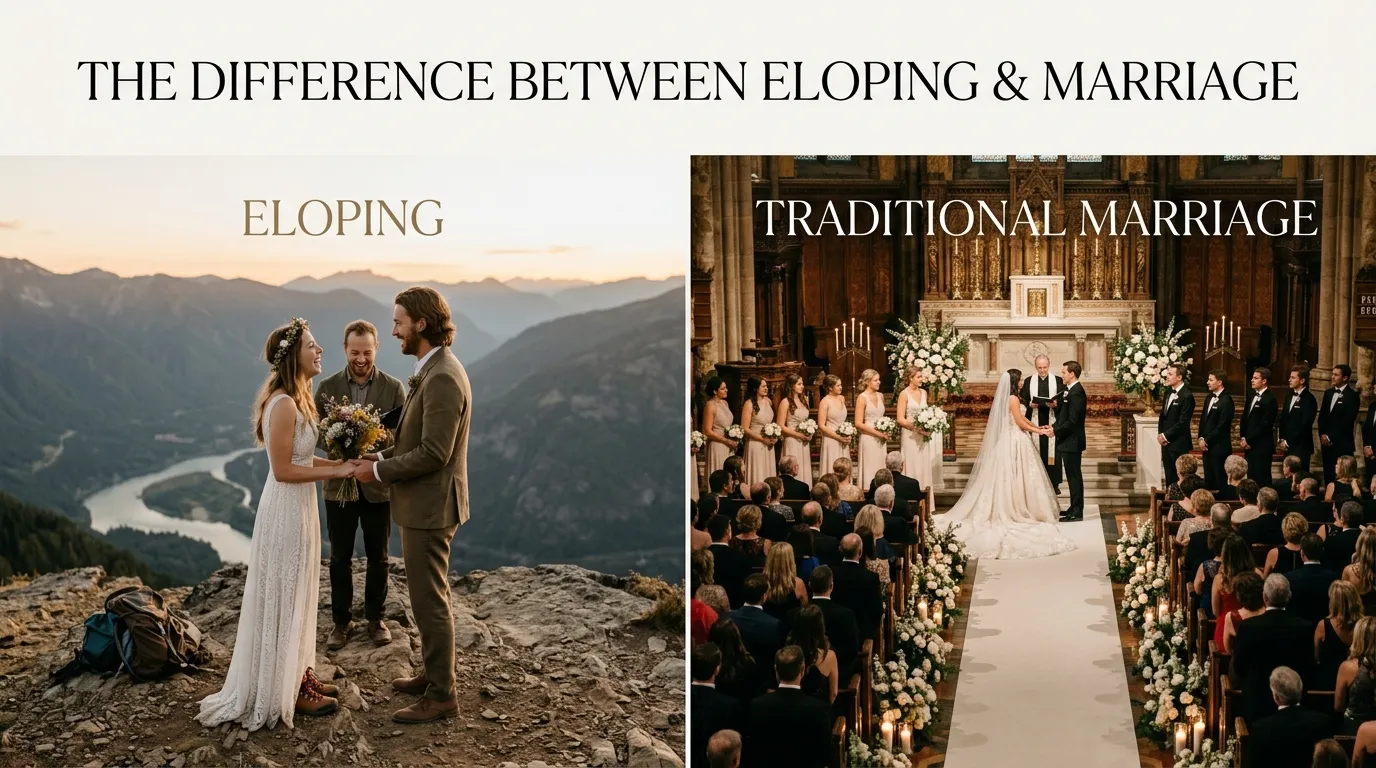
Imagine two people who love each other and want to spend their lives together. One couple chooses to marry in a small, private way without a big event. This may be called eloping. Another couple plans a wedding with family, friends, food, and music. Both couples want to get married, but they choose different ways to do it.
The difference between eloping and marriage is that eloping is a way of getting married, while marriage is the legal or social bond between two people. The difference between eloping and marriage can help people understand wedding choices and family needs. It can also help couples plan their future. Knowing the difference between eloping and marriage helps people see that a big wedding is not the only way to show love and care.
Key Difference Between Eloping and Marriage
Eloping means getting married in a private or small way, often without a large wedding or many guests. Marriage is the bond that two people form when they wed. Eloping is a way to get married, not a different type of bond by itself.
Why Is This Difference Important for Learners and Experts?
Learners can use these terms to talk about love, weddings, and family life. Experts, such as wedding planners, legal workers, and counselors, need to know what couples want. This helps them give clear advice and support. It also helps people respect each couple’s choice and culture.
Pronunciation of Eloping and Marriage
- Eloping
- US: /ɪˈloʊpɪŋ/
- UK: /ɪˈləʊpɪŋ/
- Marriage
- US: /ˈmærɪdʒ/
- UK: /ˈmærɪdʒ/
Difference Between Eloping and Marriage
1. Meaning
Eloping: Eloping means getting married in a private or small way, often without a large planned wedding.
- Example 1: Sara and Ali eloped at a small town hall.
- Example 2: Mia and Tom chose to elope on a quiet beach.
Marriage: Marriage is a bond between two people who wed. It may be legal, social, or both.
- Example 1: Sara and Ali began their marriage after their wedding.
- Example 2: Mia and Tom built their marriage on love and trust.
2. Main Purpose
Eloping: Eloping is often chosen to keep the wedding simple, private, or less costly.
- Example 1: A couple elopes because they do not want a large event.
- Example 2: Two people elope to avoid the stress of wedding planning.
Marriage: Marriage joins two people in a lasting bond and may bring legal rights and duties.
- Example 1: A couple enters marriage to build a life together.
- Example 2: Two people marry and plan to care for each other.
3. Number of Guests
Eloping: Eloping often involves only the couple and the people needed to make the marriage valid. Rules vary by place.
- Example 1: A couple elopes with only an official and two witnesses.
- Example 2: A pair chooses a small ceremony with one close friend.
Marriage: Marriage can take place with few guests or many guests.
- Example 1: A couple invites 200 guests to their wedding.
- Example 2: Two people marry in a small family gathering.
4. Cost
Eloping: Eloping often costs less because there may be no large venue, meal, or party.
- Example 1: A couple saves money by eloping at a town hall.
- Example 2: Two people use their savings for a trip instead of a large wedding.
Marriage: The cost of getting married can be low or high. A large wedding may cost more.
- Example 1: A couple spends a lot on a wedding hall and food.
- Example 2: Two people marry in a simple civil ceremony at a low cost.
5. Planning
Eloping: Eloping often needs less planning, though legal steps and travel may still take time.
- Example 1: A couple books a short ceremony and elopes the next month.
- Example 2: Two people plan a small trip and marry during it.
Marriage: A wedding can need a lot of planning, especially when it has many guests and events.
- Example 1: A couple spends a year planning its wedding.
- Example 2: A family books a hall, food, and music for a marriage ceremony.
6. Family Involvement
Eloping: Eloping may happen without the couple’s family knowing in advance.
- Example 1: A couple elopes and tells their family after the ceremony.
- Example 2: Two people choose a private wedding because they want to make the choice themselves.
Marriage: Marriage may involve family support, customs, and shared plans. But family involvement is not required in every case.
- Example 1: A couple’s parents help plan the wedding.
- Example 2: A family takes part in a cultural marriage ceremony.
7. Legal Rules
Eloping: Eloping does not remove the need to follow the law. The couple must meet local marriage rules for the marriage to be valid.
- Example 1: A couple elopes but first gets the required marriage license.
- Example 2: Two people check the local rules before marrying abroad.
Marriage: Legal marriage rules vary by country and place. They may include age limits, documents, and a licensed official.
- Example 1: A couple files the right papers before a civil marriage.
- Example 2: Two people follow local rules to register their marriage.
8. Social and Cultural Views
Eloping: Some people see eloping as romantic and free. Others may feel sad if close family members are left out.
- Example 1: Friends praise a couple for choosing a private wedding.
- Example 2: A parent feels hurt when a child elopes without telling the family.
Marriage: Marriage can be marked by customs, faith, family events, or civil rites.
- Example 1: A couple follows its family’s wedding customs.
- Example 2: Two people have a civil marriage with no religious service.
9. Public Celebration
Eloping: Eloping often has a small or private ceremony, with little public celebration.
- Example 1: A couple elopes and has dinner alone after the ceremony.
- Example 2: Two people marry quietly and share the news online later.
Marriage: A wedding can include a large party, but a celebration is not required for a marriage to exist.
- Example 1: A couple hosts a large party after the ceremony.
- Example 2: Two people marry in a small room and celebrate with close friends.
10. Life After the Ceremony
Eloping: Eloping describes how a couple gets married. It does not decide how the couple will live after the wedding.
- Example 1: A couple elopes and later holds a family party.
- Example 2: Two people elope and then begin life in a new home.
Marriage: Marriage is the bond that continues after the wedding. It may involve shared plans, care, and duties.
- Example 1: A couple works together to raise a family.
- Example 2: Two spouses support each other through hard times.
Nature and Behaviour of Eloping
Eloping is a choice about how to get married. It is often private, simple, and less formal than a large wedding. Some couples choose it to save money, avoid stress, or enjoy a quiet day together. Others may elope because family members do not support their plans.
Eloping does not always mean running away or keeping the marriage secret forever. Some couples tell their families before the ceremony. Others share the news after they marry. The meaning can change with culture, family needs, and local customs.
Nature and Behaviour of Marriage
Marriage is a bond between two people who wed. In many places, it creates legal rights and duties. It may also have a strong social, family, or religious role.
Marriage can begin with a large wedding, a small ceremony, or an elopement. Its form depends on the couple, their beliefs, and the law where they marry. A healthy marriage often needs care, trust, respect, and clear talk. A wedding is one event, but marriage is the bond that follows it.
Why Are People Confused About Their Use?
People may confuse eloping and marriage because both terms relate to weddings. They may also think that eloping means the couple is not truly married.
Here are three main reasons for this confusion:
- They are linked: Eloping often leads to marriage, so people may use the words as if they mean the same thing.
- Old meanings still exist: In the past, eloping often meant running away to marry without family approval. Today, it can also mean choosing a small, private wedding.
- Different customs: Each culture and country has its own wedding customs and legal rules. This can make the words seem different from place to place.
The key point is simple: eloping is one way to get married, while marriage is the bond formed by the wedding.
Difference and Similarity Between Eloping and Marriage
| Feature | Eloping | Marriage |
| Meaning | A private or small way to get married | A bond formed when two people wed |
| Main role | Describes how the couple gets married | Describes the bond between the spouses |
| Guests | Often few or none beyond those needed | Can have few or many guests |
| Cost | Often lower, but not always | Can be low or high |
| Planning | Often simple | Can be simple or detailed |
| Family role | Family may not take part | Family may or may not take part |
| Legal rules | Must still follow local law | Legal rules depend on the place |
| Celebration | Often small or private | May include a large celebration |
| Can last over time? | It is the way the couple weds | The bond may continue after the ceremony |
| Similarity | Can lead to a marriage | Can begin with an elopement |
Similarity: Both relate to a couple getting married. Both may be shaped by love, culture, faith, family, and local law. A couple can elope and still have a valid marriage if they follow the law.
also read more about https://comparificationn.com/difference-between-ucaas-and-ccaas-3/
Which Is Better in What Situation?
When Is Eloping Better?
Eloping may be better for couples who want a quiet day, a small event, or lower costs. It can suit people who do not enjoy large crowds or who want to focus on each other. It may also help couples avoid the stress of planning a big wedding. Still, they should check local legal rules and think about how their choice may affect close family members. A private wedding can be meaningful, but both people should agree on the plan and feel safe and respected.
When Is a Large Wedding Better?
A large wedding may be better for couples who want to share the day with family, friends, and their community. It can be a way to honor cultural or faith-based customs and bring loved ones together. Some couples enjoy planning the clothes, food, music, and other parts of a big event. But a large wedding can cost more and take more time to plan. It is not needed for a strong marriage. The best choice is the one that fits the couple’s needs, values, and budget.
How Are Eloping and Marriage Used in Metaphors and Similes?
Eloping and marriage are real-life terms, but writers can use them in figurative language to show love, freedom, and commitment.
Metaphors for Eloping
- “Eloping is a leap into a new life.” This means the couple starts a new part of life with a bold choice.
- “Their elopement was a quiet escape from wedding stress.” This shows how a small wedding can help a couple avoid a busy event.
Similes for Eloping
- “They eloped like two birds flying to a quiet place.”
- “Their small wedding was as calm as a still lake.”
Metaphors for Marriage
- “Marriage is a shared journey.” This means two people move through life together.
- “Marriage is a bridge between two lives.” This suggests that the couple joins their lives and plans.
Similes for Marriage
- “Their marriage was like a strong tree, growing over time.”
- “Their bond was as steady as a lighthouse in a storm.”
Connotative Meaning of Eloping and Marriage
Connotation means the feeling or idea that a word brings to mind. The meaning can change with a person’s views and life.
Connotative Meaning of Eloping
Positive meaning: Eloping may suggest freedom, love, and a bold choice.
- Example: “They chose a happy elopement and made the day their own.”
Negative meaning: Eloping may suggest secrecy or family pain when loved ones are left out.
- Example: “Her family felt hurt when she eloped without telling them.”
Neutral meaning: Eloping can simply mean getting married in a small or private way.
- Example: “The couple is eloping next month.”
Connotative Meaning of Marriage
Positive meaning: Marriage may suggest love, trust, care, and a shared future.
- Example: “They built a happy marriage through trust and respect.”
Negative meaning: In some cases, marriage may bring to mind conflict, pressure, or a lack of freedom.
- Example: “He feared marriage because he had seen many unhappy couples.”
Neutral meaning: Marriage can mean the legal or social bond between two people.
- Example: “Their marriage was registered last week.”
Neither word is always positive or negative. The meaning depends on the setting and the people involved.
Idioms and Proverbs Related to Eloping and Marriage
There are few common idioms that directly use the word “eloping.” But many sayings relate to love, weddings, and married life.
1. “Tie the knot”
Meaning: To get married.
- Example: “They plan to tie the knot in a small town hall.”
2. “A match made in heaven”
Meaning: Two people who seem perfect for each other.
- Example: “Her friends called them a match made in heaven after they eloped.”
3. “For better or for worse”
Meaning: To stay together through good and hard times.
- Example: “They promised to stand by each other for better or for worse.”
4. “Love is blind”
Meaning: Love can make people overlook faults or problems.
- Example: “Some people said love is blind when the couple eloped without planning their future.”
These sayings relate to marriage and love, but they do not define the legal meaning of marriage or eloping.
Works in Literature Related to Eloping and Marriage
Many stories explore secret love, elopement, and marriage. Here are a few well-known works.
- Romeo and Juliet — Tragedy, written by William Shakespeare, first published in 1597. It tells the story of two young lovers whose families are in conflict.
- Pride and Prejudice — Novel, written by Jane Austen, published in 1813. It explores love, marriage, family, and social class.
- Jane Eyre — Novel, written by Charlotte Brontë, published in 1847. It explores love, duty, and the rules that shape marriage.
- The Importance of Being Earnest — Comedy play, written by Oscar Wilde, first performed in 1895. It makes fun of social rules and courtship.
These works do not all focus on eloping, but they show how love and marriage can shape a story.
Movies Related to Eloping and Marriage
These films explore love, weddings, and the choices couples make about marriage.
- The Runaway Bride — 1999, United States. A romantic comedy about a woman who has left several weddings before reaching the altar.
- My Best Friend’s Wedding — 1997, United States. A romantic comedy about friendship, love, and a planned wedding.
- The Wedding Planner — 2001, United States. A romantic comedy about a wedding planner who falls in love while planning a wedding.
- Mamma Mia! — 2008, United States and United Kingdom. A musical comedy about family, love, and a wedding on a Greek island.
Five Possible Asked Questions About Eloping and Marriage
1. What is the main difference between eloping and marriage?
Eloping is a way of getting married, often in a small or private setting. Marriage is the bond between two people who wed.
2. Are couples who elope legally married?
They can be. They must follow the legal rules where they marry. The rules may include papers, witnesses, or an official.
3. Is eloping the same as running away?
Not always. In the past, eloping often meant running away to marry without family approval. Today, many couples use the word for a small, private wedding.
4. Is eloping cheaper than a large wedding?
Often, yes. Eloping may cost less because it may not need a large venue or many guests. But travel and other costs can make it costly too.
5. Can a couple elope and have a big party later?
Yes. A couple can marry in private and hold a party later to share the news and celebrate with family and friends.
How Are Eloping and Marriage Useful for Society?
Marriage can help two people build a shared life and may create legal rights and duties. It can also bring families together and mark a new stage in life. Eloping gives couples another way to celebrate their bond. It can offer privacy, lower costs, and more control over the day.
Both choices can be meaningful when they are made freely and with care. People should respect that couples have different needs and beliefs. It is also important to follow local laws and protect each person’s rights. Society benefits when people can make safe, informed choices about their relationships.
Final Words for Eloping and Marriage
Eloping is a way to get married in a small or private setting. It often suits couples who want a simple event with few guests.
Marriage is the bond between two people who wed. It may bring legal duties, social meaning, and a shared future.
The two terms are linked, but they do not mean the same thing. A couple can elope and still enter a valid marriage. A couple can also have a large wedding or a small one. What matters most is that both people agree, understand the legal rules, and choose a path that fits their lives.
Conclusion
The difference between eloping and marriage is clear when we look at what each word means. Eloping describes one way a couple may get married, often in private or with few guests. Marriage is the bond that forms when two people wed. A couple can elope and still have a legal marriage if they follow the rules in their area. Some couples prefer a quiet day, while others want a large event with family and friends. Neither choice is best for everyone. The right choice depends on the couple’s wishes, needs, values, and budget. Most of all, both people should feel respected and free to make the choice together.

I’m Zahid Abbas, an educator, researcher, and digital publishing strategist with a passion for linguistics, grammar, and clear communication. As a content creator and SEO specialist, I craft research-driven, reader-focused content that empowers learners and makes knowledge accessible worldwide.










