Imagine a family cooking food over a fire in the garden. They use black pieces of charcoal to heat a grill. At the same time, a power plant burns coal to make electricity. Both fuels are black and can burn, but they are not the same. Charcoal is made by heating wood or other plant matter with little air. Coal is a natural rock found deep in the ground. The difference between charcoal and coal matters when we choose fuel for cooking, heating, or industry. The difference between charcoal and coal also helps us understand how fuels affect our air and land. In this guide, we will explain the difference between charcoal and coal in simple words, with clear examples.
Key Difference Between Charcoal and Coal
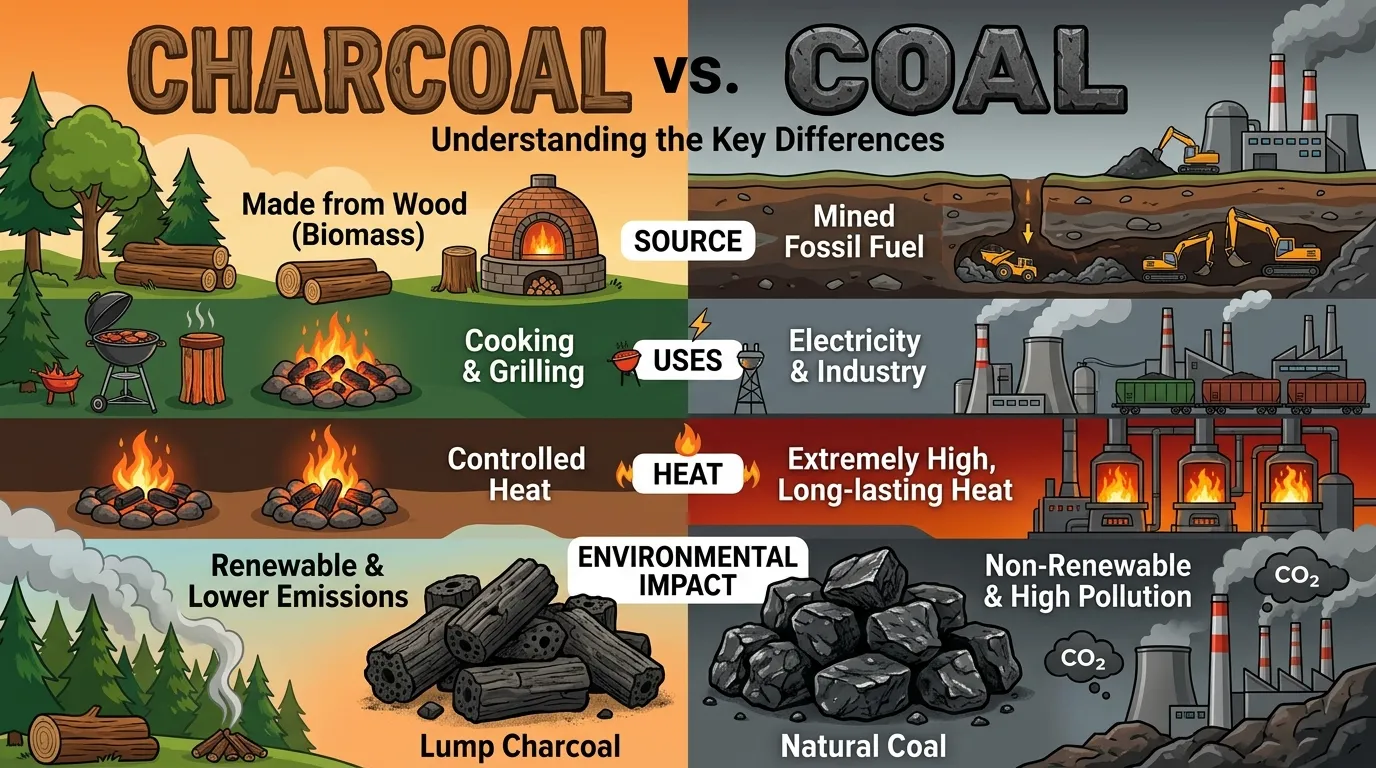
Charcoal is made by heating wood or other plant matter with little oxygen. Coal forms naturally from ancient plant matter over millions of years. Charcoal is often used for cooking and grilling. Coal is often used to make electricity and provide heat for industry.
Why Is It Important to Know the Difference?
Knowing the difference helps people choose the right fuel. Cooks can use suitable charcoal for a grill. Workers in power plants can learn how coal is used to make energy. Students can better understand natural resources and fuel production. This knowledge also matters for health and the environment. Burning either fuel can release smoke and harmful gases. Using the wrong fuel in a closed room can be dangerous.
Pronunciation of Charcoal and Coal
- Charcoal
- US English: /ˈtʃɑːrˌkoʊl/
- UK English: /ˈtʃɑːˌkəʊl/
- Coal
- US English: /koʊl/
- UK English: /kəʊl/
A Simple Guide to Their Main Differences
Charcoal and coal both give heat when they burn. Yet, they come from different sources and serve different needs. Let us explore ten key points to see how each fuel works and when people use it.
Difference Between Charcoal and Coal
1. Source
Charcoal: People make charcoal by heating wood or other plant matter with little air. This process is called carbonization.
- Example 1: A maker heats wood in a special kiln to make charcoal.
- Example 2: A company turns coconut shells into charcoal for use as fuel.
Coal: Coal forms in the ground from old plant matter. Heat and pressure change this matter over millions of years.
- Example 1: Miners take coal from a deep mine.
- Example 2: A power plant buys coal from a coal mine.
2. How It Is Made or Formed
Charcoal: Charcoal is made by people. They heat wood or plant matter while keeping most air away.
- Example 1: A worker makes charcoal from dry wood.
- Example 2: A factory makes charcoal from coconut shells.
Coal: Coal forms through natural processes over a very long time. It cannot be made in the same way as charcoal.
- Example 1: A coal seam lies deep below the soil.
- Example 2: Miners dig coal from rock layers.
3. Main Uses
Charcoal: People often use charcoal for grilling, cooking, and some heating tasks. Special forms are also used in filters.
- Example 1: A family uses charcoal to grill food outdoors.
- Example 2: A water filter may use activated charcoal to help remove some unwanted substances.
Coal: Coal is often used in power plants and heavy industry. Some factories use it to make steel or cement.
- Example 1: A power plant burns coal to make steam and electricity.
- Example 2: A steel plant uses coal-derived coke in iron production.
4. Appearance
Charcoal: Charcoal is often black, light, and easy to break. Its shape depends on the material and how it was made.
- Example 1: A piece of wood charcoal may break into small parts.
- Example 2: Charcoal briquettes may look like small black blocks.
Coal: Coal is a natural rock. It can look black, dark brown, shiny, or dull.
- Example 1: Hard coal may have a shiny surface.
- Example 2: A lump of softer coal may look dull and dusty.
5. Weight and Texture
Charcoal: Charcoal is often light for its size and can be brittle. Some types may crumble when pressed.
- Example 1: A piece of charcoal may break when dropped.
- Example 2: A charcoal briquette may leave black dust on the hands.
Coal: Coal is usually denser than ordinary wood charcoal, but its weight and texture vary by type.
- Example 1: A lump of hard coal may feel heavy.
- Example 2: Soft coal may leave dust as it is moved.
6. Heat and Burning
Charcoal: Charcoal can burn with steady heat when it has enough air. It is often useful for grilling food.
- Example 1: Hot charcoal cooks food on an outdoor grill.
- Example 2: Charcoal in a suitable stove can provide heat.
Coal: Coal can also provide strong heat. Its burning features depend on the coal type and the equipment used.
- Example 1: A coal-fired boiler heats water to make steam.
- Example 2: A factory uses coal in a furnace made for that fuel.
7. Smoke and Air Quality
Charcoal: Charcoal may make less visible smoke than some kinds of wood when it burns well. Still, it can release carbon monoxide and fine particles.
- Example 1: A charcoal grill gives off gases even when little smoke is seen.
- Example 2: Burning charcoal indoors can cause deadly carbon monoxide buildup.
Coal: Burning coal can release carbon dioxide, sulfur dioxide, nitrogen oxides, fine particles, and other pollutants. The amount depends on the coal and pollution controls.
- Example 1: A coal plant uses filters and other controls to reduce some pollution.
- Example 2: Burning coal without proper controls can harm air quality.
8. Carbon Content
Charcoal: Charcoal is rich in carbon because heating removes much of the water and other parts of the original material. Its exact carbon content varies.
- Example 1: Hardwood charcoal contains carbon left from the wood.
- Example 2: Activated charcoal has many tiny pores and is used in some filters.
Coal: Coal also contains carbon, but its carbon level varies by type. Anthracite has more carbon than many other types of coal.
- Example 1: Anthracite is a high-carbon type of coal.
- Example 2: Lignite usually has less carbon and more moisture than higher-rank coal.
9. Cost and Supply
Charcoal: The cost of charcoal depends on the wood or plant material, the making process, and local supply.
- Example 1: A small bag of grilling charcoal may cost little in a local shop.
- Example 2: Special activated charcoal may cost more than ordinary charcoal.
Coal: The cost of coal depends on its type, mining costs, transport, and demand.
- Example 1: A factory may buy coal in large amounts.
- Example 2: Coal may cost more in a place far from a mine.
10. Environmental Impact
Charcoal: Making charcoal can harm forests if trees are cut without care. Burning it also adds carbon dioxide to the air. Its impact depends on how the material is sourced and made.
- Example 1: Charcoal made from waste wood can reduce the need for new trees.
- Example 2: Cutting many trees to make charcoal can damage habitats.
Coal: Mining coal can change land and damage habitats. Burning coal also releases large amounts of carbon dioxide.
- Example 1: A coal mine may leave large areas of disturbed land.
- Example 2: A coal power plant releases carbon dioxide as it makes electricity.
Nature and Behaviour of Charcoal
Charcoal is a artificial fuel made by heating wood or other plant matter with little air. It is often light and brittle. It can burn well when it gets enough oxygen. And it is common in outdoor grills and some cooking stoves. Special charcoal, called activated charcoal, has many tiny pores. It is used in some filters and other products. Charcoal is not safe to burn in a closed room. It can release carbon monoxide, a gas that has no smell and can kill.
also read more about https://comparificationn.com/difference-between-ucaas-and-ccaas-3/
Nature and Behaviour of Coal
Coal is a natural fuel found in the ground. It forms from ancient plant matter over millions of years. Its types include lignite, bituminous coal, and anthracite. These types differ in moisture, carbon content, and heat output. Coal is often used in power plants and heavy industry. It can give off a lot of heat, but burning it can also release harmful gases and particles. Coal mining can damage land and water if it is not managed well.
Why People Often Confuse Charcoal and Coal
People often mix up charcoal and coal because both are dark and can burn. Both can be used as fuel, and both give off heat. Their names also sound alike. But their sources are different. Charcoal is made from wood or other plant matter. Coal is a natural rock found underground. People may also see both fuels sold in bags or used near fires. The best way to tell them apart is to ask where each fuel comes from and what it is made for.
Charcoal vs. Coal: Differences and Similarities
| Feature | Charcoal | Coal |
| Source | Made from wood or plant matter | Forms naturally underground |
| Type | artificial fuel | Natural rock and fuel |
| Main uses | Grilling, cooking, filters | Power plants and industry |
| Appearance | Often black and light | Black or brown; may be shiny or dull |
| Heat | Gives heat when burned | Gives heat when burned |
| Carbon | Carbon-rich; amount varies | Carbon level varies by type |
| Air pollution | Can release harmful gases and particles | Can release many gases and particles |
| Land impact | Can harm forests if wood is not sourced well | Mining can disturb land and habitats |
| Similarity | Both can be used as fuel | Both can be used as fuel |
Which Is Better in What Situation?
When Is Charcoal Better?
Charcoal is often a good choice for outdoor grilling. It can give steady heat and add a smoky taste to food. It is also useful for some small cooking tasks. Some forms of charcoal are used in filters, but ordinary grilling charcoal should not be used for this purpose. Choose charcoal made for your task, and follow the safety advice on the pack. Never burn charcoal in a home, tent, or other closed space. It can release carbon monoxide, which can cause serious harm or death.
When Is Coal Better?
Coal is often used where large amounts of heat or power are needed. Power plants may burn coal to make steam, which turns machines that produce electricity. Some industries also use coal or products made from it. However, coal is not a good choice for a home grill. It can produce harmful pollution and needs equipment made for safe use. The right choice depends on the task, local rules, cost, and the effects on people and the environment. Cleaner energy sources may be a better option when they are available.
Charcoal and Coal in Metaphors and Similes
A metaphor compares one thing to another without using “like” or “as.” A simile makes a comparison using words such as “like” or “as.”
Charcoal
- Metaphor: “The charcoal was the heart of the fire.” This means the charcoal kept the fire going.
- Simile: “The charcoal was black as night.” This describes its dark color.
- Metaphor: “Her drawing was a charcoal dream.” This suggests that the drawing had a soft, dark look.
Coal
- Metaphor: “The coal was buried treasure.” This shows that coal can be a valuable resource.
- Simile: “The coal looked as black as ink.” This describes its color.
- Metaphor: “The coal mine was a giant storehouse of energy.” This compares the mine to a place that holds fuel.
Connotative Meaning of Charcoal and Coal
A word’s connotation is the feeling or idea it brings to mind. The feeling can be positive, negative, or neutral.
Charcoal
- Positive: Charcoal may suggest tasty grilled food and time with family.
Example: “The smell of charcoal made the garden feel warm and happy.” - Negative: Charcoal may suggest smoke or danger.
Example: “The charcoal smoke filled the air and made us cough.” - Neutral: Charcoal may simply name a fuel or art material.
Example: “She bought charcoal for the grill.”
Coal
- Positive: Coal may suggest jobs, power, or industry.
Example: “Coal once gave many towns work and energy.” - Negative: Coal may suggest dirty air and damage to the land.
Example: “The coal smoke darkened the sky.” - Neutral: Coal may be named as a natural resource.
Example: “The mine produces coal for factories.”
The feeling depends on the context. Neither word is always positive or negative.
Idioms, Proverbs, and Sayings Related to Charcoal and Coal
There are few common English idioms that use the word charcoal or coal directly. However, several well-known sayings are linked to fire, heat, and burning.
- “Out of the frying pan and into the fire.” This means moving from a bad situation to a worse one.
Example: “He left a poor job for an even worse one. He went out of the frying pan and into the fire.” - “Add fuel to the fire.” This means making a problem or fight worse.
Example: “His rude reply added fuel to the fire.” - “Where there is smoke, there is fire.” This means that signs of a problem may point to a real cause.
Example: “Many workers raised the same concern, so the manager thought there might be a problem. Where there is smoke, there is fire.”
These sayings relate to fire and fuel, not to charcoal or coal alone.
Books and Literary Works Related to Charcoal and Coal
The following works explore coal mining, fuel, industry, or life around these themes. They are not all books about the fuels themselves.
- ** Germinal (1885)** — Novel by Émile Zola. This French work tells the story of coal miners and their hard lives.
- ** King Coal (1917)** — Novel by Upton Sinclair. It looks at the lives of coal miners in the United States.
- ** The Road (2006)** — Post-apocalyptic novel by Cormac McCarthy. Fire and the need for fuel form part of the struggle to survive.
- ** Coal: A Human History (2004)** — Nonfiction history by Barbara Freese. It explains how coal shaped people, work, and industry.
Movies Related to Charcoal and Coal
These films relate to coal mining, industrial work, or fire. They are not all directly about charcoal or coal as a fuel.
- ** How Green Was My Valley (1941, United States)** — Drama about a Welsh mining family and their community.
- ** Germinal (1993, France and Belgium)** — Drama based on Émile Zola’s novel about coal miners.
- ** Billy Elliot (2000, United Kingdom)** — Drama set in a coal-mining town during a time of social change.
- ** October Sky (1999, United States)** — Drama about a boy from a coal-mining town who dreams of building rockets.
- ** The Burning Train (1980, India)** — Action film about a train fire and a rescue effort; it relates to fire and fuel rather than being about coal or charcoal itself.
Five Possible Asked Questions
1. Is charcoal the same as coal?
No. Charcoal is made by heating wood or other plant matter with little air. Coal is a natural rock that forms underground over millions of years.
2. Which burns hotter, charcoal or coal?
It depends on the type of fuel and how it burns. Some coals can reach very high temperatures in suitable equipment. Charcoal also gives strong heat and is often used for grilling.
3. Can I use coal instead of charcoal for grilling?
Do not use ordinary coal in a grill made for charcoal. Coal may give off harmful gases and may not be safe for food cooking. Use the fuel recommended by the grill maker.
4. Is charcoal cleaner than coal?
Not always. Charcoal may make less visible smoke in some cases, but it still releases harmful gases and particles. Coal can cause serious air pollution. The full impact depends on how each fuel is made and burned.
5. Is charcoal natural or artificial?
Charcoal is usually artificial. People heat wood or plant matter with little air to make it. Coal forms naturally underground over a very long time.
How Charcoal and Coal Affect Our Surroundings
Both fuels affect the air, land, and people around us. Making charcoal can lead to tree loss if wood is not sourced with care. Burning charcoal can release carbon monoxide and tiny particles. Coal mining can disturb land and harm habitats. Burning coal can add carbon dioxide and other pollutants to the air. These effects can harm health and add to climate change. People can reduce harm by using fuels safely, choosing products from responsible sources, and using cleaner energy when possible. Good ventilation and the right equipment are important whenever fuel is burned.
Final Words on Charcoal and Coal
Charcoal and coal both provide heat, but they are different fuels. Charcoal is made from wood or plant matter and is often used for grilling. Coal forms underground and is often used in power plants and industry. Both need care because burning them can harm health and the environment. The right choice depends on the job, the equipment, and local safety rules.
Conclusion
The difference between charcoal and coal starts with how each fuel forms. People make charcoal by heating wood or other plant matter with little air. Coal forms naturally from ancient plant matter over millions of years. Charcoal is often used for grilling and some small cooking tasks. Coal is often used to make power and support heavy industry. Both can give heat, but both can also pollute the air. Charcoal can be unsafe indoors because it releases carbon monoxide. Coal mining can damage land and habitats. When we understand these differences, we can choose fuel with more care. We can also protect our health and help reduce harm to the environment.

I’m Zahid Abbas, an educator, researcher, and digital publishing strategist with a passion for linguistics, grammar, and clear communication. As a content creator and SEO specialist, I craft research-driven, reader-focused content that empowers learners and makes knowledge accessible worldwide.