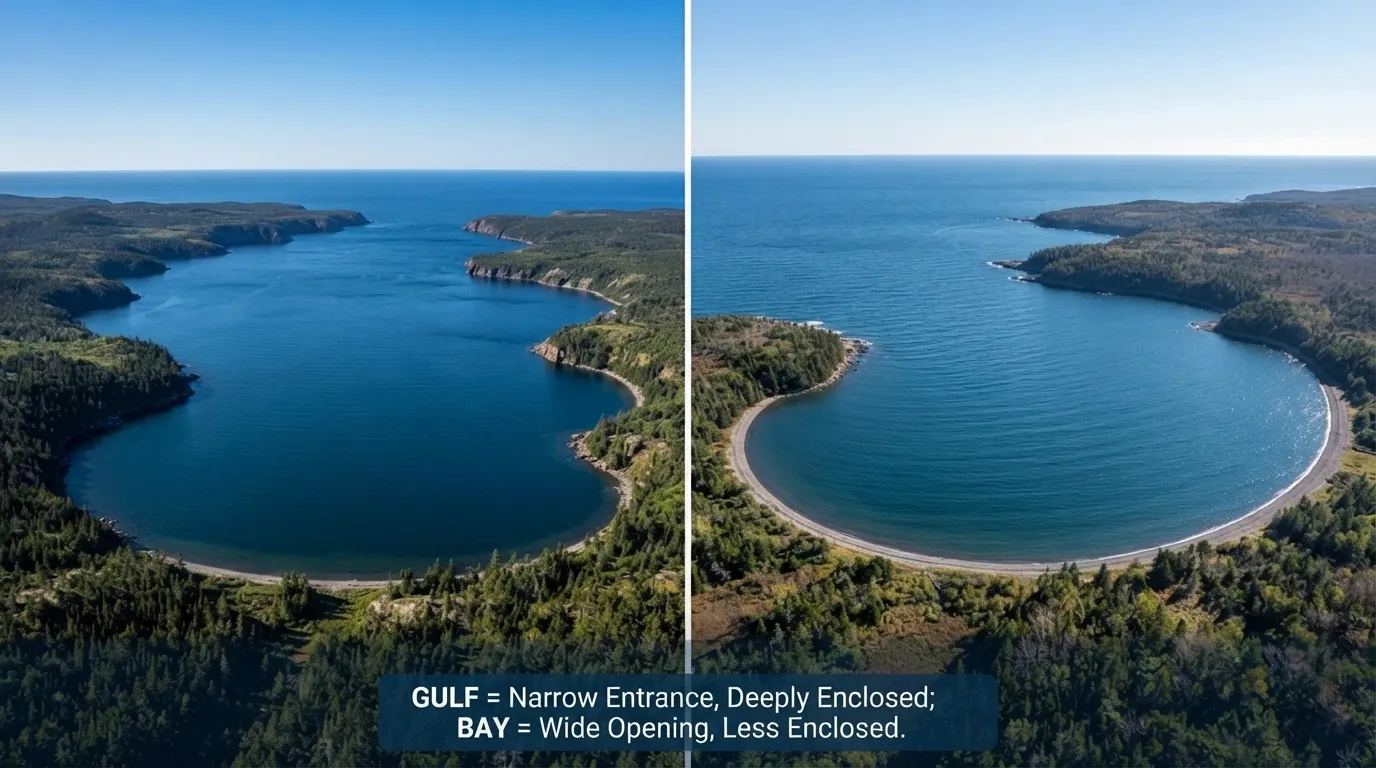
Imagine standing near the coast and looking at a large area of seawater surrounded by land. You may wonder whether it is called a gulf or a bay. Both words describe parts of the sea or ocean that reach into the land. For example, the Gulf of Mexico is surrounded by the United States, Mexico, and Cuba, while the Bay of Bengal lies between India, Bangladesh, and Myanmar. The difference between gulf and bay is not always easy to see because there is no single worldwide rule based only on size. In general, a gulf is often larger and more deeply surrounded by land than a bay. Understanding the difference between gulf and bay helps students learn geography. The difference between gulf and bay is also useful for understanding maps, coastal areas, trade, fishing, and travel. This guide explains the difference between gulf and bay in simple English.
Key Difference Between a Gulf and a Bay
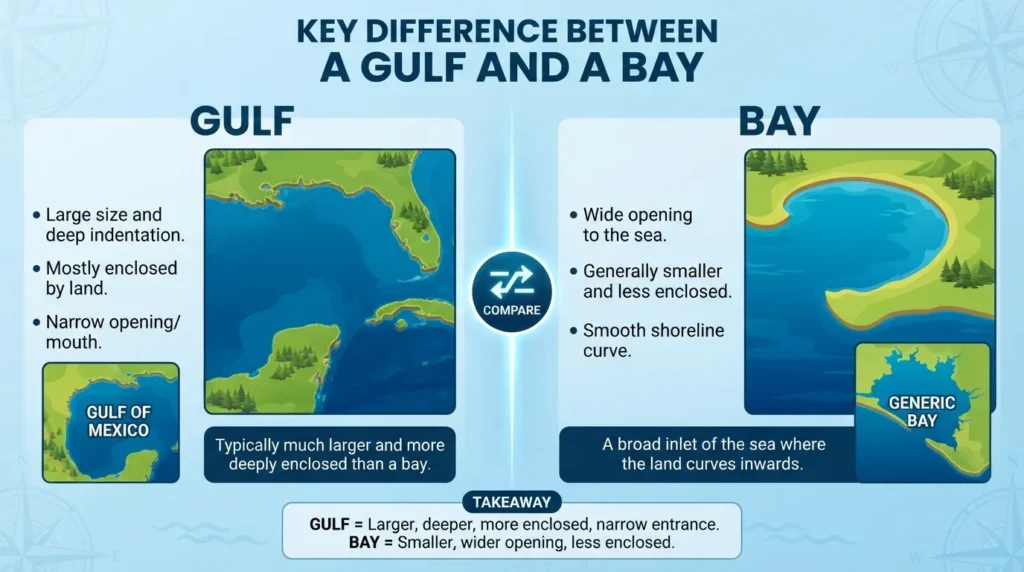
The main difference is usually the size and shape of the water body.
- A gulf is usually a large part of the sea or ocean that reaches deeply into land.
- A bay is a part of the sea or ocean partly surrounded by land.
- Gulfs are often larger and more enclosed.
- Bays can be smaller and more open.
However, names are not always based on strict scientific rules. Some places called “gulf” may be smaller than places called “bay.”
Why Is Their Difference Important?
Knowing this difference helps students understand maps and physical geography. It also helps people understand coastal regions, ports, fishing areas, and sea routes.
Experts in geography, ocean studies, shipping, and environmental science also use these terms when describing coastal areas.
Pronunciation of Gulf and Bay
Gulf
- US: gulf
- UK: gulf
Bay
- US: bay
- UK: bay
The words are short, but their geographical meanings are important. Let us now look at their differences step by step.
Difference Between Gulf and Bay
1. Basic Meaning
Gulf
A gulf is a large part of the sea that extends deeply into the land.
Examples:
- The Gulf of Mexico reaches far into the land.
- The Persian Gulf is surrounded by several countries.
Bay
A bay is a part of a sea or ocean that is partly surrounded by land.
Examples:
- Hudson Bay is a large body of water in Canada.
- San Francisco Bay is surrounded by land on several sides.
2. Size
Gulf
A gulf is often large.
Examples:
- The Gulf of Mexico covers a very large area.
- The Gulf of Guinea is a large part of the Atlantic Ocean.
Bay
A bay can be large or small.
Examples:
- Chesapeake Bay is a large bay.
- A small coastal bay may cover only a small area.
3. Shape
Gulf
A gulf often has a deep and curved shape.
Examples:
- The Gulf of Mexico curves into North America.
- The Persian Gulf extends between land areas.
Bay
A bay can have many different shapes.
Examples:
- A bay may form between two headlands.
- A bay can have a wide opening toward the sea.
4. How Much Land Surrounds It?
Gulf
A gulf is often surrounded by land on several sides.
Examples:
- The Gulf of Mexico has land around much of its coast.
- The Persian Gulf is bordered by several countries.
Bay
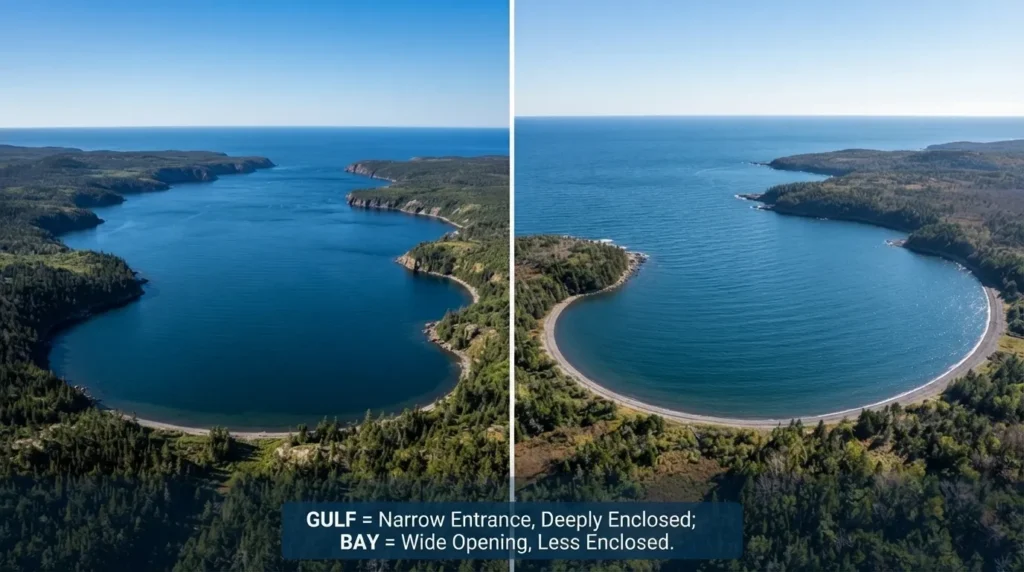
A bay is also surrounded by land but may have a wider opening.
Examples:
- San Francisco Bay connects to the Pacific Ocean.
- The Bay of Bengal has a broad opening toward the Indian Ocean.
5. Opening to the Ocean
Gulf
A gulf may have a relatively narrow entrance compared with its size.
Examples:
- The Persian Gulf connects to the Gulf of Oman through the Strait of Hormuz.
- The Gulf of California connects to the Pacific Ocean.
Bay
A bay can have a narrow or wide opening.
Examples:
- Some bays have wide openings.
- Others have narrow entrances between coastal areas.
6. Water Movement
Gulf
Water in a gulf can be affected by tides, currents, winds, and its partly enclosed shape.
Examples:
- Currents move through the Gulf of Mexico.
- Tides affect water levels in the Persian Gulf.
Bay
Bays are also affected by tides, waves, and currents.
Examples:
- Tides change water levels in San Francisco Bay.
- Ocean waves enter many open bays.
7. Location
Gulf
Gulfs can occur along the edges of oceans and seas.
Examples:
- The Gulf of Mexico is part of the Atlantic Ocean.
- The Gulf of Aden is connected to the Indian Ocean.
Bay
Bays can also occur along coastlines around the world.
Examples:
- The Bay of Bengal is in the northeastern Indian Ocean.
- Hudson Bay is in northeastern Canada.
8. Human Activities
Gulf
Gulfs can be important for shipping, fishing, oil, and gas.
Examples:
- The Gulf of Mexico is important for energy production and shipping.
- The Persian Gulf is important for international trade and oil transport.
Bay
Bays can also support ports, fishing, tourism, and cities.
Examples:
- San Francisco Bay supports major ports and cities.
- The Bay of Bengal supports fishing and coastal communities.
9. Environmental Importance
Gulf
Large gulfs can contain many different marine habitats.
Examples:
- The Gulf of Mexico has wetlands and marine ecosystems.
- Coastal areas of the Persian Gulf contain important habitats.
Bay
Bays can also provide important habitats for marine life.
Examples:
- Chesapeake Bay supports many aquatic species.
- Coastal bays can provide shelter for fish and birds.
10. Naming Rules
Gulf
The word “gulf” does not always follow one strict scientific size rule.
Examples:
- The Gulf of Mexico is extremely large.
- Some smaller areas are also officially called gulfs.
Bay
The same is true for the word “bay.”
Examples:
- Hudson Bay is larger than some areas called gulfs.
- The Bay of Bengal is one of the world’s largest bays.
This shows that geographical names often come from history and local usage, not only from measurements.
Nature and Behaviour of a Gulf
A gulf is a coastal water body that extends into land. Because it is partly enclosed, its water can have special patterns of tides, currents, temperature, and salinity.
Large gulfs can be important for marine life and human activities. They can also contain busy ports and major shipping routes.
Nature and Behaviour of a Bay
A bay is also a coastal water body partly surrounded by land. Bays can provide protected water for boats and ships.
Their shape and depth can affect waves, tides, water temperature, and marine life. Some bays are also important tourist destinations.
Why Are People Confused About Their Use?
People are confused because gulf and bay have very similar meanings. Both describe water that enters or lies partly inside land.
Another reason is that there is no perfect worldwide rule saying that every gulf must be larger than every bay. Geographic names are often based on history, local language, and tradition.
Gulf vs Bay: Difference and Similarity
| Feature | Gulf | Bay |
| Basic meaning | Sea area extending deeply into land | Sea area partly surrounded by land |
| Usual size | Often large | Can be small or very large |
| Shape | Often deeply curved | Many shapes |
| Land around it | Often more enclosed | Usually partly enclosed |
| Opening | May be relatively narrow | Can be narrow or wide |
| Tides | Yes | Yes |
| Currents | Yes | Yes |
| Marine life | Important habitat | Important habitat |
| Human use | Shipping, fishing, energy | Shipping, fishing, tourism |
| Both are coastal water bodies? | Yes | Yes |
Which Is Better in What Situation?
Gulf
A gulf is important when studying large coastal water bodies, shipping routes, energy resources, and marine ecosystems. Large gulfs often connect important countries and trade areas. For example, the Persian Gulf is important for international shipping and energy trade. The Gulf of Mexico is important for fishing, tourism, shipping, and energy production. If you are studying a large and deeply enclosed part of the sea, the term gulf may be used.
Bay
A bay is useful when describing a coastal area that is partly surrounded by land. Bays can be important for ports, fishing, tourism, and local ecosystems. Some bays are small, while others are extremely large. For example, San Francisco Bay is important for transportation and cities, while the Bay of Bengal is a huge marine region. The term bay is often useful for describing protected or partly enclosed coastal waters.
Gulf and Bay in Metaphors and Similes
The words can also be used creatively.
- “Like a gulf between them” can describe a large difference between two people or ideas.
- “A bay of calm” can be used poetically to describe a peaceful place.
- Example: “There was a gulf between their opinions.”
- Example: “The quiet garden felt like a bay of peace.”
The word gulf is more common in figurative English than bay.
Connotative Meaning of Gulf and Bay
Gulf
Gulf can have a neutral or negative meaning.
- Neutral: “The ship crossed the gulf.”
- Negative: “There was a gulf between the two groups.”
- Positive: “The gulf provided a beautiful view.”
In a figurative sense, gulf often suggests distance or separation.
Bay
Bay usually has a neutral or positive feeling when used as a geographical word.
- Neutral: “The boat entered the bay.”
- Positive: “The bay looked beautiful at sunset.”
- Negative: “The storm damaged homes around the bay.”
Idioms and Proverbs Related to Gulf and Bay
“A gulf between”
This means a large difference or separation.
Example:
“There is a gulf between the two teams’ opinions.”
“At bay”
The expression “keep someone at bay” means to keep someone or something away.
Example:
“The fence helped keep the animals at bay.”
“Hold someone at bay”
It means to prevent someone from coming closer or causing harm.
Example:
“The goalkeeper held the attacking players at bay.”
Gulf and Bay in Literature
- Moby-Dick — adventure novel, Herman Melville, 1851. It contains many descriptions of oceans, seas, and coastal waters.
- The Old Man and the Sea — novella, Ernest Hemingway, 1952. It focuses on the sea and a fisherman’s journey.
- The Sea-Wolf — adventure novel, Jack London, 1904. It uses the sea as an important setting.
Movies Related to Gulfs and Bays
- The Bay — horror film, 2012, United States. The story is set around a coastal community affected by an environmental event.
- Jaws — thriller film, 1975, United States. It is set in a coastal island community and focuses on the sea.
- Moana — animated adventure film, 2016, United States. The story strongly features the ocean and coastal environments.
Final Thoughts
Difference between gulf and bay is mainly related to their shape, size, and how much land surrounds them. A gulf is usually a large and deeply enclosed part of the sea, while a bay is a part of the sea or ocean that is partly surrounded by land.
However, the names are not based on a strict worldwide rule. Some bays are larger than some gulfs. Both can be important for marine life, fishing, shipping, tourism, and coastal communities.

I’m Zahid Abbas, an educator, researcher, and digital publishing strategist with a passion for linguistics, grammar, and clear communication. As a content creator and SEO specialist, I craft research-driven, reader-focused content that empowers learners and makes knowledge accessible worldwide.