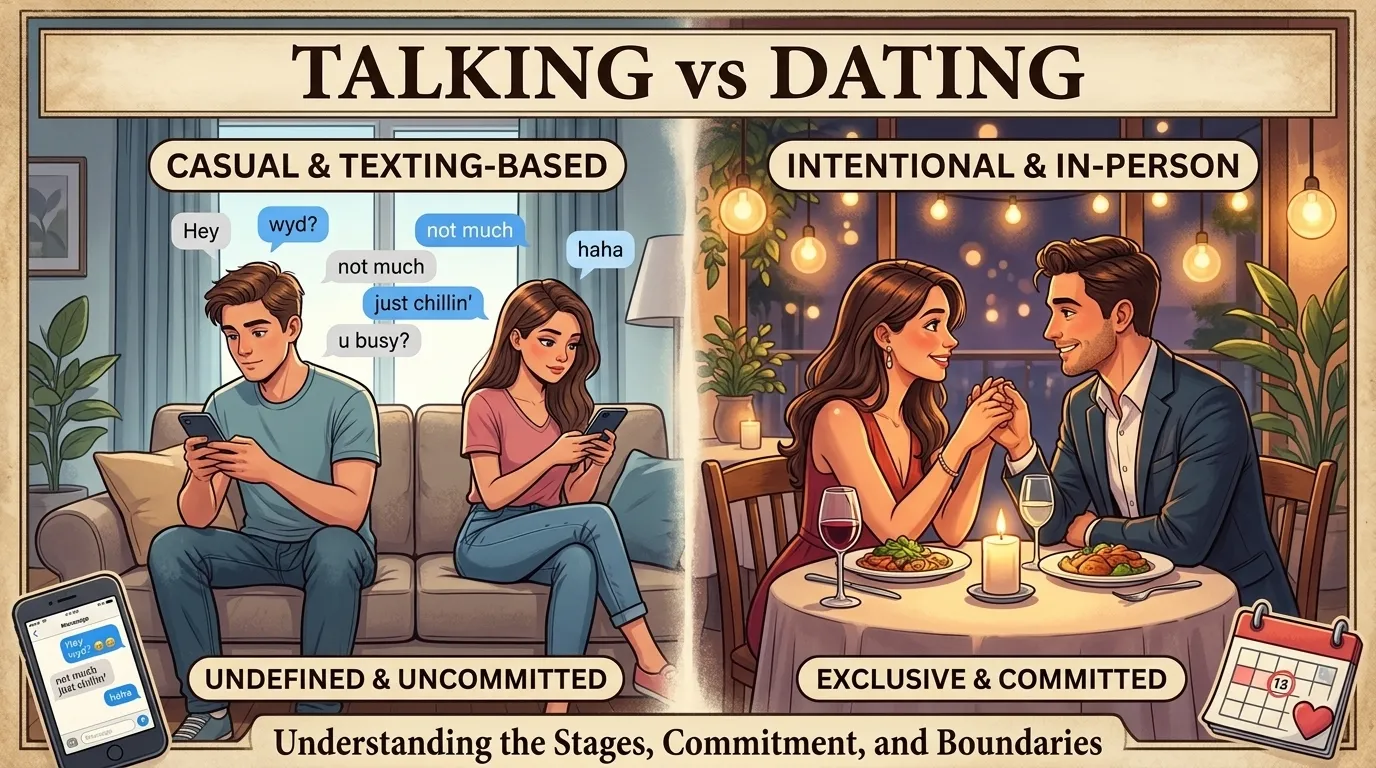
Imagine two people, Ali and Sara. They talk every day, share jokes, and learn about each other. Their friends may think they are a couple, but they have not said that they are dating. This story shows the difference between talking and dating. Talking means having conversations and getting to know someone. Dating means spending time with someone to explore a romantic bond. Both can help people build close ties, but they do not always mean the same thing.
The difference between talking and dating matters because people may have different hopes. One person may want love, while the other may only want friendship. Knowing the difference between talking and dating can help people speak clearly, avoid hurt feelings, and respect each other. It can also help people understand what they want before they take the next step.
Key Difference Between Talking and Dating
Talking is often the first step in a new bond. People chat and learn about each other. Dating usually means that they spend time together with a romantic goal. Yet, dating does not always mean that both people are in an official or exclusive bond. They need to talk about what they want.
Why Is It Important for Learners and Experts to Know the Difference?
Learners need to know these terms to use them well in speech and writing. Experts, such as teachers, writers, and counselors, also need to explain them in a clear way. In daily life, this knowledge can help people set limits, share their hopes, and avoid mixed signs. It can also help them respect the feelings of others.
Pronunciation of Talking and Dating
- Talking
- US English: /ˈtɔːkɪŋ/
- UK English: /ˈtɔːkɪŋ/
- Dating
- US English: /ˈdeɪtɪŋ/
- UK English: /ˈdeɪtɪŋ/
Difference Between Talking and Dating
1. Meaning
Talking: Talking means having a chat with someone. It can be friendly, social, or romantic.
- Example 1: Mia talks to her new classmate after school.
- Example 2: Tom and Emma talk online every night.
Dating: Dating means spending time with someone to explore a romantic bond.
- Example 1: Mia goes on a dinner date with Jack.
- Example 2: Tom asks Emma to go to the movies with him as a date.
2. Main Purpose
Talking: The main goal may be to share ideas, have fun, or get to know someone.
- Example 1: Ben talks to Ana to learn about her hobbies.
- Example 2: Two friends talk about their plans for the weekend.
Dating: The main goal is often to see if a romantic bond can grow.
- Example 1: Sara goes on a date to learn if she and Ali are a good match.
- Example 2: Mark takes Lily to a café because he likes her and wants to know her better.
3. Level of Commitment
Talking: Talking alone does not show that two people have made a promise to each other.
- Example 1: Nina talks to two new people in her class.
- Example 2: Adam chats with a friend but makes no romantic promise.
Dating: Dating may show a stronger romantic interest, but it does not always mean a promise of long-term love.
- Example 1: Eva and Sam go on dates but have not agreed to be exclusive.
- Example 2: Jack and Rose date and agree to focus on each other.
4. Time Spent Together
Talking: People can talk for a few minutes or for many hours. They may speak in person or online.
- Example 1: Sara talks to Ali during lunch.
- Example 2: Ben and Mia chat by phone before bed.
Dating: People may plan time together for a date. They may eat out, walk in a park, or watch a film.
- Example 1: Leo and Emma plan a picnic for Saturday.
- Example 2: Aisha and Omar meet for coffee as a date.
5. Feelings and Emotions
Talking: Talking can involve any kind of feeling. It may be friendly, caring, or romantic.
- Example 1: A student talks to a friend when feeling sad.
- Example 2: Two people share their dreams during a long chat.
Dating: Dating often includes romantic feelings or a wish to see if such feelings can grow.
- Example 1: Maya feels excited before her first date.
- Example 2: Dan and Rose talk about what they like about each other during a date.
6. Expectations
Talking: People may not expect romance or a clear plan for the future.
- Example 1: Ali talks to Sara, but he thinks they are just friends.
- Example 2: Jane chats with a new person without expecting a date.
Dating: People may expect romance, care, or more time together. Still, they should not guess what the other person wants.
- Example 1: Amy hopes her date will lead to a closer bond.
- Example 2: Ben asks his date if they want to meet again.
7. Communication
Talking: Talking is itself a form of communication. It can happen in person, by phone, or through messages.
- Example 1: Tim sends a text to ask how his friend is doing.
- Example 2: Sara talks with Ali about a book they both like.
Dating: Dating also needs communication, but people may discuss their feelings, limits, and hopes for the bond.
- Example 1: Mia tells her date that she likes to take things slowly.
- Example 2: Jack asks Emma what she wants from their dates.
8. Social Meaning
Talking: Other people may see talking as a normal part of friendship or daily life.
- Example 1: Two classmates talk while waiting for a bus.
- Example 2: A worker talks with a new co-worker during lunch.
Dating: People may see dating as a sign of romantic interest, though it does not always mean the pair is a couple.
- Example 1: Sara tells her friend that she has a date on Friday.
- Example 2: Ali says he is dating someone, but they have not yet agreed to be a couple.
9. Boundaries
Talking: People may talk without any romantic rules or duties. They should still respect each other’s time and privacy.
- Example 1: Nina tells her friend she cannot chat late at night.
- Example 2: Omar asks before sharing a private message.
Dating: People may need to discuss romantic limits, comfort, and what they expect from each other.
- Example 1: Emma tells her date that she is not ready for a kiss.
- Example 2: Leo and Mia agree to ask before making plans for each other.
10. The Next Step
Talking: Talking may lead to friendship, dating, or no further bond at all.
- Example 1: Two people chat at work and become good friends.
- Example 2: A long online chat leads to a first date.
Dating: Dating may lead to a closer bond, an official relationship, or a choice to part ways.
- Example 1: Sara and Ali decide to become a couple after several dates.
- Example 2: Ben and Emma enjoy two dates but agree they are not a good match.
Nature and Behaviour of Talking
Talking is a broad and common act. It can happen between friends, family members, classmates, co-workers, or people who have just met. It does not need romantic feelings. And it may be short or long, serious or fun.
Talking can also be the first step toward a deeper bond. People ask questions, share stories, and learn about each other. Yet, frequent chats do not prove that someone wants to date. It is best not to guess another person’s feelings from messages alone.
Nature and Behaviour of Dating
Dating is often more focused on romance. Two people may plan time together to learn if they enjoy each other’s company and share the same hopes. They may go for a walk, eat a meal, or take part in an activity they both like.
Dating can be casual or serious. Some people date to find a long-term partner, while others want to learn more before making a choice. Dating does not always mean love, a promise, or an exclusive bond. Clear and kind words help both people know where they stand.
Why People Confuse Talking and Dating
People may confuse talking and dating for several reasons:
- Frequent messages: Daily chats may feel romantic, but they can also be friendly.
- Mixed signs: One person may show interest while the other sees the bond as friendship.
- Different meanings: People may use the word “dating” in different ways.
- No clear talk: Some people avoid asking what the other person wants.
- Social pressure: Friends may call two people a couple before they do so themselves.
- Online habits: Emojis, likes, and quick replies may seem like signs of love, but they do not prove it.
The best way to avoid confusion is to ask kind, clear questions. Do not assume that two people share the same hopes just because they talk a lot or go on dates.
Table Showing the Differences and Similarities
| Point | Talking | Dating |
| Meaning | Having a chat | Spending time to explore romance |
| Main goal | Share ideas or learn about someone | Explore romantic interest |
| Romance | May or may not be present | Usually part of the purpose |
| Commitment | No promise is needed | Commitment may or may not be present |
| Time together | Can happen at any time | Often planned as a date |
| Communication | General talk and sharing | May include hopes and limits |
| Boundaries | Respect is still needed | Romantic limits may need discussion |
| Future | May lead to friendship or dating | May lead to a relationship or end |
| Similarity | Both help people learn about each other | Both help people learn about each other |
| Key lesson | Talking does not prove romantic interest | Dating does not always mean an official bond |
Which Is Better in Different Situations?
Talking is better when two people are new to each other or want to build a friendship. It lets them share ideas without the pressure of a romantic bond. It is also useful when someone wants to learn about another person’s values and interests first.
Dating is better when two people feel romantic interest and want to explore it. A date gives them time to see how they feel together. Neither choice is always better than the other. The right choice depends on what both people want. Honest words, mutual respect, and clear limits matter more than the label they use.
Talking and Dating in Metaphors and Similes
Metaphors and similes help us explain feelings in a simple way. A metaphor says that one thing is another thing. A simile compares two things using words such as “like” or “as.”
Talking in Metaphors and Similes
- Metaphor: “Talking is a bridge between two people.” This means that talking can help people understand each other.
- Simile: “Their talk flowed like a river.” This means that their chat felt easy and natural.
- Metaphor: “Their words opened a door.” This means that their talk helped them build trust.
Dating in Metaphors and Similes
- Metaphor: “Dating is a journey.” This means that two people learn about each other over time.
- Simile: “Their first date felt like a new adventure.” This means that the date was exciting and new.
- Metaphor: “A date is a window into another person’s world.” This means that a date can help someone learn about another person’s life and values.
These are creative examples, not fixed rules. They show how people can use language to describe social bonds.
also read more abouthttps://comparificationn.com/difference-between-lutheran-and-protestant-3/
Connotative Meaning of Talking and Dating
A connotative meaning is the feeling or idea that a word brings to mind beyond its basic meaning.
Talking: Positive, Negative, and Neutral Meanings
Positive: Talking can suggest trust, care, and open communication.
- Example: “Talking with my sister always makes me feel better.”
Negative: Talking can suggest gossip, too much noise, or empty words.
- Example: “All that talking caused trouble in the class.”
Neutral: Talking can simply mean having a conversation.
- Example: “We were talking about the weather.”
Dating: Positive, Negative, and Neutral Meanings
Positive: Dating can suggest romance, hope, and a chance to build a close bond.
- Example: “Dating Sam has brought joy into her life.”
Negative: Dating can suggest stress, fear, or hurt feelings when people do not agree on what they want.
- Example: “Dating without clear limits made both of them feel confused.”
Neutral: Dating can simply describe the act of going on dates.
- Example: “They started dating in the spring.”
The feeling behind each word depends on the setting and the speaker’s experience.
Idioms and Proverbs Related to Talking and Dating
There are no widely used English idioms that refer only to the modern dating stage called “talking.” However, several common sayings can help explain these ideas.
Idioms Related to Talking
- Talk things over: To discuss a problem.
- Example: “Ali and Sara talked things over when they had a small fight.”
- Speak your mind: To say what you really think.
- Example: “Mia spoke her mind and told her date what she wanted.”
- Actions speak louder than words: What a person does can matter more than what they say.
- Example: “He said he cared, but he never made time for her. Actions speak louder than words.”
- Get straight to the point: To say the main thing without delay.
- Example: “Sara got straight to the point and asked Ali if he wanted to date.”
Sayings Related to Dating
- Love is blind: Love can make people overlook a person’s faults.
- Example: “Mia ignored every warning sign because she liked him. Her friend said, ‘Love is blind.’”
- Better safe than sorry: It is wise to take care before making a choice.
- Example: “Before they began dating, Sara asked about his plans. She felt it was better safe than sorry.”
- Honesty is the best policy: Telling the truth is often the best choice.
- Example: “Ali told Sara that he was not ready for a serious bond. He believed honesty is the best policy.”
These sayings are useful reminders, but they do not tell us exactly what every person feels or wants.
Works in Literature Related to Talking and Dating
Many works of literature show people talking, falling in love, going on dates, or trying to understand their feelings. The titles below are examples of works about love and social bonds; the words “talking” and “dating” do not need to appear in their titles.
- Pride and Prejudice — Romance novel by Jane Austen, first published in 1813. It shows how talk, first impressions, and courtship shape relationships.
- Romeo and Juliet — Tragedy by William Shakespeare, first published in 1597. It tells the story of two young people who fall in love.
- Emma — Novel by Jane Austen, first published in 1815. It explores courtship, social life, and misunderstandings.
- Jane Eyre — Novel by Charlotte Brontë, first published in 1847. It explores love, trust, and personal choice.
- The Great Gatsby — Novel by F. Scott Fitzgerald, first published in 1925. It explores romance, desire, and social life.
These works can help readers see how people express interest, misunderstand each other, and make choices about love.
Movies Related to Talking and Dating
Many films explore the early stages of romance and the role of conversation in building a bond.
- Before Sunrise — Romance drama, 1995, United States and Austria. Two young people meet and spend a night talking as they get to know each other.
- When Harry Met Sally… — Romantic comedy, 1989, United States. It explores friendship and the question of whether friends can become romantic partners.
- 10 Things I Hate About You — Romantic comedy, 1999, United States. It shows young people dealing with attraction, trust, and dating.
- The Notebook — Romantic drama, 2004, United States. It follows a love story across many years.
- To All the Boys I’ve Loved Before — Teen romantic comedy, 2018, United States. It explores crushes, letters, and new romantic bonds.
These films show different views of love and dating. They are stories for fun and thought, not rules for how every relationship should work.
Five possible Asked Questions About Talking and Dating
1. Can talking turn into dating?
Yes. Two people may begin by chatting and later feel romantic interest. They can choose to go on a date if both want to.
2. Does talking every day mean we are dating?
No. Daily chats may show friendship, care, or interest, but they do not prove that you are dating. Ask the other person how they see the bond.
3. Is dating the same as being in a relationship?
No. Dating can be a way to explore romantic interest. Being in a relationship often means that both people have agreed on what their bond means. People should discuss their own terms.
4. Can two people date without being exclusive?
Yes. Some people date more than one person until they agree to focus on each other. They should be honest about this and respect each other’s choices.
5. How can I know if someone wants to date me?
Look for clear signs, but do not rely on signs alone. The best way is to ask in a kind and direct way, such as, “Would you like to go on a date with me?”
How Talking and Dating Help Build Healthy Social Bonds
Talking helps people share news, learn from each other, solve problems, and build trust. It is useful at home, at school, at work, and in the wider community. Good talk can reduce confusion and help people feel heard.
Dating can help people learn about romance, care, and shared values. It can teach them to respect limits, listen well, and make choices together. Both talking and dating work best when people are honest and kind. They should never feel forced to share private details or accept a bond they do not want. Clear words and respect can make social life safer and more caring.
Final Words on Talking and Dating
Talking and dating are linked, but they are not the same. Talking is a way to share words and learn about another person. Dating is a way to explore romantic interest. Talking may lead to dating, but it may also lead to friendship or remain a simple chat.
Do not judge a bond only by how often two people message each other or how much time they spend together. Instead, listen to what they say and ask clear questions when needed. Both people should feel safe to share their hopes and limits. A healthy bond does not depend on guessing. It grows through trust, respect, and honest communication.
Conclusion
The difference between talking and dating is important because both words describe different stages or forms of human connection. Talking can be friendly, social, or romantic. Dating usually means spending time with someone to explore a romantic bond. Still, neither word tells the full story without clear communication.
People may talk every day and remain friends. They may also go on dates without agreeing to be an official couple. This is why it is wise to ask questions instead of making guesses. Learners can use these words more clearly, while adults can use them to explain their hopes and limits. In the end, the best bonds are built on honesty, kindness, and respect. The label matters less than how people treat each other.

I’m Zahid Abbas, an educator, researcher, and digital publishing strategist with a passion for linguistics, grammar, and clear communication. As a content creator and SEO specialist, I craft research-driven, reader-focused content that empowers learners and makes knowledge accessible worldwide.