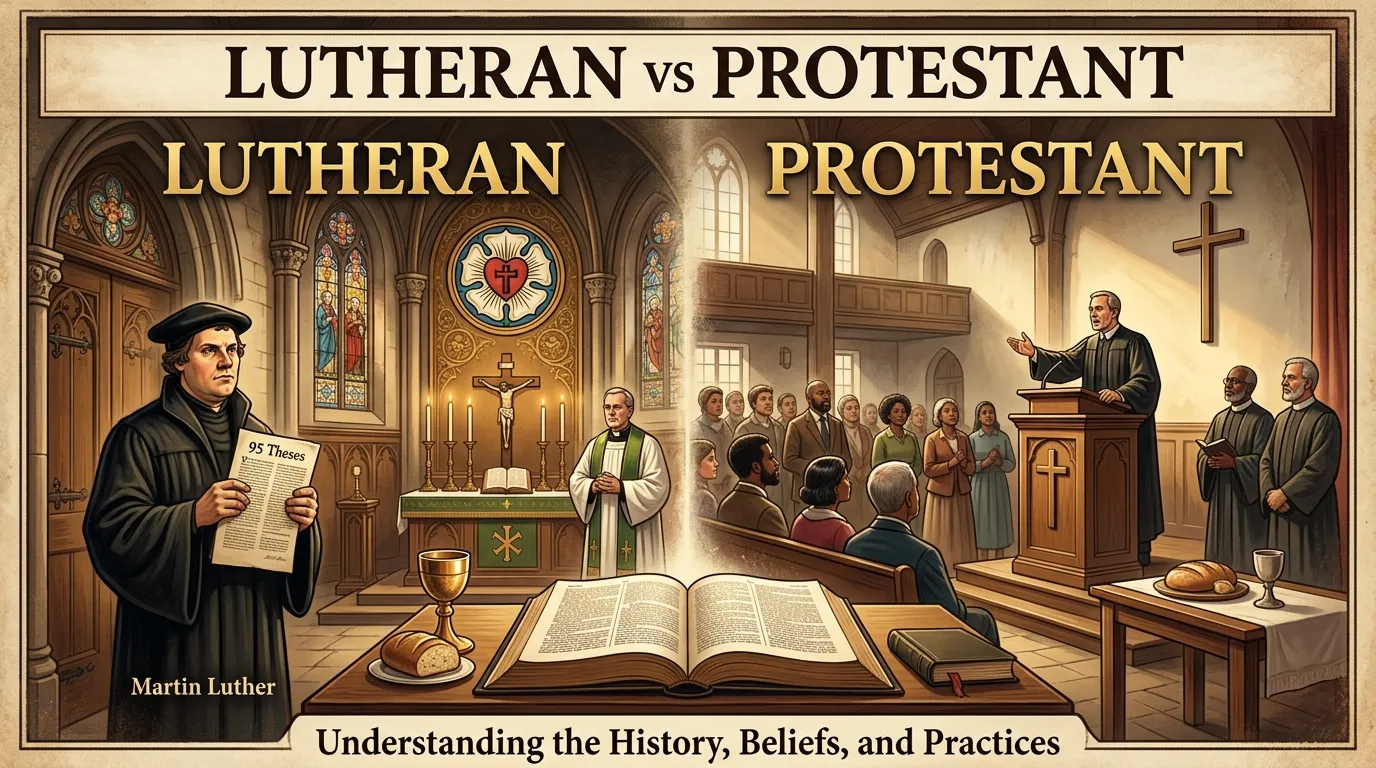
Imagine two people who go to church every Sunday. Both believe in Jesus Christ and read the Bible. Yet, they may belong to different church groups. One may be Lutheran, while the other may belong to another Protestant church. A Protestant is a Christian who belongs to a branch of Christianity that grew from the Reformation. A Lutheran is a Protestant who follows the teachings of Martin Luther, a key leader of that movement. So, the difference between Lutheran and Protestant is that one is a specific group, while the other is a wider term. Learning the difference between Lutheran and Protestant helps people understand Christian history and faith. It also helps readers speak about religion with care and respect.
Key Difference Between Lutheran and Protestant
Protestant is the broad name for many Christian groups that grew from the Reformation. Lutheran is one of these groups. All Lutherans are Protestants, but not all Protestants are Lutherans.
Why Is It Important to Know the Difference?
This difference matters to learners, teachers, and people who study religion. It helps them understand church history and the beliefs of different Christian groups. It can also reduce confusion and help people respect one another. In a diverse society, knowing the right terms can support kind and clear talks about faith.
Pronunciation of Lutheran and Protestant
The pronunciations below are common in both US and UK English, though small accent differences may occur.
- Lutheran: “LOO-thuh-run”
- Protestant: “PROT-uh-stunt”
Difference Between Lutheran and Protestant
1. Meaning
Lutheran
Lutheran refers to a Christian who follows the teachings of Martin Luther and the Lutheran church tradition.
- Example 1: Anna attends a Lutheran church in her town.
- Example 2: The Lutheran pastor teaches about faith and grace.
Protestant
Protestant is a broad term for Christians who belong to churches that grew from the Reformation. These include Lutheran, Baptist, Methodist, and many other groups.
- Example 1: James is a Protestant who attends a Baptist church.
- Example 2: A school lesson explains the growth of Protestant churches in Europe.
2. History
Lutheran
The Lutheran movement began in the 1500s. Martin Luther, a German monk and teacher, spoke against some practices in the Western Church. His ideas helped start the Reformation.
- Example 1: A history class studies Martin Luther’s Ninety-five Theses from 1517.
- Example 2: A Lutheran church holds a service to remember its history.
Protestant
The Protestant movement grew during the Reformation. It led to many new church groups across Europe and later in other parts of the world.
- Example 1: Students learn how the Reformation changed Europe.
- Example 2: A museum shows how Protestant churches spread to new lands.
3. Main Leaders
Lutheran
Martin Luther is the key leader linked to Lutheran beliefs. Other early teachers, such as Philipp Melanchthon, also helped shape the tradition.
- Example 1: A book tells the story of Martin Luther’s life.
- Example 2: A Lutheran class studies the writings of Philipp Melanchthon.
Protestant
Protestant history includes many leaders. These include Martin Luther, John Calvin, Huldrych Zwingli, and other reformers. Different Protestant groups follow different traditions.
- Example 1: A lesson compares the ideas of Luther and Calvin.
- Example 2: A church history book explains the work of many reformers.
4. View of the Bible
Lutheran
Lutherans see the Bible as the main source for Christian teaching. They believe church teachings should agree with the message of the Bible.
- Example 1: A Lutheran pastor reads a Bible passage during worship.
- Example 2: A church group studies a Bible story to learn about faith.
Protestant
Many Protestant churches also place the Bible at the center of faith. However, they may differ in how they read and explain some passages.
- Example 1: A Baptist group studies the Bible in a small class.
- Example 2: A Methodist pastor uses a Bible passage in a sermon.
5. Salvation and Faith
Lutheran
Lutherans teach that people are saved by God’s grace through faith in Jesus Christ. They do not believe that people can earn salvation through good deeds.
- Example 1: A Lutheran sermon explains that God’s grace is a gift.
- Example 2: A church member says that faith gives hope in hard times.
Protestant
Many Protestant churches teach that salvation comes through God’s grace and faith in Jesus. Yet, different groups may explain faith, good works, and the life of a believer in different ways.
- Example 1: A Reformed church teaches about grace and faith.
- Example 2: A Methodist group talks about faith and acts of love.
6. Baptism
Lutheran
Lutherans baptize infants and adults. They teach that baptism is a gift from God and is linked to God’s promise.
- Example 1: A Lutheran church baptizes a baby during a service.
- Example 2: An adult joins the church through baptism.
Protestant
Protestant views on baptism differ. Some churches baptize infants, while others baptize people who can make their own choice to follow Christ.
- Example 1: A Methodist church may baptize a baby.
- Example 2: A Baptist church often baptizes people after they profess their faith.
7. Communion
Lutheran
Lutherans believe that Christ is truly present in the bread and wine of Holy Communion. They see this meal as an important gift from God.
- Example 1: A Lutheran church shares Communion during Sunday worship.
- Example 2: A pastor explains why Communion matters to the church.
Protestant
Protestant churches have different views of Communion. Some believe Christ is truly present, while others see the bread and wine mainly as signs that help people remember Jesus.
- Example 1: A Reformed church explains its view of Communion.
- Example 2: A Baptist church shares bread and grape juice to remember Jesus’ death.
8. Church Services
Lutheran
Lutheran services often follow a set order. They may include Bible readings, prayers, hymns, a sermon, and Communion.
- Example 1: A Lutheran service begins with a hymn and prayer.
- Example 2: The pastor reads from the Bible before giving a sermon.
Protestant
Protestant worship can look very different from one church to another. Some services follow a set form, while others use more open prayer, music, and personal stories.
- Example 1: A Methodist church uses hymns and set prayers.
- Example 2: A Pentecostal church may include lively music and open prayer.
9. Church Structure
Lutheran
Lutheran churches have leaders such as pastors and bishops, depending on the church body. Some Lutheran groups are led by bishops, while others use different forms of leadership.
- Example 1: A Lutheran pastor leads a local church.
- Example 2: A Lutheran bishop serves churches in a region.
Protestant
Protestant churches use many forms of leadership. Some have bishops, some are led by elders, and others give local churches more control.
- Example 1: An Anglican church has bishops.
- Example 2: A Baptist church may be led by local elders and members.
10. Types and Groups
Lutheran
Lutheran refers to one main Protestant tradition. It includes different Lutheran church bodies, which may vary in worship style and some teachings.
- Example 1: A person joins a Lutheran church in their city.
- Example 2: Two Lutheran churches compare their worship practices.
Protestant
Protestant includes many church traditions. These include Lutheran, Baptist, Methodist, Reformed, Pentecostal, and Anglican churches, though Anglican identity and how it is classified can vary by context.
- Example 1: A family visits a Methodist church.
- Example 2: A student makes a chart of different Protestant groups.
Nature and Behaviour of Lutheran Beliefs
Lutheranism is a Christian tradition with clear teachings about faith, grace, and the Bible. It follows the ideas of Martin Luther. Lutherans believe that people receive salvation through God’s grace by faith in Jesus Christ.
Lutheran worship often follows a set order. It may include hymns, prayers, Bible readings, a sermon, and Holy Communion. Many Lutheran churches baptize babies and adults. Still, practices can differ among Lutheran church bodies.
Lutheranism is part of the wider Protestant family. It has its own history, teachings, and ways of worship.
Nature and Behaviour of Protestant Churches
Protestantism is a broad family of Christian churches. It began during the Reformation and grew into many traditions. These churches share some core Christian beliefs, but they do not all teach or worship in the same way.
Some Protestant churches follow set prayers and formal services. Others use modern songs, open prayer, and less formal worship. Some baptize infants, while others baptize people who choose to follow Christ.
Protestant churches may also differ in how they understand Communion, church leaders, and certain Bible passages. This wide range of beliefs is one reason why the word Protestant covers many different groups.
Why People Confuse Lutheran and Protestant
People often confuse these words because they are closely linked. Lutheran churches are Protestant churches, so both terms can describe the same person or church.
The main point is that Lutheran is a specific group, while Protestant is the wider family name. It is like saying that a rose is a flower, but not every flower is a rose.
For example, a Lutheran person is a Protestant. A Methodist person is also a Protestant, but not a Lutheran. Knowing this helps people use both words in the right way.
also read more about https://comparificationn.com/difference-between-ucaas-and-ccaas-4/
Table of Differences and Similarities
| Point | Lutheran | Protestant |
| Meaning | A specific Christian tradition | A broad family of Christian traditions |
| History | Linked to Martin Luther | Linked to the wider Reformation |
| Main leader in its history | Martin Luther | Many reformers |
| Bible | Central to Christian teaching | Central to most Protestant traditions |
| Salvation | By God’s grace through faith | Many groups teach salvation by grace through faith |
| Baptism | Usually includes infants and adults | Views differ by church |
| Communion | Christ is truly present in bread and wine | Views differ by church |
| Worship | Often follows a set order | May be formal or informal |
| Church leadership | Varies by Lutheran church body | Varies across traditions |
| Relationship | A type of Protestant | The wider group that includes Lutherans |
Similarities Between Lutheran and Protestant
- Both are part of Christianity.
- Both grew from the history of the Reformation.
- Both place great value on the Bible.
- Both teach about Jesus Christ.
- Both include churches that gather for prayer, worship, and teaching.
Which Is Better in What Situation?
When Is Lutheranism a Better Fit?
Lutheranism may suit a person who values its teachings on grace and faith, its view of the Bible, and its style of worship. Many Lutheran churches use hymns, set prayers, Bible readings, and Holy Communion. A person who likes this form of worship may feel at home in a Lutheran church. It may also suit someone who wants to learn about Martin Luther and the Lutheran tradition. The best choice depends on personal belief, local church life, and the way a person wishes to grow in faith.
When Is a Different Protestant Church a Better Fit?
Another Protestant church may suit a person whose beliefs or worship needs match that tradition more closely. For example, some people prefer Baptist views on baptism, while others like Methodist worship or Pentecostal prayer. Protestant churches are not all the same, so it is wise to learn about each church before joining. A person can visit services, read the church’s statement of faith, and ask questions. The goal should not be to prove that one group is better than all others. It should be to find a church that fits one’s beliefs and helps one live with care and faith.
Lutheran and Protestant in Metaphors and Similes
Lutheran and Protestant are names for Christian traditions. They are not common words in everyday metaphors or similes. Still, we can use figures of speech to explain how the terms relate.
Metaphors
A metaphor describes one thing as another to explain an idea.
- “Protestantism is a large tree with many branches.” This means Protestantism includes many church traditions.
- “Lutheranism is one branch of that tree.” This shows that Lutheranism is part of the wider Protestant family.
Similes
A simile compares two things using words such as like or as.
- “Protestantism is like a family with many members.” Each group has its own features, but they share a wider history.
- “Lutheranism is like one room in a large house.” It is a distinct part of a larger group.
These examples are teaching tools. They are not official religious statements.
Connotative Meaning of Lutheran and Protestant
Connotation means the feelings or ideas that a word may bring to mind. The words Lutheran and Protestant are mainly neutral. Their meaning can feel positive or negative based on how people use them.
Lutheran
- Positive meaning: It may suggest faith, tradition, and a strong sense of community.
Example: “The Lutheran church gave the family a warm place to worship.” - Negative meaning: A person may use the word unfairly to suggest that a group is too strict or old-fashioned.
Example: “He wrongly called the Lutheran service old-fashioned.” - Neutral meaning: It can simply name a church tradition.
Example: “Maria is a Lutheran who attends church each week.”
Protestant
- Positive meaning: It may suggest faith, reform, or freedom of belief.
Example: “The book tells how Protestant reform changed church life.” - Negative meaning: Some people may use the word in a harsh way during a religious dispute.
Example: “The speaker used the word Protestant to insult people from another church.” - Neutral meaning: It can name a broad group of Christian churches.
Example: “The class studied Protestant history.”
The words themselves are not good or bad. The tone depends on the speaker and the setting.
Idioms and Proverbs Related to Lutheran and Protestant
There are no common English idioms made just for Lutheranism or Protestantism. However, some common sayings can help explain ideas about faith, unity, and respect.
1. Practice What You Preach
Meaning: Do what you tell others to do.
- Lutheran example: “The Lutheran leader asked the members to practice what they preach by helping people in need.”
- Protestant example: “The Protestant group tried to practice what they preach by serving its local community.”
2. Actions Speak Louder Than Words
Meaning: What people do can matter more than what they say.
- Lutheran example: “The church showed care for its neighbours because actions speak louder than words.”
- Protestant example: “The Protestant group helped a family in need, showing that actions speak louder than words.”
3. Live and Let Live
Meaning: Let other people live as they choose, even when they differ from you.
- Lutheran example: “The Lutheran teacher told the class to live and let live when talking about other faiths.”
- Protestant example: “The Protestant community used the idea of live and let live to promote respect among church groups.”
4. Many Hands Make Light Work
Meaning: A task becomes easier when people work together.
- Lutheran example: “Many Lutheran church members helped prepare meals for the town, proving that many hands make light work.”
- Protestant example: “Several Protestant churches joined a food drive because many hands make light work.”
5. Do Unto Others as You Would Have Them Do Unto You
Meaning: Treat others as you would like them to treat you.
- Lutheran example: “The Lutheran youth group followed the rule to do unto others as you would have them do unto you.”
- Protestant example: “The Protestant speaker asked the crowd to treat people of other faiths with kindness.”
These sayings are not unique to either tradition. They can be used in many parts of life.
Works in Literature Related to Lutheran and Protestant History
The words Lutheran and Protestant appear in works about religion, history, and society. The following books explore related themes.
- On the Freedom of a Christian — Religious writing by Martin Luther, published in 1520. It explains Luther’s views on faith and Christian life.
- The Bondage of the Will — Religious writing by Martin Luther, published in 1525. It discusses human will and God’s role in salvation.
- Institutes of the Christian Religion — Christian theology by John Calvin, first published in 1536. It became an important work in the Reformed Protestant tradition.
- The Book of Concord — Collection of Lutheran confessions, published in 1580. It sets out key teachings of the Lutheran church.
- Foxe’s Book of Martyrs — Religious history by John Foxe, first published in 1563. It tells stories of people who suffered for their faith, including many from the English Reformation.
These works do not all discuss Lutheran and Protestant beliefs in the same way. They offer views into the history and ideas that shaped Christian traditions.
Movies Related to Lutheran and Protestant History
Some films show people and events linked to the Reformation. They can help viewers learn about the history behind these terms.
- Luther (2003, Germany and United States): A historical drama about Martin Luther and the events that helped shape the Reformation.
- A Man for All Seasons (1966, United Kingdom): A historical drama about Thomas More during the religious changes of King Henry VIII’s rule.
- Elizabeth (1998, United Kingdom): A historical drama about Queen Elizabeth I and religious conflict in England.
- The New World (2005, United States): A historical drama set in early English colonial America, where Protestant beliefs and English culture form part of the wider setting.
- Silence (2016, United States, United Kingdom, and other countries): A historical drama about Jesuit priests in Japan. It is about Catholic faith rather than Lutheranism, but it offers a wider view of Christian belief and religious pressure.
Not all these films focus on Lutheran or Protestant churches. They are related to the wider history of Christianity, religious change, or faith.
Five possible Asked Questions About Lutheran and Protestant
1. Is Lutheran the same as Protestant?
No. Lutheranism is one type of Protestant Christianity. Protestantism includes many other groups, such as Baptist, Methodist, and Reformed churches.
2. Are all Lutherans Protestant?
Yes. Lutheran churches grew from the Reformation and are part of the Protestant family.
3. Who started the Lutheran movement?
Martin Luther, a German monk and teacher, was the key figure behind the Lutheran movement. His ideas helped start the Reformation in the 1500s.
4. Do Lutherans and other Protestants read the same Bible?
They use the Bible as a key source of faith, but some traditions differ in how they explain certain passages. Some Protestant groups also use different Bible canons, meaning the lists of books they accept as Scripture may vary.
5. Do Lutherans and other Protestants worship in the same way?
Not always. Many Lutheran services follow a set order with hymns, prayers, readings, and Communion. Other Protestant churches may use different forms of worship, music, and prayer.
How Lutheran and Protestant Communities Help Society
Lutheran and other Protestant communities can help people in many ways. Their work often includes care for people in need, teaching, support for families, and local service. The exact work depends on the church and its community.
Lutheran churches may run food drives, schools, care homes, and support groups. Some also help people who face poverty or loss. These efforts can bring neighbours together and offer help during hard times.
Other Protestant churches may also run schools, shelters, food banks, youth groups, and health programs. Some work with other faith groups to help people in need.
Both Lutheran and other Protestant communities can build trust when they show kindness and respect. Their service can help people from many backgrounds, not only those who attend church.
Final Words on Lutheran and Protestant
Lutheran and Protestant are linked terms, but they do not mean the same thing.
- Lutheran names a specific Christian tradition linked to Martin Luther.
- Protestant names a wider family of Christian traditions that grew from the Reformation.
Both are part of Christian history, and both include people who value faith, the Bible, and worship. Yet, Protestant churches differ in their teachings and practices. It is best to learn about each group with care and avoid making claims about all Protestants based on one church. Knowing these terms helps people speak clearly and respect the beliefs of others.
Conclusion
The difference between Lutheran and Protestant is simple once we know how the terms fit together. Lutheranism is one branch of Protestant Christianity. Protestantism is the wider family that includes Lutheran, Baptist, Methodist, Reformed, and many other traditions. They share some roots and beliefs, but they can differ in baptism, Communion, worship, and church leadership.
Learning about these differences helps students, teachers, and readers understand Christian history. It can also help people talk about faith in a fair and kind way. No group should be judged by a label alone. To understand a church, it is best to learn its beliefs and listen to its members. Knowledge and respect can help people live well together.

I’m Zahid Abbas, an educator, researcher, and digital publishing strategist with a passion for linguistics, grammar, and clear communication. As a content creator and SEO specialist, I craft research-driven, reader-focused content that empowers learners and makes knowledge accessible worldwide.