A student writing an email to a teacher at University of Cambridge paused. Should he write “I sent this to you” or “I made this for you”? Many learners face this problem.
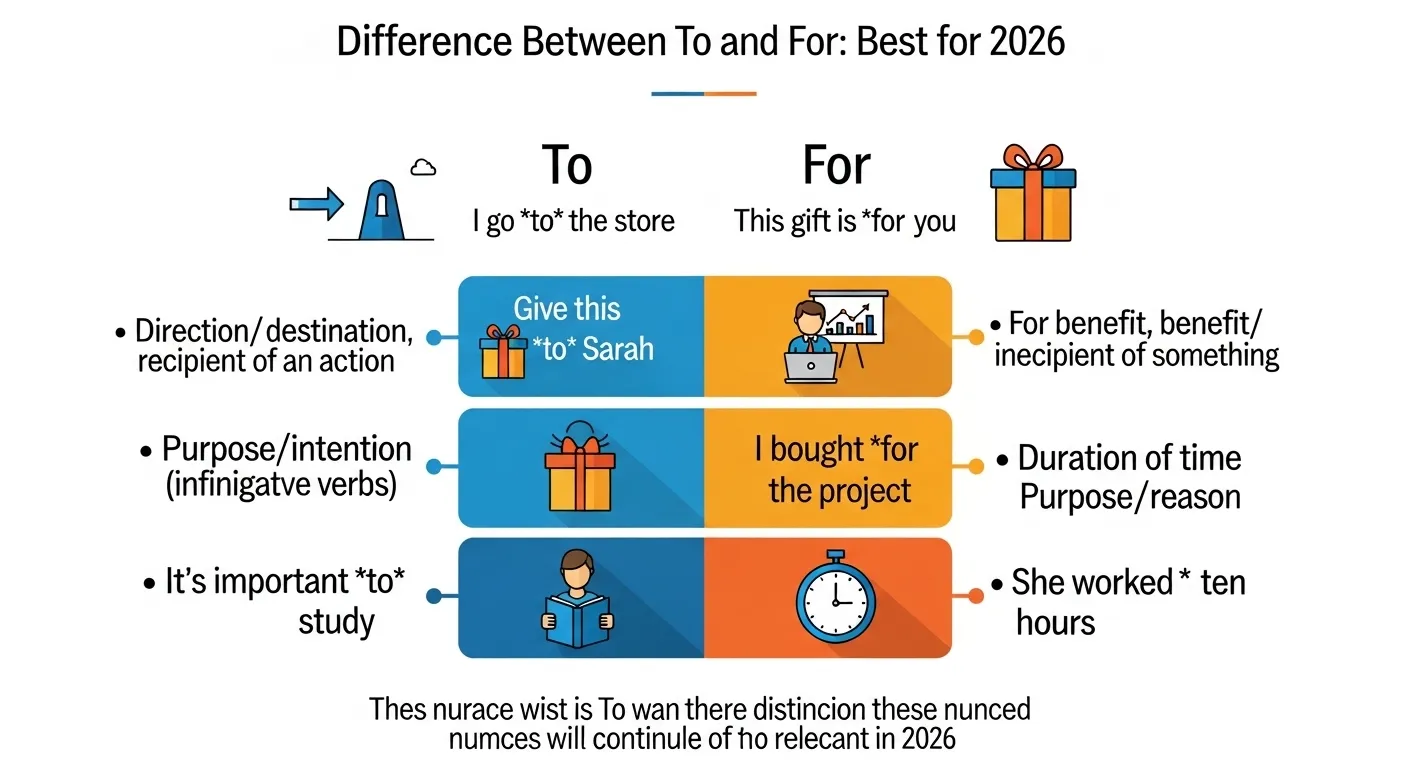
The difference between to and for is small but important. The difference between to and for is about direction and purpose. When you understand the difference between to and for, your English becomes correct and clear. Learning the difference between to and for helps in writing, speaking, and exams.
Key Difference Between the Both
To shows direction or movement.
For shows purpose, benefit, or reason.
The main difference is direction vs purpose.
Why Is Their Difference Necessary to Know for Learners and Experts?
These are very common words. A small mistake can change meaning. Students need them for exams. Professionals need them for clear communication. In society, correct language builds understanding.
Pronunciation
To
- US: /tuː/ or /tə/
- UK: /tuː/ or /tə/
For
- US: /fɔːr/ or /fər/
- UK: /fɔː/ or /fə/
Now let us explore more.
Difference Between To and For
1. Direction
To shows movement toward something.
- Example 1: I go to school.
- Example 2: She walked to the park.
For does not show direction.
- Example 1: I bought a gift for you.
- Example 2: This letter is for him.
2. Purpose
To can show purpose with verbs.
- Example 1: I study to learn.
- Example 2: He works to earn money.
For shows purpose with nouns.
- Example 1: This tool is for cutting.
- Example 2: Shoes for running.
3. Recipient
To shows who receives something.
- Example 1: I gave the book to her.
- Example 2: Send it to me.
For shows who benefits.
- Example 1: I made food for her.
- Example 2: This gift is for you.
4. Time Duration
To is not used for duration.
- Example 1: ❌ I waited to two hours.
- Example 2: ❌ He stayed to a week.
For shows duration.
- Example 1: I waited for two hours.
- Example 2: He stayed for a week.
5. Comparison
To used in comparisons.
- Example 1: I prefer tea to coffee.
- Example 2: This is similar to that.
For not used in this way.
- Example 1: ❌ prefer tea for coffee.
- Example 2: ❌ similar for that.
6. Opinion
To shows relation.
- Example 1: Kind to others.
- Example 2: Nice to me.
For shows opinion or support.
- Example 1: Good for health.
- Example 2: Bad for you.
7. Exchange
To used in giving.
- Example 1: Give it to him.
- Example 2: Hand it to me.
For used in exchange.
- Example 1: Buy for money.
- Example 2: Trade for goods.
8. Grammar Pattern
To + verb (infinitive).
- Example 1: To eat.
- Example 2: To study.
For + noun/pronoun.
- Example 1: For him.
- Example 2: For the class.
9. Feeling
To shows direction of feeling.
- Example 1: I am kind to her.
- Example 2: He spoke to me.
For shows feeling about benefit.
- Example 1: I feel happy for you.
- Example 2: Sad for them.
10. Usage in Questions
To used in movement questions.
- Example 1: Where are you going to?
- Example 2: Who did you give it to?
For used in reason questions.
- Example 1: What is this for?
- Example 2: Who is it for?
Nature and Behaviour of Both
To is direct and shows movement or link.
For is supportive and shows purpose or benefit.
Why Are People Confused About Their Use?
Both are small words. Both are used often. Their meanings overlap in some cases. This creates confusion.
Table Showing Difference and Similarity
| Feature | To | For | Similarity |
| Meaning | Direction | Purpose | Prepositions |
| Use | Movement | Benefit | Common words |
| Pattern | To + verb | For + noun | Grammar tools |
| Time | Not used | Used for duration | Daily use |
| Role | Receiver | Beneficiary | Communication |
Which Is Better in What Situation?
Use to when you talk about movement, direction, or giving something. It is best for actions and verbs.
Use for when you talk about purpose, benefit, or time. It is best for reasons and duration.
Use in Metaphors and Similes
These words are not used in metaphors. They are functional grammar words.
Connotative Meaning
To – Neutral
- Example: “Go to school.”
For – Neutral
- Example: “Gift for you.”
Idioms and Proverbs
For
- “For good”
- Example: “He left for good.”
To
- “To and fro”
- Example: “He walked to and fro.”
Five Frequently Asked Questions
1. Can I use “to” for time?
No, use “for.”
2. Can “for” show direction?
No, use “to.”
3. Which is used with verbs?
“To” (infinitive form).
4. Which shows benefit?
“For.”
5. Are both prepositions?
Yes.
How Are Both Useful for Surroundings?
They help clear communication. Both improve writing and speaking. They support learning and education.
Final Words for Both
“To” shows direction.
“For” shows purpose.
Conclusion
The difference between to and for is simple but important. “To” shows direction, movement, and connection. “For” shows purpose, benefit, and time. Both are essential in English. Understanding their difference helps you speak and write clearly.

I’m Zahid Abbas, an educator, researcher, and digital publishing strategist with a passion for linguistics, grammar, and clear communication. As a content creator and SEO specialist, I craft research-driven, reader-focused content that empowers learners and makes knowledge accessible worldwide.