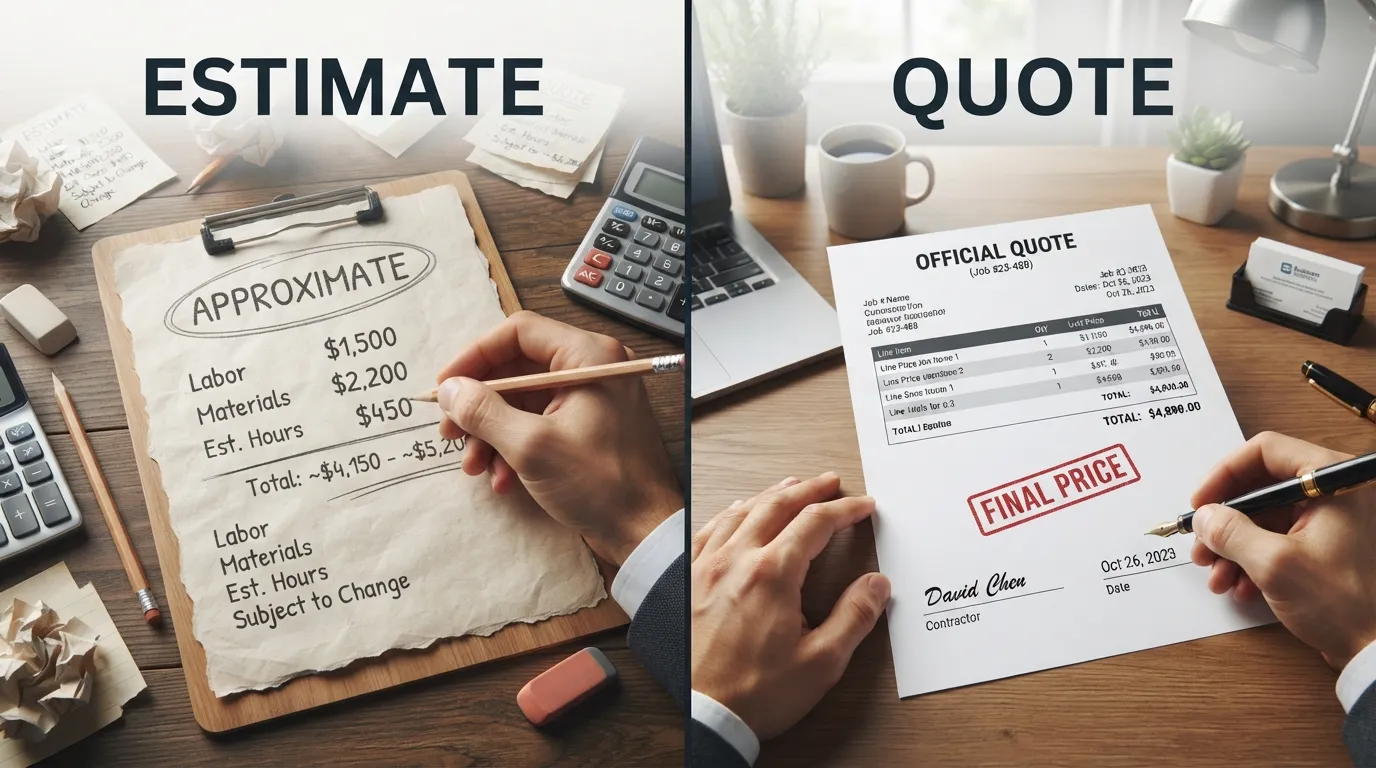
Imagine that your family wants to paint your house. You ask a painter how much the work might cost. The painter looks at the size of the house and says, “It may cost around $1,500.” This is an estimate because the final cost could be higher or lower. Later, the painter measures everything carefully and gives you a written price of $1,650 for the agreed work. This is a quote. Understanding the difference between estimate and quote is important when people buy products or hire services. An estimate gives an expected cost, while a quote usually gives a specific price for clearly described work. In this article, we will explain the difference between estimate and quote in simple words. Learning the difference between estimate and quote can help students, customers, workers, and business owners avoid confusion.
Key Difference Between Estimate and Quote
The main difference is how certain the price is.
- An estimate is an approximate idea of what something may cost.
- A quote is a specific price offered for particular goods or services under stated conditions.
For example, a plumber might estimate that repairing a pipe will cost $100–$150. After inspecting the pipe, the plumber may give a quote of $125 for the agreed repair.
Read more about:https://comparificationn.com/peach-vs-nectarine/
Why Is Their Difference Necessary to Know for Learners and Experts?
Knowing the difference between estimate and quote is useful in everyday life. Students can understand business, mathematics, shopping, and budgeting more easily when they know how these words work.
For customers, the difference can prevent misunderstandings about prices. For business owners and professionals, using the correct word helps them communicate clearly with customers.
In society, people regularly pay for construction, repairs, transportation, education, technology, and other services. A clear understanding of estimates and quotes can help both buyers and sellers make better decisions.
Pronunciation of Estimate and Quote
WordUS PronunciationUK PronunciationEstimate/ˈes.tə.mət/ — ES-tuh-mit (noun)/ˈes.tɪmət/ — ES-ti-mit (noun)Quote/kwoʊt/ — KWOHT/kwəʊt/ — KWOHT
Note: As a verb, estimate is commonly pronounced /ˈes.tə.meɪt/ (“ES-tuh-mate”).
Now that we understand the basic meanings, let’s look at the important differences between these two words.
Difference Between the Keywords
1. Meaning
An estimate is a rough calculation of the expected cost, amount, or value.
Example 1: The builder estimated that the house would cost $50,000 to repair.
Example 2: The mechanic estimated the repair would cost about $300.
A quote is a specific price given for a particular job or product.
Example 1: The mechanic gave us a quote of $320 for the repair.
Example 2: The builder sent a quote for the complete renovation.
2. Level of Accuracy
An estimate is usually less exact.
Example 1: A painter estimates that painting a room may cost $200–$250.
Example 2: A delivery company estimates that a package will arrive in three to five days.
A quote is generally more specific.
Example 1: The painter quotes $225 for painting the room.
Example 2: The company quotes $40 for delivering the package.
3. Certainty
An estimate contains some uncertainty because the final cost may change.
Example 1: A builder estimates that the project will cost $10,000, but unexpected repairs may increase the price.
Example 2: A mechanic estimates a repair at $400, but the cost may rise if another problem is found.
A quote usually provides a clearer price for the work described.
Example 1: The electrician quotes $150 to install the light.
Example 2: The printer quotes $80 for printing 500 invitations.
4. When It Is Usually Given
An estimate is often given early, before all details are known.
Example 1: A customer calls a plumber and receives an estimated repair cost over the phone.
Example 2: A construction company gives an estimated project cost before making detailed plans.
A quote is usually given after the seller has enough information about the requested work.
Example 1: The plumber inspects the bathroom and then gives a quote.
Example 2: A photographer learns the event date and number of hours before giving a quote.
5. Changes in Price
An estimate can easily change when new information becomes available.
Example 1: A mechanic estimates $200, but finds another damaged part that needs replacing.
Example 2: A builder estimates $5,000, but material prices increase during the project.
A quote may have conditions that explain when its price can change.
Example 1: A contractor quotes $2,000 for the job, excluding extra materials requested later.
Example 2: A company gives a quote that is valid for 30 days.
6. Purpose
The main purpose of an estimate is to help someone plan a budget.
Example 1: A family gets an estimate before deciding whether they can afford a kitchen renovation.
Example 2: A student estimates the cost of a school trip before asking their parents for money.
A quote helps a customer decide whether to accept a particular offer.
Example 1: A customer compares three quotes before choosing a contractor.
Example 2: A company accepts a supplier’s quote for office furniture.
7. Written or Verbal
An estimate can be verbal or written.
Example 1: “The repair should cost about $100,” says the mechanic.
Example 2: A company sends a document showing an estimated project cost.
A quote is often provided in writing, especially for business work.
Example 1: The contractor emails a written quote to the customer.
Example 2: A printing company sends a quotation showing the price for an order.
8. Detail
An estimate may contain fewer details because it is an early approximation.
Example 1: “Painting the house may cost around $2,000.”
Example 2: “Roof repairs could cost between $1,000 and $1,500.”
A quote often includes details about what the customer will receive for the stated price.
Example 1: “The quote includes labor, paint, and two coats on all walls.”
Example 2: “The quote includes design, printing, and delivery of 500 cards.”
9. Acceptance
An estimate is generally used as a planning figure rather than a final offer.
Example 1: A customer uses an estimate to decide whether to continue discussing a project.
Example 2: A family uses an estimate to compare different renovation ideas.
A quote can be accepted as an offer, depending on its wording and the applicable contract rules.
Example 1: The customer accepts the company’s quote for website design.
Example 2: The homeowner accepts the contractor’s quote for installing new windows.
Important: Whether a quote is legally binding depends on its terms, the agreement between the parties, and local law.
10. Common Situations
Estimates are common when the final cost is difficult to know at the beginning.
Example 1: A doctor may estimate how long a treatment program could take.
Example 2: A builder may estimate how much a large construction project could cost.
Quotes are common when a customer wants a clear price for a defined product or service.
Example 1: A caterer gives a quote for food for 100 guests.
Example 2: A web designer gives a quote for creating a five-page website.
Difference and Similarity Between Estimate and Quote
| Feature | Estimate | Quote |
| Basic meaning | Approximate cost | Specific offered price |
| Accuracy | Usually less exact | Usually more specific |
| Purpose | Budget planning | Making a purchasing decision |
| Timing | Often early | Usually after details are known |
| Can change? | Yes, quite easily | May have conditions limiting changes |
| Details | May be general | Usually more detailed |
| Format | Verbal or written | Often written |
| Customer acceptance | Usually not a final offer | May be accepted as an offer, depending on terms |
| Common use | Uncertain projects | Clearly defined jobs |
| Similarity | Both help people understand expected cost | Both help people understand expected cost |
Nature and Behaviour of an Estimate
An estimate is flexible and approximate. It is often based on available information, experience, past projects, measurements, or calculations.
An estimate can change because:
- the amount of work changes;
- material costs change;
- unexpected problems appear;
- the original information was incomplete;
- the customer’s requirements change.
Think of an estimate as a best prediction based on what is known at the time.
Nature and Behaviour of a Quote
A quote is more specific. It normally tells a customer how much a defined product or service will cost.
A quote may include:
- price;
- description of the work;
- materials;
- quantity;
- taxes;
- delivery costs;
- payment terms;
- expiration date;
- conditions.
Think of a quote as a clear price offer for specified work or goods.
Why Do People Confuse Their Use?
People confuse these words because both are connected with price predictions.
For example, a customer might ask, “How much will this cost?” A businessperson could respond with either an estimate or a quote, depending on how much information is available.
There is also a difference between everyday and business language. In casual conversations, people sometimes use estimate, quote, price, and quotation as if they mean the same thing.
The safest way to remember them is:
Estimate = approximate price. Quote = specific price for defined work.
Which Is Better in What Situation?
An estimate is better when you only need a rough idea of the cost. For example, if you are thinking about renovating your house but have not decided on the exact materials, an estimate can help you plan your budget. A quote is better when you know exactly what you want and need a clear price before making a decision. For example, if you know the type of tiles, number of rooms, and installation requirements, you can ask a contractor for a quote. In short, use an estimate for early planning and a quote for a defined purchase or service.
How Are Estimate and Quote Used in Metaphors and Similes?
Writers can use these words creatively to explain uncertainty and certainty.
Metaphors
- “An estimate is a roadmap, not a final destination.” This means an estimate helps guide you but may not show the exact final result.
- “A quote is a price tag for a planned job.” This compares a quote to a clear price label.
Similes
- “The estimate was like a rough sketch.” It gives the general idea without showing every detail.
- “The quote was as clear as a price tag.” It suggests that the price was easy to understand.
Connotative Meaning of Estimate
The word estimate is generally neutral.
Positive
“The careful estimate helped the family plan its budget.”
Here, estimate suggests good planning.
Negative
“His careless estimate caused the project to go over budget.”
Here, estimate has a negative result.
Neutral
“The engineer gave an estimate of the total cost.”
Here, the word simply means an approximate calculation.
Connotative Meaning of Quote
Quote is usually neutral, although its meaning can become positive or negative depending on the situation.
Positive
“The company gave us a reasonable quote.”
Here, quote suggests a fair and useful price.
Negative
“The contractor’s quote was much higher than expected.”
Here, quote is connected with an unwanted price.
Neutral
“We received a quote for the new furniture.”
Here, quote simply means a stated price.
Idioms and Proverbs Related to Estimate and Quote
There are not many traditional idioms specifically about estimate and quote, but several common expressions relate to their ideas.
“Don’t count your chickens before they hatch”
This means you should not assume a result before it actually happens.
Example: “Don’t count your chickens before they hatch; the project estimate could still change.”
“Better safe than sorry”
This means it is better to take precautions than face problems later.
Example: “Let’s get a written quote first—better safe than sorry.”
“Get it in writing”
This means you should have an agreement or important information written down.
Example: “The contractor gave us a quote, and we asked to get it in writing.”
“Read the fine print”
This means to carefully read all the small details and conditions.
Example: “Before accepting the quote, read the fine print.”
“A ballpark figure”
This means a rough estimate rather than an exact number.
Example: “Can you give me a ballpark figure for repairing the roof?”
Works in Literature Related to Estimation, Value, and Quotation
- The Merchant of Venice — Play, William Shakespeare, 1596–1598. The work explores money, contracts, value, and agreements.
- Great Expectations — Novel, Charles Dickens, 1861. The story explores expectations, money, social position, and changing fortunes.
- The Wealth of Nations — Economics/philosophy, Adam Smith, 1776. The work discusses value, trade, prices, and economic activity.
- Middlemarch — Novel, George Eliot, 1871–1872. The story explores social choices, money, expectations, and human judgment.
Movies Related to Estimates, Prices, Business, and Quotes
- The Pursuit of Happyness — Biographical drama, 2006, United States. It explores money, work, business opportunities, and financial challenges.
- The Founder — Biographical drama, 2016, United States. It focuses on business, negotiation, contracts, and the growth of a company.
- Moneyball — Sports drama, 2011, United States. It shows how data and calculations can be used to make decisions.
- The Big Short — Comedy-drama, 2015, United States. It explores financial markets, risk, predictions, and economic decisions.
- Jerry Maguire — Sports comedy-drama, 1996, United States. It includes business relationships, negotiations, clients, and professional agreements.
Conclusion
The difference between estimate and quote is mainly about certainty and purpose. An estimate gives an approximate idea of what something may cost, while a quote normally gives a specific price for clearly described goods or services.
A simple memory trick is:
Estimate = “It may cost about this much.” Quote = “This is the price for this specific work.”
Understanding these words can help you become a smarter customer, student, and communicator. When you need a rough idea for planning, ask for an estimate. When you are ready to compare or accept a price for clearly defined work, ask for a quote.

I’m Zahid Abbas, an educator, researcher, and digital publishing strategist with a passion for linguistics, grammar, and clear communication. As a content creator and SEO specialist, I craft research-driven, reader-focused content that empowers learners and makes knowledge accessible worldwide.