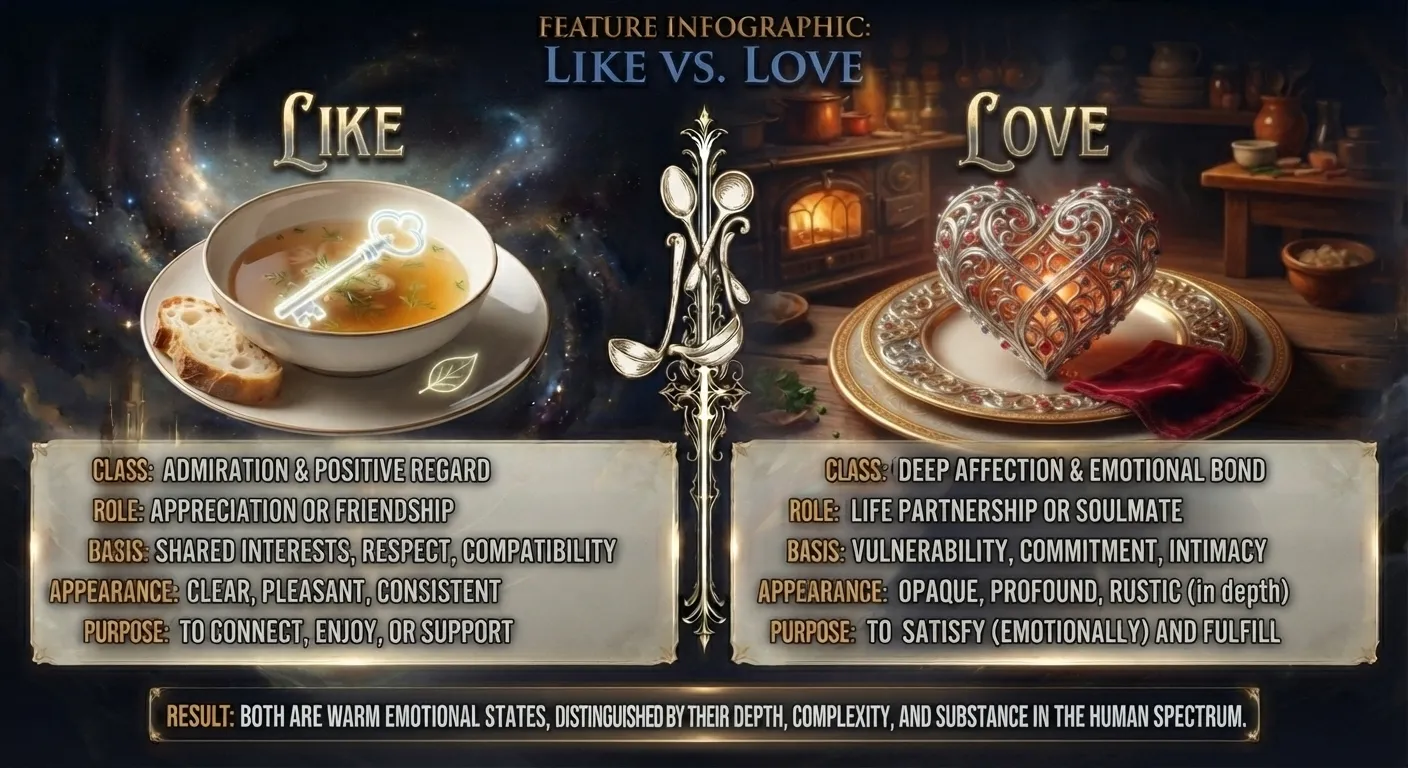
A teen once told his friend that he really liked a girl in his class. His friend asked a simple but tricky question in return: “Do you like her, or do you actually love her?” The teen paused for a long moment and realized he did not know how to answer. This kind of pause happens to almost everyone at some point in their life. Like and love both point toward warm, good feelings, yet they don’t truly mean the same thing at all. The difference between like and love shapes how we treat our friends, our family, and our partners each and every day. Knowing the real gap in like vs love helps us speak with more honesty, and it helps us build ties that actually fit the true depth of how we feel inside.
Key Difference Between Like and Love
The main difference between like and love comes down to depth and time. Like is a light, warm feeling. It can grow fast and fade fast too. Love runs deeper. It tends to grow slow, and it often lasts through hard times, not just good ones. You may like a new song right away, but love takes time, trust, and shared moments to grow strong.
Why This Difference Matters
Knowing like vs love matters for young people, couples, and even close friends. Mixing up the two words can lead to hurt hearts, mixed signals, or choices made too fast. For learners of English, and for anyone who wants to speak with more care, knowing this gap helps them share their true feelings in a clear way. For society, this small bit of knowledge helps build more honest ties between people, since words shape how we treat each other.
Pronunciation
| Word | US | UK |
| Like | “lyk” (rhymes with “bike”) | “lyk” |
| Love | “luv” | “luv” |
Difference Between Like and Love
- Depth of Feeling Like sits on the surface, a light and pleasant feeling. Love runs deep, tied to strong, lasting care. Example 1: You may like a new coworker after one fun chat. Example 2: You may love a close friend after years of trust and shared joy.
- Speed of Growth Like can form fast, often in just a moment. Love tends to grow slow, built over time. Example 1: You can like a stranger’s kind smile right away. Example 2: You may love a partner only after months or years of shared life.
- Effort Involved Like often asks for little effort to keep. Love often asks for real work, care, and time. Example 1: You like a hobby with no real effort, just for fun. Example 2: You love a family member through hard times, which takes real work and care.
- Response to Flaws Like can fade fast once flaws show up. Love often stays strong, even when flaws show up. Example 1: You may stop liking a new show once it gets boring. Example 2: You may still love a sibling, even after a big fight.
- Type of Bond Like often builds a light bond, like a new friendship. Love often builds a deep bond, like family or a close partner. Example 1: You like a new neighbor after a few kind chats. Example 2: You love your best friend after years of shared trust.
- Word Strength Like is a lighter, more common word used in daily talk. Love is a stronger word, often saved for deep, true feelings. Example 1: “I like your shoes” fits daily, light talk. Example 2: “I love you” carries deep weight and true meaning.
- Use with Objects Like fits well with things, like food or a movie. Love can fit both people and things, though it carries more weight with people. Example 1: “I like pizza” feels light and normal. Example 2: “I love my mom” carries deep, true feeling.
- Risk of Loss Losing something you like brings mild upset. Losing someone you love brings deep, real pain. Example 1: You feel mild upset if your liked show gets canceled. Example 2: You feel deep grief if you lose someone you truly love.
- Time Span Like can be short-term, coming and going with mood. Love tends to be long-term, staying steady over time. Example 1: You may like a song for a few weeks, then move on. Example 2: You may love your best friend for your whole life.
- Level of Trust Like does not always need deep trust to exist. Love almost always grows from deep, built-up trust. Example 1: You can like a new coworker without deep trust yet. Example 2: You love a long-time partner built on years of trust.
How They Act
Like: Like acts light and quick, showing up fast and fading fast too. It often stays on the surface, tied to small joys, fun chats, or shared taste.
Love: Love acts deep and steady, growing slow but staying strong. It often stands firm through hard times, tied to trust, care, and years of shared life.
Why People Mix Them Up
People mix up like and love because both point to warm, good feelings, and the line between them can feel blurry at first. Many people also use “love” in a light, joking way, like “I love this pizza,” which blurs its true, deep meaning. Since feelings can grow and shift over time, it’s often hard to know just when a like turns into a true love.
Comparison Table
| Feature | Like | Love |
| Depth | Light | Deep |
| Growth speed | Fast | Slow |
| Effort needed | Little | A lot |
| Response to flaws | Can fade | Often stays strong |
| Bond type | Light bond | Deep bond |
| Word strength | Common, light | Strong, deep |
| Fits with | People and things | People and things, deeper |
| Loss impact | Mild upset | Deep pain |
| Time span | Often short-term | Often long-term |
| Trust level | Not always needed | Almost always present |
Which Fits Which Case?
When “like” fits: If your feeling is new, light, or tied to shared fun or taste, “like” is the right word. It fits new friendships, shared hobbies, or light daily talk, where deep trust and time have not yet built up.
When “love” fits: If your feeling has grown strong over time, tied to deep trust and care, “love” is the right word. It fits close family, long-time friends, and partners, where the bond has grown firm through shared life and hard times.
Metaphors and Similes
- “Love is a flame that never fades” — means love feels lasting and strong.
- “Her like for the hobby grew like a small spark” — means her feeling started small and simple.
- “Love hit him like a wave” — means it felt sudden and strong all at once.
- “Like” shows up in light, daily talk, while “love” tends to shine in poems, songs, and deep, heartfelt talk.
Connotative Meanings
Like:
- Positive: “I really like you” — means warm, friendly feeling.
- Neutral: “I like tea more than coffee” — just states a simple taste.
- Negative (rare): “I don’t really like him” — means mild dislike or distance.
Love:
- Positive: “I love my family” — means deep warmth and care.
- Neutral: “I love how the sun sets tonight” — light use, close to strong liking.
- Negative (rare): “Love can hurt too” — points to the pain that can come with deep care.
Idioms and Proverbs
Both words show up in many well-known sayings:
- “Love at first sight” — “It was love at first sight when they met at the park.”
- “Love conquers all” — “Even through hard times, love conquers all in the end.”
- “Like father, like son” — “He works just like his dad, like father, like son.”
- “Love is blind” — “She stayed with him through his flaws; love is blind.”
Works in Literature
Books that explore love and liking deeply:
- Pride and Prejudice — romance novel, Jane Austen, 1813 (explores the slow growth from dislike to deep love)
- Love in the Time of Cholera — romance novel, Gabriel García Márquez, 1985 (explores love that lasts a lifetime)
- The Notebook — romance novel, Nicholas Sparks, 1996 (explores lasting love through time and memory)
Movies Made on the Theme
- Love Actually — 2003, United Kingdom (explores many forms of love)
- The Notebook — 2004, USA (based on the novel, explores deep, lasting love)
- La La Land — 2016, USA (explores love, dreams, and hard choices)
Five Common Questions
1. Can like turn into love over time? Yes. Many strong loves start as a simple like that grows deeper through shared time, trust, and care.
2. Is it okay to say “I love you” too soon? This shifts by person and case, but many feel it’s wiser to build trust first, since love often needs time to grow true and steady.
3. Can you love someone without liking them? Yes, in some cases. You may love a family member deeply, even if you don’t always like their choices or habits.
4. Why does love last longer than like? Love often builds on deep trust, shared time, and care, which helps it stay strong even through hard times, unlike a light like.
5. Is love always stronger than like? Mostly, yes, though a strong like can still feel warm and real. Love simply tends to run deeper and last longer.
How Both Are Useful
Like and love both help us build strong, warm ties with others. Like helps us find new friends, shared hobbies, and light joy in daily life. Love helps us build deep, lasting bonds that support us through hard times. Together, these two feelings help shape a caring, connected world, where people find joy in both small and deep ties.
Final Words
Like stands for light joy and easy warmth. Love stands for deep care that grows strong over time. Both feelings matter in their own way, and knowing the gap between them helps us speak and act with more truth and care in our ties with others.
Conclusion
Difference between like and love comes down to depth, time, and trust. Like is light, quick, and often tied to shared taste or fun. Love is deep, slow to grow, and tied to real trust and care. Knowing like vs love helps us speak with more honesty and treat others with the care that fits how we truly feel. Whether you’re a teen figuring out new feelings, or simply curious about the words we use each day, understanding like and love gives you a clearer, wiser view of the human heart.

I’m Zahid Abbas, an educator, researcher, and digital publishing strategist with a passion for linguistics, grammar, and clear communication. As a content creator and SEO specialist, I craft research-driven, reader-focused content that empowers learners and makes knowledge accessible worldwide.










