Picture a boy baking cookies with his grandmother from an old family recipe book. The recipe calls for “2 cups of flour” and “350 degrees Fahrenheit.” His friend from another country looks at the recipe and asks, “What’s a cup? We use grams and Celsius back home.” The boy is confused. He always thought cups and degrees were the only way to measure things. His grandmother explains that they’re using the imperial system, while his friend is used to the metric system.
Many people grow up using just one system and don’t realize there’s another one used across most of the world. Learning the difference between metric and imperial helps with cooking, travel, school, and even everyday shopping. The words metric and imperial come up more often than people think, especially when reading labels, recipes, or maps from other countries.
Key Difference Between the Two
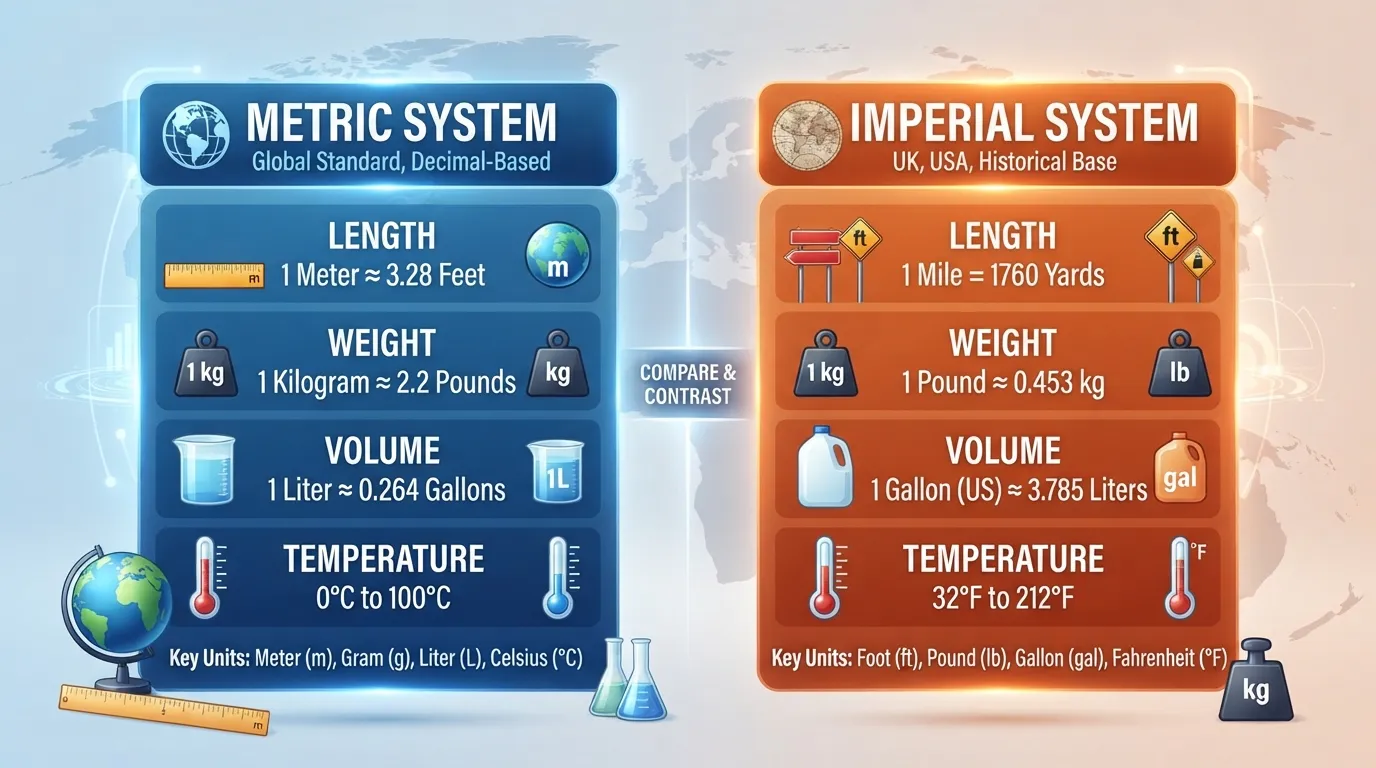
The biggest difference between metric and imperial comes down to how each system is built. The metric system uses units based on multiples of ten, like grams, meters, and liters. The imperial system uses units based on older, less even numbers, like inches, pounds, and gallons. This one difference makes metric easier for quick math, while imperial has stayed common in a few countries due to long tradition.
Why This Difference Matters for Learners and Experts
For everyday people, knowing the difference between metric and imperial helps when reading food labels, following recipes, or understanding weather reports from other countries. For students learning science and math, understanding metric and imperial systems is an important early skill, since most of the world’s science uses metric. For engineers, doctors, and other professionals, knowing the exact difference between metric and imperial can prevent costly or even dangerous mistakes. In a wider sense, this knowledge helps people communicate clearly across countries and industries.
Pronunciation:
- Metric — US: “MEH-trik” | UK: “MEH-trik” (same sound)
- Imperial — US: “im-PEER-ee-ul” | UK: “im-PEER-ee-ul” (same sound)
Difference Between Metric and Imperial
1. Basic Structure The metric system is based on units of ten, making conversions simple. Example: A meter equals 100 centimeters, an easy jump using tens. Example: A kilogram equals 1,000 grams, another clean number. The imperial system uses less even numbers between units. Example: A foot equals 12 inches, not a round number. Example: A gallon equals 4 quarts, which isn’t based on ten either.
2. Length Measurement Metric length is measured in millimeters, centimeters, meters, and kilometers. Example: A pencil might be 15 centimeters long. Example: A road trip might be measured in kilometers. Imperial length is measured in inches, feet, yards, and miles. Example: A pencil might be measured as 6 inches long. Example: A road trip might be measured in miles.
3. Weight Measurement Metric weight is measured in grams, kilograms, and metric tons. Example: A bag of sugar might weigh 500 grams. Example: A car’s weight might be measured in metric tons. Imperial weight is measured in ounces, pounds, and tons. Example: A bag of sugar might weigh about 1 pound. Example: A car’s weight might be measured in tons using the imperial system.
4. Temperature Measurement Metric temperature is measured in Celsius. Example: Water freezes at 0 degrees Celsius. Example: A hot summer day might reach 35 degrees Celsius. Imperial temperature is measured in Fahrenheit. Example: Water freezes at 32 degrees Fahrenheit. Example: A hot summer day might reach 95 degrees Fahrenheit.
5. Volume Measurement Metric volume is measured in milliliters and liters. Example: A soda bottle might hold 500 milliliters. Example: A car’s gas tank might be measured in liters. Imperial volume is measured in fluid ounces, cups, pints, and gallons. Example: A soda bottle might hold 16 fluid ounces. Example: A car’s gas tank might be measured in gallons.
6. Countries That Use Each System Metric is used by nearly every country in the world today. Example: Most of Europe uses metric for everyday measurements. Example: Countries like Japan and Australia rely fully on metric. Imperial is mainly used in the United States, along with a few other places. Example: The US still uses imperial units for most daily measurements. Example: Some countries, like the UK, use a mix of both systems.
7. Ease of Conversion Metric conversions are simple, since everything moves in tens. Example: Converting centimeters to meters just means moving a decimal point. Example: Converting grams to kilograms works the same simple way. Imperial conversions often require more complex math. Example: Converting inches to feet means dividing by 12. Example: Converting ounces to pounds means dividing by 16.
8. Use in Science Metric is the standard system used in scientific research worldwide. Example: Scientists measure chemicals in grams and liters. Example: Lab experiments almost always use metric units for accuracy. Imperial is rarely used in modern scientific work. Example: A science class might briefly mention imperial units for comparison. Example: Most global scientific journals only publish using metric measurements.
9. Historical Origins Imperial units often come from old, everyday references, like body parts or common objects. Example: A “foot” was originally based on the length of a human foot. Example: Many imperial units trace back centuries to old British trade practices. Metric units come from a more modern, planned system created for consistency. Example: The metric system was designed in France in the late 1700s. Example: Metric units were built to be easy to standardize across the world.
10. Everyday Use Metric is used for almost everything in countries that have fully adopted it, from shopping to weather. Example: A grocery store in Germany prices meat by the kilogram. Example: Weather reports in most countries use Celsius. Imperial is still deeply built into daily life in places like the US. Example: American recipes almost always use cups and Fahrenheit. Example: US road signs show distances in miles, not kilometers.
How Each One Behaves
Metric behaves like an organized, simple system, built around clean number patterns that make math and conversions easy.
Imperial behaves like an older, tradition-based system, tied closely to everyday history but often requiring more complex math for conversions.
Why People Get Confused
Most confusion comes from growing up with only one system and rarely using the other in daily life, which makes switching between metric and imperial feel unfamiliar. Many people also don’t realize how many countries fully use metric, since places like the US show imperial units so often in daily life, movies, and media.
Metric vs Imperial: Quick Comparison Table
| Feature | Metric | Imperial |
| Base system | Units of ten | Uneven, older units |
| Length units | Millimeters, meters, kilometers | Inches, feet, miles |
| Weight units | Grams, kilograms | Ounces, pounds, tons |
| Temperature | Celsius | Fahrenheit |
| Volume units | Milliliters, liters | Cups, pints, gallons |
| Used in | Most of the world | Mainly the US |
| Conversion ease | Very easy | Often more complex |
| Used in science | Yes, standard | Rarely |
| Origin | France, late 1700s | Old British traditions |
| Everyday use in US | Rare | Very common |
Which Is Better in What Situation?
For scientific work and global communication: Metric is the better system, since it’s the world standard and much easier to convert.
For everyday US recipes and daily life: Imperial still works well, since it’s deeply built into American habits, tools, and recipes.
For international travel: Understanding metric helps most, since the majority of countries use it for road signs, weather, and shopping.
For traditional trades tied to imperial history: Imperial units remain useful, especially in fields like carpentry in the US, where tools and measurements are built around inches and feet.
Metric and Imperial in Metaphors and Similes
People sometimes describe something very precise and organized as “as neat as the metric system.” Something old-fashioned but familiar might be compared to “sticking to imperial ways,” meaning tied to older habits. Writers sometimes describe global unity through measurement as “the world speaking the same metric language.”
Connotative Meanings
Metric carries a modern, efficient connotation, often linked to logic and global standards. Example: “The new lab switched to metric for cleaner, easier results.”
Imperial carries a traditional, familiar connotation, often linked to comfort and old habits. Example: “Grandma still measures everything in cups and inches, the imperial way she grew up with.”
Idioms and Proverbs Related to Measurement
- “Give an inch, take a mile” — uses imperial units to describe someone pushing for more after getting a little. Example: “He asked for one small favor, but you know how it goes, give an inch, take a mile.”
- “Weigh your options” — a common phrase about thinking carefully before deciding, tied loosely to weight measurement. Example: “Before switching jobs, she took time to weigh her options.”
- “Measure twice, cut once” — a classic saying about being careful and precise, often used in imperial-based carpentry. Example: “He always followed measure twice, cut once before starting a project.”
Works in Literature Featuring Metric and Imperial
Metric and imperial systems are practical topics, so they rarely appear as central themes in classic literature. However, some educational and historical books discuss the systems directly:
- The Measure of All Things — Nonfiction, by Ken Alder, 2002 (explores the creation of the metric system)
- Weights and Measures: Their Ancient Origins — Nonfiction, by Ronald Zupko, 1990 (explores the history of imperial units)
Movies Featuring Metric and Imperial
There are no major movies made specifically about metric or imperial systems, since these are practical, everyday topics rather than dramatic subjects. However, some documentaries touch on measurement history and science:
- The Story of Units — Educational Documentary, various release dates, multiple countries (explores measurement systems in science)
Five Frequently Asked Questions About Metric vs Imperial
1. Why does the US still use imperial units? The US has used imperial units for centuries, and switching fully to metric would require large changes across industries, education, and daily habits.
2. Is metric more accurate than imperial? Metric isn’t necessarily more accurate, but its simple base-ten structure makes it much easier to work with and convert.
3. Do any countries use both systems? Yes. Countries like the UK often use a mix, with road signs in miles but groceries sold in grams and kilograms.
4. Why is metric the standard in science? Metric offers consistent, easy-to-convert units, which makes it ideal for accurate scientific research and global collaboration.
5. Will the US ever fully switch to metric? It’s uncertain. While some efforts to adopt metric have happened over the years, imperial remains deeply built into everyday American life.
How Both Are Useful for Society
Metric and imperial both play useful roles depending on where and how they’re used. Metric supports clear, consistent communication across science, trade, and international travel. Imperial continues to serve everyday life in places like the US, where it’s built into tools, recipes, and long-standing habits. Understanding both systems helps people navigate a world that hasn’t fully settled on just one.
Final Thoughts
Metric stands out as a clean, modern system built for easy math and global use. Imperial stands out as a tradition-rich system, still deeply woven into daily life in a handful of countries. Both continue to shape how people measure the world around them.
Conclusion
Difference between metric and imperial isn’t just a matter of numbers — it shapes how people cook, build, travel, and understand the world around them. Whether you’re reading a recipe, checking the weather, or studying science, understanding metric and imperial gives you a clearer picture of how measurement works across different places. Next time you see a measurement, you’ll know exactly which system you’re looking at.

I’m Zahid Abbas, an educator, researcher, and digital publishing strategist with a passion for linguistics, grammar, and clear communication. As a content creator and SEO specialist, I craft research-driven, reader-focused content that empowers learners and makes knowledge accessible worldwide.