Look at the night sky and you may see many objects moving through space. Some are planets, while others are small bodies called asteroids and comets. At first, they may look similar, but they are quite different.
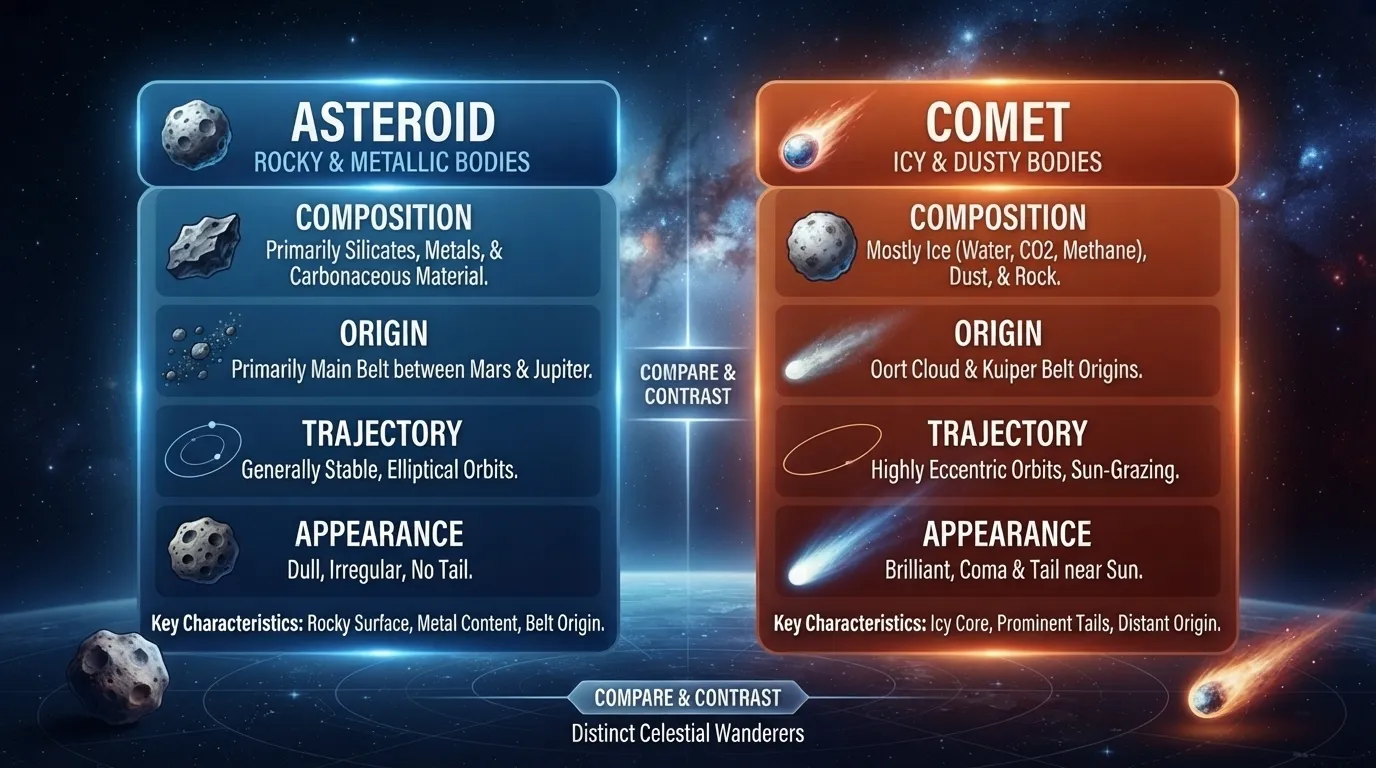
The difference between asteroid and comet is mainly about what they are made of and how they behave. An asteroid is mostly made of rock and metal. A comet contains ice, dust, and rock. When a comet comes close to the Sun, its ice can turn into gas and form a bright cloud and tail. An asteroid usually does not have this tail.
Knowing the difference between asteroid and comet helps students understand space more easily. It also helps us understand news about objects that pass near Earth. In this article, we will explain the difference between asteroid and comet in simple words.
Key Difference Between an Asteroid and a Comet
The main difference is their material.
- Asteroids are mostly rock and metal.
- Comets are made of ice, dust, and rock.
- Asteroids usually do not have tails.
- Comets can form a bright tail when they get close to the Sun.
Why Is Their Difference Important?
Learning the difference is useful for students, teachers, and space scientists. It helps us understand how the Solar System was formed.
Scientists also watch some asteroids and comets because their paths can bring them close to Earth. Knowing what these objects are helps people understand space news correctly.
Pronunciation of Asteroid and Comet
Asteroid
- US: AS-tuh-royd
- UK: AS-tuh-royd
Comet
- US: KOM-it
- UK: KOM-it
Now let us look at the main differences one by one.
Difference Between Asteroid and Comet
1. Composition
Asteroid
An asteroid is mainly made of rock and metal.
Examples:
- Some asteroids contain iron and nickel.
- Others contain dark, carbon-rich materials.
Comet
A comet contains ice, dust, and rock.
Examples:
- A comet may contain frozen water.
- Its ice can turn into gas near the Sun.
2. Appearance
Asteroid
Asteroids often look like dark, rocky objects. They can have craters and uneven surfaces.
Examples:
- An asteroid may look like a large space rock.
- Some have rough and rocky surfaces.
Comet
A comet can look very different when it gets close to the Sun.
Examples:
- It can form a bright cloud called a coma.
- It can develop a long tail.
3. Tail
Asteroid
Most asteroids do not have a tail.
Examples:
- A rocky asteroid can travel near the Sun without a tail.
- A near-Earth asteroid usually looks like a solid object.
Comet
A comet can form a tail when sunlight heats it.
Examples:
- Dust can form a dust tail.
- Gas can form an ion tail.
4. Location
Asteroid
Many asteroids are found in the asteroid belt between Mars and Jupiter.
Examples:
- Ceres is in the main asteroid belt.
- Some asteroids have paths that bring them close to Earth.
Comet
Many comets come from the colder, outer parts of the Solar System.
Examples:
- Some short-period comets are linked to the Kuiper Belt.
- Long-period comets may come from the distant Oort Cloud.
5. Orbit
Asteroid
Many asteroids have fairly regular paths around the Sun.
Examples:
- An asteroid can travel around the Sun again and again.
- Some near-Earth asteroids cross Earth’s orbital area.
Comet
Comets often have long and stretched-out orbits.
Examples:
- A comet may spend many years far from the Sun.
- It may return to the inner Solar System after a long time.
6. Behavior Near the Sun
Asteroid
Most asteroids do not change much when they move near the Sun.
Examples:
- A rocky asteroid may stay dry and solid.
- It normally does not produce a large coma.
Comet
A comet becomes more active when it gets close to the Sun.
Examples:
- Heat can turn its ice into gas.
- Gas and dust can form a coma and tail.
7. Size
Asteroid
Asteroids can be very small or hundreds of kilometers wide.
Examples:
- Some are only a few meters across.
- Ceres is hundreds of kilometers wide.
Comet
The solid center of a comet, called its nucleus, is usually much smaller.
Examples:
- A comet nucleus may be several kilometers wide.
- Its tail can stretch much farther than its nucleus.
8. Surface
Asteroid
Asteroids can have rocky, dusty, and cratered surfaces.
Examples:
- Some have large impact craters.
- Others are covered with loose rocks and dust.
Comet
A comet’s nucleus can have a dark and dusty surface with ice below or inside it.
Examples:
- Sunlight can slowly remove ice from its surface.
- Gas and dust can escape from active areas.
9. Connection With Earth
Asteroid
Some asteroids pass close to Earth, so scientists track them.
Examples:
- Telescopes can track near-Earth asteroids.
- Scientists can calculate their future paths.
Comet
Comets can also enter the inner Solar System and come near Earth’s orbital area.
Examples:
- A comet can arrive from a distant part of the Solar System.
- It can pass close to the Sun and become bright.
10. Scientific Importance
Asteroid
Asteroids help scientists study the early Solar System.
Examples:
- Asteroid samples can show ancient minerals.
- Their surfaces can tell us how small space bodies change.
Comet
Comets also contain old material from the early Solar System.
Examples:
- Scientists study comet dust.
- Comet ice and gas can give clues about the early Solar System.
Nature and Behaviour of Asteroids
Asteroids are mostly solid bodies that travel around the Sun. They can be made of rock, metal, or a mixture of different materials.
Most asteroids do not have a coma or tail. Some asteroids can collide with other objects or change their paths because of gravity.
Nature and Behaviour of Comets
Comets are icy bodies made of ice, dust, and rock. They can spend a long time far from the Sun.
When a comet comes closer to the Sun, heat causes some of its ice to turn into gas. The gas and dust can create a coma and tail.
A comet’s tail usually points away from the Sun because of sunlight and the solar wind.
Why Are People Confused About Them?
People often confuse asteroids and comets because both are small objects that travel around the Sun.
The easiest way to remember the difference is:
Asteroid = mostly rock and metal.
Comet = ice, dust, and rock.
A comet can form a tail when it gets close to the Sun, while an asteroid normally does not.
Asteroid vs Comet: Difference and Similarity
| Feature | Asteroid | Comet |
| Main material | Rock and metal | Ice, dust, and rock |
| Tail | Usually no | Can have one |
| Coma | Usually no | Can form one |
| Common location | Asteroid belt and other areas | Outer Solar System and other orbits |
| Orbit | Often less stretched | Often more stretched |
| Activity near Sun | Usually low | Often high |
| Both orbit the Sun? | Yes | Yes |
| Both are old Solar System bodies? | Yes | Yes |
Which Is Better in What Situation?
Asteroid
An asteroid is useful to study when scientists want to learn about rocks and metals from the early Solar System. Asteroids are also important when scientists watch objects that may come close to Earth. Space missions can study their surfaces and materials. Asteroids can help scientists understand how planets were built from smaller bodies.
Comet
A comet is useful when scientists want to study ice, dust, and other old materials from the early Solar System. Comets become active near the Sun, making them easier to study. Their gas and dust can tell scientists about the materials that existed when the Solar System was young.
Asteroid and Comet in Metaphors and Similes
These words can also be used in creative writing.
- “Like an asteroid” can describe something hard or distant.
- “Like a comet” can describe someone who becomes famous very quickly.
- Example: “The young player rose like a comet.”
- Example: “The rock moved through the sky like an asteroid.”
Connotative Meaning of Asteroid and Comet
Asteroid
Asteroid usually has a neutral meaning.
- Positive: “The asteroid became an important science target.”
- Negative: “Scientists were watching an asteroid near Earth.”
- Neutral: “The spacecraft studied the asteroid.”
Comet
Comet also has a mostly neutral meaning. In creative writing, it can suggest beauty or sudden success.
- Positive: “The comet looked beautiful in the night sky.”
- Negative: “The comet caused public concern.”
- Neutral: “Scientists studied the comet.”
Idioms and Proverbs
There are no common English proverbs specifically about asteroids. The word comet can sometimes be used creatively to describe a fast rise.
Example:
“She rose like a comet and became famous very quickly.”
Another common expression is “once in a blue moon.” It means something happens very rarely.
Example:
“We see such a rare space event only once in a blue moon.”
Asteroids and Comets in Literature
- The Star — short story, science fiction, H. G. Wells, 1897.
- The Comet — short story, speculative fiction, W. E. B. Du Bois, 1920.
- The Star — short story, science fiction, Arthur C. Clarke, 1955.
Movies Related to Asteroids and Comets
- Deep Impact — 1998, United States. It is about a comet threatening Earth.
- Armageddon — 1998, United States. It is about an asteroid threat.
- Don’t Look Up — 2021, United States. It features a comet heading toward Earth.
Final Thoughts
Difference between asteroid and comet is easy to understand. Asteroids are mainly made of rock and metal, while comets contain ice, dust, and rock. Comets can form a bright coma and tail when they get close to the Sun. Asteroids usually do not.
Both are important because they contain clues about the history of our Solar System. Once you remember “asteroid = rock and metal” and “comet = ice, dust, and rock,” the difference becomes much easier to remember.

I’m Zahid Abbas, an educator, researcher, and digital publishing strategist with a passion for linguistics, grammar, and clear communication. As a content creator and SEO specialist, I craft research-driven, reader-focused content that empowers learners and makes knowledge accessible worldwide.










