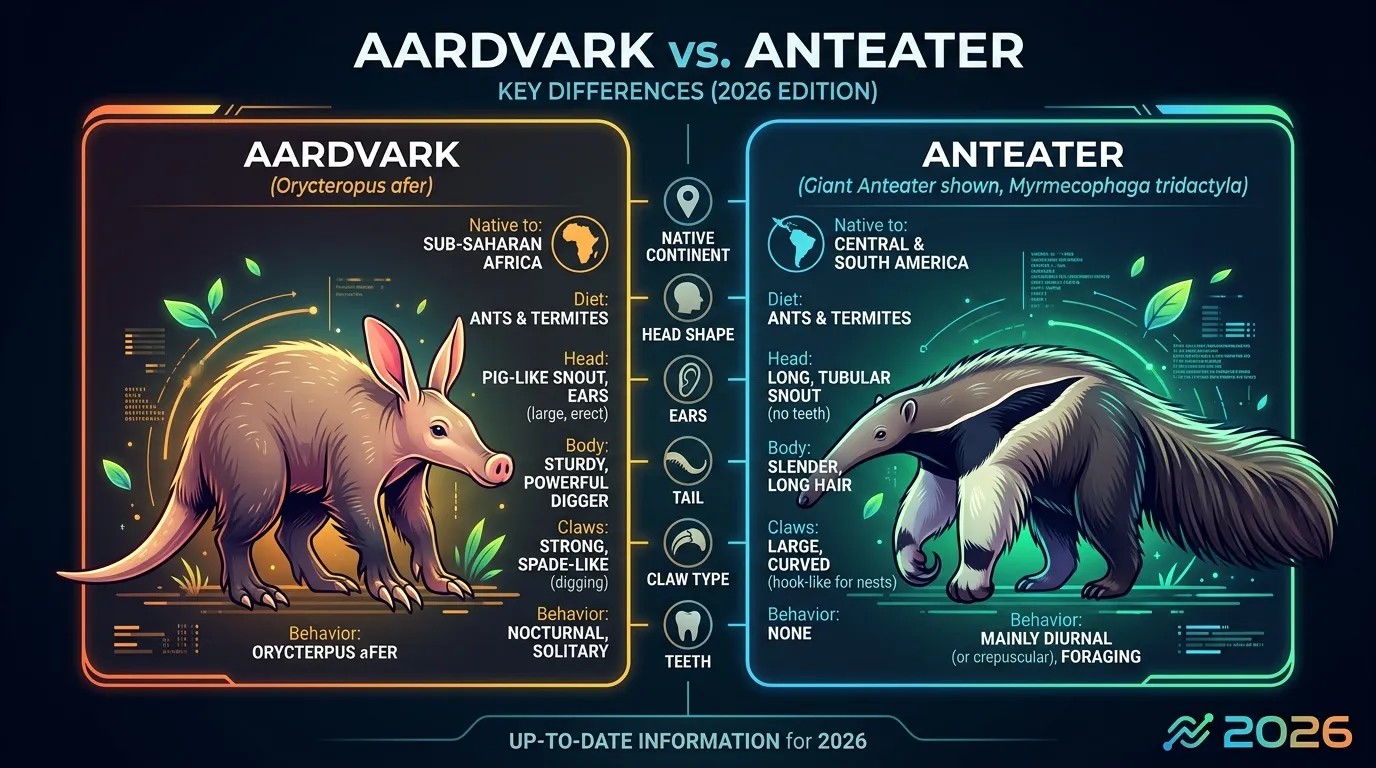


A child visited a zoo and saw two strange animals with long noses. One was called an aardvark. The other was an anteater. They looked similar, so the child thought they were the same animal.
Many people make this mistake. The difference between aardvark and anteater is not obvious at first. Both animals eat ants and termites. Both have long snouts and strong claws. But they are very different animals.
Understanding the difference between aardvark and anteater is useful for students, animal lovers, and English learners. It helps you learn correct animal names and understand how animals are grouped in science.
In this guide, you will learn what aardvarks and anteaters are, how they differ, and which animal is found in which part of the world.
What is “aardvark”?
An aardvark is a mammal that eats ants and termites. It has a long nose, big ears, strong claws, and a thick tail. Aardvarks live mainly in Africa.
History of the word aardvark
The word aardvark comes from the Afrikaans language spoken in South Africa. It means “earth pig.” People gave it this name because the animal digs in the ground and has a pig-like snout. Aardvarks have lived in Africa for millions of years and are the only living members of their scientific family.
What is “anteater”?
An anteater is a mammal that eats ants and termites. It has a very long snout, a sticky tongue, strong claws, and a bushy tail. Anteaters live mainly in Central and South America.
History of the word anteater
The word anteater is a simple English name that describes what the animal eats: ants. Anteaters are part of a group of animals native to the Americas. There are several types, including the giant anteater, silky anteater, and tamandua.
Aardvark vs Anteater
Aardvark: An African mammal with big ears and a thick tail.
Anteater: An American mammal with a very long snout and a bushy tail.
Both animals eat insects, but they belong to different animal groups and live in different parts of the world. Let’s look at the main differences in detail.
How “aardvark” Works
Key Features
- Lives in Africa
- Has large ears
- Has a thick, muscular tail
- Digs deep burrows
- Eats ants and termites
Examples
- 🔵 The aardvark used its claws to dig for termites.
- 🔵 An aardvark sleeps in a burrow during the day.
Uses
- Studied in biology and zoology
- Found in African wildlife education
- Discussed in animal documentaries
- Compared with other insect-eating mammals
How “anteater” Works
Key Features
- Lives in Central and South America
- Has a very long snout
- Has a sticky tongue
- Has a bushy tail
- Eats ants and termites
Examples
- 🟢 The giant anteater used its tongue to catch ants.
- 🟢 An anteater walks slowly through the forest looking for food.
Uses
- Studied in zoology and ecology
- Featured in wildlife programs
- Used in discussions about South American animals
- Compared with other insect-eating mammals
Which one should you use?
Use aardvark when talking about the African animal with big ears and a thick tail.
Use anteater when talking about the American animal with a very long snout and a bushy tail.
10 Differences Between aardvark and anteater
1. Home Region
Aardvark Meaning
Lives mainly in Africa.
- 🔴 Aardvarks are common in sub-Saharan Africa.
- 🔴 An aardvark lives in African grasslands and forests.
Anteater Meaning
Lives mainly in Central and South America.
- 🔴 Giant anteaters live in South America.
- 🔴 Tamanduas are found in Central America.
2. Ears
Aardvark Meaning
Has large, upright ears.
- 🔴 An aardvark’s ears help it hear insects underground.
- 🔴 The aardvark has ears that look like rabbit ears.
Anteater Meaning
Has small ears that are less noticeable.
- 🔴 An anteater’s ears are much smaller than an aardvark’s.
- 🔴 The giant anteater has tiny ears hidden in its fur.
3. Tail
Aardvark Meaning
Has a thick, muscular tail.
- 🔴 The aardvark’s tail is heavy and strong.
- 🔴 An aardvark uses its tail for balance while digging.
Anteater Meaning
Has a long, bushy tail.
- 🔴 The giant anteater has a tail covered in long fur.
- 🔴 A tamandua can use its tail to hold onto branches.
4. Nose Shape
Aardvark Meaning
Has a shorter, pig-like snout.
- 🔴 The aardvark’s nose is broad and rounded.
- 🔴 Its snout helps it smell termites underground.
Anteater Meaning
Has a very long, tube-shaped snout.
- 🔴 The anteater’s snout is narrow and long.
- 🔴 Its snout is perfect for reaching into ant nests.
5. Tongue
Aardvark Meaning
Has a long sticky tongue, but it is shorter than an anteater’s.
- 🔴 The aardvark uses its tongue to catch termites.
- 🔴 Its tongue is sticky and flexible.
Anteater Meaning
Has an extremely long sticky tongue.
- 🔴 A giant anteater’s tongue can reach deep into ant nests.
- 🔴 The tongue moves quickly to catch insects.
6. Fur
Aardvark Meaning
Has sparse, rough fur.
- 🔴 An aardvark’s skin and fur look rough.
- 🔴 Its fur is not very thick.
Anteater Meaning
Has thicker and often longer fur.
- 🔴 The giant anteater has long shaggy fur.
- 🔴 Some anteaters have soft, thick coats.
7. Scientific Group
Aardvark Meaning
Belongs to its own unique scientific family.
- 🔴 The aardvark is the only living member of its order.
- 🔴 Scientists consider it a very unique mammal.
Anteater Meaning
Belongs to the anteater family in the Americas.
- 🔴 Giant anteaters and tamanduas are related.
- 🔴 Anteaters are part of a larger group of American mammals.
8. Burrows and Climbing
Aardvark Meaning
Famous for digging deep burrows.
- 🔴 Aardvarks create large underground homes.
- 🔴 Many other animals use abandoned aardvark burrows.
Anteater Meaning
Some species can climb trees.
- 🔴 Tamanduas spend time in trees.
- 🔴 Giant anteaters mostly stay on the ground.
9. Size
Aardvark Meaning
Usually medium-sized with a sturdy body.
- 🔴 An aardvark has a heavy, compact build.
- 🔴 It is shorter and stockier than a giant anteater.
Anteater Meaning
Size varies by species, and the giant anteater is very large.
- 🔴 The giant anteater can be over six feet long including its tail.
- 🔴 Silky anteaters are much smaller and tree-dwelling.
10. Appearance
Aardvark Meaning
Looks more like a pig or rabbit with big ears.
- 🔴 The aardvark has a rounded body and large ears.
- 🔴 Its appearance is unusual but sturdy.
Anteater Meaning
Looks more like a long-snouted, furry animal.
- 🔴 The giant anteater has a long face and shaggy tail.
- 🔴 Its body is covered with distinctive fur patterns.
Why People Get Confused About Their Use
People get confused because both animals eat ants and termites. Both have long noses, strong claws, and similar feeding habits. Their names also sound related because both are associated with ants. However, they are different animals from different parts of the world and different scientific groups.
Table: Difference and Similarity
| Feature | Aardvark | Anteater | Similarity |
|---|---|---|---|
| Region | Africa | Central & South America | Both live in warm regions |
| Diet | Ants and termites | Ants and termites | Both eat insects |
| Ears | Large and upright | Small and less visible | Both use hearing to find food |
| Tail | Thick and muscular | Long and bushy | Both use tails for balance |
| Snout | Shorter and pig-like | Very long and tube-shaped | Both have long noses |
| Claws | Strong digging claws | Strong digging claws | Both dig for food |
| Fur | Rough and sparse | Thick and often shaggy | Both are mammals |
| Scientific Group | Unique family | Anteater family | Both are insect-eating mammals |
Which is Better in What Situation?
Aardvark
Aardvarks are better examples when learning about African wildlife and burrowing animals. They are also useful for studying unique mammal groups because they belong to their own special scientific family.
Anteater
Anteaters are better examples when learning about South American wildlife and animals with specialized feeding adaptations. Their long tongues and climbing abilities make them interesting examples of insect-eating mammals.
How Are “aardvark” and “anteater” Used in Metaphors and Similes?
- 🟣 “As curious as an aardvark” – used for someone who explores or digs for answers.
- 🟣 “Like an anteater searching for ants” – used for someone carefully looking for small details.
- 🟣 “An aardvark nose for trouble” – means being good at finding hidden problems.
- 🟣 “Slow and steady like an anteater” – describes calm and patient behavior.
Connotative Meaning
Aardvark
- 🟣 Positive: Curious, hardworking, unique
- 🟣 Neutral: Burrowing animal
- 🟣 Example: “The aardvark is a unique animal found in Africa.”
Anteater
- 🟣 Positive: Patient, specialized, interesting
- 🟣 Neutral: Insect-eating mammal
- 🟣 Example: “The anteater is famous for its long sticky tongue.”
Idioms or Proverbs
There are no common English idioms that specifically use aardvark or anteater.
However, related expressions include:
- 🟣 “Nose to the ground” – means searching carefully.
- 🟣 Example: “The detective kept his nose to the ground like an aardvark looking for food.”
Works in Literature
- 🟣 Arthur’s Nose — Marc Brown (1976)
- 🟣 Aardvarks, Disembark! — Ann Jonas (1990)
- 🟣 Anteaters Don’t Dream — Alyssa Satin Capucilli (1998)
Movies Related to the Keywords
- 🟣 The Ant Bully (2006, USA)
- 🟣 Arthur’s Perfect Christmas (2000, USA)
- 🟣 Rio 2 (2014, USA) – features South American wildlife, including anteater-like animals.
Possible Questions
1. Is an aardvark the same as an anteater?
No. They are different animals from different parts of the world.
2. Which animal lives in Africa?
The aardvark lives in Africa.
3. Which animal lives in South America?
The anteater lives in Central and South America.
4. Do both animals eat ants?
Yes. Both animals mainly eat ants and termites.
5. Which animal has bigger ears?
The aardvark has much larger ears than the anteater.
Final Words
Aardvarks and anteaters may look alike at first, but they are very different animals. Learning about them helps you understand wildlife, geography, and animal science better. Keep exploring the animal world with curiosity and confidence.
Conclusion
The difference between aardvark and anteater is mainly about where they live, how they look, and their scientific groups. Aardvarks are African animals with big ears and thick tails. Anteaters are American animals with very long snouts and bushy tails. Both eat ants and termites, which is why people often confuse them. However, they are separate animals with unique features and behaviors. By understanding the difference between aardvark and anteater, you can use the correct names and better understand these fascinating insect-eating mammals.

I’m Zahid Abbas, an educator, researcher, and digital publishing strategist with a passion for linguistics, grammar, and clear communication. As a content creator and SEO specialist, I craft research-driven, reader-focused content that empowers learners and makes knowledge accessible worldwide.










