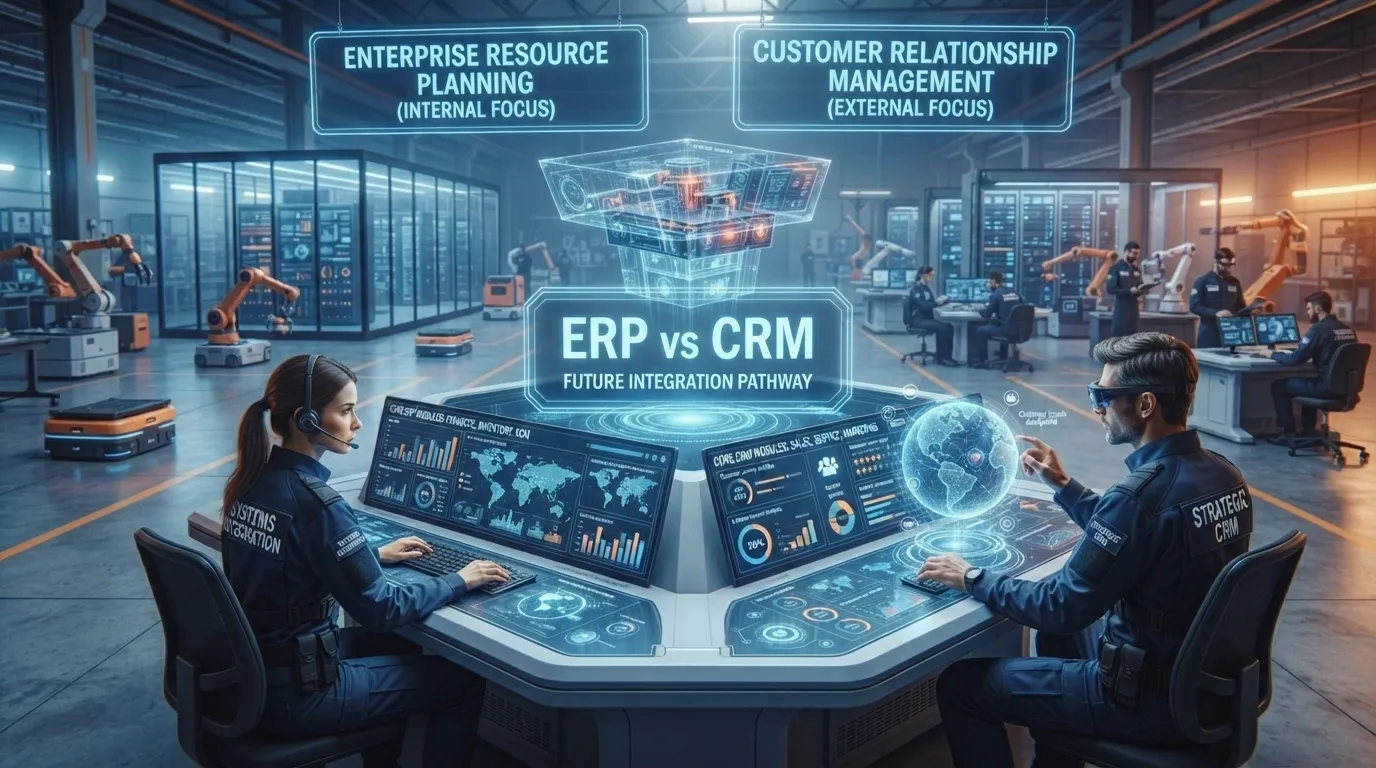
A small shop owner once told her friend that she had bought new software, yet sales still felt messy and her stock counts were still off. Her friend asked a simple question: “Did you get an ERP system or a CRM system?” She paused for a moment and admitted that she did not know the difference between the two. This kind of mix-up happens often in the business world. Both ERP and CRM are software tools that are meant to help firms run more smoothly. However, the difference between ERP and CRM is actually quite large, and understanding it truly matters. Knowing the real gap between ERP vs CRM can help a firm choose the right tool, avoid wasted money, and grow with far less stress along the way.
Key Difference Between ERP and CRM
The core difference between ERP and CRM lies in what each tool tracks. ERP, or Enterprise Resource Planning, manages the whole firm — money, stock, staff, and more. CRM, or Customer Relationship Management, tracks just one thing: how a firm talks to and sells to its buyers. Think of ERP as the brain of the whole firm, and CRM as the friendly voice that talks to buyers.
Why This Difference Matters
Knowing ERP vs CRM helps firm owners, staff, and tech experts pick the right tool for the right job. Many small firms waste money on the wrong tool, or buy both when they only need one. For the wider world of trade and jobs, this knowledge helps firms run with less waste, serve buyers with more care, and grow in a smart way. This is why the topic is taught in business schools and used in real firms each day.
Read more about https://comparificationn.com/difference-between-wants-and-needs/
Pronunciation
| Word | US | UK |
| ERP | “E-R-P” (say each letter) | “E-R-P” (say each letter) |
| CRM | “C-R-M” (say each letter) | “C-R-M” (say each letter) |
Difference Between ERP and CRM
- Main Goal ERP aims to run the whole firm well. CRM aims to build strong ties with buyers. Example 1: An ERP tool tracks stock, pay, and staff hours in one place. Example 2: A CRM tool tracks each buyer’s past deals and likes.
- Who Uses It ERP gets used by many teams, like finance and shipping. CRM gets used mostly by sales and support staff. Example 1: A finance team logs bills and pay through the ERP. Example 2: A sales rep checks a buyer’s past chats through the CRM.
- Data Tracked ERP tracks firm-wide data like cash flow and stock. CRM tracks buyer data like contact facts and sales chats. Example 1: An ERP shows how much stock is left in a warehouse. Example 2: A CRM shows when a buyer last called for help.
- Scope ERP has a wide scope that covers the whole firm. CRM has a narrow scope that covers just sales and buyer care. Example 1: An ERP links shipping, pay, and stock into one view. Example 2: A CRM links just the sales team’s calls and emails.
- End Goal ERP aims to cut costs and boost how well the firm runs. CRM aims to boost sales and keep buyers happy. Example 1: A firm uses ERP to spot waste in its stock room. Example 2: A firm uses CRM to spot which buyers may leave soon.
- Data Flow ERP data flows across many teams and tasks. CRM data flows mostly between sales staff and buyers. Example 1: Stock data from ERP feeds into the shipping team’s plan. Example 2: Buyer notes in CRM feed into the next sales call.
- Type of Firm That Needs It Firms with complex stock, staff, or cash needs lean on ERP. Firms that sell a lot and need to track buyers lean on CRM. Example 1: A large factory needs ERP to track parts and staff shifts. Example 2: A small sales team needs CRM to track leads and deals.
- Cost and Setup Time ERP tools tend to cost more and take longer to set up. CRM tools tend to cost less and set up faster. Example 1: A big firm may spend months to set up its ERP system. Example 2: A small firm may set up a CRM tool in just a few days.
- Report Type ERP gives reports on the firm’s health, like cash and stock. CRM gives reports on sales, like deals closed and buyer trends. Example 1: An ERP report shows the firm spent too much on shipping this month. Example 2: A CRM report shows which sales rep closed the most deals.
- Link to Buyers ERP touches buyers in a small, back-end way, like billing. CRM touches buyers in a close, front-end way, like calls and emails. Example 1: ERP sends a bill to a buyer after a sale. Example 2: CRM reminds a sales rep to call a buyer back.
How They Act
ERP: ERP acts like the back office of a firm. It works behind the scenes, linking money, stock, and staff data so the whole firm runs in step.
CRM: CRM acts like the front desk of a firm. It works in the open, helping staff talk to buyers, track deals, and keep buyers happy and loyal.
Why People Mix Them Up
People mix up ERP and CRM because both are firm software, both track data, and both aim to help a firm run well. Many firms use both tools at once, and some tools even blend features from each. This overlap makes it hard for new staff or small firm owners to see where one tool ends and the other starts.
Comparison Table
| Feature | ERP | CRM |
| Full name | Enterprise Resource Planning | Customer Relationship Management |
| Main goal | Run whole firm well | Build buyer ties |
| Main users | Finance, stock, staff teams | Sales and support teams |
| Data type | Firm-wide data | Buyer data |
| Scope | Wide | Narrow |
| Cost | Often higher | Often lower |
| Setup time | Longer | Shorter |
| Report focus | Firm health | Sales and buyer trends |
| Buyer contact | Indirect (billing) | Direct (calls, emails) |
| Goal shared | Help the firm grow | Help the firm grow |
Which Fits Which Case?
When ERP fits: If a firm has many moving parts — stock, staff, cash, and shipping — and needs one system to link it all, ERP is the right choice. Large firms and factories with complex needs gain the most from ERP’s wide reach.
When CRM fits: If a firm’s main goal is to sell more and keep buyers happy, CRM fits best. Small sales teams, shops, and service firms that talk to buyers often will get more value from a CRM tool than a full ERP system.
Metaphors and Similes
- “The ERP system is the backbone of the firm” — means it holds everything up and in place.
- “Their CRM works like a friendly memory” — means it recalls buyer facts with ease.
- “Sales grew like wildfire once the CRM was in place” — means sales spread fast.
- These terms are new, tech-based words, so they show up in metaphors mostly within business talk, not in daily speech.
Connotative Meanings
ERP:
- Positive: “Our ERP saved us so much time” — means it helped a lot.
- Neutral: “The firm runs its ERP each night for reports” — just states a fact.
- Negative (rare): “The ERP rollout was a mess” — means it caused stress or trouble.
CRM:
- Positive: “The CRM helped us keep our best buyers” — means it brought good results.
- Neutral: “Sales staff log calls in the CRM” — just states a fact.
- Negative (rare): “No one updates the CRM, so it’s useless” — means it’s not being used well.
Idioms and Proverbs
ERP and CRM are modern tech terms, so no idioms or old proverbs exist for them. That said, they connect well to common business sayings:
- “Time is money” — “A good ERP saves time, and time is money.”
- “The customer is always right” — “A strong CRM helps staff live by the idea that the customer is always right.”
Books and Movies
ERP and CRM are business tools, not story topics, so they rarely show up by name in books or films. A few works do touch on the wider world of business systems:
- The Goal — business novel, Eliyahu M. Goldratt, 1984 (touches on firm-wide systems, close to ERP ideas)
- Death by Meeting — business book, Patrick Lencioni, 2004 (touches on how firms run and share data)
No known films are built around ERP or CRM software directly, since these are back-office business tools, not common story themes.
Five Common Questions
1. Can a firm use ERP and CRM at the same time? Yes. Many firms use both, since ERP runs the back office while CRM runs the front-end sales work. They often link up to share data.
2. Which costs more, ERP or CRM? ERP often costs more, since it covers more parts of a firm and takes longer to set up.
3. Do small firms need ERP? Not always. Many small firms start with just a CRM and only add ERP once their stock or staff needs grow complex.
4. Is CRM only for sales teams? Mostly, yes. But support and marketing teams also use CRM to track buyer needs and past chats.
5. Can ERP replace CRM? Some ERP tools have basic CRM features, but they often lack the depth a true CRM gives for sales and buyer care.
How Both Help Us
ERP and CRM help firms run with less waste and serve buyers with more care. ERP cuts down on lost stock, late pay, and staff mix-ups. CRM helps firms keep loyal buyers and grow sales through better care and follow-up. Together, they help build firms that run well and treat buyers with respect, which helps the wider trade world grow stronger.
Final Words
ERP stands for order and control across a whole firm. CRM stands for care and connection with each buyer. Both tools serve a firm in their own way, and knowing when to use each one can shape how well a firm runs and grows.
Conclusion
The difference between ERP and CRM comes down to scope and goal. ERP runs the whole firm’s back office, while CRM builds strong ties with buyers on the front end. Both tools help a firm grow, but they solve very different problems. Knowing ERP vs CRM helps firm owners pick the right tool, save money, and avoid costly mix-ups. Whether you run a small shop or study business in school, understanding ERP and CRM gives you a clear view of how modern firms stay strong and grow with care.

I’m Zahid Abbas, an educator, researcher, and digital publishing strategist with a passion for linguistics, grammar, and clear communication. As a content creator and SEO specialist, I craft research-driven, reader-focused content that empowers learners and makes knowledge accessible worldwide.