Last week, Ali had a headache. He went to a pharmacy and got medicine. When he looked at the box, he saw capsules and tablets. He wondered if they were the same. Many people ask this question every day.
The difference between capsule and tablet is important because both are common forms of medicine. Knowing the difference between capsule and tablet helps you choose and use medicines correctly. Doctors and pharmacists often prescribe both, but they work in slightly different ways.
Some medicines come in a hard shell, while others are pressed into a solid shape. Although both help treat illness, they have different features, uses, and benefits. This guide explains everything in simple words so that beginners, students, and English learners can understand easily.
What is “Capsule”?
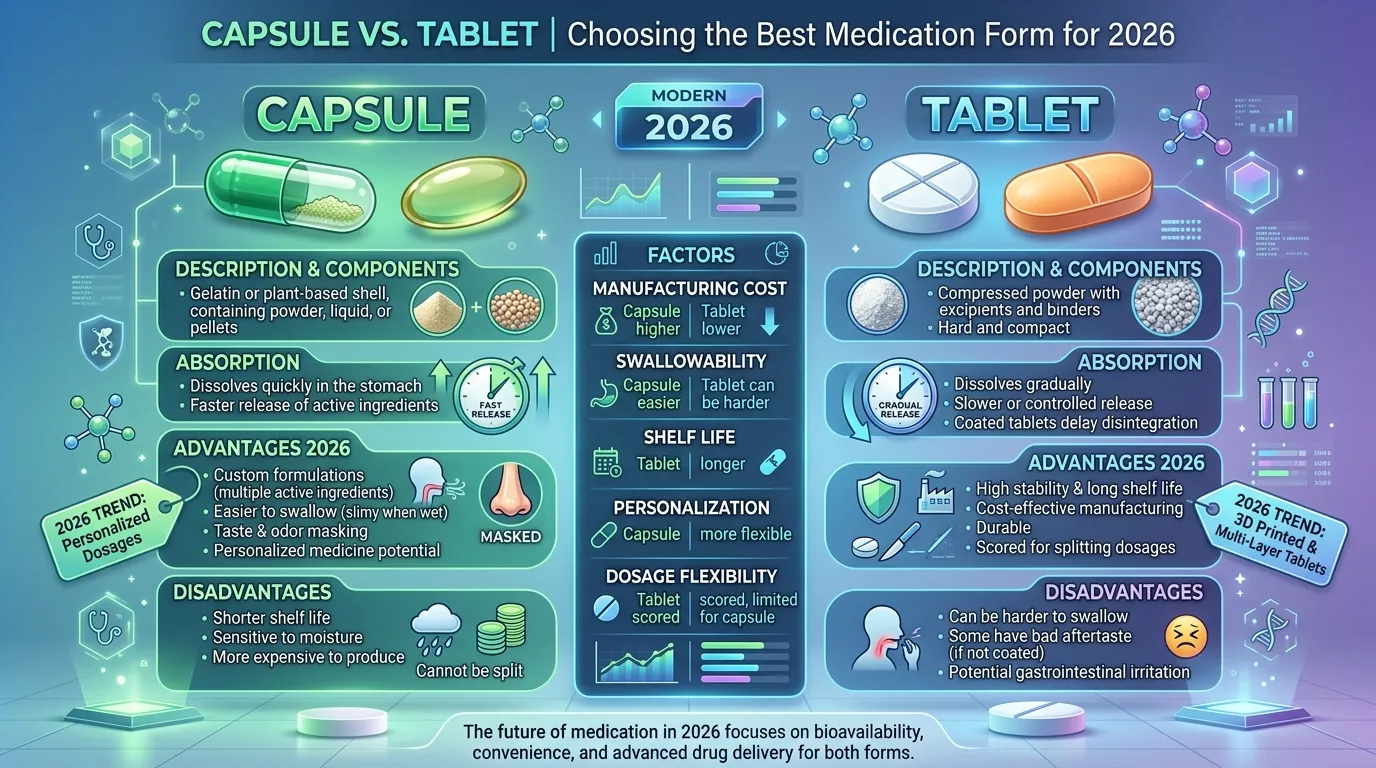
A capsule is a type of medicine covered by a soft or hard outer shell. Inside the shell, there may be powder, liquid, or tiny medicine beads. The shell usually dissolves in the stomach and releases the medicine.
History of Capsule
Capsules were first developed in the early 1800s. Pharmacists wanted a way to hide the bad taste of medicines. Early capsules were made from gelatin, a material taken from animal products. Over time, scientists improved capsule designs. Today, many capsules are made from gelatin or plant-based materials. They are popular because they are easy to swallow and can hold different forms of medicine. Capsules are now used around the world in hospitals, clinics, and homes.
What is “Tablet”?
A tablet is a solid piece of medicine made by compressing powdered ingredients into a fixed shape. Tablets are one of the most common medicine forms in the world.
History of Tablet
Tablets have existed for thousands of years. Ancient people mixed herbs and powders and pressed them into small shapes for easier use. Modern tablets became popular in the nineteenth century when machines were invented to produce them quickly. Scientists found that tablets were easy to store, transport, and manufacture. Today, tablets are available in many forms, such as chewable tablets, coated tablets, and dissolving tablets. They remain one of the most widely used medicine forms worldwide.
Capsule vs Tablet
Capsule: A medicine enclosed in a dissolvable shell.
Tablet: A medicine compressed into a solid form.
Both deliver medicine to the body, but their design, manufacturing process, and user experience are different. Let us explore them in detail.
How Capsule Works
When a capsule reaches the stomach, its outer shell dissolves. The medicine inside is then released into the body.
Key Features
- Has a soft or hard outer shell
- Easy to swallow
- Can contain liquid or powder
- Often masks bad tastes
- Dissolves quickly
Examples
🔵 The doctor gave me a capsule for my stomach pain.
🔵 She swallowed the capsule with a glass of water.
Uses
- Treating infections
- Vitamin supplements
- Pain relief medicines
- Digestive treatments
- Daily healthcare products
How Tablet Works
A tablet dissolves or breaks down after entering the stomach. The medicine is then absorbed into the bloodstream.
Key Features
- Solid and compact
- Easy to manufacture
- Long shelf life
- Often less expensive
- Available in many shapes and sizes
Examples
🟢 I took a tablet for my fever.
🟢 The pharmacist advised me to take one tablet after dinner.
Uses
- Pain relief
- Allergy treatment
- Vitamins
- Blood pressure control
- Daily medical care
Which One Should You Use?
Capsules are often easier to swallow and may work faster. Tablets are usually cheaper and easier to store. The best choice depends on the medicine and your doctor’s advice.
10 Differences Between Capsule and Tablet
1. Structure
Capsule: Has an outer shell containing medicine.
🔴 I took a vitamin capsule today.
🔴 The capsule dissolved quickly.
Tablet: A compressed solid medicine.
🔴 The tablet was round and white.
🔴 She split the tablet into two pieces.
2. Form of Medicine
Capsule: Can hold powder, liquid, or beads.
🔴 The capsule contained liquid medicine.
🔴 The powder stayed inside the shell.
Tablet: Usually contains compressed powder.
🔴 The tablet was made from pressed ingredients.
🔴 He swallowed the tablet whole.
3. Taste
Capsule: Usually hides unpleasant tastes.
🔴 The capsule had no noticeable taste.
🔴 Children preferred the capsule.
Tablet: May have a bitter taste.
🔴 The tablet tasted unpleasant.
🔴 She drank water immediately after taking it.
4. Swallowing
Capsule: Often easier to swallow.
🔴 The capsule slid down smoothly.
🔴 My grandmother likes capsules.
Tablet: Can be harder to swallow.
🔴 The tablet felt large.
🔴 He preferred smaller tablets.
5. Cost
Capsule: Usually more expensive.
🔴 The capsule medicine cost more.
🔴 Capsules often require extra materials.
Tablet: Usually cheaper.
🔴 The tablet version was affordable.
🔴 Many generic medicines are tablets.
6. Manufacturing
Capsule: Requires a shell and filling process.
🔴 The capsule was filled with powder.
🔴 Special machines produce capsules.
Tablet: Made by compression.
🔴 The tablet was pressed into shape.
🔴 Factories produce tablets quickly.
7. Dissolving Speed
Capsule: Often dissolves faster.
🔴 The capsule released medicine quickly.
🔴 Fast absorption helped the patient.
Tablet: May take longer.
🔴 The tablet dissolved slowly.
🔴 Some tablets are designed for gradual release.
8. Shelf Life
Capsule: May be affected by moisture.
🔴 The capsule needed dry storage.
🔴 Humidity damaged the shell.
Tablet: Often has a longer shelf life.
🔴 Tablets stayed stable for months.
🔴 They were easy to store.
9. Splitting
Capsule: Cannot usually be split.
🔴 The capsule had to be taken whole.
🔴 Opening it changed the dosage.
Tablet: Many tablets can be split.
🔴 He cut the tablet in half.
🔴 The score line helped divide it.
10. Appearance
Capsule: Usually smooth and shiny.
🔴 The blue capsule looked glossy.
🔴 It had a clear outer shell.
Tablet: Often flat or round.
🔴 The tablet had a chalky texture.
🔴 It was shaped like a small disc.
Why People Get Confused About Their Use
People often confuse capsules and tablets because both are medicines taken by mouth. They may look similar in a medicine box and often treat the same illness. Since doctors prescribe both forms, many people think they are identical. However, their design and function are different.
Table: Difference and Similarity
| Feature | Capsule | Tablet | Similarity |
| Structure | Shell with medicine inside | Compressed solid medicine | Both contain medicine |
| Taste | Usually hidden | May be noticeable | Both are swallowed |
| Cost | More expensive | Less expensive | Both are widely available |
| Speed | Often faster | May be slower | Both release medicine |
| Storage | Sensitive to moisture | More stable | Both need proper storage |
| Shape | Shell-like | Flat or round | Both come in different sizes |
| Use | Medical treatment | Medical treatment | Same purpose |
Which is Better in What Situation?
Capsule
Capsules are often better when a medicine has a strong taste. They are also useful for people who have trouble swallowing tablets. Many vitamins and supplements come in capsule form.
Tablet
Tablets are better when low cost and long storage are important. They are easy to produce and widely available. Many common medicines are sold as tablets because they are practical and effective.
How Are “Capsule” and “Tablet” Used in Metaphors and Similes?
🟣 “The idea came in a capsule of wisdom.” (small but valuable information)
🟣 “His message was like a tablet carved in stone.” (firm and lasting)
🟣 “The lesson was packed like a capsule.” (full of information)
🟣 “The rule stood like a tablet of law.” (strong and clear)
Connotative Meaning
Capsule
🟣 Neutral: A medicine capsule.
🟣 Negative: Rarely used negatively.
Tablet
🟣 Positive: A tablet of knowledge.
🟣 Neutral: A medical tablet.
Idioms or Proverbs
There are no common English idioms specifically based on “capsule” or “tablet.” However, related expressions exist.
🟣 “A bitter pill to swallow” — Accepting an unpleasant truth.
Example: Losing the game was a bitter pill to swallow.
🟣 “Written in stone” — Something that cannot be changed.
Example: The decision is not written in stone.
Works in Literature
🟣 The Time Capsule — David A. Adler (1986)
🟣 The Golden Tablets — Various historical and religious writings
🟣 Medical and science books often discuss capsules and tablets as medicine forms.
Movies Related to the Keywords
🟣 Awakenings (1990, USA) — Focuses on medicine and treatment.
🟣 Extraordinary Measures (2010, USA) — Related to medical research.
Possible Questions
1. What is a capsule?
A capsule is medicine inside a dissolvable shell.
2. What is a tablet?
A tablet is compressed medicine in solid form.
3. Which is easier to swallow?
Capsules are usually easier to swallow.
4. Are capsules more expensive?
Yes, capsules are often more expensive.
5. Do capsules and tablets work the same way?
Both deliver medicine, but they release it differently.
Final Words
Understanding medicine forms can help you make better health decisions. Small details often matter. When you know how capsules and tablets differ, you can use medicines more confidently and correctly.
Conclusion
Capsules and tablets are both common ways to take medicine. A capsule has a shell that contains medicine, while a tablet is made by compressing ingredients into a solid shape. Capsules are often easier to swallow and may dissolve faster. Tablets are usually cheaper and easier to store. Each has its own benefits and uses. Knowing the difference between capsule and tablet helps you understand prescriptions, medicine labels, and healthcare advice more clearly. Whether you take a capsule or a tablet, always follow the instructions given by your doctor or pharmacist for the best results.

I’m Zahid Abbas, an educator, researcher, and digital publishing strategist with a passion for linguistics, grammar, and clear communication. As a content creator and SEO specialist, I craft research-driven, reader-focused content that empowers learners and makes knowledge accessible worldwide.