One day, Sara left a wet shirt outside. After a few hours, the shirt became dry. Later that day, she saw her mother boiling water for tea. Sara asked, “Does water disappear in the same way both times?”
Many people ask this question. They want to know the difference between evaporation and boiling. The difference between evaporation and boiling is important because both change a liquid into a gas, but they do not happen in the same way.
You can see these changes every day. Wet clothes dry because of evaporation. Water for tea boils on the stove. Knowing the difference helps students, teachers, and English learners understand science better.
In this guide, you will learn simple meanings, history, examples, and clear differences between evaporation and boiling.
What is “Evaporation”?
Evaporation is the process in which a liquid slowly changes into gas from its surface. It can happen at any temperature.
For example, water in a pond slowly disappears because of evaporation.
History of Evaporation
People noticed evaporation thousands of years ago. Ancient farmers saw rainwater disappear from the ground after sunny days. Greek thinkers tried to explain why this happened. Later, scientists such as John Dalton studied water vapor and gases. They learned that tiny particles move and escape into the air. Today, evaporation is an important topic in science. It helps explain clouds, rain, and the water cycle. People also use evaporation in making salt and drying clothes. It plays a big role in nature and daily life.
What is “Boiling”?
Boiling is the rapid change of a liquid into gas when it reaches a certain temperature called the boiling point.
For water, the boiling point is 100°C or 212°F at normal pressure.
History of Boiling
People have used boiling for thousands of years. Early humans boiled water and food to make them safe. Ancient Chinese, Egyptians, and Romans used boiling in cooking and medicine. Scientists later studied boiling and found that each liquid has its own boiling point. Daniel Fahrenheit and Anders Celsius helped create temperature scales that made studying boiling easier. Today, boiling is used in homes, factories, and laboratories. It is important for cooking, making medicines, and producing steam energy. Boiling remains one of the most useful processes in daily life.
Evaporation vs Boiling
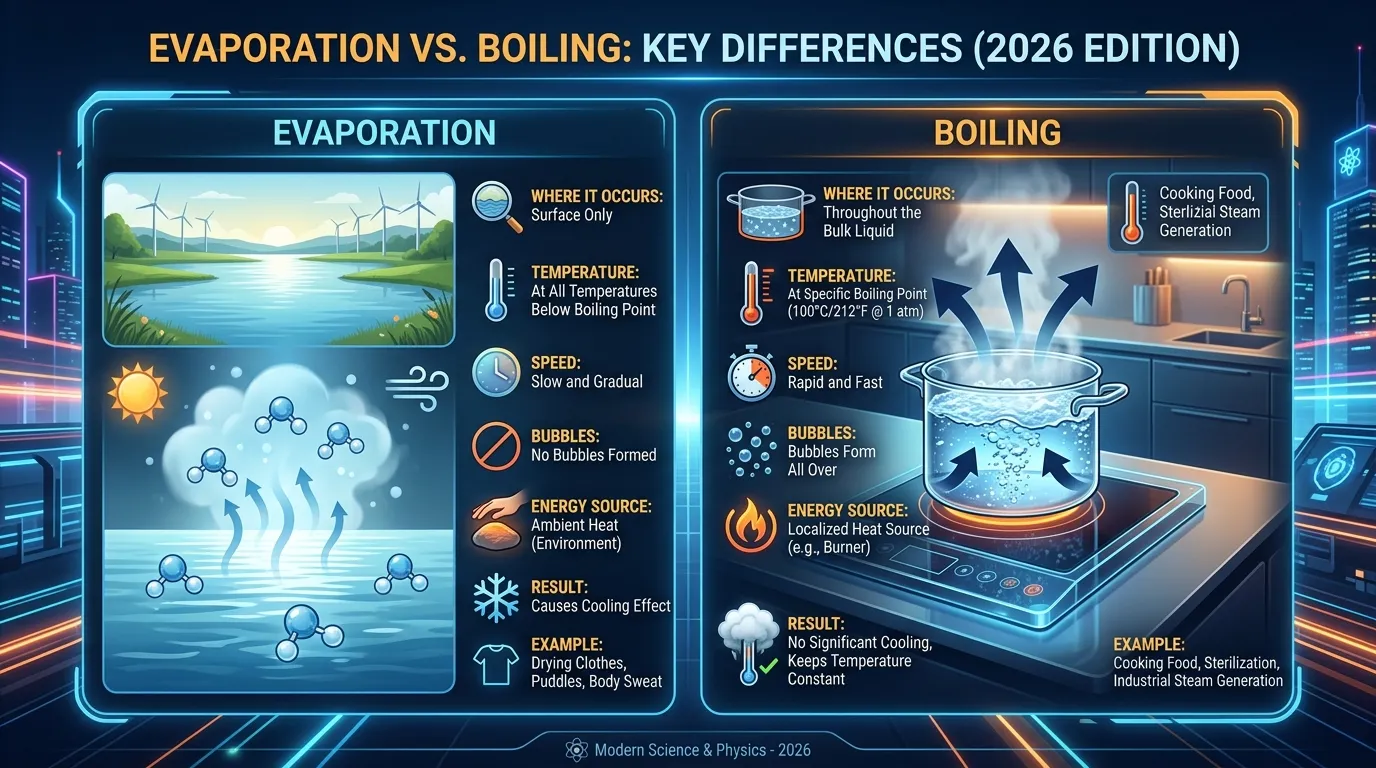
Evaporation is a slow process that happens on the surface of a liquid. Boiling is a fast process that happens throughout the liquid.
Now let’s understand them in more detail.
How Evaporation Works
Key Features
- Happens at any temperature.
- Occurs only on the surface.
- Slow process.
- Does not form bubbles.
- Depends on wind and temperature.
Examples
🔵 Wet clothes dry in the sun because of evaporation.
🔵 Sweat disappears from your skin through evaporation.
Uses
- Drying clothes.
- Cooling the body through sweat.
- Making salt from seawater.
- Part of the water cycle.
- Drying paint and ink.
How Boiling Works
Key Features
- Happens at a fixed temperature.
- Takes place throughout the liquid.
- Fast process.
- Produces bubbles.
- Needs continuous heating.
Examples
🟢 Water boils when making tea.
🟢 Soup boils while cooking dinner.
Uses
- Cooking food.
- Purifying water.
- Making steam.
- Industrial processes.
- Laboratory work.
Which One Should You Use?
Use evaporation when talking about slow drying or natural water loss.
Use boiling when talking about heating a liquid until it reaches its boiling point.
10 Differences Between Evaporation and Boiling
1. Speed
Evaporation: Slow process.
🔴 Water in a bowl dries slowly.
🔴 Wet roads dry after rain.
Boiling: Fast process.
🔴 Water boils quickly on a stove.
🔴 Soup cooks faster when boiling.
2. Temperature
Evaporation: Happens at any temperature.
🔴 Clothes dry even in winter.
🔴 Water slowly leaves lakes.
Boiling: Happens only at the boiling point.
🔴 Water boils at 100°C.
🔴 Milk boils when heated enough.
3. Location
Evaporation: Happens only on the surface.
🔴 Water leaves from the top of a pond.
🔴 Sweat evaporates from skin.
Boiling: Happens throughout the liquid.
🔴 Bubbles rise everywhere in water.
🔴 Soup bubbles from all sides.
4. Bubble Formation
Evaporation: No bubbles.
🔴 A wet floor dries quietly.
🔴 A puddle disappears without bubbles.
Boiling: Forms bubbles.
🔴 Tea water bubbles.
🔴 Rice water bubbles while cooking.
5. Heat Requirement
Evaporation: Can happen without heating.
🔴 Wet clothes dry outside.
🔴 Rainwater disappears naturally.
Boiling: Needs heating.
🔴 A kettle needs fire.
🔴 Soup needs heat.
6. Cooling Effect
Evaporation: Causes cooling.
🔴 Sweat cools the body.
🔴 Water keeps plants cool.
Boiling: Does not cool.
🔴 Boiling water becomes hotter.
🔴 Steam feels hot.
7. Energy Needed
Evaporation: Needs less energy.
🔴 A wet towel dries naturally.
🔴 A pond loses water slowly.
Boiling: Needs more energy.
🔴 Cooking needs heat.
🔴 Factories use fuel for boiling.
8. Rate of Change
Evaporation: Gradual.
🔴 Perfume slowly disappears.
🔴 Paint dries with time.
Boiling: Rapid.
🔴 Tea water changes quickly.
🔴 Milk boils within minutes.
9. Pressure Effect
Evaporation: Little effect from pressure.
🔴 Water evaporates outdoors.
🔴 Sweat evaporates normally.
Boiling: Pressure changes the boiling point.
🔴 Water boils faster on mountains.
🔴 Pressure cookers change boiling conditions.
10. Daily Use
Evaporation: Used in drying and cooling.
🔴 Clothes dry after washing.
🔴 Sweat cools athletes.
Boiling: Used in cooking and cleaning.
🔴 Eggs are boiled.
🔴 Water is boiled for safety.
Why People Get Confused About Their Use
People get confused because both processes turn liquid into gas. Also, both involve water and heat. Since they have the same result, many people think they are identical. In fact, they work in different ways.
Table: Difference and Similarity
| Feature | Evaporation | Boiling | Similarity |
|---|---|---|---|
| Speed | Slow | Fast | Both change liquid to gas |
| Temperature | Any temperature | Fixed temperature | Both need energy |
| Surface | Surface only | Whole liquid | Both involve molecules |
| Bubbles | No | Yes | Both produce vapor |
| Heat | Not always needed | Needed | Both occur in liquids |
| Daily Use | Drying | Cooking | Both happen in daily life |
Which is Better in What Situation?
Evaporation is better when slow drying or cooling is needed. It helps dry clothes, cool our bodies, and support the water cycle. It does not need much energy.
Boiling is better when fast heating is needed. It helps cook food and kill germs in water. It is useful in homes and industries.
How Are “Evaporation” and “Boiling” Used in Metaphors and Similes?
🟣 “His anger evaporated like water in the sun.”
🟣 “The crowd was boiling with excitement.”
🟣 “Fear evaporated after the good news.”
🟣 “The room was boiling with energy.”
Connotative Meaning
Evaporation
🟣 Positive: “Her worries evaporated.”
🟣 Neutral: “Water evaporated from the lake.”
Boiling
🟣 Positive: “Ideas were boiling in his mind.”
🟣 Negative: “He was boiling with anger.”
Idioms or Proverbs
🟣 “Boiling point” means becoming very angry.
Example: “Dad reached his boiling point.”
🟣 “Evaporate into thin air” means disappear completely.
Example: “My savings evaporated into thin air.”
Works in Literature
🟣 The Water Cycle by Rebecca Olien, 2005, explains evaporation.
🟣 A Drop Around the World by Barbara McKinney, 1998, discusses boiling and evaporation.
Movies Related to the Keywords
🟣 The Boy Who Harnessed the Wind (2019, UK) shows water and weather processes.
🟣 Cloudy with a Chance of Meatballs (2009, USA) includes weather ideas linked to evaporation.
Possible Questions
1. What is the main difference between evaporation and boiling?
Evaporation is slow and happens at any temperature. Boiling is fast and happens at a fixed temperature.
2. Does evaporation need heat?
Yes, but it does not always need direct heating.
3. Does boiling make bubbles?
Yes. Bubbles are a sign of boiling.
4. Which process cools the body?
Evaporation cools the body through sweat.
5. Which process is used in cooking?
Boiling is used in cooking food and making drinks.
Final Words
Science becomes easy when we connect it with daily life. Look around your home. You will see evaporation and boiling happening every day. Learning these ideas will help you understand nature and science with confidence.
Conclusion
The difference between evaporation and boiling is simple once you know how each process works. Evaporation is slow and happens on the surface of a liquid. It can occur at any temperature and helps dry clothes and cool the body. Boiling is fast and happens throughout the liquid when it reaches its boiling point. It creates bubbles and is useful for cooking and making safe drinking water. Although both turn liquid into gas, they work in different ways. Understanding this difference helps students and English learners understand science more clearly. The next time you see wet clothes drying or water boiling for tea, you will know exactly what is happening.

I’m Zahid Abbas, an educator, researcher, and digital publishing strategist with a passion for linguistics, grammar, and clear communication. As a content creator and SEO specialist, I craft research-driven, reader-focused content that empowers learners and makes knowledge accessible worldwide.










