Tom was reading a news story. He saw the word dissociate. A few minutes later, he saw disassociate in another article.
He stopped and wondered, “Are these words different?”
Many people ask the same question. The difference between dissociate and disassociate can be confusing because both words look alike and often mean the same thing. The difference between dissociate and disassociate is not always easy to see.
This topic is useful for students, writers, and English learners. It helps you choose the right word when speaking or writing. In this guide, you will learn the meanings, history, uses, and key differences in a very simple way.
What is “Dissociate”?
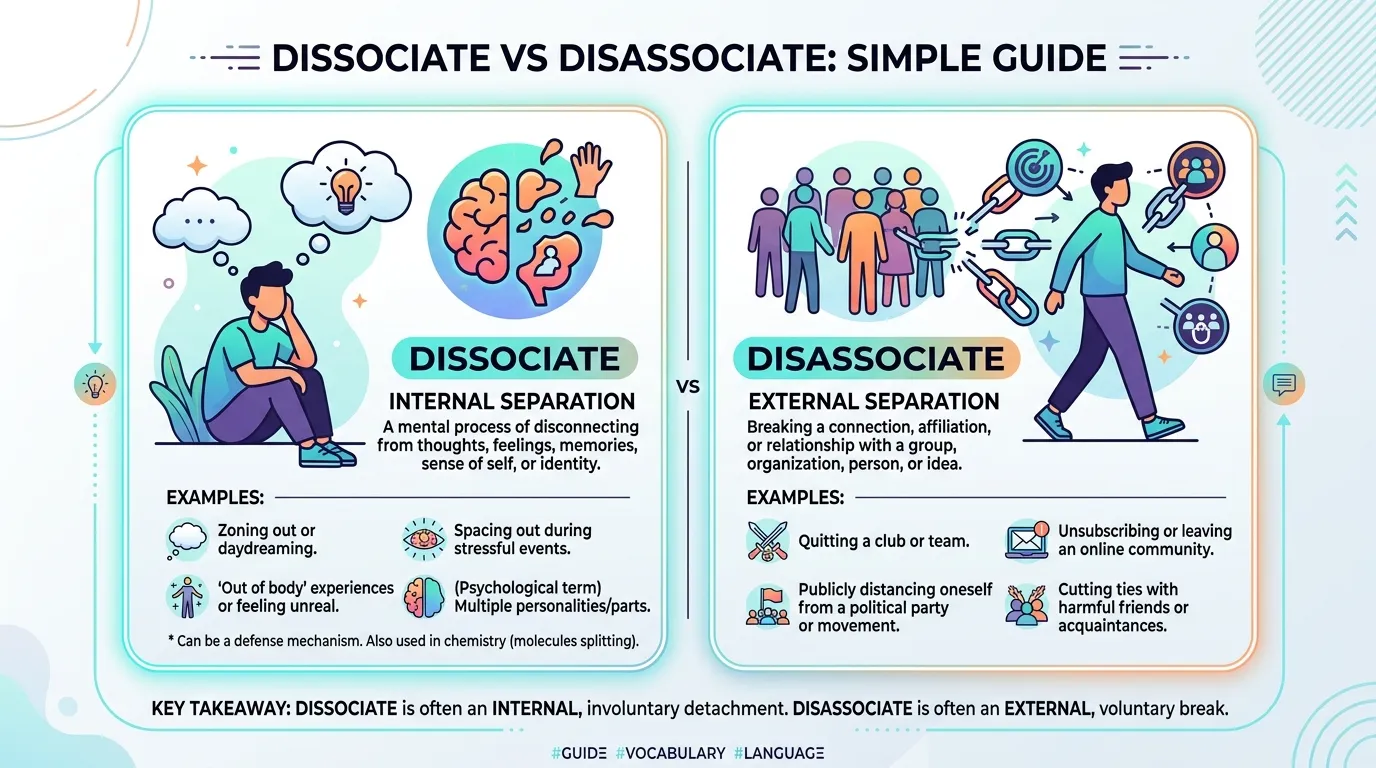
Dissociate means to separate something from something else. It can also mean to stop having a connection with a person, group, idea, or action.
Example:
“I dissociate myself from that decision.”
What is “Disassociate”?
Disassociate also means to separate or disconnect. Many people use it in the same way as dissociate.
Example:
“She disassociated herself from the argument.”
History of Dissociate
The word dissociate comes from the Latin word dissociare. It entered English in the early 1600s. The word was created from parts that mean “apart” and “join.” Over time, people used dissociate to describe separating ideas, people, or things. Scientists, teachers, and writers often used the word. Today, dissociate is the older and more traditional form. Many dictionaries list it as the preferred spelling. It is common in academic writing, psychology, science, and everyday English.
History of Disassociate
Disassociate appeared later than dissociate. It became common in the 1800s. Many language experts believe people added the extra “dis-” because it sounded more natural. Since “dis” often means “not” or “apart,” speakers felt comfortable using disassociate. Over time, the word became widely accepted. Today, most dictionaries recognize it as a correct word. However, some style guides still prefer dissociate because it is shorter and older. Both forms are now used by many English speakers around the world.
Dissociate vs Disassociate
Dissociate: To separate or disconnect.
Disassociate: To separate or disconnect.
Both words usually mean the same thing. Now let’s look at them in more detail.
How Dissociate Works
Key Features
- Older form
- More common in formal writing
- Preferred by many dictionaries
- Means to separate or disconnect
Examples
🔵 I dissociate myself from those comments.
🔵 The scientist dissociated the two ideas.
Uses
- School writing
- Business writing
- Psychology
- Science
- Daily conversation
How Disassociate Works
Key Features
- Newer form
- Common in everyday speech
- Accepted by dictionaries
- Means to separate or disconnect
Examples
🟢 He disassociated himself from the group.
🟢 She disassociated the event from her work.
Uses
- Daily conversation
- News articles
- Personal writing
- Business communication
Which One Should You Use?
Both words are correct.
Use dissociate if you want the traditional and preferred form.
Use disassociate if it sounds more natural to you or matches the style you are following.
10 Differences Between Dissociate and Disassociate
1. Age
Dissociate: Older word.
🔴 Dissociate appeared first in English.
🔴 Writers used dissociate for centuries.
Disassociate: Newer word.
🔴 Disassociate became common later.
🔴 It gained popularity in modern English.
2. Length
Dissociate: Shorter spelling.
🔴 Dissociate has fewer letters.
🔴 Many style guides prefer shorter words.
Disassociate: Longer spelling.
🔴 Disassociate adds an extra syllable.
🔴 Some people find it easier to understand.
3. Formal Writing
Dissociate: Often preferred.
🔴 Academic papers use dissociate.
🔴 Research articles often use dissociate.
Disassociate: Used less often.
🔴 Some formal writers avoid it.
🔴 It appears less in academic work.
4. Everyday Speech
Dissociate: Common.
🔴 People say dissociate in discussions.
🔴 Teachers often use it.
Disassociate: Also common.
🔴 Many speakers use it naturally.
🔴 It sounds familiar to some people.
5. Dictionary Preference
Dissociate: Often listed first.
🔴 Many dictionaries prefer it.
🔴 It is usually the main entry.
Disassociate: Usually listed second.
🔴 Dictionaries still accept it.
🔴 It remains a correct word.
6. Popularity
Dissociate: More popular overall.
🔴 It appears in many books.
🔴 It appears in academic writing.
Disassociate: Popular too.
🔴 It appears in news articles.
🔴 It appears in casual writing.
7. Pronunciation
Dissociate: Slightly shorter sound.
🔴 Many people say it quickly.
🔴 It has fewer spoken parts.
Disassociate: Slightly longer sound.
🔴 The extra “dis” is heard.
🔴 It takes longer to say.
8. Style
Dissociate: Traditional style.
🔴 Many editors prefer it.
🔴 It looks more formal.
Disassociate: Modern style.
🔴 Some writers choose it.
🔴 It feels natural to many speakers.
9. Academic Use
Dissociate: Very common.
🔴 Psychology books use it.
🔴 Research papers use it.
Disassociate: Less common.
🔴 Seen in some studies.
🔴 Seen in some reports.
10. Meaning
Dissociate: Separate or disconnect.
🔴 I dissociate myself from that idea.
🔴 They dissociated the problem from the solution.
Disassociate: Separate or disconnect.
🔴 He disassociated himself from the event.
🔴 She disassociated the two topics.
Why People Get Confused About Their Use
People get confused because both words mean almost the same thing. They look similar and sound similar. Many dictionaries accept both forms. Because of this, many English learners think one must be wrong. In fact, both are correct.
Table: Difference and Similarity
| Feature | Dissociate | Disassociate | Similarity |
|---|---|---|---|
| Meaning | Separate | Separate | Same meaning |
| Age | Older | Newer | Both are English words |
| Length | Shorter | Longer | Both are verbs |
| Formal Use | More common | Less common | Both are accepted |
| Everyday Use | Common | Common | Both are understood |
Which is Better in What Situation?
Dissociate is often better for school work, academic writing, and professional documents. Many teachers, editors, and dictionaries prefer it. If you are unsure which word to choose, dissociate is usually the safest choice.
Disassociate works well in daily conversation and informal writing. Many native speakers use it naturally. Most readers understand it easily. It is also accepted by modern dictionaries.
How Are “Dissociate” and “Disassociate” Used in Metaphors and Similes?
🟣 “He dissociated himself like a leaf floating away.”
🟣 “She disassociated from the problem like a bird leaving a nest.”
🟣 “The company dissociated itself from the mistake.”
🟣 “He disassociated himself from the rumor.”
Connotative Meaning
Dissociate
🟣 Neutral: Separate ideas.
🟣 Negative: Avoid responsibility.
🟣 “She dissociated herself from the scandal.”
Disassociate
🟣 Neutral: Disconnect from something.
🟣 Negative: Step away from blame.
🟣 “He disassociated himself from the bad decision.”
Idioms or Proverbs
There are no common idioms that use these exact words.
Related expression:
🟣 “Wash your hands of something”
Meaning: Stop being involved.
Example: “He washed his hands of the project.”
Works in Literature
🟣 The Interpretation of Dreams — Sigmund Freud (1899)
🟣 Man and His Symbols — Carl Jung (1964)
These works discuss ideas related to mental separation and identity.
Movies Related to the Keywords
🟣 A Beautiful Mind (2001, United States)
🟣 Fight Club (1999, United States)
These films explore identity and mental separation themes.
Possible Questions
1. Are dissociate and disassociate the same?
Yes. In most cases, they have the same meaning.
2. Which word is older?
Dissociate is older.
3. Which word is more formal?
Dissociate is usually more formal.
4. Is disassociate wrong?
No. It is a correct English word.
5. Which should I use in school writing?
Dissociate is often the safer choice.
Final Words
English has many words that look different but mean the same thing. Dissociate and disassociate are good examples. Learning these small differences can make your writing stronger and clearer.
Conclusion
The difference between dissociate and disassociate is very small. Both words mean to separate or disconnect. Dissociate is older and more common in formal writing. Disassociate is newer but still correct and widely used. Most of the time, either word will be understood by readers. If you want the safest choice, use dissociate. If you prefer the longer form, disassociate is also acceptable. Knowing the difference between dissociate and disassociate can help you write with more confidence and accuracy.

I’m Zahid Abbas, an educator, researcher, and digital publishing strategist with a passion for linguistics, grammar, and clear communication. As a content creator and SEO specialist, I craft research-driven, reader-focused content that empowers learners and makes knowledge accessible worldwide.